
UAE Corporate Tax Group Exit | Tax Losses, Asset Transfers, and Compliance Rules

Zahira Shaik
SEO Content Writer
Zahira Shaik is an SEO Content Writer and Published Author specializing in research-based content. She excels at analyzing market trends, regulations, and industry developments… Read more

Tulika Saxena
AVP, Sales & Marketing | IIM Nagpur
Tulika Saxena specializes in business finance, sales strategy, and market positioning. Leads growth and partnerships, ensuring seamless business setup experiences and client success across… Read more


Key Fact: In the case of a subsidiary leaving a UAE Corporate Tax Group, any tax loss incurred during its membership in the tax group is retained by the tax group forever. However, pre-grouping tax losses will belong to the exiting entity, following stringent ring-fencing guidelines.
Table of contents
- 1. Understanding UAE Corporate Tax Groups and Subsidiary Exits
- 2. UAE Corporate Tax Loss Rules When a Subsidiary Exits
- 3. Intra-Group Asset Transfers and the Two-Year Clawback Rule
- 4. Asset Valuation and Financial Reporting After Tax Group Exit
- 5. Corporate Tax Filing and Liability After a Subsidiary Leaves
- 6. Practical Examples: Tax Group Exit Scenarios
- 7. How Businesses Can Prepare for a UAE Corporate Tax Group Exit
- 8. How Arnifi Supports UAE Corporate Tax Group Planning and Exit Compliance
- Conclusion
- Frequently Asked Questions (FAQs)
- References
Introduction
UAE corporate tax law recognizes a Tax Group arrangement that enables the consolidation of income for taxation purposes between a parent company and its subsidiaries, simplifying the administration process. This is covered under Federal Decree-Law No. 47 of 2022. In the event that a subsidiary leaves a tax group, various tax consequences emerge for both the exiting entity and the parent company. The exit of a subsidiary from a tax group affects previous transfers of losses, intra-group asset transfers, and individual filing requirements. Some of the key issues to be considered include loss allocation, two-year clawback, opening asset valuation, and post-exit filing obligations.
1. Understanding UAE Corporate Tax Groups and Subsidiary Exits
A Tax Group is the option of filing a joint tax return. However, the sale of assets or changes in strategy often lead to the exit of the subsidiary.
What Is a UAE Corporate Tax Group Under Article 40?
Article 40 permits the formation of a Tax Group by a resident parent company with resident subsidiaries if the company owns more than 95% of the share capital, voting rights, and net assets. The parent company files one consolidated tax return.
Why Would a Subsidiary Leave a Tax Group?
- Corporate reorganization or internal sale of the shares leads to a reduction in the ownership of the parent company below 95%.
- The third party buys the subsidiary.
- The subsidiary becomes a Qualifying Free Zone Person.
- The strategic changes lead to different corporate tax planning in the UAE.
What Happens When a Company Exits a Tax Group?
The company no longer files the consolidated tax return. It must comply independently with corporate tax in the UAE again, including standalone record-keeping, separate financial statements, and individual return filings.
2. UAE Corporate Tax Loss Rules When a Subsidiary Exits
UAE tax regulations on corporate taxes are stringent on how entities manage their tax losses when leaving the organization.
What Happens to Tax Losses Generated During Group Membership?
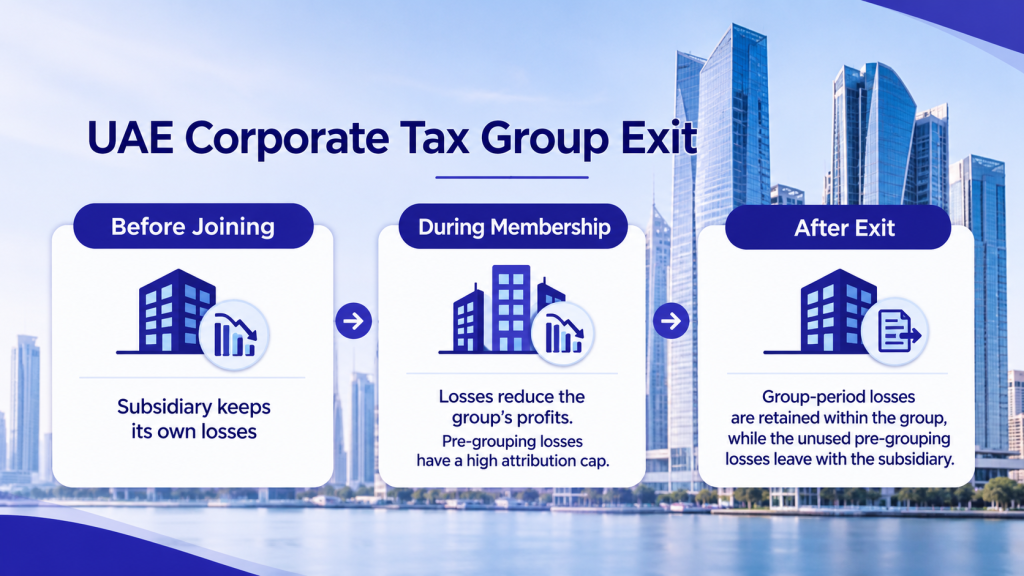
Losses that were incurred during membership in the Tax Group will be retained by the group. The exiting subsidiary is not allowed to carry forward the group-period losses in order to reduce its future taxable income.
Treatment of Unutilized Pre-Grouping Tax Losses
The unused tax losses that were incurred by the subsidiary before its membership in the Tax Group will be transferred back to that subsidiary when it leaves.
How Are Pre-Grouping Losses Ring-Fenced?
Pre-grouping losses are still ring-fenced. They can only be used against the taxable income of that particular subsidiary at a maximum of 75%.
Tax Loss Allocation: Before Joining, During Membership, and After Exit
3. Intra-Group Asset Transfers and the Two-Year Clawback Rule
There are instances where entities make asset transfers among themselves tax-free as per special relief provisions.
How Are Intra-Group Transfers Treated Under UAE Corporate Tax?
According to Qualifying Group Relief, there is a tax-neutral transfer of assets or liabilities within the group at net book value.
When Does the Two-Year Clawback Rule Apply?
In the case where one entity leaves the group within two years of an intra-group transfer, FTA will revoke the tax-neutral treatment.
How Are Previously Eliminated Gains or Losses Recognized?
Gain or loss will be calculated by the transferor on the market value of the asset at the original transfer date and added to the taxable income.
Exceptions to the Two-Year Clawback Rule
The clawback rule will not be applicable if the transaction qualifies independently for Participation Exemption or Business Restructuring Relief.
4. Asset Valuation and Financial Reporting After Tax Group Exit
Independent accounting resumes once the business leaves.
Determining Opening Asset and Liability Values
The leaving business shall use the same opening asset and liability valuations as those used by the Tax Group at the time of exit.
Preparing Standalone Financial Statements
The leaving business is required to create its own financial statements based on proper accounting principles, such as IFRS.
Accounting for Intra-Group Transactions After Exit
Future intra-group transactions will be priced according to the rules of transfer pricing.
5. Corporate Tax Filing and Liability After a Subsidiary Leaves
| Aspect | Requirements for the Departing Company |
| Individual Tax Return Filing | The company must file its own corporate tax return starting from the tax period in which it exits the tax group. |
| Tax Group Exit Notification | The parent company must notify the FTA of the member’s exit in accordance with applicable tax regulations and procedures. |
| Joint and Several Liability | The departing company remains jointly and severally liable for the group’s tax debts relating to periods before its exit. |
| Ongoing Corporate Tax Compliance | The company must maintain individual tax registration, keep standalone financial records, and comply with standard corporate tax requirements in the UAE. |
6. Practical Examples: Tax Group Exit Scenarios
Practical examples help to understand the rules about corporate tax in the UAE.
Example 1: A Subsidiary Exits With Unused Pre-Grouping Losses
Company A is part of a Tax Group with unabsorbed pre-grouping losses worth AED 100,000. On withdrawal, Company A carries forward its unabsorbed AED 100,000 losses.
Example 2: A Subsidiary Leaves With Group-Period Losses
Company B incurs a loss worth AED 200,000 within a Tax Group period. On withdrawal, Company B loses its right to all the losses.
Example 3: An Intra-Group Asset Transfer Followed by Exit Within Two Years
Company C transfers property to Company D at cost value. Company C withdraws 18 months later with a clawback tax on market value.
Example 4: An Asset Transfer Qualifies for an Independent Tax Relief
Company E transfers assets that qualify for participation exemption. Company E withdraws within 12 months without any clawback tax.
7. How Businesses Can Prepare for a UAE Corporate Tax Group Exit
Proper planning minimizes unexpected liabilities under corporate tax in UAE regulations.
Review Tax Loss Balances Before Exit
Examine historical returns to track pre-grouping and group-period loss balances accurately.
Identify Intra-Group Asset Transfers Within the Previous Two Years
Catalog all intercompany asset transfers completed during the past 24 months.
Assess Potential Clawback and Tax Liabilities
Calculate potential gain recognition before executing restructuring plans.
Prepare Standalone Financial Records and Tax Filings
Re-establish standalone accounting ledgers to ensure a smooth transition.
Evaluate the Tax Impact of Restructuring Before Implementing Changes
Assess ownership changes to avoid unintentional tax group disqualifications.
8. How Arnifi Supports UAE Corporate Tax Group Planning and Exit Compliance
Arnifi provides specialized corporate advisory to simplify complex transitions under corporate tax in the UAE.
Corporate Tax Advisory and Tax Filing Support
Arnifi handles efficient registration and tax filing, as well as FTA requirements for your corporate taxes.
Tax Group Structuring and Restructuring Advisory
Arnifi reviews corporate structures to determine how best to structure your tax group and future exits.
Accounting and Financial Reporting Support
Arnifi assists companies in making their transition into standalone accounting in adherence to IFRS.
Arni Organogram for Visualizing Corporate Ownership
Arnifi offers visual organogram tools that allow groups to identify both direct and indirect ownership percentages.
Arnifi Docs and Business Compliance Tools
Arnifi Docs automates all compliance filings and corporate documentation needs after your exit.
Conclusion
Subsidiary exits necessitate knowledge of tax loss allocation, tax clawback of intra-group assets, and adjustments to financial reporting. Unutilized pre-grouping losses are returned to the exiting member, while the group-period losses will stay with the Tax Group. Moreover, tax clawbacks apply to any intra-group asset transfer made within two years after the exit unless certain exemptions are applicable.
A careful assessment of historical intercompany transactions may avoid future tax payments and delayed filings. Standalone accounting procedures need to be set up before the implementation of a corporate ownership change.
If your entity intends to undertake a corporate restructuring or subsidiary exit, please contact Arnifi for assistance with tax consultancy. Find out how Arnifi tax group structuring can help preserve your business assets and ensure compliance. Contact Arnifi professionals for an audit of your historic intra-group asset transfers before conducting your transaction. Work with Arnifi and file your standalone corporate taxes without any hassle.
Frequently Asked Questions (FAQs)
What happens to tax losses when a company leaves a UAE Corporate Tax Group?
The group-period losses will remain with the Tax Group, while unutilized pre-grouping losses will revert to the exiting subsidiary.
Can a subsidiary take group-period tax losses with it when it exits?
No, tax losses generated during group membership remain with the Tax Group permanently.
What happens to unused pre-grouping tax losses after exit?
The exiting entity carries unused pre-grouping losses forward into its standalone tax periods.
What is the two-year clawback rule for intra-group asset transfers?
It revokes tax-neutral status if an entity leaves within two years of an asset transfer.
Are all intra-group asset transfers subject to clawback when a member exits?
No, transfers qualifying for independent reliefs like Participation Exemption avoid clawback provisions.
How are assets valued when a subsidiary leaves a Tax Group?
The subsidiary adopts the net book value recorded by the Tax Group at the exit date.
Does a departing subsidiary need to file its own UAE Corporate Tax return?
Yes, the entity must file independent tax returns starting from the exit tax period.
Is a company liable for Tax Group liabilities after leaving?
Yes, the exiting company stays jointly and severally liable for tax periods during its membership.
What is the deadline for notifying the FTA about a Tax Group exit?
The parent company must notify the FTA within timelines set by tax administration regulations.
Can a company rejoin a UAE Corporate Tax Group after leaving?
Yes, provided it satisfies all Article 40 eligibility requirements and receives FTA approval.
References
Top UAE Packages
Related Articles

Top UAE Packages
Get in Touch
