
UAE Guide to Shareholder Loan Accounting Treatment 2026

Zahira Shaik
SEO Content Writer
Zahira Shaik is an SEO Content Writer and Published Author specializing in research-based content. She excels at analyzing market trends, regulations, and industry developments… Read more

Tulika Saxena
AVP, Sales & Marketing | IIM Nagpur
Tulika Saxena specializes in business finance, sales strategy, and market positioning. Leads growth and partnerships, ensuring seamless business setup experiences and client success across… Read more



Key Fact: The proper classification of shareholder financing under IFRS and UAE Corporate Tax legislation will avoid tax sanctions, allow for the deduction of interest, and keep the financial health of the business safe.
Table of contents
- Introduction
- Shareholder Loan vs Capital Contribution: Key Differences
- Shareholder Loan Accounting Treatment Under IFRS
- UAE Corporate Tax: How Shareholder Loans Are Treated
- Genuine Debt vs Equity vs Quasi-Equity: How to Classify Shareholder Funding
- Converting Shareholder Loans into Share Capital in the UAE
- Documentation and Compliance Checklist for Shareholder Loans
- How Arnifi Helps Businesses Manage Shareholder Loans and Capital Contributions
- Conclusion
- Frequently Asked Questions (FAQs)
- References
Introduction
A shareholder loan is an example of debt financing through which the shareholder loans money to the corporation with an anticipated repayment in the future. Shareholders often employ shareholder funding for financing working capital requirements, expansion of business operations, or even keeping the operations liquid without reducing ownership percentage. But businesses need to be careful about whether the loaned money qualifies as debt financing or as permanent capital investment.
Proper classification of funds is essential for financial accounting, deduction of interest, and other aspects like compliance with UAE Corporate Tax law. Applying International Financial Reporting Standards (IFRS) alongside local tax rules ensures transparent reporting and audit readiness.
Shareholder Loan vs Capital Contribution: Key Differences
Proper knowledge of the process of funding enables adequate reporting on the balance sheet.
What Is a Shareholder Loan?
A shareholder loan is when an owner provides money to the firm with some pre-established repayment conditions. This is accounted for in the books as a loan that is payable by the company.
What Is a Capital Contribution?
Capital contribution takes place when owners provide the firm with funds as share capital without incurring any debts. The business records these funds directly under share capital or equity accounts.
Shareholder Loan vs Equity: Key Differences
| Comparison Point | Shareholder Loan | Capital Contribution / Equity |
| Balance Sheet | Recorded as Current or Non-Current Liability | Recorded under Share Capital / Equity |
| Repayment | Contractual repayment obligation exists | Permanent capital with no fixed repayment |
| Interest | May yield tax-deductible interest | Returns paid as post-tax dividends |
| Ownership | Does not alter equity ownership ratios | Expands share ownership allocation |
| Tax Impact | Subject to transfer pricing and deduction caps | Exempt from interest deductibility rules |
Shareholder Loan Accounting Treatment Under IFRS
Adequate utilization of the shareholder loan accounting standard ensures uniformity in treatment and avoids distortions in the balance sheet.
Balance Sheet Classification: Liability vs Equity
Borrowings with fixed maturity periods and compulsory repayment terms are classified as liabilities. Interest free, open-ended, or highly subordinated loans need to be assessed for classification as debt or quasi-equity under IFRS.
Journal Entries for Shareholder Loans
Accurate bookkeeping requires structured accounting entries:
| Transaction | Debit Account | Credit Account |
| Initial Loan Inflow | Bank Account | Shareholder Loan Payable (Liability) |
| Accrued Interest Expense | Interest Expense (P&L) | Accrued Interest Payable (Liability) |
| Payment-in-Kind (PIK) | Interest Expense (P&L) | Shareholder Loan Principal (Liability) |
| Principal Repayment | Shareholder Loan Payable (Liability) | Bank Account |
| Debt Conversion | Shareholder Loan Payable (Liability) | Share Capital / Share Premium |
How to Record Shareholder Loan Repayments
Principal payments clear outstanding liabilities. It is not allowed for accountants to record principal payments as P&L expenses of the business.
Common Accounting and Bookkeeping Mistakes
- Consolidation of several balances belonging to different shareholders in one ledger.
- Recording principal payments of loans as P&L expenses of the business.
- Failure to record necessary interest or PIK adjustments.
- Recording unconfirmed loans as equity directly without confirmation.
- Inconsistent loan schedule across reporting years.
UAE Corporate Tax: How Shareholder Loans Are Treated
Federal Decree-Law No. 47 of 2022 sets clear guidelines regarding related-party financing.
Arm’s Length Principle Under Article 34
It is necessary under Article 34 that the terms of the transactions, such as financing arrangements, have to be on an arm’s length basis. It means that the agreed-upon interest rates should equal those in the independent commercial lending markets.
Connected Persons Rules Under Article 36
According to Article 36, the rules concerning transactions with connected persons aim to restrict tax-deductible expenses. All the financial expenditures must be legitimate and reflect the cost of doing business.
Interest Deductibility Under UAE Corporate Tax
The general rule on interest deductibility provides that net interest expense deductions are limited to 30% of adjusted EBITDA or AED 12 million.
When Can Shareholder Loan Interest Become Non-Deductible?
There are specific provisions that disallow interest deduction where financing is used for the purpose of paying dividends, reducing capital, or making purchases from a related entity.
Genuine Debt vs Equity vs Quasi-Equity: How to Classify Shareholder Funding
Categorization needs an exact contractual analysis.
What Qualifies as Genuine Shareholder Debt?
True debt includes payment dates, commercial rates, amount, and legal documentation.
When Is Shareholder Funding Considered Equity?
Shareholder investments constitute equity if the funds provided by the shareholders are permanent and non-repayable in exchange for shares.
What Is Quasi-Equity or Quasi-Capital?
Quasi-equity consists of open-ended, interest-free, or subordinated financing lacking the characteristics of commercial debt.
The Substance-over-Form Approach
Tax authorities rely on economic substance and not the name given to contractual arrangements in the documents.
Converting Shareholder Loans into Share Capital in the UAE
Turning debts into equity improves the strength of the companies’ balance sheets and helps lower financial liabilities.
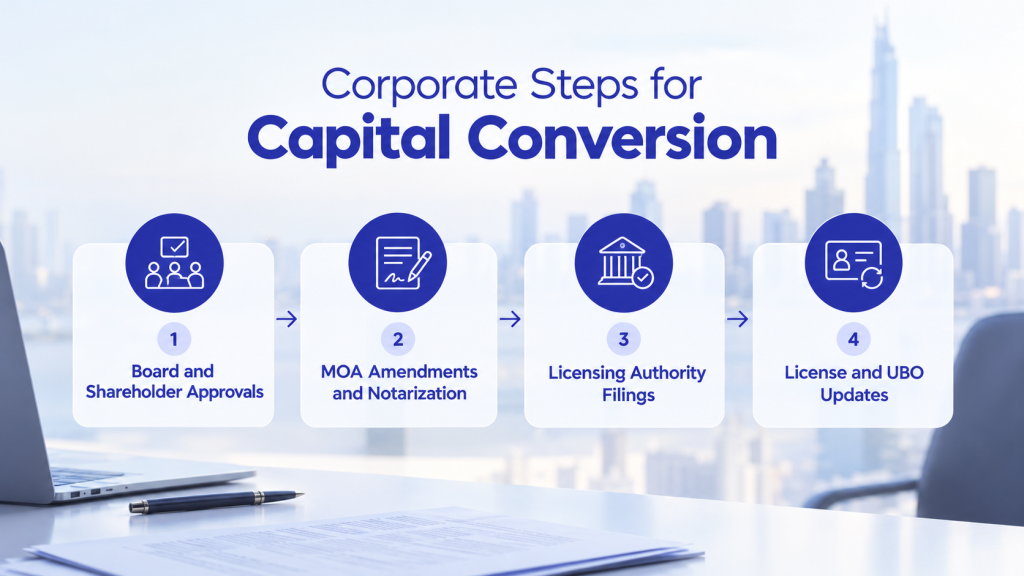
Corporate Steps for Capital Conversion
- Board and Shareholder Approvals: Consider pre-emption rights and pass shareholder resolutions.
- MOA Amendments and Notarization: Amend the Memorandum of Association (MOA) and get notarization.
- Licensing Authority Filings: File the capital transformation documents at DET or the Free Zone licensing department.
- License and UBO Updates: Obtain updated trade licenses and update the Ultimate Beneficial Owner (UBO) register.
Documentation and Compliance Checklist for Shareholder Loans
Systematic Documentation is Needed for Compliance:
- Written Loan Agreements: Establish principal amounts, maturity dates, interest rates, and subordination arrangements.
- Separate Ledgers: Maintain a ledger for each shareholder, which records payments, contributions, and interest amounts separately.
- Bank Records: Keep the official wire documentation for all loan payments and repayment transactions.
- Transfer Pricing File: Keep benchmark reports to support interest rates under the transfer pricing system.
- Audit File: Reconcile ledgers, tax filings, and loan agreements for annual audits.
How Arnifi Helps Businesses Manage Shareholder Loans and Capital Contributions
Arnifi helps make complicated corporate governance, accounting, and tax issues easy for companies in the region.
Legal Documentation with Arni Docs
With the help of Arni Docs, companies create customized shareholder loan agreements and board resolutions.
Shareholder Loan-to-Capital Conversion
Arnifi handles complete MOA amendments, notarization, and registration updates in UAE Free Zones and mainland.
Accounting and Bookkeeping Services
Arnifi keeps track of separate sub-ledgers, accounts for the shareholder loan in accordance with accounting standards, accrues interest, and prepares IFRS-based financial statements.
Tax and Transfer Pricing Compliance
Arnifi can assist in UAE Corporate Tax filings, transfer pricing, and interest deductibility analyses.
Group Visualization with Arni Organogram
Use Arni Organogram for visualizing group structure, easily mapping intercompany loans and holdings.
Conclusion
Appropriate classification of shareholder financing will shield UAE firms from accounting mistakes, deduction claims not allowed by the system, and tax penalties. Firms need to have signed loan agreements, keep accurate records, and follow transfer pricing guidelines.
A funding structure review will ensure full compliance before doing any audits, capital restructuring, and tax reports. Speak with Arnifi about your structuring strategy.
Frequently Asked Questions (FAQs)
1. How are shareholder loans recorded in accounting?
Shareholder loans are accounted for by treating them as a liability, where bank accounts are debited, while the loan payable account is credited.
2. Is a shareholder loan considered a liability or equity?
It is a liability since there is a legal obligation to pay back the principal amount borrowed.
3. Are shareholder loans taxable in the UAE?
The principal amount of the loans is not taxed, while interest has to conform to UAE Corporate Tax regulations.
4. Can a UAE company repay a shareholder loan without paying Corporate Tax?
It is a balance sheet event and therefore does not have any corporate tax liability.
5. Is interest paid on shareholder loans tax-deductible in the UAE?
Interest will be tax-deductible as long as it meets the arm’s-length principles and is within the statutory EBITDA cap.
6. Can a shareholder provide an interest-free loan to a UAE company?
Yes, although such transactions will be assessed according to the transfer pricing rules.
7. What happens if a shareholder loan has no repayment date?
Loans lacking repayment terms may be reclassified as quasi-equity during tax or audit reviews.
8. Can a shareholder loan be converted into share capital in the UAE?
Yes, companies can convert debt into share capital by amending their MOA and updating registry details.
References
Top UAE Packages
Related Articles



Top UAE Packages
Get in Touch
