
UAE Metal Scrap Trading | Understanding the 2026 VAT Reverse Charge Updates

Nishant
Content Writer
Nishant Kumar is a technical content writer, he shares global business insights and bridges the gap between complex regulatory frameworks and actionable growth strategies.… Read more

Tulika Saxena
AVP, Sales & Marketing | IIM Nagpur
Tulika Saxena specializes in business finance, sales strategy, and market positioning. Leads growth and partnerships, ensuring seamless business setup experiences and client success across… Read more


Key Fact: As of January 14, 2026, Cabinet Decision Number 153 requires the Reverse Charge Mechanism to be applied for VAT registrants engaged in domestic metal scrap trade. The buyers must self-account VAT if the purchase is made for resale or processing purposes; however, missing documentation will prevent input tax recovery.
Table of contents
- Introduction
- What Is the Reverse Charge Mechanism for Metal Scrap?
- What Goods and Transactions Qualify Under Cabinet Decision No. 153?
- How Are Suppliers and Customers Approaching Compliance Before Supply?
- What Are the Financial Risks of Not Being Compliant?
- How We at Arnifi Help Scrap Traders Manage UAE Tax Compliance
- How Arnifi Assists Scrapper Companies with Tax Compliance in the UAE
- Conclusion
- FAQs
- References
Introduction
The scrap metal trade within the UAE now works under new tax filing requirements. On January 14, 2026, Cabinet Decision Number 153 of 2025 was enacted, changing the way local VAT registrants process domestic metal scrap transactions.
In this regard, instead of the supplier applying 5 percent VAT at the time of purchase, the tax accounting takes place directly by the buyer. Understanding such legal amendments will help protect trading businesses from any future audit issues.
What Is the Reverse Charge Mechanism for Metal Scrap?
In accordance with the VAT regulations of the UAE, the supplier of services will impose a 5 percent tax that will be charged from the customer and paid to the tax authority. In case of using the Reverse Charge Mechanism, the entire process of the transaction becomes different.
If two registered persons trade metal scrap among themselves within the territory of the UAE, the supplier does not charge or collect the VAT. On the other hand, the purchaser will calculate the amount of tax that needs to be paid and report the output and input VAT at once.
What Goods and Transactions Qualify Under Cabinet Decision No. 153?
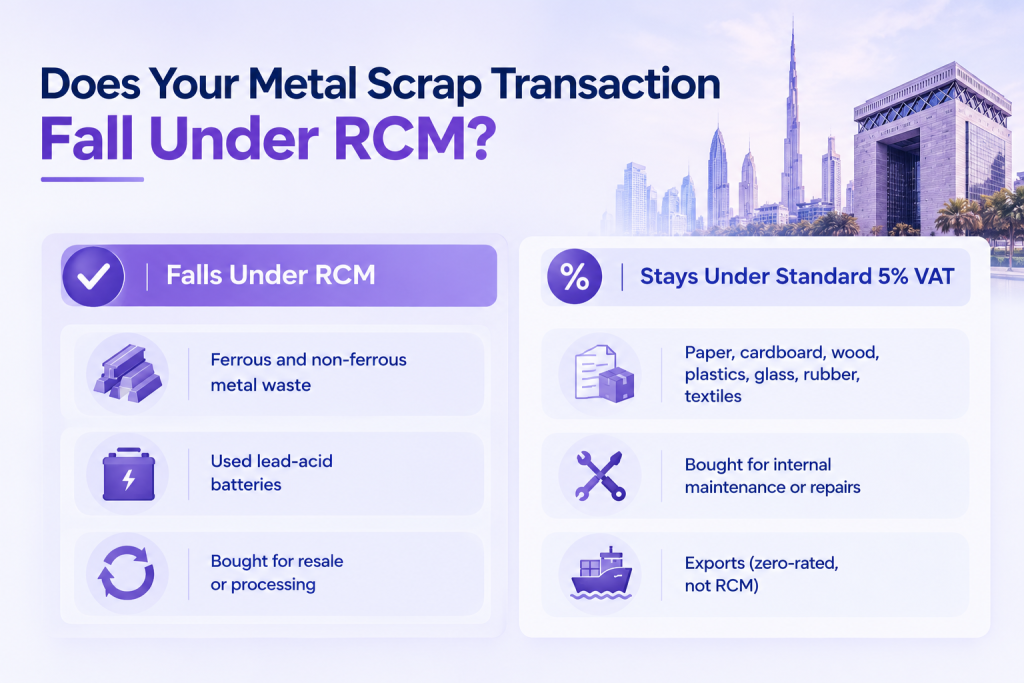
This is only applicable for commercial metal scrap. According to the Federal Tax Authority of the UAE, Metal scrap is any industrial waste of ferrous or non-ferrous metal that holds some commercial value and can be utilized after processing.
Metal scrap includes primary metal waste such as used lead-acid batteries with lead as the main material.
Other waste except metal does not fall in the category of metal scrap and those include:
- Paper, cardboard, wood waste
- Plastics and synthetic polymers
- Glass, industrial textiles, rubber, organic waste
The above-excluded waste will come under the existing VAT regulations and 5 percent VAT will apply to invoices.
The buyer should have the intention of reselling the scrap or using it to produce new materials. Such processing will involve recycling, repairing, or manufacturing products such as construction materials and vehicle parts. Buying metal scrap to carry out maintenance in the company’s warehouse, for example, will not fit the definition.
Metal trading companies should, therefore, establish the operational purpose of all metal materials before issuing commercial invoices.
How Are Suppliers and Customers Approaching Compliance Before Supply?
Each party must carry out certain verification processes even before the date of supply. Automatic failure to comply means that the reverse charge method will not be applied.
The purchasing company must give the seller two statements before supply. One of the statements should show that the purchaser is a registered VAT vendor, while the other one shows that the metal scrap is being bought for resale or further manufacturing process. Purchasers can combine the two statements within one document.
The supplier has very important verifications before releasing the goods. The seller should verify whether the buyer is registered through the TRN verification process on the Federal Tax Authority website.
After verifying, the seller will issue a tax invoice indicating that the transaction will use the reverse charge system. In terms of tax returns, the purchaser will put down the tax in Box 3 and declare the recoverable tax in Box 10 without using Box 9. Companies setting up trade firms can find the structure of federal licenses through the Ministry of Economy website.
What Are the Financial Risks of Not Being Compliant?
Failure to meet any compliance requirement results in serious financial repercussions for the purchasing party. In case the buyer fails to submit the necessary documentation prior to the delivery of goods, the reverse charge system will not be applicable.
The supplier, therefore, will have to impose 5 percent VAT and make the declaration under Box 1 on the sales. More critically, the purchasing company will forfeit all the rights to reclaim the input tax paid.
| Transaction Status | Supplier Tax Obligation | Buyer Tax Treatment | Tax Return Box Used |
| Compliant Domestic RCM | Zero tax charged on invoice | Accounts for Due Tax directly | Buyer: Box 3 and Box 10 |
| Non-Compliant Supply | Charges standard 5% VAT | Permanent loss of input tax recovery | Seller: Box 1 |
| Direct or Indirect Export | Zero-rated export rules apply | Handled under overseas customs laws | Seller: Box 4 (Zero-rated) |
Cross-border exports also travel through different channels. Both direct and indirect scrap exports still constitute zero-rated supplies and not reverse charges. Mainland traders may refer to the Invest in Dubai portal, whereas those operating in zones may find details on the trading process in the zone-specific manual.
How We at Arnifi Help Scrap Traders Manage UAE Tax Compliance
At Arnifi, we provide digital-first corporate infrastructure designed to remove administrative friction for international traders and local business operators. As new tax decisions take effect across the UAE, our team helps trading businesses establish proper invoicing frameworks and audit-ready supplier dossiers.
Our specialists handle end-to-end accounting and bookkeeping, ensuring tax returns report transactions accurately across Box 3 and Box 10 without triggering recovery disputes. Through our post-setup compliance services, we assist companies in maintaining valid TRN records, standardizing customer declarations, and avoiding costly filing errors. Businesses looking to streamline local VAT workflows can connect directly with our advisory specialists.
How Arnifi Assists Scrapper Companies with Tax Compliance in the UAE
We at Arnifi offer digital-first corporate infrastructure that is built to eliminate any sort of administrative inefficiency for international traders and local businesses. With new tax laws implemented in the UAE, our professionals help trading firms create their invoicing system as well as maintain their suppliers’ records properly.
We provide accounting and bookkeeping services to ensure the accuracy of tax return reporting in terms of Box 3 & Box 10 without causing any recovery conflict. With our post-setup compliance services, we help businesses to maintain their TRN records as well as customer declaration records properly.
Conclusion
Cabinet Decision No. 153 of 2025 creates significant cash flow benefits for metal scrap traders while introducing strict documentation rules. Failing to obtain buyer declarations before delivery permanently wipes out input tax recovery rights. Establishing standardized verification processes and maintaining compliant invoice templates protects trading margins against unnecessary losses.
Contact us at Arnifi for a tailored setup plan and a clear cost estimate today.
FAQs
What is the Reverse Charge Mechanism?
It is a tax mechanism where the buyer, rather than the seller, calculates and reports VAT directly on its tax return.
When did the metal scrap reverse charge come into effect?
The rules took effect on January 14, 2026, under Cabinet Decision No. 153 of 2025.
Which goods fall under the metal scrap reverse charge?
Ferrous and non-ferrous metal waste with commercial value that can be reused after processing, including spent lead-acid batteries.
Does the reverse charge apply to plastic, glass, or rubber scrap?
No. Non-metal waste like plastics, paper, textiles, glass, and rubber remain subject to standard 5 percent VAT.
What happens if metal scrap is bought for internal facility repairs?
Internal repairs do not qualify as resale or processing, meaning the seller must charge standard 5 percent VAT.
What declarations must the buyer submit to the seller?
Written confirmation of active VAT registration and a written statement confirming intent to resell or process the scrap.
How must the seller verify the buyer before delivery?
The seller must verify the buyer’s Tax Registration Number using the official TRN tool on the Federal Tax Authority website.
What is the financial penalty if declarations are missing?
The seller must charge 5 percent VAT, and the buyer permanently loses the right to recover the input tax.
Which boxes on the VAT return are used for compliant scrap purchases?
The buyer declares the supply in Box 3 and recovers eligible tax in Box 10, leaving Box 9 untouched.
Does the reverse charge apply to scrap metal exported overseas?
No. Direct and indirect exports follow standard zero-rating export rules rather than the domestic reverse charge.
References
Top UAE Packages
Related Articles



Top UAE Packages
Get in Touch
