
Singapore Company Taxes Explained | A Complete Guide for Businesses

Anushka
Content Writer
Anushka Basu is a business content writer specialised in global business market insights. She aims to simplify complex regulatory, financial, and business concepts into… Read more

Tulika Saxena
AVP, Sales & Marketing | IIM Nagpur
Tulika Saxena specializes in business finance, sales strategy, and market positioning. Leads growth and partnerships, ensuring seamless business setup experiences and client success across… Read more


KEY FACT: Singapore’s headline Corporate Income Tax rate is 17% of chargeable income. For YA 2026, eligible companies can also receive a 50% Corporate Income Tax rebate capped at S$40,000, subject to applicable conditions and the S$2,000 CIT Rebate Cash Grant.
Table of contents
- Introduction
- What Is Business Tax in Singapore?
- What Is the Corporate Tax Rate in Singapore?
- How Is Business Tax Calculated in Singapore?
- What Income Is Taxable for Singapore Companies?
- What Are the Start-Up Tax Exemptions in Singapore?
- What Is the Partial Tax Exemption for Singapore Companies?
- What Is the Singapore Corporate Income Tax Rebate for YA 2026?
- What Is the Difference Between Corporate Tax and GST?
- When Does a Singapore Business Need to Register for GST?
- What Is Withholding Tax in Singapore?
- How Are Dividends Taxed in Singapore?
- How Is Foreign Income Taxed in Singapore?
- What Tax Incentives Are Available for Singapore Businesses?
- What Are the Corporate Tax Filing Requirements in Singapore?
- What Are the Singapore Business Tax Filing Deadlines?
- What Records Should Singapore Businesses Keep for Tax Purposes?
- What Are the Penalties for Late Business Tax Filing?
- How Can Singapore Businesses Legally Reduce Their Tax Liability?
- How Does Accounting Support Singapore Business Tax Compliance?
- How Can Arnifi Help With Singapore Business Tax?
- FAQs
- Conclusion
Introduction
The tax system for businesses in Singapore includes Corporate Income Tax, which is a flat-rate system with some exemptions and rebates. There might also be GST and other taxes that depend on the activities performed by the company.
The main Corporate Income Tax rate is 17%, but the tax paid after exemptions, rebates, and other factors can be different. The understanding of these terms will help to differentiate taxable income from chargeable income, tax rates, and taxes payable.
What Is Business Tax in Singapore?
Taxes that may apply to a company’s activities and income:
- Corporate Income Tax
- Goods and Services Tax (GST)
- Withholding tax
- Tax on certain foreign-sourced income
- Sector-specific tax incentives and concessions
Corporate Income Tax is generally imposed on taxable income accrued in or derived from Singapore, as well as certain foreign income received in Singapore.
The applicable obligations depend on the company’s activities, income sources, tax residency and transactions.
What Is the Corporate Tax Rate in Singapore?
Singapore’s headline Corporate Income Tax rate is 17% of chargeable income for both local and foreign companies.
| Tax Component | Rate / Treatment |
| Corporate Income Tax | 17% |
| Start-up tax exemption | Available to qualifying companies |
| Partial tax exemption | Available to qualifying companies |
| YA 2026 CIT rebate | 50%, subject to S$40,000 cap and applicable conditions |
| GST | 9% |
The 17% rate applies to chargeable income, not a company’s total sales or gross revenue.
How Is Business Tax Calculated in Singapore?
A company’s tax calculation generally starts with its accounting results and adjusts them according to Singapore tax rules.
Accounting Profit → Tax Adjustments → Chargeable Income × 17% → Tax Exemptions/Rebates → Final Tax Payable
Example:
Accounting profit: S$300,000
→ Less allowable adjustments: S$50,000
→ Chargeable income: S$250,000
→ Corporate Tax at 17%: S$42,500
→ Less applicable exemptions/rebates
→ Final tax payable
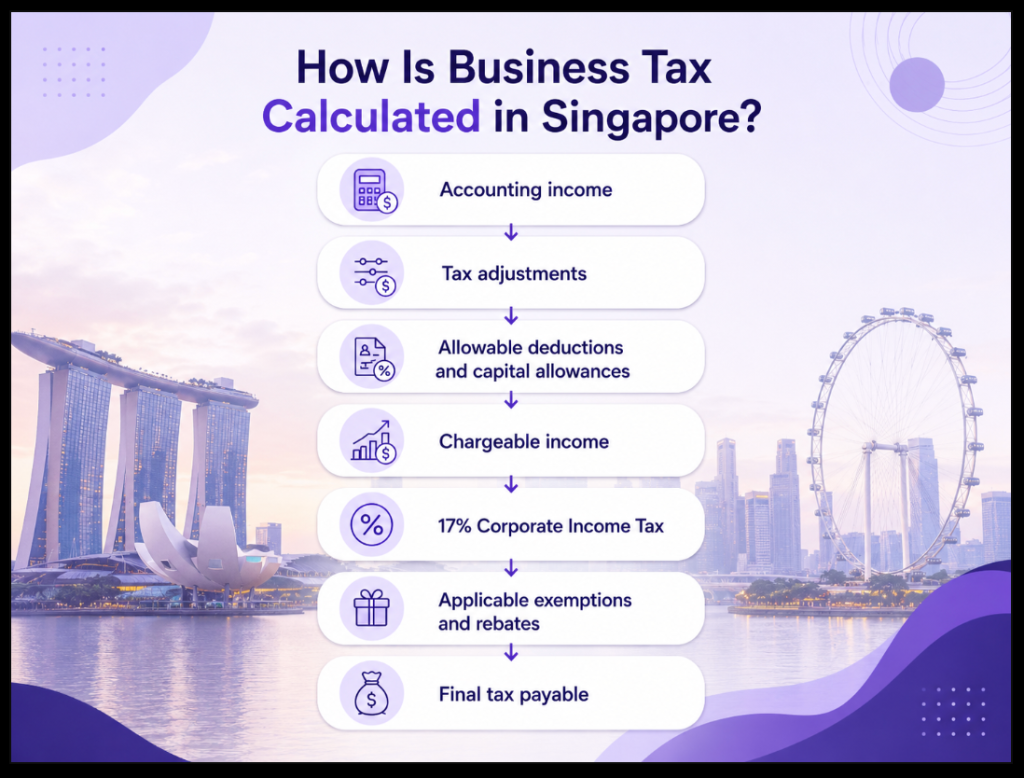
This means a company should not simply multiply its annual revenue by 17%.
What Income Is Taxable for Singapore Companies?
Singapore companies may be taxed on income that is:
- Accrued in or derived from Singapore
- Received in Singapore from outside Singapore
- Derived from a trade or business carried on in Singapore
Tax treatment depends on the nature and source of the income. Capital gains are generally not taxable, although gains that are revenue in nature may be subject to tax.
Foreign-sourced income can also have specific exemptions or foreign-tax-credit arrangements, depending on the circumstances.
What Are the Start-Up Tax Exemptions in Singapore?
Qualifying newly incorporated companies can benefit from the Start-Up Tax Exemption (SUTE) for their first three consecutive Years of Assessment.
For YA 2020 onwards, the exemption is:
- 75% of the first S$100,000 of normal chargeable income
- 50% of the next S$100,000
This provides a maximum exemption of S$125,000 per YA.
The scheme is subject to eligibility conditions. For example, the company must generally be incorporated in Singapore and be a Singapore tax resident for the relevant YA.
Certain companies, including companies whose principal activity is investment holding or property development for sale or investment, are excluded.
What Is the Partial Tax Exemption for Singapore Companies?
Companies that do not qualify for the start-up exemption may benefit from the Partial Tax Exemption.
For YA 2020 onwards:
- 75% exemption on the first S$10,000 of normal chargeable income
- 50% exemption on the next S$190,000
The maximum exemption is S$102,500.
The remaining chargeable income is taxed at the prevailing 17% Corporate Income Tax rate.
What Is the Singapore Corporate Income Tax Rebate for YA 2026?
For YA 2026, companies can receive a 50% Corporate Income Tax rebate, capped at S$40,000, subject to the applicable rules. Eligible companies may also receive a S$2,000 CIT Rebate Cash Grant, which affects the maximum rebate available.
The rebate is calculated on the company’s tax payable after applicable tax set-offs and before tax deducted at source, and it is separate from the 17% Corporate Income Tax rate and any tax exemptions available to the company.
What Is the Difference Between Corporate Tax and GST?
| Corporate Income Tax | GST |
| Tax on chargeable income | Consumption tax |
| Generally calculated on taxable business income | Applied to taxable supplies |
| Headline rate is 17% | Current rate is 9% |
| Paid by the company | Collected from customers and accounted for to IRAS |
GST registration is a separate obligation from Corporate Income Tax.
When Does a Singapore Business Need to Register for GST?
A business generally must register for GST when its taxable turnover:
- Exceeds S$1 million at the end of the calendar year under the retrospective basis; or
- Is reasonably expected to exceed S$1 million in the next 12 months under the prospective basis.
Businesses may also voluntarily register for GST if they meet the applicable conditions.
Once registered, the business generally charges GST on taxable supplies and may claim eligible input tax.
What Is Withholding Tax in Singapore?
Withholding tax can apply when specified payments are made to non-resident companies or individuals.
Examples include:
- Interest
- Royalties
- Technical service fees
- Management fees
- Certain payments connected with loans or indebtedness
The applicable rate depends on the type of payment and whether a tax treaty affects the treatment.
Singapore currently does not impose withholding tax on dividends paid by Singapore companies.
How Are Dividends Taxed in Singapore?
Singapore has a one-level corporate tax regime.
After Corporate Income Tax is levied on the income of a Singapore corporation, the dividends declared by that corporation will no longer be taxed in Singapore.
There is also no withholding tax on dividends in Singapore from Singapore corporations.
How Is Foreign Income Taxed in Singapore?
Income from overseas sources may be taxable in Singapore upon receipt. Singapore tax-resident companies may qualify for exemption on specified foreign-sourced:
- Dividends
- Branch profits
- Service income
The exemption is subject to conditions, including the applicable foreign tax and headline-tax-rate requirements.
Businesses should therefore assess foreign income based on its source, nature, receipt and available reliefs rather than assuming that overseas income is automatically tax-free.
What Tax Incentives Are Available for Singapore Businesses?
Singapore provides targeted tax incentives for qualifying businesses and activities.
Depending on the company’s circumstances, incentives can cover areas such as:
- Innovation
- Technology
- Finance
- Investment
- Headquarters activities
- Specific industries
These incentives are subject to individual eligibility and approval requirements. Businesses should verify the conditions applicable to their particular activity before relying on an incentive.
What Are the Corporate Tax Filing Requirements in Singapore?
Singapore companies generally need to manage two key Corporate Income Tax filing obligations:
Estimated Chargeable Income (ECI)
Companies generally submit ECI within three months from the end of their financial year, unless an applicable waiver applies.
Corporate Income Tax Return
Companies file the applicable:
- Form C
- Form C-S
- Form C-S (Lite)
The YA 2026 Corporate Income Tax Return deadline is 30 November 2026, and the appropriate form depends on the company’s circumstances and eligibility.
What Are the Singapore Business Tax Filing Deadlines?
For Corporate Income Tax, businesses should track:
| Obligation | General Deadline |
| ECI | Within 3 months after financial year-end |
| YA 2026 Corporate Income Tax Return | 30 November 2026 |
| GST return | According to the assigned GST accounting period |
| Withholding tax | According to the applicable payment and filing rules |
Maintaining a tax calendar helps businesses avoid missing separate filing and payment obligations.
Businesses should check whether they qualify for the relevant waiver rather than assuming that inactivity removes the filing requirement.
What Records Should Singapore Businesses Keep for Tax Purposes?
Companies should maintain records supporting their income, expenses and tax calculations, including:

IRAS requires companies to retain relevant accounting records and supporting documents for at least five years from the relevant Year of Assessment.
What Are the Penalties for Late Business Tax Filing?
Late filing or payment can result in additional compliance action, including penalties, estimated assessments or enforcement measures depending on the obligation and circumstances.
Companies should therefore track both filing and payment deadlines rather than focusing only on the annual Corporate Income Tax return.
How Can Singapore Businesses Legally Reduce Their Tax Liability?
Businesses can manage their tax liability through legitimate measures such as:
- Allowable business deductions
- Capital allowances
- Start-up tax exemption
- Partial tax exemption
- YA 2026 Corporate Income Tax rebate
- Approved tax incentives
- Foreign tax credits
- Double taxation agreements
Tax planning should be based on genuine business transactions and applicable legislation rather than artificial arrangements designed solely to reduce tax.
How Does Accounting Support Singapore Business Tax Compliance?
Accurate accounting provides the information needed for:
- Tax calculations
- Expense classification
- ECI preparation
- Corporate tax returns
- GST reconciliation
- Financial reporting
- Supporting tax deductions
- Responding to IRAS queries
Maintaining accounts throughout the year can make tax preparation significantly more straightforward.
How Can Arnifi Help With Singapore Business Tax?
Arnifi can support Singapore businesses with accounting and tax-compliance requirements, including:
- Bookkeeping
- Corporate Income Tax support
- ECI preparation
- Corporate tax return support
- GST registration and reporting
- Tax incentive support
- Tax planning
- Financial record maintenance
- Ongoing compliance
The focus is on helping businesses keep their financial records organised while managing their applicable Singapore tax obligations.
FAQs
What is the business tax rate in Singapore?
Singapore’s headline Corporate Income Tax rate is 17% of chargeable income.
How much tax does a company pay in Singapore?
A company generally pays 17% on chargeable income before applicable exemptions, rebates and other tax adjustments.
What is the difference between Corporate Income Tax and GST in Singapore?
Corporate Income Tax applies to chargeable income, while GST is a 9% consumption tax on taxable supplies.
Do small businesses get tax exemptions in Singapore?
Qualifying companies may benefit from the start-up or partial tax exemption schemes.
Do Singapore companies pay tax on dividends?
Singapore generally does not impose further tax or withholding tax on dividends paid by Singapore companies.
When does a Singapore company need to file its tax return?
Companies generally file their Corporate Income Tax Return by 30 November each year, subject to applicable rules and waivers.
Conclusion
Singapore’s business tax framework is built around a 17% Corporate Income Tax rate, but the actual tax payable can be affected by exemptions, rebates, deductions, incentives and the nature of the company’s income.
For YA 2026, eligible companies can benefit from a 50% Corporate Income Tax rebate, subject to the applicable S$40,000 cap and conditions. GST remains a separate obligation, with compulsory registration generally linked to the S$1 million taxable-turnover threshold.
Businesses should also consider withholding tax, foreign income rules and their annual IRAS filing requirements. Maintaining accurate accounting records throughout the year is essential for supporting tax computations and meeting compliance obligations.
Arnifi can support Singapore businesses with accounting, Corporate Income Tax, GST and ongoing tax-compliance requirements. To know more information, reach out to us at Arnifi today!
References
Top Singapore Packages
Related Articles

Top Singapore Packages
Get in Touch
