
Dubai Free Zone Business Setup for Singapore Entrepreneurs: Costs, Benefits & Process

Zahira Shaik
SEO Content Writer
Zahira Shaik is an SEO Content Writer and Published Author specializing in research-based content. She excels at analyzing market trends, regulations, and industry developments… Read more

Tulika Saxena
AVP, Sales & Marketing | IIM Nagpur
Tulika Saxena specializes in business finance, sales strategy, and market positioning. Leads growth and partnerships, ensuring seamless business setup experiences and client success across… Read more



Key Fact: Bilateral merchandise trade between Singapore and the UAE is SGD 27.94 billion. Singapore businesses can establish their Dubai free zone business within 5 working days online, thus obtaining 100% FDI and the ability to repatriate 100% of profits.
Table of contents
- Introduction
- Why Choose a Dubai Free Zone for Business Setup?
- Which Dubai Free Zone Should Singapore Entrepreneurs Choose?
- Dubai Free Zone Corporate Tax, DTAA and Profit Repatriation
- Dubai Free Zone Business Setup Costs for Singapore Entrepreneurs
- Step-by-Step Dubai Free Zone Company Setup Process
- Corporate Banking: The Critical Post-Incorporation Step
- UAE Residency and Golden Visa Options
- Singapore Parent + UAE Subsidiary: The Dual-Entity Model
- Post-Setup Compliance: Keeping Your Dubai Company in Good Standing
- How Arnifi helps Singapore Entrepreneurs for Dubai Expansion
- Frequently Asked Questions
- Conclusion
Introduction
Singapore is undoubtedly the leading corporate and financial center of the APAC region, yet expanding businesses face certain geographic and practical limitations on the western expansion of their operations. Dubai becomes a perfect solution to this issue as a key point of entry into GCC, MENA, South Asia, and other western regions, providing Singapore founders with access to European and Middle Eastern time zones and top-notch infrastructure for international trade.
Leveraging the economic corridor is simple, thanks to the good policies of entry and remoteness of incorporation procedures. Passport holders of Singapore will be allowed 90 days’ visa-free entry into the UAE upon arrival, which means that it will be easy to conduct explorations of the market, meet with partners, and incorporation into banks. Additionally, founders can go through Free Zone incorporation procedures, such as trade name registration, approval of activities, signing of the articles of association, and issuance of a trade license from Singapore.
Why Choose a Dubai Free Zone for Business Setup?
Dubai Free Zones are unique economic jurisdictions that aim to lure foreign investments through favorable corporate laws and administrative processes.
- 100% Foreign Ownership Without a Local Sponsor: Singapore business owners retain full capital ownership and control over the corporate entity without requiring a service agent in the UAE or an Emirati partner in the corporation.
- Full Profit Repatriation: The capital, as well as the net profits earned in Dubai, can be freely transferred outside the UAE to any other country such as Singapore, without being affected by any currency regulations or capital export restrictions.
- Flexible Office & Licensing Options: Free Zone legal entities provide flexible infrastructure solutions to suit your operational needs, from flexi-desk workstations for a sole founder to exclusive commercial office space for multiple employees.
- Access to Regional Markets: Having a free zone entity will allow you to seamlessly deliver services internationally and trade across the MENA and GCC region (Note: Direct sales in the UAE mainland are subject to different licensing regimes).
- Potential 0% Corporate Tax for Qualifying Income: Entities that meet certain criteria are eligible to have 0% corporate tax on qualified profits under the QFZP structure.
Which Dubai Free Zone Should Singapore Entrepreneurs Choose?
Dubai has more than 30 different Free Zones to choose from. The choice of the Free Zone depends upon your business functions, office needs, and your target market.
DMCC (Dubai Multi Commodities Centre)
Being located at Jumeirah Lakes Towers (JLT), DMCC has won the title of Global Free Zone of the Year several times. This zone is best for physical commodities transactions, financial services, Web3 and technology companies, and heavy-duty corporate operations. DMCC can give you institutional credibility for enterprises requiring robust enterprise infrastructure.
Meydan Free Zone
Meydan Free Zone is located at the Meydan Hotel complex just outside Downtown Dubai. Meydan is a fully digital zone providing various options for business setup. It is perfect for consultancies, digital agencies, freelancers, and lightweight e-commerce operations needing remote processing.
IFZA (International Free Zone Authority)
IFZA operates out of Silicon Oasis and is good for general trading, professional consultancies, and service organizations. It provides various options of licensing for years, flexible desk facilities, and cost-efficient incorporation facilities.
How to Match Your Business Activity to the Right Free Zone
It is not advisable to choose a Free Zone simply based on the price. Choose the jurisdiction based on these factors:
- Activity Match: Make sure that your specific business activity code (e.g., Software Development, Management Consultancy, Proprietary Trading) is allowed by the jurisdiction.
- Banking Acceptance: High-quality traditional banks have an affinity towards well-established Free Zones (like DMCC).
- Visa Requirements: Confirm the total number of employee/investor visas allocated to your office package space.
Dubai Free Zone Corporate Tax, DTAA and Profit Repatriation
UAE Corporate Tax: The 9% Baseline
The UAE has implemented Corporate Tax through Statutory Law. An income of up to AED 375,000 will be taxed at 0%, whereas income more than AED 375,000 will attract a tax rate of 9%.
When Can a Free Zone Company Qualify for 0% Tax?
Free Zone firms do not qualify for automatic 0% tax. However, a free zone company can have a 0% Corporate Tax rate by satisfying the following conditions:
- Provision of enough economic substance (physical presence, employment, and expenses incurred in the Free Zone).
- Qualification of income (income earned through operations and dealings with other entities in the Free Zone or engaging in particular Qualifying Activities, i.e., manufacture, fund management, or headquarter services).
- Meeting of transfer pricing and documentation requirements stipulated in Section 14 of UAE Corporate Tax Law.
- No election for standard tax rates.
The De Minimis Rule for Non-Qualifying Income
The QFZP will be able to retain the zero percent QFZP status only if the amount of non-qualifying income is less than the De Minimis threshold, which is either 5% of total income or AED 5 million (the lower of the two). Exceeding the De Minimis threshold results in losing the QFZP status for five consecutive tax years and paying the regular 9% corporate tax on all net income.
FTA Registration & Tax Compliance
All corporate firms in the UAE, including Free Zone firms, have to be registered under Corporate Tax with the Federal Tax Authority (FTA) and should have a Tax Registration Number (TRN) even if they are expecting to pay either 0% or 9% tax.
Singapore-UAE DTAA (Double Taxation Avoidance Agreement)
Singapore-UAE DTAA provides relief from double taxation in international transactions. According to this DTAA, the profits made by the UAE firm with real business operations are subject to taxation in the UAE. The Tax Residency Certificate (TRC) issued by the UAE Federal Tax Authority will help the Singapore parent firm to avoid double taxation on profit repatriation.
UAE Withholding Tax & Profit Repatriation
The United Arab Emirates does not impose any withholding tax on outward payments of fees, royalties, dividends, and interest made by its resident companies to non-resident entities such as the Parent Holding Company based in Singapore.
Dubai Free Zone Business Setup Costs for Singapore Entrepreneurs
Budgeting for a Dubai Free Zone company requires accounting for both one-off legalisation fees and recurring annual setup fees.
| Expense Category | Description / Coverage | Estimated Cost Range (AED) | Estimated Cost Range (SGD) |
| Core Incorporation & License | Trade name, initial approvals, annual license fee | AED 12,000 – AED 30,000+ | ~S$ 4,400 – S$ 11,000+ |
| Flexi-Desk / Office Space | Annual lease allocation for visa eligibility | AED 4,000 – AED 15,000 | ~S$ 1,500 – S$ 5,500 |
| Establishment Card | Immigration registration file fee (annual) | AED 1,800 – AED 2,000 | ~S$ 660 – S$ 735 |
| Residency Visa (Per Person) | Medical test, Emirates ID, entry permit, stamping | AED 3,000 – AED 5,000 | ~S$ 1,100 – S$ 1,835 |
| Employee Health Insurance | Basic compulsory plan per sponsored individual | AED 1,000 – AED 3,500 | ~S$ 370 – S$ 1,300 |
| SG Document Legalisation | SAL authentication + UAE Embassy legalisation | AED 2,500 – AED 5,000 | ~S$ 900 – S$ 1,835 |
Singapore Document Legalisation Costs
When a Singapore corporate entity (Pte Ltd) sets up a UAE subsidiary, its corporate governance documents (ACRA Profile, Certificate of Incorporation, M&AA, Board Resolutions) must undergo an official document chain:
- Singapore Notary Public notarization.
- Singapore Academy of Law (SAL) legalisation.
- UAE Embassy in Singapore authentication.
- MOFA (Ministry of Foreign Affairs) attestation inside the UAE.
This process incurs legalisation, administrative, and courier expenses.
Step-by-Step Dubai Free Zone Company Setup Process
The following is a list of order-critical activities that need to be performed in order:
1. Select Your Business Activity: Ensure the activity aligns with ISIC definitions.
Select your activities from the business activity list issued by the Free Zone Authority. Check if you need any special approval for your business (for example, VARA – cryptocurrency, KHDA – education, or CBUAE – financial services).
2. Choose the Free Zone & Corporate Structure: Select a location based on commercial scope.
Choose whether you will operate as FZE (Free Zone Establishment – one shareholder), FZ-LLC (Free Zone LLC – more than one shareholder), or a branch of a Foreign Singapore company.
3. Prepare & Legalise Singapore Corporate Documents: Required for corporate entity ownership.
In case of forming a subsidiary of a Singapore Pte Ltd, prepare a Board Resolution and POA. Perform SAL and UAE Embassy legalisation in Singapore.
4. Reserve Trade Name & Submit Incorporation Application: Can be completed 100% remotely.
Register trade name choices that abide by the UAE business naming policies (for example, no religious or offensive words, compulsory ending) along with passport copy and proof of address of the ultimate beneficial owners (UBO).
5. Secure Workspace / Flexi-Desk Lease: Tied to immigration visa quota.
Arrange the agreements for renting a virtual flexi-desk or a commercial office. The contract sets the immigration visa quota for your company.
6. Receive Business Trade License & Establishment Card: Entity is officially incorporated.
Get the formal Trade License, Memorandum of Association (MOA), and Immigration Establishment Card. You have officially established your business entity in the UAE.
7. Complete UAE Residency Visa & Emirates ID Formalities: Requires physical presence in Dubai (~3-5 days).
Visit Dubai on a visa-free basis. Undergo an in-country fitness test (blood tests and chest X-ray), provide biometric data, and get your residence visa.
8. Open Corporate Bank Account: Final operational enablement stage.
Submit corporation documents, evidence of business operations, contracts, bank statements, and profile of the UBO to your selected banking partner.
Corporate Banking: The Critical Post-Incorporation Step
Corporate banking is the most compliance-oriented step in business establishment because of international standards of Anti-Money Laundering (AML) and the Common Reporting Standard (CRS).
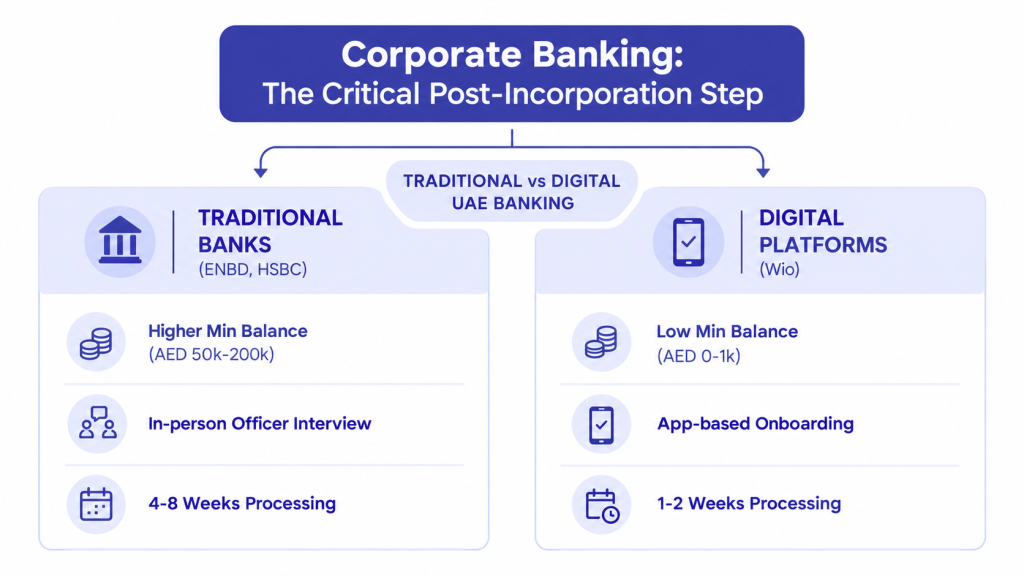
Traditional UAE Banks vs Digital Business Banking
- Traditional Tier-1 Banks (e.g., Emirates NBD, Mashreq, RAKBANK, HSBC): Provide a wide range of trade financing options, multicurrency accounts, and credit services. On the other hand, they have stringent KYC regulations, average monthly balances ranging from AED 50,000 to AED 200,000, and onboarding takes 4-8 weeks.
- Digital Business Platforms (e.g., Wio Business): Provide quick onboarding through applications, integration with local payment systems, and zero or low minimum balance. The account opening process takes 1-2 weeks.
Documents Required by UAE Banks
Banks verify substance, financial viability, and beneficial ownership using these core documents:
- Certified Trade License, Certificate of Formation, and MOA.
- Immigration Establishment Card and Share Register.
- Passport and Emirates ID copies for shareholders/directors.
- Comprehensive Business Plan detailing core products, revenue models, key client profiles, and expected transactional flows.
- 6-Month Personal or Corporate Bank Statements from the Singapore entity/founders.
- Proof of operating business substance (e.g., supplier invoices, client contracts, or MOUs).
UAE Residency and Golden Visa Options
Standard Investor/Employee Residency Visa
By registering a Free Zone company, the entrepreneurs and employees are eligible for a 2-Year or 3-Year Renewable UAE Investor / Employee Visa. It will enable the entrepreneur to have a residency visa, Emirates ID card, Tax residency, and sponsorship of their family members and domestic servants.
10-Year UAE Golden Visa for Entrepreneurs & Investors
For Singaporean entrepreneurs wanting long-term residency in the UAE, there is an option of a 10-Year UAE Golden Visa, which does not require a local sponsor. Some common ways through which the visa can be acquired include:
- Entrepreneur Category: Being the owner or partner in an active UAE tech / commercial company with an annual income of at least AED 1,000,000 or getting approval of the venture idea from a recognized business incubator.
- Capital Investment Category: Having corporate investment, bank deposits, and public investments in the UAE of AED 2,000,000 and above.
- Real Estate Category: Buying property in the UAE with a gross value of at least AED 2,000,000.
Do You Need UAE Residency to Own a Free Zone Company?
Having UAE residency is not necessary when you want to own a 100%-owned Free Zone company since even non-residents are legally allowed to own a Free Zone company. Nevertheless, getting residency will be extremely helpful for opening a corporate bank account, as well as having a personal one, and confirming your tax residency.
Singapore Parent + UAE Subsidiary: The Dual-Entity Model
Many expanding companies choose a Dual-Entity Structure, keeping their Singapore entity as the primary corporate parent while running a UAE Free Zone operating company.
Why Use Two Entities Instead of Moving Completely to Dubai?
- APAC Operational Continuity: Continue your operations and keep all the customer agreements, banks, and grant funding from Singapore (e.g., Enterprise Singapore).
- Targeted Market Expansion: Use the UAE operating company to contract with customers in GCC countries, earn money from there, and hire Middle Eastern staff.
- IP Protection: Keep all the Intellectual Property (IP) and holding structure in Singapore jurisdiction and license it to the UAE subsidiary.
Cross-Border Compliance Considerations
- Transfer Pricing: The business dealings between the Singaporean parent and UAE subsidiary have to be conducted at arm’s length and supported by intercompany service agreements.
- Place of Effective Management (POEM): It needs to be made sure that corporate governance practices adequately establish the management of the UAE entity in its locality.
Post-Setup Compliance: Keeping Your Dubai Company in Good Standing
To remain compliant in the UAE, the following recurring regulatory issues need to be managed:
- Annual License & Establishment Card Renewals: The Trade Licenses and Establishment Cards need to be renewed every year before their expiry. Running any business with an expired license leads to paying administrative penalties, and the corporate bank account becomes frozen.
- Corporate Tax Returns & FTA Compliance: The Free Zone companies are supposed to submit their Corporate Tax Return to the FTA within 9 months of the year-end, along with documents that qualify them for QFZP status.
- Audited Financial Statements: Almost all Free Zones and the FTA require the companies to maintain their Audited Financial Statements as per IFRS guidelines.
- Economic Substance Regulations (ESR) & UBO Registrations: If the companies have Relevant Activities like Headquarters, Holding, and Distribution centers, then they need to maintain an updated UBO Register and report as per ESR guidelines.
- Bookkeeping & Accounting: Companies should maintain their books of accounts properly from Day 1. Proper financial records are essential for annual tax filings, banking reviews, and auditing.
How Arnifi helps Singapore Entrepreneurs for Dubai Expansion
Going beyond borders requires synchronization in company formation, cross-border documentation, and compliance processes. Making expansion easier across multiple markets, Arnifi provides clear and well-defined Dubai company incorporation packages, complete corporate secretarial services for a Singapore-Dubai two-entity structure, and management of visas, tax filings, and document attestation, including those from SAL, the UAE Embassy in Singapore, and the UAE Ministry of Foreign Affairs (MOFA).
In order to make the entire process smoother, Arnifi provides entrepreneurs with various software tools that will be useful when operating across different markets. Arni Organogram will help to see the complex structure of parent-sub company relations, while Arni Docs will allow making legal resolutions and board meetings automatically. Moreover, the platform is provided with software such as Arni AML Checker to get automatic compliance checks against international sanctions lists and the Arni Cost Calculator to make your own budget. In order to help founders save cash while expanding, Arnifi allows payment in four installments without interest.
Frequently Asked Questions
Can a Singapore company set up a Dubai Free Zone company remotely?
Yes. Trade name reservation, document filing, approval of shareholders, and electronic licensing are all possible to do 100% remotely from Singapore.
How much does it cost to set up a Free Zone company in Dubai from Singapore?
The core cost of incorporation will range from AED 12,000-30,000+ (approximately S$4,400-11,000+) depending on location, nature of business, and visa availability.
Which Dubai Free Zone is best for Singapore entrepreneurs?
It varies by area of expertise: DMCC for commodities and technology, Meydan for consulting and e-commerce, and IFZA for all other business services.
Do Dubai Free Zone companies pay 9% corporate tax?
Tax is charged at 9% on any profits above AED 375,000, while Qualifying Free Zone Persons (QFZP) are exempt at 0%.
How does the QFZP 0% tax regime work?
A certain number of criteria have to be fulfilled, including economic substance, qualifying income, and De Minimis non-qualifying income limits.
Can a Dubai Free Zone company trade directly with UAE mainland customers?
Yes, they are allowed to conduct international B2B operations. Conducting mainland retail trade necessitates a licensed distributor or mainland office.
Do Singapore corporate documents need to be legalised for Dubai company formation?
Yes, notarisation, SAL, UAE Embassy legalisation in Singapore, and UAE MOFA attestation of the documents are required.
Can a Singapore citizen get UAE residency through a Free Zone company?
Yes, forming a Free Zone company provides founders and staff with the ability to apply for 2- or 3-year renewable UAE residency.
How long does it take to incorporate a Dubai Free Zone company remotely?
The process takes between 3 and 5 days once all the signed documentation and passport copies are submitted.
Can a Singapore parent company own 100% of a UAE Free Zone subsidiary?
Yes, a Singapore Pte Ltd company can be the sole 100% shareholder of the UAE Free Zone firm.
Can I open a UAE corporate bank account remotely after incorporation?
Generally no. Most banks in the UAE have strict in-person procedures but digital banks ease things after biometrics.
What documents are required to open a UAE business bank account?
Trade license, MOA, Establishment Card, passport/id of shareholders, bank statements of the last six months, business plan, and evidence of operating substance.
Can I hire UAE employees without establishing a Dubai company?
Yes. An Employer of Record (EOR) service like Arnifi HR allows you to legally employ staff without local incorporation.
What is the difference between an EOR and a UAE Free Zone company?
EOR enables you to employ people in the UAE legally, while a Free Zone company allows complete ownership of the business.
Can a Dubai Free Zone company qualify for the UAE Golden Visa?
Yes, the founder can qualify through enterprises having more than AED 1,000,000 annual turnover or more than AED 2,000,000 in qualifying capital/realestate.
What are the ongoing costs after setting up a Dubai Free Zone company?
Annual trade license, office rental, Establishment Card renewal, health insurance, accounting, auditing, and taxes.
Conclusion
Creating a Dubai Free Zone company is a way for Singaporean businessmen to establish a solid business base to tap into markets throughout the GCC, MENA, and South Asia. The success of the process depends on choosing the appropriate Free Zone, creating a proper dual-entity structure, handling tax matters through the QFZP system, and ensuring correct legalisation of documents.
With Singapore’s position in the APAC region and Dubai’s in Western trade routes, founders can create a reliable international business presence.
Credible Resources & Governing Authorities
Top Singapore Packages
Related Articles

Top Singapore Packages
Get in Touch
