
Dubai Business Registration Number for Singapore EntreMG Road Boulevardpreneurs: How to Get & Verify It

Zahira Shaik
SEO Content Writer
Zahira Shaik is an SEO Content Writer and Published Author specializing in research-based content. She excels at analyzing market trends, regulations, and industry developments… Read more

Tulika Saxena
AVP, Sales & Marketing | IIM Nagpur
Tulika Saxena specializes in business finance, sales strategy, and market positioning. Leads growth and partnerships, ensuring seamless business setup experiences and client success across… Read more



Key Fact: Any UAE company that operates legally has a unique Company Registration Number (CRN) along with a Trade License. While in Singapore there is a single Unique Entity Number (UEN) issued by ACRA, in Dubai, corporate identity and permits for doing business are kept separate.
Table of contents
- Decoding the Dubai Business Registration Number: What Every Singapore Founder Needs to Know
- Singapore UEN vs. Dubai CRN: Key Similarities and Structural Differences
- Mainland vs. Free Zone vs. Offshore: Selecting the Right UAE Jurisdiction
- Singapore Document Attestation: Legalising Corporate Documents for the UAE
- Step-by-Step Roadmap: How to Secure Your Dubai CRN from Singapore
- Opening a UAE Corporate Bank Account: Timelines, Eligibility and Requirements
- B2B Due Diligence: How to Verify UAE Licenses and Setup Consultants Before Paying
- Tax Planning and Compliance: UAE Corporate Tax, ESR & the Singapore, UAE DTAA
- How Arnifi Simplifies Your Dubai Expansion from Singapore
- Frequently Asked Questions
- References
The Unique Entity Number (UEN) is an easily recognizable corporate identity used by Singaporean entrepreneurs in all official documents, tax payments, and banking. However, if you plan on expanding to Dubai, you will find yourself dealing with a whole identification system.
Establishing a business in Dubai requires different numbers to perform different tasks. In order to start business operations in Dubai successfully, Singaporean entrepreneurs should be able to differentiate between CRN, Trade License Number, and TRN (Tax Registration Number).
Decoding the Dubai Business Registration Number: What Every Singapore Founder Needs to Know
Incorporated companies in the UAE corporate structure will differentiate between the legal status of an entity and its permissible scope of operation in commerce. Grasping these crucial identities will assist in the appropriate compliance of the process.
- Company Registration Number (CRN): The entity’s permanent legal identity. This is proof of incorporation and will remain attached to the company throughout its existence.
- Trade License Number: Issued either by the Department of Economy and Tourism (DET) in mainland Dubai or particular Free Zones. It grants the company legal permission to conduct particular approved commercial activities.
- Tax Registration Number (TRN): Issued by the Federal Tax Authority (FTA) for tax compliance.
- VAT TRN vs. Corporate Tax Registration: VAT registration (compulsory if taxable supplies exceed AED 375,000) and Corporate Tax registration are handled as different compliance documents on the FTA portal.
Key Takeaway: Your CRN is your legal entity identification, the Trade License shows what commercial operations you are permitted to do, and the TRN is your link to the Federal Tax Authority.
Singapore UEN vs. Dubai CRN: Key Similarities and Structural Differences
Singaporean founders often assume the Dubai CRN functions identically to the ACRA UEN. While both establish corporate legal standing, their administrative frameworks differ significantly.
| Feature | Singapore UEN | Dubai CRN |
| Issuing Authority | Centralized via ACRA | Issuance depends on jurisdiction (DET for Mainland; respective Free Zone Authorities) |
| Entity Identification | Single, universal identification code for all interactions | Permanent legal entity ID, issued alongside activity-specific Trade Licenses |
| Jurisdictional Scope | Uniform framework across Singapore | Segmented rules across Mainland, Free Zones, and Offshore regimes |
| Licensing Linkage | Activity codes (SSIC) are linked directly to the UEN | Trade License dictates operational scope and requires separate annual renewal |
| Verification Portal | BizFile+ (ACRA) | Invest in Dubai (Mainland), National Economic Register (Nomu), or specific Free Zone registers |
Mainland vs. Free Zone vs. Offshore: Selecting the Right UAE Jurisdiction
Choice of the appropriate jurisdiction is crucial for the determination of property rights, freedom of operation, tax policies, and the need for an office.
Mainland (Dubai Economy and Tourism – DET)
- 100% foreign-owned businesses are possible for almost all commercial and industrial activities.
- Direct access to the local market of the UAE and government tenders is guaranteed.
- An actual office or a commercial space is needed and should be registered using Ejari.
Free Zones (e.g., DMCC, DIFC, IFZA)
- 100% foreign-owned companies are allowed for easier procedures.
- Suitable for international trade, regional centers, professional services, and technological startups.
- Provides flexible workspace options such as flexi-desks.
Remark: The direct engagement of clients from mainland UAE would require the appointment of local distributors or the registration of a mainland branch.
Offshore
- Appropriate mainly for asset holding, restructuring of business, international tax planning, and real estate.
- No operational trade license and local visa quota for employees are provided.
- Inappropriate for entrepreneurs wishing to operate actively from Dubai.
Singapore Parent–Dubai Subsidiary Structure
One structure that is used by firms looking to expand is the creation of a Dubai subsidiary owned by a Singapore holding company. The advantage of such a structure is that founders would have the management of the APAC region in Singapore and the MENA region in Dubai, taking advantage of the Singapore-UAE DTAA.
Singapore Document Attestation: Legalising Corporate Documents for the UAE
In order to register a Dubai company with the Singaporean parent, the documents from Singapore will need to go through a series of legalisation processes.
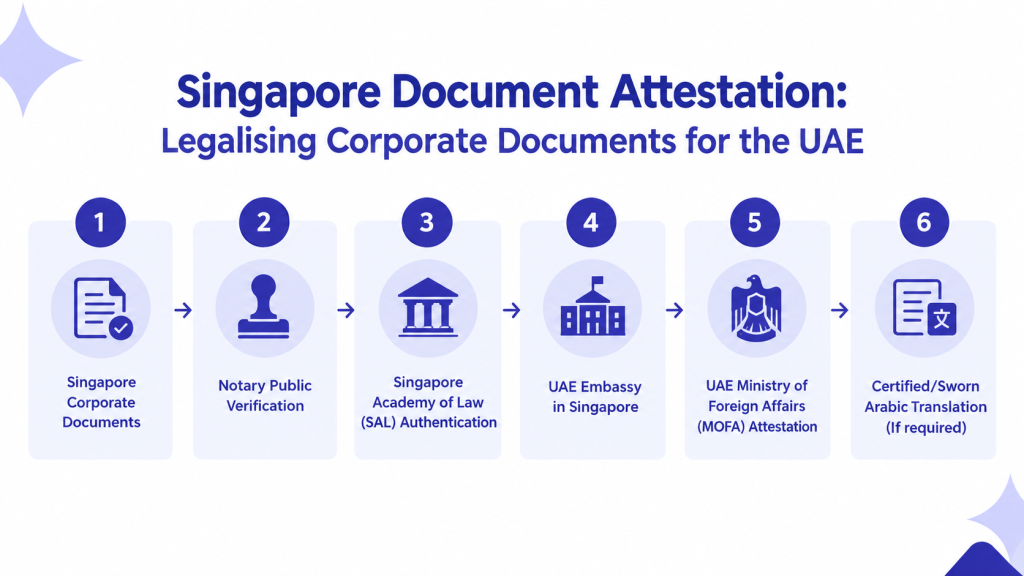
Essential Documents to Attest:
- Certificate of Incorporation (issued by ACRA)
- ACRA Business Profile (Corporate Information Extract)
- Memorandum & Articles of Association / Constitution
- Board Resolution authorizing the Dubai setup and appointing signatories
- Power of Attorney (POA) for local legal representation
Step-by-Step Roadmap: How to Secure Your Dubai CRN from Singapore
Singaporean entrepreneurs may be able to carry out the incorporation process from their side.
1. Select Business Activity & Jurisdiction: Make sure that the codes fit your needs.
Define your market of operation (Mainland or Free Zone) and code your core business activities using the codes provided by the DET or by the selected Free Zone.
2. Reserve the Trade Name: Make sure that your name complies with UAE’s naming rules.
Submit your company name proposals to the Invest in Dubai website or to the appropriate Free Zone website. Trade names should avoid certain restricted political, religious, and trademark words.
3. Obtain Initial Approvals: Make sure that you pass initial background checks.
File initial application forms and copies of the passports of the owners or directors of the company for approval.
4. Complete Corporate Documentation: Authenticate documents of the parent company in case of subsidiary incorporation.
Prepare the Memorandum of Association and Articles of Association. Notarize and authenticate documents of foreign corporate shareholders.
5. Arrange Office Space / Flexi-Desk Requirements: Confirmation of either physical or virtual office setup.
Obtain the lease agreement for your physical office setup (as per Ejari for mainland companies) or obtain an authorized flexi-desk facility for the free zone.
6. Receive Trade License & CRN: Issuance of your legal registration.
Make the necessary payments regarding your licensing fees for issuance of your official trade license and CRN.
7. Complete Post-Incorporation Requirements: Immigration, tax, and banking processes.
Obtain the Establishment Card, issue visas to your investors and employees, Corporate Tax registration at FTA, and create a corporate bank account.
Opening a UAE Corporate Bank Account: Timelines, Eligibility and Requirements
Incorporation and issuance of a CRN does not mean that one is automatically approved for a bank account in corporate status. UAE banks impose stringent KYC and AML policies.
Traditional Tier-1 Banks (e.g., Emirates NBD, Mashreq Bank, First Abu Dhabi Bank)
- Best For: Experienced companies, heavy transactions, complicated trade finance solutions.
- Requirements: Proper proof of doing business in the UAE, existence of an office in the UAE, and verification of the source of funds.
- Timelines: 4-8 weeks; sometimes an in-person meeting with a bank official in Dubai is required.
Digital Business Banking (e.g., Wio Bank)
- Best For: Startups, small & medium enterprises, digital-born businesses.
- Requirements: UAE Trade License, Emirates ID of authorized signatory, and business documents.
- Timelines: 1-2 weeks using a simple digital onboarding process.
Core Banking Documentation Checklist:
- Trade License, CRN, and Memorandum of Association (MOA)
- Certificate of Company Establishment and lease agreement (Ejari/Flexi-desk)
- Copies of passport, visa, and Emirates ID of the ultimate beneficial owner and signatories
- Bank statements for the last 6 months from Singapore/hometown
- Detailed Business Plan with supplier/client agreements, invoice formats, and projected volumes of transactions
B2B Due Diligence: How to Verify UAE Licenses and Setup Consultants Before Paying
Before making any financial commitment or signing any contract with the UAE counterparties or setup consultants, verify their credentials using the government registers.
How to Verify Live Government Records
- Mainland Entities: Search the Invest in Dubai platform (app.invest.dubai.ae) or National Economic Register (Nomu) by Trade Name or License Number.
- Free Zone Entities: Consult publicly available registers maintained by individual Free Zone regulators (such as DMCC Public Register or DIFC Public Register).
3-Point Business Verification Checklist
- Check License Status: Make sure the license is Active and not cancelled or suspended.
- Verify Approved Activities: Make sure the activity codes in the license include all the activities the company is doing.
- Confirm Tax Registration: Validate the Tax Registration Number (TRN) at FTA portal to ensure valid VAT registration.
Set up Consultant Red Flags to Avoid
- Payments into private bank accounts, rather than business accounts.
- Consultants who cannot produce their own valid UAE Trade License or credentials as consultancy companies.
- Vague and non-itemized payment terms with undefined “processing fees” paid to the government.
- Promise of guaranteed corporate bank account approval (no consultancy company can do it, as banks check it independently).
Tax Planning and Compliance: UAE Corporate Tax, ESR & the Singapore, UAE DTAA
Understanding tax structures for both Singapore and the UAE requires careful advance planning.
UAE Corporate Tax
- Standard Rate: There is a 9% rate of Corporate Tax on taxable net profits above AED 375,000 (profits of up to AED 375,000 are taxed at 0%).
- Qualifying Free Zone Persons (QFZP): Free Zone companies that satisfy certain conditions related to qualifying income, substance, and transfer pricing can continue to pay 0% Corporate Tax on their qualifying income.
Economic Substance Regulations (ESR) & Local Operations
Organizations undertaking qualifying activities (such as holding company activities, distribution, headquarters activities) must prove sufficient substance in Dubai for their income-generating activities, expenditure, and local management.
The Singapore–UAE Double Taxation Avoidance Agreement (DTAA)
A bilateral DTAA avoids the problem of double taxation of business transactions between the two countries:
- Withholding Taxes: It clearly defines the taxability of dividends, interest, and royalties paid between the two countries.
- Permanent Establishment (PE): It protects Singapore-based companies from paying unwanted taxes in the UAE, without crossing the PE thresholds.
How Arnifi Simplifies Your Dubai Expansion from Singapore
Business expansion to other countries involves legal incorporation, legalisation of documents, and banking processes. Arnifi has developed a platform for the seamless management of all these activities for Singapore-based entrepreneurs expanding to Dubai.
- End-to-End Company Formation: Easy setting up of the company in Dubai mainland and the best free zones with an efficient corporate structure.
- Document Attestation Management: Efficient management of legalisation of Singapore documents from notarization through SAL verification to the UAE Embassy & MOFA.
- Post-Incorporation Support: Support in acquiring an investor visa, Emirates ID issuance, corporate taxation, and banking services.
- Automated Expansion Tools: Use the Arni cost calculator for budgeting the cost of setting up and the Arni AML checker for B2B counterparties’ due diligence.
Ready to launch your UAE entity? Simplify your business expansion with Arnifi’s platform today.
Frequently Asked Questions
1. Is the Dubai Company Registration Number (CRN) the same as the Trade License Number?
No. CRN represents the identification of the company itself, whereas the Trade License Number represents the permissions for your company to conduct business in that field. Both numbers will appear on your business documents.
2. Can a Singapore company open a Dubai business entity without visiting the UAE?
Yes, you can conduct all of the first processes, including incorporation and name reservation, remotely. Later, you will need to visit the UAE to do Emirates ID biometrics and open a corporate bank account.
3. Do I need to register for Corporate Tax in Dubai if my profits are under AED 375,000?
Yes, all business entities should be registered for Corporate Tax with the Federal Tax Authority (FTA) annually, regardless of the income amount, as long as it is not more than AED 375,000.
4. How long does it take for a Singapore entrepreneur to secure a Dubai Trade License and CRN?
Free Zone company registration normally takes 3 to 7 business days after all documents are verified. The time taken for mainland registrations is normally 5 to 10 business days. Getting the Singapore corporate documents attested takes around 2 to 3 weeks.
References
Top Singapore Packages
Related Articles


Top Singapore Packages
Get in Touch
