
Dubai Business Formation for Singapore Entrepreneurs: Mainland vs. Free Zone (2026 Guide)

Zahira Shaik
SEO Content Writer
Zahira Shaik is an SEO Content Writer and Published Author specializing in research-based content. She excels at analyzing market trends, regulations, and industry developments… Read more

Tulika Saxena
AVP, Sales & Marketing | IIM Nagpur
Tulika Saxena specializes in business finance, sales strategy, and market positioning. Leads growth and partnerships, ensuring seamless business setup experiences and client success across… Read more


Key Fact: Singaporean businesses expanding to Dubai can leverage 100% foreign ownership in eligible Mainland sectors, zero foreign exchange controls, and a lower 9% tax rate while maintaining global trade links via the Singapore-UAE Double Taxation Avoidance Agreement.
Table of contents
- Introduction: The Singapore-Dubai “Dual-Hub” Expansion Corridor
- Mainland vs. Free Zone at a Glance: Core Structural Comparison
- 100% Foreign Ownership and Market Access: Breaking Down the Rules
- Tax Optimization: Singapore’s 17% vs. UAE’s 9%
- Profit Repatriation and Cross-Border Efficiency Under the Singapore-UAE DTAA
- Setup Costs and Real Estate Realities: Ejari Leases vs. Flexi-Desks
- Regulatory Flexibility: Operating Across Mainland and Free Zone
- The Singapore-Specific Compliance Workflow: Document Legalisation and Banking
- Economic Substance: Why Dubai Cannot Be a “Mailbox Company”
- How Arnifi Streamlines Your Singapore-to-Dubai Expansion
- Decision Framework: Which Setup Suits Your Business Model?
- Frequently Asked Questions
- Conclusion: Building a Singapore-Dubai Dual-Hub Business Structure
- References
Introduction: The Singapore-Dubai “Dual-Hub” Expansion Corridor
The economies of Singapore and Dubai are amongst the most dynamic nodes for commerce and finance in the world. For startup and SME entrepreneurs from Singapore who have secured market share in Southeast Asia, the local scope may very soon act as a limitation. Opening up a venture in Dubai would be an excellent strategy, with Singapore being your base for the East Asian and APAC regions and Dubai your gateway to the MENA and Europe regions.
Your Singapore-UAE business corridor will be made possible through trade agreements, logistics routes, and regulatory frameworks. Choosing between a Mainland and a Free Zone entity is the first decision when setting up your UAE office.
Mainland vs. Free Zone at a Glance: Core Structural Comparison
Selecting the right corporate framework determines where you can trade, how you are taxed, your initial costs, and your ability to hire staff.
Comparison Table
| Factor | UAE Mainland | UAE Free Zone |
| Foreign Ownership | Up to 100% foreign ownership (for 1,000+ commercial & industrial activities) | 100% foreign ownership guaranteed across all zones |
| UAE Market Access | Unrestricted direct trading across all 7 UAE Emirates | Restricted to designated zone; requires local distributor or branch for direct Mainland sales |
| Government Tender Eligibility | Fully eligible to bid on UAE Federal & Emirate government tenders | Ineligible for direct local government contracts |
| Corporate Tax | Standard 9% on taxable income > AED 375,000 | 0% on Qualifying Income (QFZP status); standard 9% on non-qualifying income |
| Setup Costs | Higher initial outlay (Licensing + Ejari Commercial Lease) | Flexible entry packages (Virtual desks to dedicated office space) |
| Office Requirements | Physical office space required (Minimum ~200 sq ft with Ejari registration) | Flexible (Flexi-desk, co-working, or physical offices allowed) |
| Visa Quotas | Tied directly to physical office size (approx. 1 visa per 8–10 sq meters) | Package-dependent (typically 1 to 6+ visas per package) |
| Suitable Business Models | Retail, onshore consulting, logistics, civil contracting, local distribution | Cross-border trade, tech startups, regional HQ, SaaS, IP holding |
100% Foreign Ownership and Market Access: Breaking Down the Rules
Is a Local UAE Sponsor Still Required?
Historically, to establish a UAE Mainland entity, it was mandatory for a local UAE national to have 51% shares in the company. After recent legislative amendments through the Federal Decree-Law No. 26 of 2020 and the Federal Decree-Law No. 32 of 2021, the foreign investor is able to keep 100% foreign ownership of the Mainland company for over 1,000 commercial, industrial, and trading activities. The Local Service Agent (LSA) or sponsor now has certain restrictions related to strategic sectors (oil & gas, defense, healthcare) and civil professional licenses.
Mainland vs. Free Zone Trading Rights
- Mainland Entities: These entities are registered with Dubai’s Department of Economy and Tourism (DET). These entities have the ability to invoice any enterprise or individual consumer directly throughout the entire UAE territory without any commission fees or customs duty.
- Free Zone Entities: These entities are geographically bound by the borders of their jurisdictions. To sell any item directly to the consumer located in UAE Mainland, one needs a local distributor from the Mainland, to establish a Mainland branch, or to pay 5% customs duty.
Which Structure Offers Broader UAE Market Access?
Mainland is better for business organizations that depend on their domestic B2B/B2C contracts, customer retail operations, or government tenders. Free Zones are better in cases where business entities deal with cross-border re-exports, software or SaaS, and international holding operations.
Tax Optimization: Singapore’s 17% vs. UAE’s 9%
Singapore Corporate Tax vs. UAE Corporate Tax
Singapore has a flat headline corporate tax rate of 17%. The UAE implemented a corporate taxation system with a headline rate of 9% for taxable net profits above AED 375,000 (~SGD 137,000). For taxable income below AED 375,000, there will be a 0% tax.
Understanding the 0% QFZP Corporate Tax Regime
Companies registered in the Free Zones in the UAE are entitled to apply for the status of Qualifying Free Zone Person (QFZP). QFZP can pay 0% corporate tax on the “Qualifying Income”.
Conditions for Maintaining QFZP Status
The 0% QFZP tax status shall be retained by your Free Zone company provided that you comply with the following requirements:
- Adequate Economic Substance: Establish sufficient physical presence in the Free Zone, operating expenses, and qualified personnel.
- Qualifying Income: Generate income through conducting qualifying operations or dealing with other companies in the Free Zone.
- Arm’s-Length Transfer Pricing: Comply with OECD-compliant transfer pricing documentation guidelines with respect to related parties.
- Audited Financial Statements: Prepare and retain audited annual financial accounts, verified by a registered UAE auditor.
- De Minimis Threshold: Non-qualifying income should not exceed 5% of total income or AED 5,000,000 (whichever is lower).
- Ineligibility for Small Business Relief: Choosing QFZP status renders a company ineligible for UAE Small Business Relief.
Profit Repatriation and Cross-Border Efficiency Under the Singapore-UAE DTAA
Singapore-UAE Double Taxation Avoidance Agreement
The DTAA is an agreement signed by the two nations to ensure there are no duplicate taxes on earnings across borders. This ensures there will be no tax abuse from the transfer of capital, management fees, dividends, and royalty payments from one parent company to its subsidiary.
Dividends, Interest & Royalties
- Dividends: Both Singapore and the UAE do not have any withholding taxes on dividend payments within the countries.
- Interest & Royalties: As per the Singapore-UAE DTAA provisions, withholding tax on royalties can be up to 5%, preventing excessive tax burdens on cross-border intellectual property licensing.
Repatriating UAE Profits to Singapore
No foreign exchange restrictions apply in either country. The full repatriation of the profits made by the Dubai subsidiary is possible from Dubai back to Singapore. If received in Singapore, the foreign-sourced dividends will also be exempt from taxation under Section 13(8) of the Singapore Income Tax Act if the relevant conditions are satisfied.
Setup Costs and Real Estate Realities: Ejari Leases vs. Flexi-Desks
Free Zone Setup Costs
Basic setup costs for free zones are in the range of AED 12,500 – AED 25,000 (approximately SGD 4,500 – SGD 9,100). The setup costs in premium free zones like DMCC or IFZA are custom-tailored depending on the licensing category and visas issued.
Mainland Setup Costs
Mainland setup costs are usually somewhat higher, typically starting at AED 18,500 and up to AED 35,000+ in licensing fees, as well as an active commercial lease under Ejari is required.
Office Requirements: Ejari vs. Flexible Workspace
- Mainland: Must have an office registered through Ejari, which includes a physical office, retail store, or warehouse.
- Free Zone: More flexible options such as flexi-desk, co-working office space, or virtual desk that will reduce the cost of real estate overhead.
How Office Space Affects Visa Quotas
- Mainland: Visa quota is directly proportional to real estate space (usually 1 employee visa for 8-10 sqm of physical space).
- Free Zone: Visa quota is linked to the licensing package selected by you (for instance, Flexi-Desk Standard Package can consist of 1 to 3 investor/employee visas).
Regulatory Flexibility: Operating Across Mainland and Free Zone
Executive Council Decision No. 11 of 2025
Executive Council Decision No. 11 of 2025 enabled a more efficient process in Dubai, where non-financial entities operating from Free Zones were allowed to conduct business on the Dubai mainland without liquidation of the original free zone base.
Temporary Mainland Permits & Dual Licensing
Free Zone enterprises may get a temporary permit for operations in the Mainland (up to six months) or launch a new branch in the Mainland under the DET license. In other words, using this approach is helpful to provide services to Mainland contracts, participate in events or activities within the Mainland territory without creating another business entity.
Transferring Registration Without Liquidation
Recent changes in the legal framework of corporations made it possible to transfer registration from one of the Free Zones to the Dubai Mainland via continuation procedures. That means that the corporation is able to transfer its corporate structure and all previous contracts and accounts of the corporation without liquidation.
The Singapore-Specific Compliance Workflow: Document Legalisation and Banking
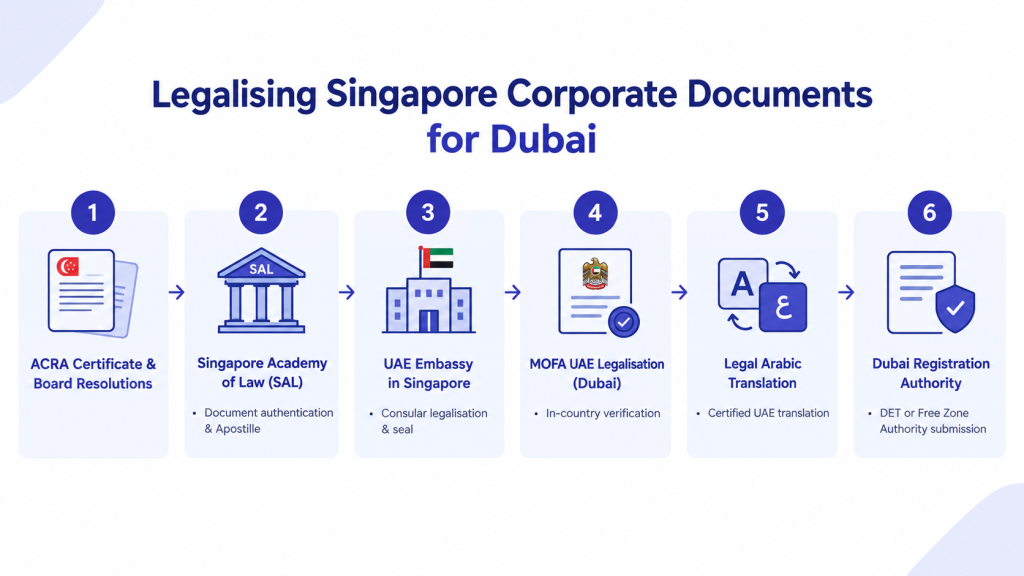
It is mandatory to legalize an entire chain of documents in order for a Dubai company to act as a subsidiary of a Singapore-based parent firm.
Legalising Singapore Corporate Documents for Dubai
Corporate Bank Account Opening: The Real Timeline
The process of opening a corporate bank account in the UAE is estimated to take between 3 and 8 weeks. The banks conduct KYC, AML, and UBO verifications on the foreign corporate entities that apply.
Traditional Banks vs. Digital-First Banking
- Traditional Tier-1 Banks (e.g., Emirates NBD, Mashreq, HSBC): They offer multi-currency accounts, trade finance services, and international treasury services; however, they have higher minimum average monthly balances (from AED 50,000 to AED 200,000+).
- Digital-First Banks (e.g., Wio Business): Provide rapid digital onboarding (approval is done within 3–7 business days), reduced initial balance requirements, and API flexibility for digital-first startups and tech platforms.
Economic Substance: Why Dubai Cannot Be a “Mailbox Company”
Understanding Economic Substance Requirements
The Economic Substance Regulations (ESR) of the UAE prohibit profit shifting. Companies engaged in certain activities (such as Headquarters, Holding Company, Distribution & Service Centre, IP, or Financing business) should have economic substance in the UAE.
Management, Employees & Local Operations
To prove substance, entities should prove:
- Core Income Generating Activities (CIGA) are performed in the UAE.
- Board meetings are conducted locally with local presence of the directors.
- Local presence of an adequate number of full-time employees.
- Operational expenditure is incurred locally.
Compliance Risks & Penalties
Non-compliance with ESR may bring fines for non-compliance (fines from AED 20,000 to AED 400,000+), information sharing with other countries’ tax authorities (e.g., IRAS of Singapore), and potentially license revocation.
How Arnifi Streamlines Your Singapore-to-Dubai Expansion
Arnifi provides a one-stop shop for startups, enterprise executives, and SME founders from Singapore setting up in the UAE.
- Business Incorporation & Licensing: Professional advice on choosing Mainland or Free Zones, activity description, and licensing clearance.
- Document Legalisation & Compliance Support: Full-service document legalization process covering SAL, the UAE Embassy in Singapore, and MOFA UAE.
- HR & Employer of Record (EOR) Support: Employ staff and obtain UAE residence visas and payroll services without a fully-fledged business set up.
- Smart Expansion Tools:
- Arni Cost Calculator: Calculate your initial incorporation, real estate, visa, and legalization costs right away.
- Arni AML Checker: Streamline background checks and compliance preparation for your company.
- Arni Organogram: Chart your multi-territory ownership for UAE banks and taxes.
Decision Framework: Which Setup Suits Your Business Model?
SaaS & Technology Startups
- Best Fit: Free Zone (e.g., DMCC, DIFC, IFZA).
- Rationale: Allows 100% foreign control, virtual desk arrangements, 0% corporate tax potential via QFZP rules, and IP holding structures.
Cross-Border E-Commerce
- Best Fit: Free Zone with Customs Bonded Warehousing (or Hybrid Structure).
- Rationale: Streamlines import/re-export logistics without triggering immediate domestic customs tariffs.
B2B Consulting & Professional Services
- Best Fit: Mainland or Free Zone + Temporary Mainland Permit.
- Rationale: Mainland entities can bill onshore corporate clients directly without legal restrictions or intermediary arrangements.
Retail & Trading Businesses
- Best Fit: Mainland (DET).
- Rationale: Essential for opening physical storefronts, managing direct distribution networks, and securing local logistics hubs.
Holding & Investment Structures
- Best Fit: Free Zone (or ADGM / DIFC Financial Hubs).
- Rationale: Protects foreign assets, structures equity investments, and facilitates international dividend flows.
Frequently Asked Questions
Do Singaporean Entrepreneurs Need to Live in Dubai to Set Up a Company?
No, you do not have to reside in Dubai for the incorporation of a company there. Nevertheless, opening a corporate bank account and getting an investor residency visa will require a short trip to Dubai for biometrics and medical tests.
Is a Local UAE Sponsor Required for a Mainland Company?
No, according to the new UAE Commercial Companies Law, more than 1,000 commercial and industrial sectors allow full foreign ownership without any local UAE sponsor.
Is Mainland or Free Zone Better for Selling Directly in the UAE?
Mainland is better for selling products directly to consumers in the UAE without any restrictions. Free Zones have certain limitations unless the business sells its products using local distributors.
How Long Does It Take to Open a UAE Corporate Bank Account?
On average, opening a UAE corporate bank account takes from 3 to 8 weeks, depending on the complexity of your ownership structure, business model clarity, and background verification checks.
Can a Singapore Company Own 100% of a Dubai Company?
Yes. It is possible for a Singapore company to be the sole shareholder of the Dubai Mainland or Free Zone company, holding 100% of its equity.
Can a Free Zone Company Later Expand Into the Dubai Mainland?
Yes. As per the Executive Council Decision No. 11 of 2025, it is possible for the free zone companies to open a branch on the Dubai mainland or obtain a temporary license from the DET.
What Documents Does a Singapore Company Need to Set Up in Dubai?
Some of the important documents that have to be submitted by a Singapore company in order to incorporate include ACRA Business Profile, Certificate of Incorporation, Memorandum and Articles of Association (Constitution), and Board Resolution allowing for UAE Expansion. All the documents need to be legalized by SAL, the UAE Embassy in Singapore, and MOFA UAE.
What Is the Dubai Business Registration Number?
The Dubai Business Registration Number, or the Commercial License Number, is the legal identification number that the DET or the relevant Free Zone Authority provides at incorporation.
How Can I Verify a Dubai Business Registration Number?
You may check registration numbers online via the official website of the Department of Economy and Tourism (DET), the UAE National Economic Register (NER), or the public register of the relevant Free Zone Authority.
Conclusion: Building a Singapore-Dubai Dual-Hub Business Structure
Expansion of operations from Singapore to Dubai gives growth-oriented businesses access to fast-growing markets in the Middle East, Africa, and Europe. Singaporean entrepreneurs will be able to set up a dual-hub business structure by choosing the optimal operational structure, combining direct Mainland access and Free Zone tax benefits. The assistance of specialists from Arnifi will make the entire process easy.
Launch Checklist
- Singapore Business Audit: Review parent company corporate structure and ownership.
- Structure Selection: Choose between Mainland (unrestricted direct trade) or Free Zone (0% QFZP tax potential).
- Document Legalisation: Complete the authentication chain: SAL → UAE Embassy Singapore → MOFA UAE.
- Dubai Incorporation: Submit incorporation documents to DET or the chosen Free Zone Authority.
- Business Registration Number: Obtain your Commercial License and official Company Registration Number.
- Corporate Banking: Complete KYC requirements to open your corporate account (Digital-First or Tier-1 Traditional).
- Office & Visa Setup: Register your Ejari commercial lease or Flexi-Desk and process UAE residency visas.
- Tax & Compliance Registration: Obtain your Tax Registration Number (TRN), fulfill Economic Substance Requirements (ESR), and align with local transfer pricing rules.
- Regional Expansion: Scale cross-border operations across the MENA region using your new dual-hub structure.
References
- Inland Revenue Authority of Singapore (IRAS): Singapore-UAE Avoidance of Double Taxation Agreement
- Ministry of Economy UAE: Federal Decree-Law No. 32 of 2021 on Commercial Companies
- Dubai Department of Economy and Tourism (DET): Mainland Business Setup & Licensing Guidelines
- UAE Federal Tax Authority (FTA): Corporate Tax & Qualifying Free Zone Person (QFZP) Guides
- Singapore Academy of Law (SAL): Document Legalisation & Apostille Services
Top Singapore Packages
Related Articles

Top Singapore Packages
Get in Touch
