
Business Licences in Cyprus | Requirements by Industry

Anushka
Content Writer
Anushka Basu is a business content writer specialised in global business market insights. She aims to simplify complex regulatory, financial, and business concepts into… Read more

Tulika Saxena
AVP, Sales & Marketing | IIM Nagpur
Tulika Saxena specializes in business finance, sales strategy, and market positioning. Leads growth and partnerships, ensuring seamless business setup experiences and client success across… Read more



Key Fact: Cyprus does not require every company to obtain the same general operating licence. Licensing depends on the activity, industry, professional qualifications and business premises.
Table of contents
- What Is a Business Licence in Cyprus?
- Does Every Company Need a Business Licence in Cyprus?
- Which Industries Require Business Licences in Cyprus?
- What Business Licence Requirements Apply to Construction and Engineering?
- What Licences Are Required for Health, Beauty and Education Businesses?
- What Licences Are Required for Tourism, Hospitality and Food Businesses?
- What Licences Apply to Professional Services and Financial Businesses?
- What Business Licences Apply to Retail, Transport and Other Industries?
- How Do You Obtain a Business Licence in Cyprus?
- What Documents Are Required for a Business Licence?
- How Do Business Premises Licences Work in Cyprus?
- What Happens If a Business Operates Without the Required Licence?
- How Can Arnifi Help With Business Licensing in Cyprus?
- FAQs
- Does every company need a business licence in Cyprus?
- Conclusion
- References
What Is a Business Licence in Cyprus?
A business licence in Cyprus authorises a company or individual to conduct a specific commercial activity, profession, or operation. Depending on the business, this may involve a professional registration, industry-specific operating permit or approval for commercial premises.
Company incorporation establishes a legal entity through the Registrar of Companies. It does not automatically authorise every activity that the company intends to conduct. Businesses operating in regulated sectors must obtain the relevant approvals from competent authorities before commencing operations.
Licensing requirements depend on several factors:
- Nature of the commercial activity
- Industry and applicable regulatory framework
- Professional qualifications and registration
- Location and suitability of business premises
- Technical, health, safety or environmental requirements
Some businesses require multiple licences covering their premises, professional activities and operational facilities.
Does Every Company Need a Business Licence in Cyprus?
Cyprus does not impose one universal operating licence on every incorporated company. The requirements depend on the business activity and whether it falls within a regulated category.
The general establishment process may involve:
- Company incorporation with the Registrar of Companies and Intellectual Property
- Income tax registration and VAT registration where applicable
- Social Insurance registration when employing workers
- Business premises licensing where required
- Industry-specific approvals for regulated activities
- Professional registration for occupations requiring authorisation
For example, a consultancy offering unregulated services may have different licensing requirements from a restaurant, pharmacy or construction contractor.
Businesses should identify their intended activities before incorporation and verify whether additional authorisations are required.
Which Industries Require Business Licences in Cyprus?
The official Business in Cyprus portal categorises operating permits by industry and profession. Its directory provides information about relevant authorities, eligibility requirements and application procedures.
| Industry | Examples of regulated activities |
| Construction and engineering | Contractors, engineering services, building permissions |
| Health and beauty | Medical services, pharmacies, beauty establishments |
| Education | Private schools, nurseries and educational institutions |
| Tourism and hospitality | Hotels, restaurants, travel agencies and tourist guides |
| Professional services | Lawyers, accountants, auditors and real estate agents |
| Transport and logistics | Road transport, taxis, driving schools and logistics services |
| Wholesale and retail | Alcohol, tobacco and food-related trading |
| Agriculture and veterinary | Veterinary services and animal-related establishments |
| Media and communications | Journalism, publications and radiocommunication services |
| Energy | Energy services and regulated installations |
The directory also covers activities such as employment agencies, childcare establishments, food supplements, swimming pools and specialist technical services.
What Business Licence Requirements Apply to Construction and Engineering?
Construction and engineering businesses may require professional registrations, contractor approvals and development permissions, depending on the services offered.
The relevant requirements can include:
- Registration of construction contractors under the applicable framework
- Professional registration for engineers, architects and other technical specialists
- Planning permission for relevant development
- Building permission for construction, alteration or change of use
- Authorisations for specific engineering or technical activities
- Requirements for temporary cross-border professional services
Planning permission is generally required before development begins. Building permission may also be necessary for construction, extension, alteration or changes to a building’s use.
Applications for building permission are handled by the relevant District Local Government Organisation through the IPPODAMOS system.
Companies providing engineering services should also verify professional registration requirements and whether their activities involve regulated technical work.
What Licences Are Required for Health, Beauty and Education Businesses?
Health, beauty and education businesses are subject to professional and establishment-specific requirements.
Health and medical businesses
Medical and healthcare activities may require:
- Registration of doctors, dentists and other regulated professionals
- Pharmacy authorisation
- Approval for healthcare establishments
- Authorisation for clinical laboratories and specialised medical activities
- Compliance with health, sanitary and premises requirements
Healthcare companies should distinguish professional registration from permission to establish or operate a healthcare facility.
Beauty and personal care
Beauty and personal care businesses may need professional or premises authorisations depending on their services.
Examples include:
- Hairdresser and barber professional requirements
- Hairdressing salon and barber shop operating requirements
- Beautician registration or authorisation where applicable
- Hygiene and premises compliance
Education and childcare
Private educational establishments and childcare facilities may require approvals from the competent education or welfare authorities.
These may include:
- Private school and educational institution approvals
- Kindergarten and nursery establishment requirements
- Childcare facility authorisations
- Qualifications for regulated teaching or childcare activities
The applicable licence depends on the institution’s purpose, age group and services offered.
What Licences Are Required for Tourism, Hospitality and Food Businesses?
Tourism and hospitality businesses often require sector-specific operating approvals alongside premises licensing.
The Deputy Ministry of Tourism is responsible for relevant tourism licensing procedures, including tourist establishments, travel agencies, tourist guides and catering or entertainment establishments.
Common requirements include:
- Registration or licensing of hotels and tourist accommodation
- Restaurant, café and catering establishment approvals
- Entertainment establishment licences
- Travel agency authorisation
- Tourist guide professional requirements
- Food-handler health requirements where applicable
- Sanitary and fire safety approvals
- Swimming pool and other tourism facility permissions
Food businesses may also need to comply with food safety legislation, hygiene requirements and product-specific rules.
Companies should identify the relevant approvals before leasing or modifying premises. A location suitable for an office may not automatically be approved for restaurant, hospitality or entertainment operations.
What Licences Apply to Professional Services and Financial Businesses?
Professional services in Cyprus may require individual registration, firm-level authorisation or regulatory approval.
| Professional activity | Relevant requirements |
| Legal services | Registration with the Cyprus Bar Association and applicable law firm requirements |
| Accounting and audit | Professional registration and authorisation through the applicable framework |
| Real estate services | Registration and licensing under the real estate agent framework |
| Employment agencies | Private employment agency authorisation |
| Financial services | Regulatory approval depending on the activity |
| Investment services | Authorisation under the applicable investment services framework |
Financial and investment activities require particular attention.
The Cyprus Securities and Exchange Commission regulates investment firms and certain investment-related activities. The Central Bank of Cyprus oversees relevant banking and payment institutions and other activities falling within its regulatory remit.
Businesses should determine whether their proposed services involve regulated financial activities before offering them to clients.
What Business Licences Apply to Retail, Transport and Other Industries?
Retail, transport and specialised commercial activities may require additional approvals depending on the products sold or services provided.
Examples include:
- Alcoholic beverage and tobacco trading
- Food supplements distribution and retail
- Veterinary products and animal-related businesses
- Road haulage and passenger transport
- Taxi driver and taxi operator requirements
- Driving schools and driving instructors
- Vehicle rental and technical inspection activities
- Energy service providers
- Telecommunications and radiocommunication services
Product-specific requirements may apply to imports, storage, distribution and retail sales. Businesses should also check whether their premises require additional sanitary, fire safety or technical approvals.
For instance, selling regulated products may involve separate permissions from those required to operate the shop itself.
How Do You Obtain a Business Licence in Cyprus?
The application process depends on the licence category and competent authority. A practical approach is to identify every required authorisation before committing to operational infrastructure.
Business licensing checklist
- Identify the exact commercial activity and services
- Search the official Business in Cyprus licensing directory
- Identify the competent licensing authority
- Confirm eligibility, professional qualifications and registration requirements
- Select suitable business premises
- Obtain planning, building or premises approvals where necessary
- Prepare application forms and supporting documents
- Submit the application and pay applicable fees
- Complete inspections or technical assessments
- Receive the required authorisation before commencing regulated operations
Some permissions must be obtained before company incorporation or before a premises can be used for the proposed activity. Others may be completed after registration.
Businesses should therefore confirm the correct sequence with the relevant authority.
What Documents Are Required for a Business Licence?
Documentation varies by industry and application type. The following checklist covers common requirements:
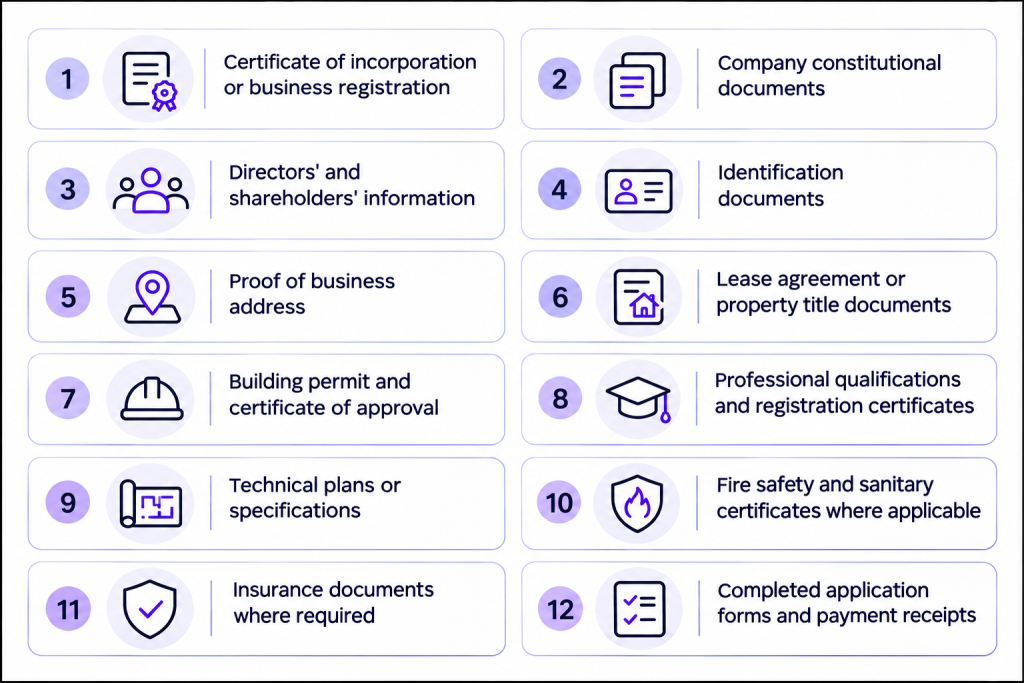
Certain applications may require additional information, including criminal record certificates, technical assessments, environmental documentation or evidence of professional experience.
Companies should use the document checklist issued by the competent authority rather than relying on a general list.
How Do Business Premises Licences Work in Cyprus?
A business premises licence is generally issued by the relevant municipal or community council for premises used to conduct commercial or professional activities.
The application may require:
- Building permission
- Certificate of approval
- Title deeds or supporting property documents
- Fire Service certificate of appropriateness
- Electrical and Mechanical Services approval
- Sanitary certificate
- Tourism or catering establishment licence where applicable
The municipality or community council may conduct an on-site inspection before approving the application. Further inspections may take place to verify compliance with licence conditions and applicable regulations.
The official Business in Cyprus portal states that an authorisation decision is generally communicated within four months after the application and supporting documents have been submitted.
Depending on the premises, the licence may be valid for six months or one year and may require renewal through the relevant application procedure.
A premises licence and an industry-specific operating licence are separate requirements. Businesses should check both before opening.
What Happens If a Business Operates Without the Required Licence?
Operating without the required authorisation can create regulatory and commercial risks.
Depending on the activity and applicable legislation, consequences may include:
- Regulatory penalties and enforcement action
- Suspension or cessation of regulated activities
- Delays in opening or expanding operations
- Problems with professional registration
- Reputational and contractual risks
- Additional costs associated with obtaining overdue approvals
Businesses may also encounter difficulties if their premises are unsuitable for the activity or if they fail to comply with licence conditions.
The consequences vary by licence category. Companies should confirm the applicable enforcement provisions rather than assume a single penalty applies across Cyprus.
How Can Arnifi Help With Business Licensing in Cyprus?
Business licensing should be considered alongside company incorporation and operational planning. Investors can identify their intended commercial activities early and assess whether additional professional, premises or industry-specific authorisations may be required.
Arnifi can support foreign investors with Cyprus company formation and administrative guidance, helping founders understand incorporation procedures and the requirements associated with establishing their business.
FAQs
Does every company need a business licence in Cyprus?
No single general operating licence applies to every company. Businesses may require premises licences, professional authorisations or industry-specific approvals depending on their activities.
How do I find the licence required for my industry?
Use the official Business in Cyprus operating permits directory to search by sector or profession and identify relevant licensing procedures.
Can I operate a business in Cyprus after incorporation?
Incorporation establishes the company, but regulated activities may require additional licences before operations begin.
Which authority issues business licences in Cyprus?
The issuing authority depends on the activity. It may include a municipal or community council, professional regulator, ministry or specialised regulatory body.
Do foreign-owned companies need additional licences?
Foreign ownership does not automatically create one universal additional operating licence. However, certain regulated activities may have specific eligibility, ownership or establishment requirements.
Is a business premises licence different from an operating licence?
Yes. A premises licence authorises business use of a location, while an operating or professional licence may authorise a particular activity.
How long does it take to obtain a business licence in Cyprus?
The timeline depends on the licence category, application completeness, inspections and authority involved. Business premises licensing has a published decision period of up to four months after submission of the required documents.
Can I apply for multiple business licences at the same time?
Some applications can proceed concurrently, while others depend on prior approvals. The sequence should be confirmed with the relevant authorities.
Do business licences need to be renewed?
Many licences have validity periods or renewal requirements. Businesses should maintain a record of expiry dates and applicable renewal procedures.
Where can I check official licensing requirements in Cyprus?
The Business in Cyprus portal provides licensing information by industry and profession. The Business Support Center also provides guidance on licensing procedures and relevant authorities.
Conclusion
Business licences in Cyprus depend on the commercial activity, industry, professional requirements and business premises. Company incorporation alone does not authorise every regulated operation.
Investors should identify the applicable licences before commencing activities, verify premises suitability and confirm professional or sector-specific requirements with the competent authorities. Reviewing licensing obligations during company setup helps businesses plan their operations, avoid unnecessary delays and maintain compliance as they expand.
References
- Operating Permits by Category – Business in Cyprus
- Business Premises Licensing – Business in Cyprus
- Business Establishment Checklist – Business in Cyprus
- Licensing Procedures – Business Support Center
- Planning Permission – Business Support Center
- Building Permission – Business Support Center
- Business Facilitation Unit – Gov.cy
Top UAE Packages
Related Articles

Top UAE Packages
Planning Your Next Business Move?
