
Redomiciling to Cyprus Companies | The Complete 2026 Tax and Compliance Guide

Zahira Shaik
SEO Content Writer
Zahira Shaik is an SEO Content Writer and Published Author specializing in research-based content. She excels at analyzing market trends, regulations, and industry developments… Read more

Tulika Saxena
AVP, Sales & Marketing | IIM Nagpur
Tulika Saxena specializes in business finance, sales strategy, and market positioning. Leads growth and partnerships, ensuring seamless business setup experiences and client success across… Read more



Key Fact: The Republic of Cyprus permits foreign companies to move their seat of incorporation without undergoing liquidation, keeping all the operational history, existing contracts, and properties, according to Cap. 113.
Table of contents
- Why Are Companies Redomiciling to Cyprus in 2026?
- Legal Framework and Eligibility Requirements
- Step-by-Step Process for Redomiciling to Cyprus
- Cyprus Tax Advantages and the 2026 Tax Reforms
- Establishing Economic Substance and Corporate Banking
- Post-Redomiciliation Compliance and Governance
- Executive Relocation, Visas, and Personal Tax Planning
- How Arnifi Simplifies Company Setup and Compliance in Cyprus
- Conclusion: Your Cyprus Redomiciliation Roadmap
- FAQs
- References
Why Are Companies Redomiciling to Cyprus in 2026?
Cyprus companies’ redomiciliation is the process by which the registered seat of a company is moved to Cyprus without affecting its legal personality, contracts, and operations. International businesses increasingly favor this migration pathway to gain full EU market access.
International bodies have made it impossible to hide any business activity because they implement strict regulations regarding transparency. Now international businesses seek onshore jurisdictions that provide economic substance, reputability, and access to reliable banks. The Republic of Cyprus is known as a transparent, OECD-compliant country for active companies.
Redomiciliation vs. Re-Incorporation
Re-incorporation implies the need to liquidate the company and thus entails some taxes and disruption of commercial contracts. On the contrary, re-domiciliation involves changing the governing jurisdiction without liquidation.
Legal Framework and Eligibility Requirements
The Cyprus legal framework provides detailed statutory procedures for relocation of foreign entities’ registered corporate domicile.
Cyprus Companies Law, Cap. 113
Articles 354A through 354I of the Cyprus Companies Law, Cap. 113, deal with the subject of foreign company continuation under the English common law system.
Key Eligibility Requirements
Executing redomiciliation to Cyprus companies requires meeting strict statutory criteria:
- Originating laws must explicitly permit foreign corporate continuation.
AGP Law - Constitutional documents must contain explicit authority for cross-border migration.
- Directors must present official certificates showing solvency and corporate good standing.
- Shareholders must convert all bearer shares into registered shares.
- The Cyprus Registrar of Companies must approve the entity name, ending in “Limited” or “Ltd”.
Step-by-Step Process for Redomiciling to Cyprus
Corporate continuation takes place through well-regulated steps by the Registrar.
Phase 1: Name Approval, Application, and Documentation
The name is reserved, and Form ME1, together with Form ME3, is completed. The directors file a certified board resolution, amended articles, solvency affidavit, and other documents.
Phase 2: Obtaining the Temporary Certificate of Continuation
The Registrar evaluates the submitted documentation. Once approved, the Department issues a Temporary Certificate of Continuation enabling the setting up of the entity locally.
Phase 3: Foreign Deregistration and Final Continuation
The company gets six months to prove deregistration from the original registry. The Registrar finally issues a Final Certificate of Continuation.
Special Pathway: EU Cross-Border Conversions
EU entities rely on Directive (EU) 2019/2121, enacted as Sections 201HA-201HK. This route entails draft terms of conversion, management report, public announcement, and verification of the pre-conversion certificate.
Cyprus Tax Advantages and the 2026 Tax Reforms
The tax system of Cyprus was modernized to ensure conformity to international standards but also to maintain key corporate benefits.
15% Corporate Tax Rate and Tax Residency
Starting January 1, 2026, Cyprus changed the effective corporate tax rate to 15%, in line with OECD Pillar Two requirements. Formation makes an entity tax resident automatically if management works locally.
Fair-Value Asset Valuation on Arrival
The tax base of assets coming into Cyprus is fair value. It protects built-in gains that arose outside Cyprus from Cyprus’s corporate tax regime.
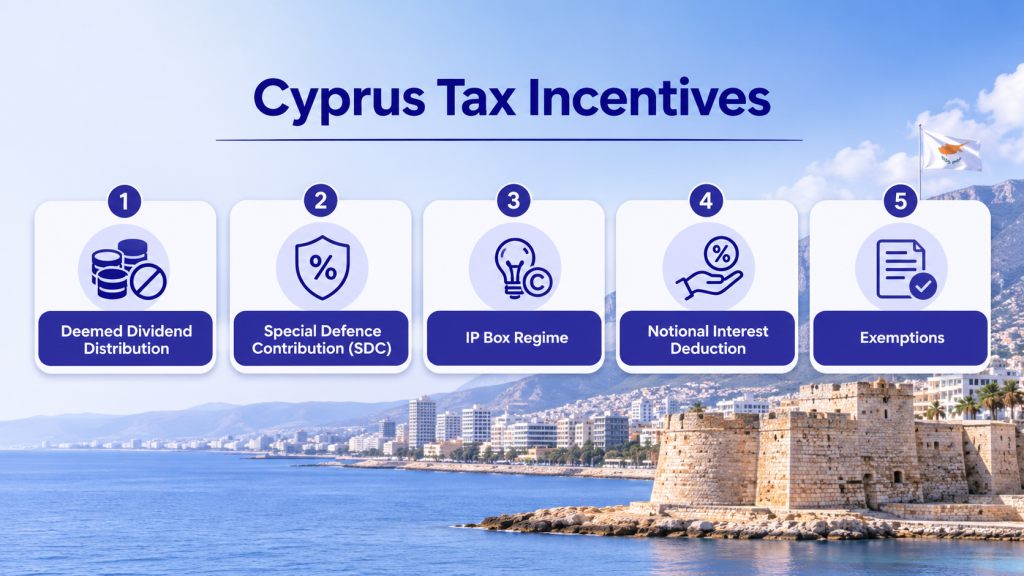
Key Tax Incentives for Redomiciled Companies
Cyprus offers attractive tax mechanisms for active businesses:
Establishing Economic Substance and Corporate Banking
Tax authorities insist on physical presence to establish the legitimacy of business operations in the area.
Demonstrating Real Management and Control
The implementation of the redomiciliation process requires that entities have a proper management structure. Resident majorities should take critical decisions physically present during their meetings. Entities have to have an office, local employees and business operations.
Corporate Banking and Financial Continuity
Entities should have multi-currency commercial bank accounts at licensed Cypriot banks or at modern payment services. Adequate preparation will avoid any interruption in the transactions during the period of the registration process.
Post-Redomiciliation Compliance and Governance
Continued compliance will ensure corporate status and up-to-date governance of the entities.
Statutory Audit vs. Limited Assurance Review
Entities above statutory limits have to submit audited financial statements prepared by the authorized auditors. Small entities can use ISRE 2400 limited assurance reviews to prove financial correctness.
Annual Returns, Tax Returns, and Filing Deadlines
Entities submit annual return form HE32 along with audited financial statements to the Registrar. Taxpayers submit corporate tax return form TD4 to the Cyprus Tax Department.
Executive Relocation, Visas, and Personal Tax Planning
Transferring the corporate structure provides obvious residential opportunities for senior personnel.
Business Facilitation Unit (BFU) and Work Permits
The Business Facilitation Unit offers a fast-tracked process for obtaining residency permits for foreign executives. Tech businesses and foreign-interest companies will get a fast-track work permit for skilled workers.
Cyprus Non-Domicile Tax Status
Expatriate directors who take local tax residence benefit from the Cyprus Non-Domicile scheme. Qualified persons get 17 years of exemption from SDC payments on dividends and interest received internationally.
How Arnifi Simplifies Company Setup and Compliance in Cyprus
Arnifi provides comprehensive corporate administration services for smooth international corporate migration.
Corporate Setup, Document Attestation, and Visa Assistance
Our team handles all initial submissions, performs legal translation, attests documents, and deals with visas for company executives.
Accounting, Compliance, and Arnifi HR (EOR)
Arnifi is responsible for your continuous accounting, compliance, and taxes. It allows you to hire local specialists without any legal hassles.
Smart Digital Tools for Business Setup
Manage international setup effortlessly using Arnifi’s digital solutions:
- Arni Cost Calculator: Estimate initial registration, legal, and operational expenses upfront.
- Arni AML Checker: Complete mandatory compliance screening and verification instantly.
- Arnifi Docs: Store, manage, and sign corporate filings securely within one unified dashboard.
Conclusion: Your Cyprus Redomiciliation Roadmap
Cyprus Company Redomiciliation enables foreign companies to benefit from EU financial markets, yet ensure business continuity in the future. Corporate heads create a solid foundation for international growth through adherence to legal requirements in Cap. 113, possession of true local substance, and new tax reform changes.
FAQs
- What does redomiciling a company to Cyprus mean?
It is the transfer of the registered office of a company to Cyprus without affecting its identity, agreements, and assets. - Which companies are eligible for redomiciliation to Cyprus?
Those that have the capacity to move abroad under the law of their country of origin and under their articles of incorporation. - How long does the Cyprus redomiciliation process take?
Provisional registration takes three to four months, and the entire foreign deregistration may take six months. - Can a company retain its existing contracts and bank accounts?
Certainly, the corporation continues its legal status and thus retains all of its agreements and accounts. - What is the difference between EU and non-EU redomiciliation?
EU entities utilize simplified cross-border conversion directives, while non-EU entities follow standard Cap. 113 regulations. - What is the corporate tax rate in Cyprus in 2026?
The corporate tax rate is 15% on a flat basis in Cyprus in 2026 according to international standards. - Does a redomiciled company need to establish economic substance in Cyprus?
Yes, the company needs to prove that it has effective local management, offices, and makes decisions. - What happens if the company fails to complete foreign deregistration within six months?
The Registrar can revoke the temporary continuation of the company or extend this period.
References
Top UAE Packages
Related Articles



Top UAE Packages
Planning Your Next Business Move?
