
Cyprus Company Compliance | Annual Returns, Audits and Filing Obligations

Anushka
Content Writer
Anushka Basu is a business content writer specialised in global business market insights. She aims to simplify complex regulatory, financial, and business concepts into… Read more

Tulika Saxena
AVP, Sales & Marketing | IIM Nagpur
Tulika Saxena specializes in business finance, sales strategy, and market positioning. Leads growth and partnerships, ensuring seamless business setup experiences and client success across… Read more


Key Fact: Cyprus companies must maintain statutory records, prepare annual financial statements and fulfil annual filing obligations with the Registrar of Companies and the Tax Department. The applicable audit or review requirements depend on the company’s circumstances and current legislation.
Table of contents
- What Are the Annual Compliance Requirements for a Cyprus Company?
- What Is the Cyprus Company Annual Return (HE32)?
- When Must a Cyprus Company File Its Annual Return?
- What Financial Statements Must a Cyprus Company Prepare?
- Are Audits Mandatory for Cyprus Companies?
- How Do Cyprus Companies File Financial Statements With the Registrar?
- What Corporate Tax Filings Must a Cyprus Company Complete?
- What VAT and Other Tax Filing Obligations Apply?
- What UBO and Statutory Register Obligations Must Cyprus Companies Maintain?
- What Other Annual and Ongoing Obligations Should Companies Remember?
- What Happens If a Cyprus Company Misses Its Filing Deadlines?
- How Can Arnifi Help With Cyprus Company Compliance?
- FAQs
- Conclusion
- References
What Are the Annual Compliance Requirements for a Cyprus Company?
Cyprus company annual compliance covers the statutory, accounting and tax obligations that businesses must fulfil after incorporation. Companies must maintain accurate records, prepare annual financial statements, submit annual returns and complete applicable tax filings. They must also keep beneficial ownership information and corporate particulars up to date.
These obligations continue even when a company has limited commercial activity or remains dormant. The applicable requirements depend on the company’s legal structure, financial position, tax registrations and business activities.
The main annual obligations include:
- Filing the annual return with the Registrar of Companies
- Preparing financial statements under applicable reporting standards
- Completing an audit or statutory review, where applicable
- Submitting corporate income tax returns
- Filing VAT and VIES returns where required
- Maintaining the beneficial ownership register
- Keeping statutory registers and accounting records accurate
What Is the Cyprus Company Annual Return (HE32)?
The Cyprus company annual return, known as Form HE32, records a company’s statutory particulars as at its return date. It enables the Registrar of Companies to maintain an accurate record of the company’s structure and official information.
The annual return generally reflects:
- Registered office address
- Directors and company secretary
- Shareholders and share capital
- Company particulars and relevant statutory information
Companies should ensure that changes to their registered office, directors, shareholders or share capital are notified to the Registrar using the relevant forms before submitting the annual return.
For private companies with share capital, the annual return is filed electronically through the Registrar’s e-filing system. Public companies and companies without share capital follow different submission arrangements.
When Must a Cyprus Company File Its Annual Return?
Cyprus companies must prepare their annual return according to their statutory return date and submit it within 28 days of its drafting date.
For a newly incorporated company, the first annual return date is generally determined by reference to the period of 18 months following incorporation. Subsequent annual returns are prepared annually, based on the company’s established return date.
The annual return must be submitted with the financial statements relating to the previous financial year. These statements must be approved and presented to the shareholders as required.
Companies should use the Registrar’s Annual Return Date Calculator to determine their applicable dates.
An extension to the annual return date may be available through the Registrar’s procedures, subject to the applicable conditions. Companies should arrange extensions before their existing return date expires.
What Financial Statements Must a Cyprus Company Prepare?
Cyprus companies must maintain proper accounting records and prepare annual financial statements in accordance with applicable reporting requirements.
The directors are responsible for ensuring that the financial statements present a true and fair view of the company’s affairs. The statements must be supported by accounting records that accurately explain transactions and allow the company’s financial position to be assessed.
A complete set of financial statements generally includes:
| Financial statement | What it presents |
| Statement of financial position | Assets, liabilities and equity |
| Statement of profit or loss | Income, expenses and financial performance |
| Statement of cash flows | Cash movements during the reporting period |
| Statement of changes in equity | Movements in shareholders’ equity |
| Notes to financial statements | Accounting policies and supporting disclosures |
Companies must apply the relevant International Financial Reporting Standards as adopted by the European Union, subject to applicable reporting provisions and any available simplified framework.
Parent companies may also need to prepare consolidated financial statements covering their subsidiaries, unless an exemption applies.
Are Audits Mandatory for Cyprus Companies?
Statutory audits are generally required for Cyprus companies under Companies Law, Cap. 113. The audit is performed by an independent auditor authorised to practise in Cyprus and assures the company’s financial statements.
However, qualifying small private companies may be eligible for a statutory review engagement instead of a full audit, subject to the applicable legal criteria.
From financial years beginning on or after 6 February 2026, the statutory review thresholds include:
- Annual net turnover of €300,000
- Total gross assets of €500,000
Eligibility depends on meeting the relevant criteria, including the applicable conditions across consecutive financial years. Companies should confirm their qualification with an authorised auditor before relying on a review exemption.
A statutory review provides limited assurance and differs from a full audit. Companies must also consider tax reporting requirements and whether their financial statements meet the requirements applicable to their circumstances.
How Do Cyprus Companies File Financial Statements With the Registrar?
Financial statements accompany the annual return and must be prepared, approved and certified in accordance with the applicable requirements.
For private companies with share capital, the annual return and accompanying financial statements are submitted through the Registrar’s e-filing system. The documents must be certified by a director and the company secretary, where applicable, and accompanied by the required filing fee.
Public companies and companies without share capital follow separate submission arrangements.
Before filing, companies should check that:
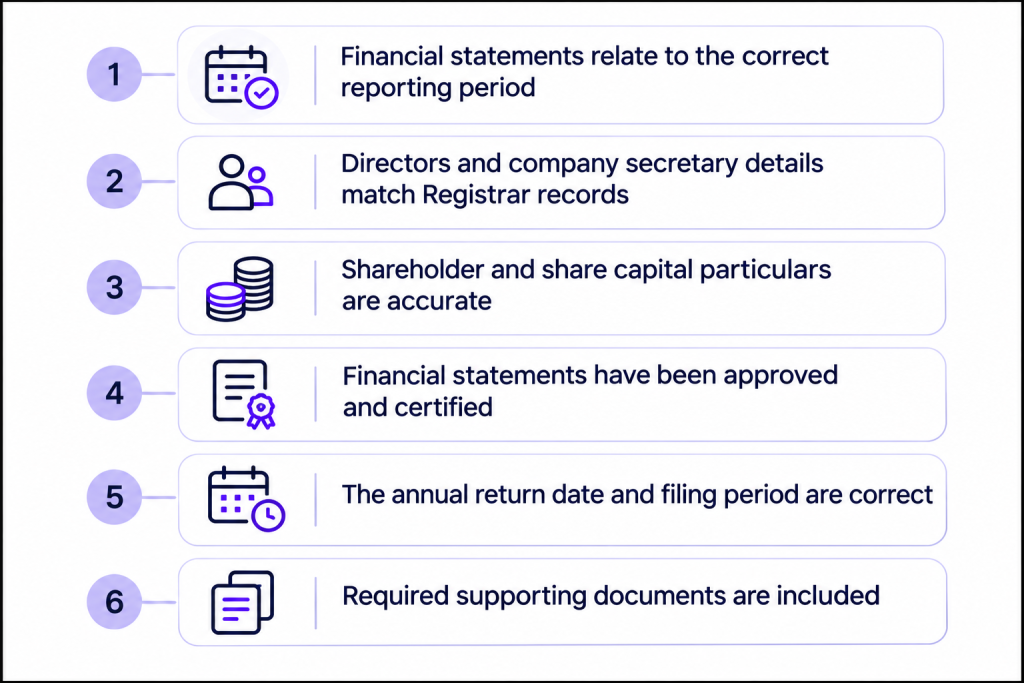
Inconsistent information or missing documents can result in rejection and additional administrative work.
What Corporate Tax Filings Must a Cyprus Company Complete?
Cyprus companies must submit an annual corporate income tax return to the Tax Department using Form TD4.
The return is prepared using the company’s financial information and tax computation. Accounting profit and taxable income may differ because tax legislation determines which income, expenses and adjustments are recognised for tax purposes.
Companies must also manage provisional tax payments during the relevant tax year.
For tax years up to 2025, the general TD4 filing deadline was 31 March of the second year following the tax year, subject to extensions and transitional arrangements.
Under the Cyprus tax reform applicable from 2026, the filing deadline changes to 31 January of the second year following the tax year. The relevant deadline should be checked against current Tax Department guidance.
What VAT and Other Tax Filing Obligations Apply?
VAT obligations depend on the company’s activities, taxable turnover and registration status.
Companies registered for VAT must submit periodic VAT returns and settle applicable VAT within the prescribed deadlines. The filing frequency depends on the company’s registration and applicable Tax Department requirements.
Businesses involved in qualifying intra-community transactions may also need to submit VIES declarations.
Additional obligations may include:
- VAT registration and deregistration notifications
- VAT return submissions
- VIES reporting for qualifying transactions
- Tax declarations relating to specific activities or transactions
- Supporting documentation requested by the Tax Department
Companies should maintain accurate transaction records and reconcile VAT reporting with their accounting systems.
What UBO and Statutory Register Obligations Must Cyprus Companies Maintain?
Cyprus companies must identify their ultimate beneficial owners and maintain accurate beneficial ownership information in accordance with applicable anti-money laundering legislation.
Changes in ownership or control must be reflected in the company’s records and reported through the relevant UBO registration procedures within the prescribed period.
Companies should also maintain statutory registers, including:
- Register of shareholders
- Register of directors
- Register of company secretaries
- Register of charges, where applicable
The information held internally should remain consistent with the records maintained by the Registrar and the beneficial ownership system.
What Other Annual and Ongoing Obligations Should Companies Remember?
Annual compliance also includes corporate governance responsibilities and notifications relating to changes in company particulars.
Companies should:
- Hold an Annual General Meeting as required
- Present and approve financial statements
- Notify the Registrar of changes to directors and company secretary
- Update registered office and shareholder particulars
- Report changes in share capital
- Maintain accounting books and supporting documentation
- Keep statutory registers accurate and accessible
The former €350 annual company levy was abolished from 2024 onwards. However, annual fees relating to 2011–2023 remain payable where outstanding.
Companies should verify current Registrar fees and procedures rather than relying on older compliance calendars.
What Happens If a Cyprus Company Misses Its Filing Deadlines?
Late annual return filing can result in additional fees and administrative consequences.
For annual returns with reference dates from 2021 onwards, the late filing penalty is capped at €150. An additional €20 overdue filing fee applies, bringing the applicable Registrar charges to €170 before any other fees.
An additional €20 fee applies to overdue annual return submissions.
Failure to file annual returns and financial statements may also affect the company’s status with the Registrar. Continued non-compliance can lead to involuntary strike-off proceedings and eventual dissolution.
Companies may encounter difficulties obtaining certificates or completing other registry procedures while filings remain outstanding.
A compliance calendar covering annual returns, financial statements, tax returns, VAT periods and statutory updates helps reduce these risks.
How Can Arnifi Help With Cyprus Company Compliance?
Cyprus company compliance requires coordination between corporate administration, accounting and tax reporting. Businesses should consider their annual compliance requirements while planning their company structure and operations. This includes identifying the professionals responsible for accounting, financial reporting, audit and tax submissions.
Arnifi can support businesses with Cyprus company formation and administrative guidance, helping investors understand incorporation procedures and the statutory obligations that follow.
FAQs
Does every Cyprus company need to file an annual return?
Yes. Cyprus companies are generally required to prepare and submit annual returns with the Registrar, accompanied by the relevant financial statements.
When must a Cyprus company file its HE32 annual return?
The annual return must generally be filed within 28 days of its drafting date, based on the company’s statutory return date.
Are audits mandatory for all Cyprus companies?
Statutory audits are generally required. Qualifying small private companies may use a statutory review engagement if they meet the applicable legal criteria.
Can a small Cyprus company submit reviewed financial statements?
Yes. Eligible companies may use a statutory review engagement instead of a full audit, subject to the applicable thresholds and conditions.
Does a Cyprus company need to file a corporate tax return if it has no income?
Companies should assess their annual tax filing obligations independently of whether they generated income. A lack of revenue does not automatically remove corporate tax reporting responsibilities.
Is the €350 annual company levy still payable?
No. The annual company levy was abolished from 2024 onwards. Outstanding levies relating to earlier years may remain payable.
What happens if a Cyprus company files its annual return late?
Late filing charges apply, and prolonged non-compliance may result in administrative difficulties or involuntary strike-off proceedings.
Must a Cyprus company update its UBO register every year?
Companies must maintain accurate beneficial ownership information and report changes within the applicable deadlines. An annual review is a useful compliance practice even where no ownership changes have occurred.
Conclusion
Cyprus company annual compliance involves annual returns, financial statements, audit or review requirements, tax submissions and statutory record maintenance. Each obligation operates under its own deadline and conditions.
Businesses should maintain accurate corporate records, review their filing calendar regularly and coordinate accounting and tax responsibilities with qualified professionals. Keeping compliance organised throughout the year helps companies avoid unnecessary filing delays and maintain their legal standing in Cyprus.
References
- Filing Annual Returns and Financial Statements – Cyprus Registrar
- When Do I Need to File an Annual Return? – Cyprus Registrar
- Forms for Filing Annual Return – Cyprus Registrar
- Abolition of the Annual Company Fee – Cyprus Registrar
- Company Income Tax Return TD4 – Cyprus Tax Department
- Changes to Statutory Review Thresholds – ICPAC
Top UAE Packages
Related Articles


Top UAE Packages
Planning Your Next Business Move?
