
Types of Companies in Cyprus | Which Business Structure Should You Choose?

Anushka
Content Writer
Anushka Basu is a business content writer specialised in global business market insights. She aims to simplify complex regulatory, financial, and business concepts into… Read more

Tulika Saxena
AVP, Sales & Marketing | IIM Nagpur
Tulika Saxena specializes in business finance, sales strategy, and market positioning. Leads growth and partnerships, ensuring seamless business setup experiences and client success across… Read more


Key Fact: Cyprus recognises five main company types under its company framework, including private limited companies, public limited companies, companies limited by guarantee and variable capital investment companies. Businesses can also operate through partnerships or branches of foreign companies. The right structure depends on ownership, liability, business activities and long-term plans.
Table of contents
- What Are the Different Types of Companies in Cyprus?
- What Is a Private Limited Company in Cyprus?
- What Is a Public Limited Company in Cyprus?
- What Is a Company Limited by Guarantee in Cyprus?
- What Is a Variable Capital Investment Company?
- Can You Set Up a Partnership in Cyprus?
- Can a Foreign Company Open a Branch in Cyprus?
- What Is the Difference Between the Main Business Structures in Cyprus?
- Which Company Structure Is Best for Your Business in Cyprus?
- What Should You Consider Before Choosing a Company Type?
- How Do You Register Your Chosen Business Structure in Cyprus?
- How Can Arnifi Help With Company Formation in Cyprus?
- FAQs
- Conclusion
What Are the Different Types of Companies in Cyprus?
The Cyprus Registrar of Companies and Intellectual Property recognises five company types under its company framework. Each serves a different purpose, depending on the organisation’s activities and objectives. Partnerships and branches of overseas companies are also available to businesses planning to operate in Cyprus.
The main options include:
- Private limited liability company by shares
- Public limited liability company by shares
- Limited liability company by guarantee without share capital
- Limited liability company by guarantee with share capital
- Variable capital investment company
A business can also register as a general or limited partnership, depending on its ownership and management arrangements. An existing overseas company may establish a branch in Cyprus instead of incorporating a separate local company.
Each structure has different legal and administrative requirements. Understanding these differences helps you choose an option that fits your business plans.
What Is a Private Limited Company in Cyprus?
A private limited liability company by shares is the most common company type in Cyprus. It has its own legal identity, separate from its shareholders, and its share capital is divided into shares. A shareholder’s liability is generally limited to any unpaid amount on the shares they hold.
A private company must have at least one shareholder and cannot have more than 50 shareholders, subject to the applicable statutory rules. It cannot offer its shares for subscription to the public.
This structure is commonly considered by:
- Small and medium-sized businesses
- Entrepreneurs establishing a new company
- International investors setting up a local business
- Businesses planning to retain profits and reinvest in operations
The company operates through its appointed directors, who are responsible for its management and statutory obligations. Shareholders own the company through their shares, while directors handle its affairs in accordance with the law and the company’s constitutional documents.
For many businesses, a private limited company offers a practical ownership structure with limited liability.
What Is a Public Limited Company in Cyprus?
A public limited liability company by shares is designed for businesses that may need to raise capital from a wider group of investors.
Like a private company, it has share capital and provides limited liability to shareholders, subject to the applicable law. However, a public company may invite the public to subscribe for its shares and may seek a stock exchange listing if it meets the relevant requirements. It must have at least seven members.
Businesses may consider this structure when they:
- Plan to raise capital from public investors
- Expect a larger shareholder base
- Need a structure suited to substantial expansion
- Intend to explore a public offering or stock exchange listing
A public company has additional requirements relating to its capital, reporting and governance. It is therefore important to assess whether the business genuinely needs this structure before proceeding with incorporation.
What Is a Company Limited by Guarantee in Cyprus?
A company limited by guarantee is generally suited to organisations whose purpose does not centre on distributing profits to shareholders. Cyprus recognises two forms: a company limited by guarantee without share capital and a company limited by guarantee with share capital.
In a company without share capital, members agree to contribute a specified amount towards the company’s assets if it is wound up. Their liability is limited according to the guarantee they have undertaken.
A company limited by guarantee with share capital combines a shareholding structure with the members’ guarantee obligations. Its precise arrangements depend on its constitution and applicable legal requirements.
These structures may be suitable for certain membership-based organisations, associations and other bodies with specific objectives. The appropriate form depends on the organisation’s purpose, funding arrangements and intended governance.
A company limited by guarantee should not automatically be treated as a registered charity or assume that all its income is exempt from tax. Those matters depend on separate legal and tax requirements.
What Is a Variable Capital Investment Company?
A variable capital investment company (VCIC) is a specialised company structure used for collective investment activities. It is a limited liability company by shares, but its shares have a variable value rather than a fixed nominal value.
A VCIC must obtain the relevant licence from the Cyprus Securities and Exchange Commission to operate as a collective investment fund. Its structure may be private or public, depending on the type of fund involved.
This option may be relevant to businesses establishing investment funds or managing collective investment arrangements.
The applicable capital requirements depend on the fund category and whether it is internally or externally managed. For example, the requirements for an undertaking for collective investment in transferable securities can differ from those for an alternative investment fund.
Because this is a specialised structure, businesses should obtain advice on the applicable regulatory framework before beginning the registration process.
Can You Set Up a Partnership in Cyprus?
Yes. Cyprus allows businesses to establish general and limited partnerships. The main difference concerns how partners participate in the business and their responsibility for its debts. The Registrar provides a separate registration process for partnerships.
General Partnership
In a general partnership, partners conduct business together and may share responsibility for its management and obligations. Partners can face personal liability for the partnership’s debts, depending on the applicable law.
This structure may suit businesses where two or more people want to work together and share responsibility for running the business.
Limited Partnership
A limited partnership has at least one general partner and one or more limited partners.
- General partners manage the business and may have unlimited liability for its obligations
- Limited partners’ liability is generally limited to their agreed contribution, subject to the applicable rules
A partnership agreement can help establish the partners’ responsibilities, contributions and profit-sharing arrangements.
Partnerships may suit professional businesses, joint ventures and other operations owned by multiple partners. Before choosing this structure, consider how much control each partner will have and the level of personal liability involved.
Can a Foreign Company Open a Branch in Cyprus?
An overseas company can establish a place of business in Cyprus by registering a branch with the relevant authority. A branch allows an existing company to conduct business locally without creating a separate subsidiary.
The main distinction is legal identity. A branch is part of its foreign parent company rather than a separate legal entity. The parent company therefore remains responsible for the branch’s obligations, subject to the applicable law.
A branch may suit a business that already operates internationally and wants to establish a presence in Cyprus while retaining its existing corporate structure.
Before registering, the company should review the required filings, local representation arrangements and ongoing reporting obligations. It should also assess whether a branch or a separately incorporated Cyprus company better suits its commercial and legal needs.
What Is the Difference Between the Main Business Structures in Cyprus?
The following table summarises the key differences between the main options.
| Business structure | Ownership | Liability | Typical use |
| Private limited company | Shareholders, with a maximum of 50 under the applicable rules | Generally limited to unpaid amounts on shares | Small and medium-sized businesses, startups and international businesses |
| Public limited company | Shareholders, with at least seven members | Generally limited to unpaid amounts on shares | Businesses considering public investment or a stock exchange listing |
| Company limited by guarantee | Members who undertake guarantee obligations, with or without share capital | Generally limited to the guaranteed amount, subject to the company’s form | Suitable membership-based organisations and other bodies with specific objectives |
| Partnership | Two or more partners | Depends on whether it is a general or limited partnership and each partner’s role | Businesses operated by partners |
| Branch of a foreign company | The overseas parent company | The parent company remains responsible for the branch’s obligations | Existing overseas businesses expanding into Cyprus |
The table provides a general comparison. The precise obligations depend on the chosen structure and the laws applicable to the business.
Which Company Structure Is Best for Your Business in Cyprus?
The right structure depends on what you want to achieve and how you intend to operate.
- A private limited company is a common choice for businesses that want a separate legal entity and limited liability for shareholders. It can suit entrepreneurs, growing businesses and international investors.
- A public limited company may be appropriate if the business plans to raise funds from public investors and can meet the additional requirements.
- A company limited by guarantee may suit an organisation that needs a membership-based structure. A partnership can work for businesses whose owners want to operate together, provided they understand the liability arrangements.
- A branch may be suitable for an established overseas company that wants to enter the Cyprus market without incorporating a separate local subsidiary.
Before deciding, consider the business’s ownership, activities, funding needs and plans. The simplest structure at the outset may not remain suitable as the business grows.
What Should You Consider Before Choosing a Company Type?
Review the following factors before making your decision:
- Ownership: Decide how many owners will be involved and whether they will be individuals, companies or other entities
- Liability: Assess the level of personal financial responsibility each owner may face
- Business activity: Check whether your industry requires a particular structure, licence or regulatory approval
- Administration: Consider the accounting, reporting and governance obligations associated with each option
- Investment plans: Think about whether the business may need outside investors or public funding
- Expansion: Consider whether the structure will support your plans to operate in other markets
It is also worth assessing the business’s tax position and ongoing compliance requirements before registration. Professional advice can help clarify the legal and financial implications of each option.
How Do You Register Your Chosen Business Structure in Cyprus?
Once you have selected a suitable structure, the next step is to complete the relevant registration process.
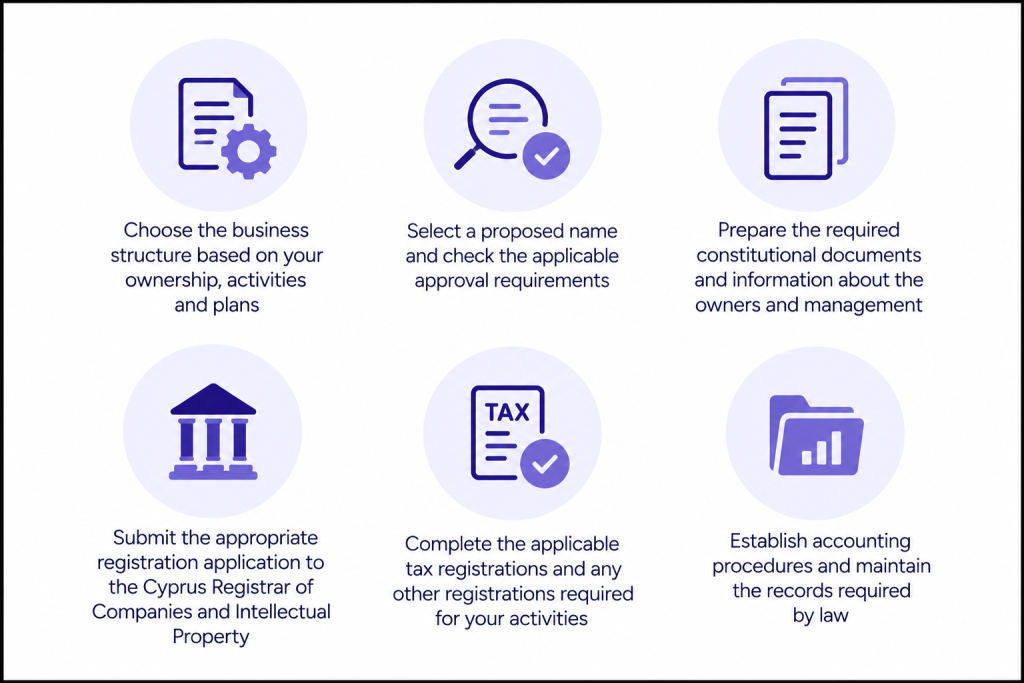
The process differs between companies, partnerships and branches. For example, a company requires incorporation documents, while a partnership or foreign branch follows its own registration procedure.
How Can Arnifi Help With Company Formation in Cyprus?
Choosing a business structure involves understanding the registration process, preparing the right documentation and identifying the obligations that apply after incorporation.
Arnifi helps businesses understand their company formation requirements and plan the administrative steps involved in establishing a business. Discuss your Cyprus company formation requirements and understand the support available for your planned business setup with Arnifi.
FAQs
What is the most common type of company in Cyprus?
The private limited liability company by shares is the most common company type in Cyprus. It offers a separate legal identity and generally limits shareholders’ liability to any unpaid amount on their shares.
Can a foreigner own a private limited company in Cyprus?
Foreign nationals can generally own shares in a Cyprus private limited company, subject to applicable legal and regulatory requirements. The proposed business activity may also require additional approvals.
What is the difference between a private and public company?
A private company cannot offer its shares for subscription to the public and can have up to 50 shareholders under the applicable rules. A public company may invite the public to subscribe for its shares and must have at least seven members.
Is a partnership a separate legal entity?
The legal position depends on the applicable rules governing the partnership. Businesses should review the relevant Cyprus partnership provisions before assuming that a partnership has the same legal status as an incorporated company.
Can an overseas company operate through a Cyprus branch?
Yes. An overseas company can register a branch in Cyprus. The branch forms part of the foreign parent company rather than becoming a separate legal entity.
How do you choose the right business structure in Cyprus?
Compare the available structures based on ownership, liability, business activities, administrative requirements and expansion plans. Seek professional advice if your business has complex ownership arrangements or operates in a regulated sector.
Conclusion
Cyprus offers several business structures, from private and public limited companies to partnerships, guarantee companies and branches of foreign businesses. Each option serves a different purpose and carries its own legal responsibilities. Before registering, assess your ownership arrangements, liability, business activities and growth plans.
References
Top UAE Packages
Related Articles

Top UAE Packages
Get in Touch
