
Cyprus Double Tax Treaties | A Guide for International Businesses

Anushka
Content Writer
Anushka Basu is a business content writer specialised in global business market insights. She aims to simplify complex regulatory, financial, and business concepts into… Read more

Tulika Saxena
AVP, Sales & Marketing | IIM Nagpur
Tulika Saxena specializes in business finance, sales strategy, and market positioning. Leads growth and partnerships, ensuring seamless business setup experiences and client success across… Read more


Key Fact: Cyprus has an extensive network of double tax treaties. The benefits available depend on the relevant agreement, the type of income and the taxpayer’s circumstances.
Table of contents
- What Are Double Tax Treaties in Cyprus?
- How Do Cyprus Double Tax Treaties Work?
- Which Countries Have Double Tax Treaties With Cyprus?
- What Types of Income Do Cyprus Double Tax Treaties Cover?
- How Can Businesses Benefit From Cyprus Double Tax Treaties?
- How Do Cyprus Tax Treaties Affect Withholding Tax?
- What Is the Role of Tax Residency in Claiming Treaty Benefits?
- How Can a Business Claim Relief Under a Cyprus Double Tax Treaty?
- What Should International Businesses Check Before Relying on a Tax Treaty?
- How Can Arnifi Help With Cyprus Company Formation?
- FAQs
- Conclusion
What Are Double Tax Treaties in Cyprus?
A double tax treaty is an agreement between two countries that sets out how certain types of income should be taxed when they have a connection with both jurisdictions.
For example, a company based in Cyprus may receive dividends, interest or royalties from another country. Without appropriate relief, the same income could face taxation in both places. A treaty establishes rules to address this situation.
Cyprus has an extensive network of double tax treaties covering jurisdictions across Europe, Asia, the Middle East and other regions. These agreements support cross-border business activity by clarifying how different types of income are treated.
A treaty does not remove every tax obligation. Its provisions must be read alongside the domestic tax laws of the countries involved.
How Do Cyprus Double Tax Treaties Work?
Cyprus double tax treaties allocate taxing rights between the countries that sign them. The precise rules depend on the agreement and the income involved.
A treaty may provide relief through:
- Reduced withholding tax on qualifying dividends, interest or royalties
- Exemption from tax in one jurisdiction for certain types of income
- Foreign tax credits that allow eligible taxpayers to offset qualifying foreign tax against domestic tax
- Rules for determining which country can tax business profits, employment income or pensions
Consider a Cyprus tax resident receiving income from a business investment overseas. The relevant treaty may limit the tax charged in the country where the income originates. Cyprus’s domestic rules and the treaty’s provisions then determine how that income is treated in Cyprus.
The available relief depends on the treaty’s wording, the taxpayer’s eligibility and the applicable domestic procedures. Businesses should assess each income stream separately rather than assume one rule applies to all payments.
Which Countries Have Double Tax Treaties With Cyprus?
Cyprus maintains an extensive treaty network. Its Ministry of Finance publishes an official list of double tax treaties, including information about signature dates and entry into force.
Selected examples include:
| Country | Why the treaty may matter |
| India | Relevant to eligible cross-border income involving Cyprus and India |
| United Kingdom | Provides rules for certain income and tax matters involving the two countries |
| Singapore | Relevant to qualifying income and business arrangements involving both jurisdictions |
| United Arab Emirates | Provides a framework for addressing certain cross-border tax questions between the two countries |
The applicable agreement and any subsequent protocols should be checked before a business relies on treaty relief. An agreement may have been amended, replaced or modified by later provisions.
Businesses should also distinguish between a treaty being signed and entering into force. The effective date for a particular tax may differ from the date on which the agreement entered into force. For current information, consult the Cyprus Ministry of Finance’s official list of double tax treaties.
What Types of Income Do Cyprus Double Tax Treaties Cover?
The scope of a treaty depends on its provisions. Many agreements address several common categories of income.
- Business profits: Rules may determine when profits can be taxed in the country where a business operates, including where it has a permanent establishment
- Dividends: Provisions may limit withholding tax on qualifying distributions from companies
- Interest: The agreement may set conditions or limits for tax on interest payments
- Royalties: Some treaties provide reduced withholding tax or other specific treatment for qualifying royalty income
- Employment income: Rules may consider where an employee works, their residency and the duration of their stay
- Directors’ fees and pensions: Specific provisions may determine which country can tax these payments
Not every treaty covers each category in the same way. Definitions, exemptions and conditions can differ between agreements, so businesses should consult the text of the relevant treaty.
How Can Businesses Benefit From Cyprus Double Tax Treaties?
Cyprus tax treaties can help international businesses assess the tax implications of operating across borders.
Potential benefits include:
- Reducing the risk of the same income being taxed twice
- Accessing lower withholding tax rates where treaty conditions are met
- Clarifying the allocation of taxing rights between countries
- Supporting decisions about cross-border investments and business operations
- Providing a framework for resolving certain disputes between tax authorities
For example, a Cyprus company receiving royalties from a country with which Cyprus has a tax treaty may be eligible for a lower withholding tax rate than the rate otherwise imposed under that country’s domestic law.
The actual result depends on the treaty and the company’s circumstances. Businesses must also consider anti-abuse provisions and any domestic reporting obligations.
How Do Cyprus Tax Treaties Affect Withholding Tax?
Withholding tax is tax deducted at source from certain payments, often before the recipient receives the money. It can apply to cross-border payments such as dividends, interest and royalties.
A Cyprus double tax agreement may reduce the withholding tax charged in the country from which the payment originates. The treaty may also set conditions that must be met before the reduced rate applies.
| Payment type | What businesses should check |
| Dividends | The applicable treaty rate, ownership conditions and recipient eligibility |
| Interest | The treaty’s rate limits, exemptions and any special conditions |
| Royalties | The treaty definition of royalties and the rate or exemption available |
Do not assume that a reduced rate applies automatically. The payer or recipient may need to submit a tax residency certificate, declaration or other supporting documents to the relevant tax authority.
Businesses should confirm the correct treatment before making payments. If tax has already been withheld, the relevant rules may provide a refund procedure where the recipient qualifies.
What Is the Role of Tax Residency in Claiming Treaty Benefits?
Tax residency is central to many treaty claims because agreements generally specify which residents can access their benefits.
A company incorporated in Cyprus should not assume that incorporation alone settles every question about tax residency or treaty eligibility. The relevant domestic rules and treaty provisions must be considered.
A tax residency certificate can help demonstrate that a person or company is treated as a tax resident of a particular jurisdiction. Cyprus’s Tax Department explains that such certificates are commonly requested when income arises in more than one country and a taxpayer needs to establish residency for treaty purposes.
The recipient’s circumstances also matter. Some agreements include conditions relating to beneficial ownership, the nature of the income or arrangements that could fall within anti-abuse rules.
Company tax residency must also be distinguished from the personal tax residency of its owners and directors. Each may have separate tax obligations depending on their circumstances.
How Can a Business Claim Relief Under a Cyprus Double Tax Treaty?
The process depends on the type of income, the countries involved, and the relief available. Businesses can use the following steps as a starting point.
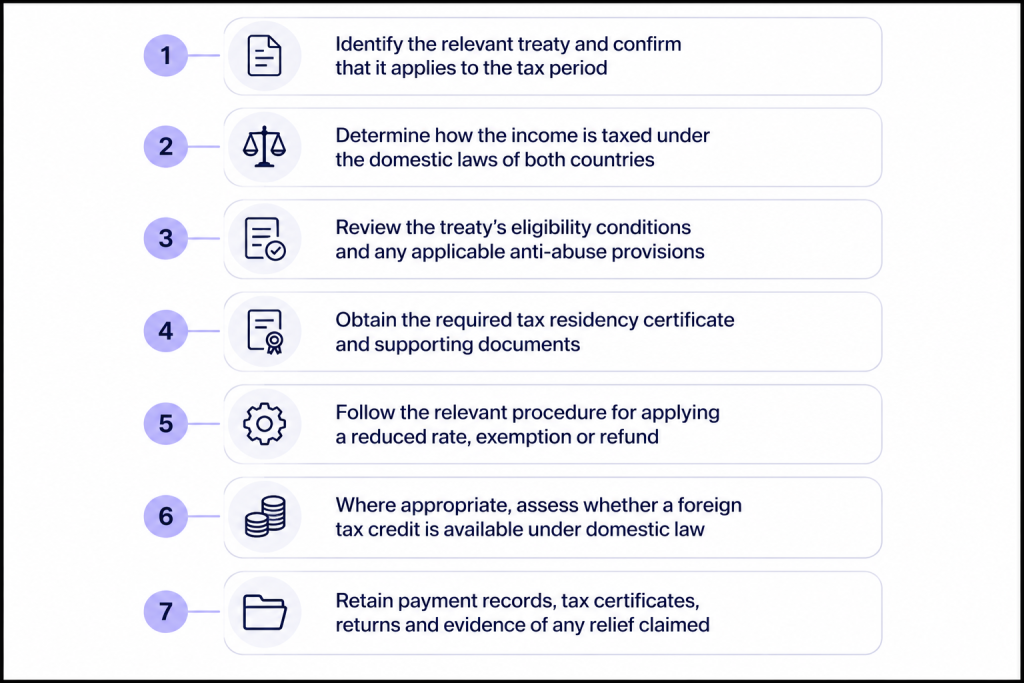
Cyprus provides procedures for eligible non-residents to apply for exemption from, or a refund of, certain Cyprus taxes withheld under an applicable treaty. Where foreign tax has been paid, and no treaty provision resolves the issue, domestic rules may also provide a foreign tax credit, subject to their conditions.
Check the relevant tax authority’s requirements before submitting a claim.
What Should International Businesses Check Before Relying on a Tax Treaty?
Before applying treaty provisions, businesses should review the following points.
- Treaty status: Confirm that the agreement is in force and applies to the relevant tax period
- Income classification: Check that the payment falls within the relevant treaty article
- Residency: Establish that the recipient qualifies as a resident under the applicable rules
- Supporting documents: Prepare the tax residency certificate and other evidence required
- Anti-abuse provisions: Review any restrictions that could affect eligibility
- Domestic compliance: Check whether local tax returns, declarations or reporting obligations still apply
Professional advice is particularly useful when a business has several entities, receives income from multiple countries or makes payments to related parties.
How Can Arnifi Help With Cyprus Company Formation?
Setting up a company in Cyprus involves choosing an appropriate structure and completing the relevant incorporation and administrative requirements.
Arnifi can support businesses with company formation and incorporation documentation, helping them organise the information required for the establishment process. This can give founders a clearer starting point when preparing to operate internationally.
Tax treaty eligibility requires a separate assessment. Businesses should consult a qualified tax adviser to review residency, cross-border income, withholding tax and the conditions for claiming relief under a specific agreement.
FAQs
Does Cyprus have double tax treaties with other countries?
Yes. Cyprus has an extensive network of double tax treaties. The official Ministry of Finance list identifies the agreements and their status.
Does a Cyprus company automatically qualify for treaty benefits?
No. Eligibility depends on the relevant treaty, tax residency, the type of income and any applicable conditions or anti-abuse provisions.
How can a business check whether a treaty applies?
Consult the official Cyprus treaty list and read the agreement covering the countries and income involved. Check any relevant protocols and effective dates before relying on its provisions.
Can a Cyprus tax treaty reduce withholding tax?
Yes, a treaty may reduce withholding tax on qualifying dividends, interest or royalties. The available rate and conditions vary by agreement.
Is a tax residency certificate required to claim treaty benefits?
It may be required as evidence of residency. The documents and procedures depend on the treaty and the tax authority handling the claim.
What happens if Cyprus does not have a tax treaty with the other country?
The domestic tax laws of the countries involved will generally determine the treatment. Depending on the circumstances, Cyprus’s domestic legislation may allow a foreign tax credit for qualifying tax paid overseas, subject to applicable limits and conditions.
Conclusion
Cyprus double tax treaties provide a framework for managing tax obligations when income crosses international borders. They may offer relief from double taxation, reduced withholding tax and greater clarity about which country can tax particular income.
The outcome depends on the specific agreement, the taxpayer’s residency, the type of income and the relevant domestic laws. Before claiming treaty benefits, businesses should verify the agreement’s status, confirm their eligibility and obtain qualified tax advice. Arnifi can help with Cyprus company formation and incorporation requirements, giving businesses a starting point for their international operations.
References
Top UAE Packages
Related Articles



Top UAE Packages
Planning Your Next Business Move?
