
Cyprus Corporate Tax & Administration in 2026: Everything Founders Need to Know

Zahira Shaik
SEO Content Writer
Zahira Shaik is an SEO Content Writer and Published Author specializing in research-based content. She excels at analyzing market trends, regulations, and industry developments… Read more

Tulika Saxena
AVP, Sales & Marketing | IIM Nagpur
Tulika Saxena specializes in business finance, sales strategy, and market positioning. Leads growth and partnerships, ensuring seamless business setup experiences and client success across… Read more



Key Fact: As of 1 January 2026, Cyprus revised the standard corporate income tax rate from 12.5% to 15% in accordance with OECD Pillar Two requirements, and increased corporate tax loss carry-forward periods to seven years.
Table of contents
- Introduction
- 1. Why Cyprus Remains a Premier EU Corporate Hub in 2026
- 2. Corporate Tax Fundamentals: Rates, Tax Residency, and Taxable Profits
- 3. Deductible Expenses and Capital Allowances: Building a Tax-Efficient Cost Base
- 4. Major Tax Exemptions and Special Income Regimes
- 5. Strategic Tax Incentives: IP Box, NID, and R&D Super-Deductions
- 6. Corporate Tax Loss Utilization: Carry-Forwards and Restrictions
- 7. Transfer Pricing and Cross-Border Transaction Rules
- 8. Corporate Administration: Deadlines, Self-Assessment, and Audits
- 9. Common Tax and Compliance Traps for International Founders
- 10. How Arnifi Simplifies Incorporation, Accounting, and Tax Compliance
- 11. Frequently Asked Questions (FAQs)
Introduction
It is well known that Cyprus has gained a reputation as one of the most popular destinations for foreign investors, structures, multinational corporations, and trading companies in the European Union. Nevertheless, working with international tax structuring and compliance involves being aware of recent corporate taxation, tests of tax residency, eligible deductions, and compliance rules.
Corporate taxation has improved since 2026. First of all, the corporate tax rate increased from 12.5% to 15%. Nonetheless, Cyprus continues to be the tax-efficient jurisdiction due to attractive structural features, such as an 80% IP box deduction, Notional Interest Deduction (NID), double taxation agreement relief, and full exemption from withholding tax on outbound dividends.
This guide aims to provide all the necessary information about corporate taxation in Cyprus in 2026.
1. Why Cyprus Remains a Premier EU Corporate Hub in 2026
Founders of international businesses select Cyprus owing to the country’s common law legal system, favorable business environment, and geographic location linking three continents.
The framework in 2026 provides for a balance between international compliance standards (like OECD Pillar Two and ATAD) and business-friendly incentives. Business entities that can gain from operations in Cyprus include:
- Technology & SaaS Entities: Through use of the IP Box to bring the effective tax rate to around 3%.
- International Holding Companies: Taking advantage of participation exemptions from dividends and capital gains on security sales.
- Regional Headquarters & EOR Operations: Through the use of double taxation agreements and statutory R&D super-deductions.
To be able to benefit from such strengths, the founders have to strike a balance between tax structuring and corporate administrative requirements.
2. Corporate Tax Fundamentals: Rates, Tax Residency, and Taxable Profits
What Is the Corporate Tax Rate in Cyprus in 2026?
For tax years starting from or after 1 January 2026, the usual rate of corporate tax that a company operating in Cyprus pays is 15%, up from the historically consistent 12.5% rate.
Corporate income tax is payable on net taxable profits, which are arrived at after deducting eligible business expenses and tax exemptions from total revenues.
How Is Corporate Tax Residency Determined in Cyprus?
The tax residency of a company determines its global tax liability:
- Management & Control Test: The old rule says a company is a Cyprus tax resident where the management and control of the company take place in Cyprus.
- Incorporation Rule: Due to the latest statutory amendments, any company incorporated or re-domiciled in Cyprus will be deemed a Cyprus tax resident, except if it is also a tax resident of another country due to the Double Taxation Treaty (DTT).
How Are Resident and Non-Resident Companies Taxed?
- Resident Companies: Subject to taxation on their worldwide taxable profits. Double taxation is avoided using foreign tax credits or the provisions of relevant Double Tax Treaties.
- Non-Resident Companies: Subject to taxation on their income or profits derived from Cyprus source or from a permanent establishment (PE) located in Cyprus.
Accounting Profit vs. Taxable Profit
Taxable profits do not equal accounting profits, which are prepared according to IFRS principles. For calculation of taxable profit, adjustments should be made to accounting profits to exclude non-deductible expenses and include statutory exclusions and allowances.
3. Deductible Expenses and Capital Allowances: Building a Tax-Efficient Cost Base
Which Business Expenses Are Tax-Deductible in Cyprus?
Under Cyprus tax law, expenses are deductible if they are incurred wholly and exclusively for the production of taxable business income. Common deductible expenses include:
- Employee salaries, benefits, and employer social contributions.
- Office rent, utilities, software licenses, and operational expenditures.
- Professional fees (legal, accounting, tax, and audit services).
Capital Allowances and Depreciation Rates
Tax law does not allow direct deductions for accounting depreciation of capital assets. Instead, businesses claim statutory capital allowances:
- Computers and hardware: 20% annually.
- Plant and machinery: 10% annually.
- Commercial buildings: 3% annually (over a 33-year period).
Limits on Entertainment Deductions
The entertainment expenses incurred in business operations are allowed up to the maximum specified amount, that is, either 1% of gross income or AED 123,000 per year. Any additional amount must be included in the taxable income.
Non-Deductible Expenses
- Personal non-business expenses.
- Initial company formation and legal setup costs.
- Regulatory fines, tax penalties, and late fees.
- Interest expenses incurred for purchasing private motor vehicles or non-business assets.
Recordkeeping Obligations
Taxpayers must maintain invoices and all other necessary papers for at least six years.
4. Major Tax Exemptions and Special Income Regimes
- Dividend Income Exemption: Dividends received by a Cyprus tax-resident company are generally exempt from corporation income tax, except for basic anti-avoidance and participation rules.
- Gains on Disposal of Securities: Gains arising from the sale of qualifying shares, corporate bonds, debentures, and other securities are completely exempt from local corporation tax, but the entity owning such securities should not hold Cyprus-based real estate.
- Crypto Asset Gains: Gains from qualifying crypto-asset transactions are taxed at a flat 8% rate, whereas crypto-assets mined directly are excluded from this regime.
- Tonnage Tax Regime: Shipping companies (owners, charterers, and managers of ships) may elect for a preferential tonnage tax regime based on the net tonnage of vessels and not corporate profits.
- Pillar Two Minimum Tax: Multinational Enterprises (MNEs) whose consolidated group revenue exceeds AED 3.075 billion are covered by the GloBE 15% global minimum tax.
5. Strategic Tax Incentives: IP Box, NID, and R&D Super-Deductions
Cyprus IP Box Regime
For those firms that own significant amounts of intellectual property, the amended IP box regime provides for an 80% notional deduction on net qualifying profits from such intellectual property (such as patents, copyrighted software, etc.). Thus, with a 15% corporate tax rate, the effective tax rate applicable to the profits will be lowered to approximately 3%.
Notional Interest Deduction (NID)
A company that uses equity financing in its capital structure can annually deduct a Notional Interest Deduction amount. It is calculated as the yield of government bonds with an added 5% premium on top of it. The NID is limited to 80% of the taxable profit earned from financed assets.
R&D Super-Deduction
To stimulate research and development activities, qualifying R&D costs benefit from a 120% super-deduction.
6. Corporate Tax Loss Utilization: Carry-Forwards and Restrictions
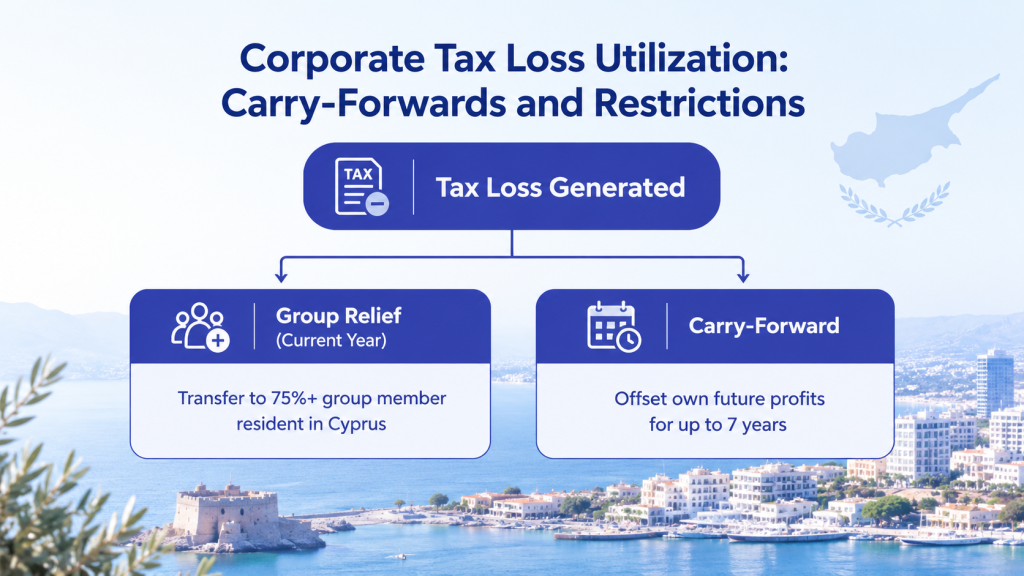
- 7-Year Loss Carry-Forward: Any corporate losses that arise in a particular tax year may be carried forward against taxable profits for the subsequent 7 years (previously 5 years). There is no carry-back allowed.
- Group Relief: Current tax losses can be transferred between Cyprus tax resident companies as long as the share of the common ownership is 75% of the total tax year.
- Prior Loss Restrictions: A company should use all the losses it has accrued before claiming any group relief loss.
- Loss Forfeiture Rules: If there is a substantial change in business activities along with changes in ownership in 3 years, then there will be a forfeiture of such losses
- Ring-Fenced Losses: Crypto losses will be ring-fenced against crypto income, and 80% restrictions apply to IP Box losses (i.e., only 20% will be carried forward).
7. Transfer Pricing and Cross-Border Transaction Rules
Transactions between related parties must strictly adhere to the arm’s-length principle.
Summary Information Table (SIT)
Any company entering into controlled, related-party transactions must produce the annual SIT report irrespective of the transaction’s size.
Local File Documentation Thresholds
In case the transactions cross the statutory threshold levels, then the company must prepare Transfer Pricing Local File documentation:
| Transaction Category | Local File Threshold |
| Financial Transactions | AED 41 Million |
| Goods | AED 20.5 Million |
| Services & Royalties | AED 10.25 Million |
Outbound Withholding Tax
Normally, Cyprus does not withhold taxes on dividends, interest, and royalties paid out of the country at the rate of 0%. Nevertheless, defensive withholding taxes exist in cases where money is paid to countries listed as blacklisted by the EU.
8. Corporate Administration: Deadlines, Self-Assessment, and Audits
Provisional Tax Payments
Cyprus operates a self-assessment system for corporate tax payments. Companies must estimate current-year taxable profits and pay provisional tax in two equal instalments:
- First Instalment: Due by 31 July.
- Second Instalment: Due by 31 December.
Underestimation Warning: If estimated taxable profit falls below 75% of the final assessed taxable profit, a 10% tax surcharge is applied to the underpaid tax balance.
Annual Tax Return (TD4)
The annual corporate tax return (TD4) and balancing tax payment should be made online through TaxisNet by 31 January of the year following the completion of the respective tax period (for example, for the 2026 year the tax return should be made by 31 January 2028).
Statutory Audit Requirements
All Cypriot organizations should have financial statements prepared according to IFRS and be audited annually by an auditor registered and licensed locally. Failure to have an audit conducted leads to delays in filing taxes and penalties from banks.
9. Common Tax and Compliance Traps for International Founders
- Mixing Personal and Business Funds: Using corporate bank accounts for non-business personal expenses triggers disallowed tax additions.
Preventive Measure: Keep separate personal and corporate accounts; process founder pay strictly via payroll, dividends, or documented director fees. - Underestimating Provisional Tax: Underestimating annual profit leads to the statutory 10% underpayment penalty.
Preventive Measure: Review quarterly management accounts before 31 December to adjust provisional estimates upward if needed. - Overlooking Transfer Pricing Rules: Failing to prepare arm’s-length documentation for intercompany management fees or loans.
Preventive Measure: Establish written intercompany agreements supported by annual benchmarks before executing transactions. - Delayed Statutory Audits: Missing audit deadlines prevents timely tax filings and causes banking compliance red flags.
Preventive Measure: Maintain real-time monthly bookkeeping to deliver audit-ready financial records right after year-end.
10. How Arnifi Simplifies Incorporation, Accounting, and Tax Compliance
Managing cross-border expansion and corporate administration in general requires professional implementation of both processes in tandem. Arnifi provides a comprehensive solution for founders that enables them to launch and keep themselves present in Cyprus.
- Company Formation & Structuring: Arnifi simplifies the process of forming companies in Cyprus. Founders will have access to Arni Organogram which will allow them to visualize corporate ownership structure and Arni Cost Calculator that will help in forecasting expenses.
- Accounting & Bookkeeping Support: Arnifi makes sure that your books of account are ready for audits throughout the year, turning statutory IFRS reporting into calculations for tax purposes in Cyprus.
- Compliance & Tax Management: With everything from provisional tax alerts, TD4 filing, and company renewal, Arnifi ensures that each business stays on time without any fines.
- Legal, AML & Global Employment: Arnifi provides you with contract management tools, Arni Docs, background checks with Arni AML Checker, and Employer of Record services with Arnifi HR.
11. Frequently Asked Questions (FAQs)
What is the corporate tax rate in Cyprus in 2026?
The ordinary tax rate on corporate income in Cyprus is 15% from tax periods beginning on or after 1 January 2026.
Is corporate tax in Cyprus calculated on revenue or profit?
Income tax is determined using net taxable income or profit after all allowable operational deductions have been subtracted from gross revenue.
Are companies incorporated in Cyprus automatically tax residents?
By default, a company registered or re-registered in Cyprus is a tax resident of the country unless it is a tax resident in another jurisdiction according to a pertinent Double Taxation Agreement.
Which business expenses are tax-deductible in Cyprus?
Deductible expenses include expenses that are necessary for earning taxable income, such as salaries, software subscriptions, office lease costs, and audit fees.
What is the Cyprus IP Box regime?
Under the IP Box scheme, an 80% notional deduction is allowed on the net income arising from intellectual property, thus giving an effective tax rate of 3%.
Can companies carry forward tax losses in Cyprus?
Yes, tax losses may be carried forward and set against future taxable income, but they cannot be carried back for a period of 7 years.
How does group relief work for Cyprus companies?
Group relief is allowed to current losses within the Cyprus group if there is a 75% common shareholding during the entire tax year.
Credible Resources & References
- Tax Department of Cyprus: https://www.mof.gov.cy/tax
- Cyprus Ministry of Finance: https://www.mof.gov.cy
- PwC Cyprus Tax Summaries: https://taxsummaries.pwc.com/cyprus
Top UAE Packages
Related Articles

Top UAE Packages
Get in Touch
