
Hiring Employees in Cyprus | Employer Registration, Payroll and Social Insurance

Anushka
Content Writer
Anushka Basu is a business content writer specialised in global business market insights. She aims to simplify complex regulatory, financial, and business concepts into… Read more

Tulika Saxena
AVP, Sales & Marketing | IIM Nagpur
Tulika Saxena specializes in business finance, sales strategy, and market positioning. Leads growth and partnerships, ensuring seamless business setup experiences and client success across… Read more



Key Fact: Employers hiring staff in Cyprus must register with the Social Insurance Services and notify the authorities of new hires through the ERGANI system before employment begins. Employers must also account for applicable payroll taxes and social insurance contributions.
Table of contents
- What Should Employers Know Before Hiring Employees in Cyprus?
- How Do You Register as an Employer in Cyprus?
- How Do You Register a New Employee in Cyprus?
- What Employment Documents Must Employers Prepare?
- How Does Payroll in Cyprus Work?
- What Social Insurance Contributions Must Employers Pay in Cyprus?
- What Payroll Taxes and Other Deductions Apply to Employees in Cyprus?
- When Must Employers Pay Payroll Taxes and Social Insurance Contributions?
- What Employment Rules Must Businesses Follow When Hiring in Cyprus?
- What Common Payroll and Employer Registration Mistakes Should You Avoid?
- How Can Arnifi Help With Company Setup in Cyprus?
- FAQs
- Conclusion
What Should Employers Know Before Hiring Employees in Cyprus?
Employers must complete several administrative steps before a new employee starts work. These requirements apply alongside employment law obligations, including providing written terms and paying the agreed salary.
Before hiring, businesses should prepare to:
- Register with the Social Insurance Services as an employer
- Notify the authorities of each new employee through ERGANI
- Prepare the employment contract and written terms
- Set up payroll to calculate salary, deductions and employer contributions
- Register for relevant tax reporting and payment obligations
- Check work authorisation requirements for employees who are not EU citizens
The exact requirements depend on the company’s activities, the employee’s circumstances and the applicable employment rules. Employers should confirm the relevant procedures before agreeing on a start date.
How Do You Register as an Employer in Cyprus?
Businesses must register with the Employers’ Register of the Social Insurance Services before recruiting personnel. The registration process establishes the employer’s official record for social insurance contributions and related communications.
To register, employers generally need to:
- Complete the employer registration application, Form YKA 01-001
- Submit it to the relevant District Social Insurance Office
- Provide the required business and registration details
- Obtain the employer registration number
- Use that number when paying contributions and communicating with the Social Insurance Services
Employer registration should be submitted no later than one day before the applicant is expected to become an employer. Businesses should allow time to complete the process before the first employee starts work.
If a company operates across different districts or has different business activities, it should confirm whether additional administrative steps apply.
How Do You Register a New Employee in Cyprus?
Employers must notify the Social Insurance Services when hiring an employee. This notification is submitted electronically through the ERGANI information system.
The recruitment notification must generally be submitted no later than one day before the employee begins work. Employers should complete this step before the agreed start date rather than waiting until the first payroll run.
The process involves:
- Registering for access to ERGANI
- Entering the employee’s personal details
- Providing the relevant identification and Social Insurance number information
- Recording the recruitment date and employment commencement date
- Keeping the required recruitment records
If the employee does not yet have a Social Insurance number, the employer should follow the relevant registration procedure and submit the required application.
An important change is that the former Certificate of Commencement of Employment is no longer issued under the current ERGANI recruitment notification process. Employers should follow the electronic procedure rather than rely on outdated forms or instructions.
What Employment Documents Must Employers Prepare?
Employers should prepare written employment terms before or at the start of employment, in line with the applicable requirements. Clear documentation helps both parties understand their responsibilities and provides a record if questions arise later.
Employment documents should cover the following information:
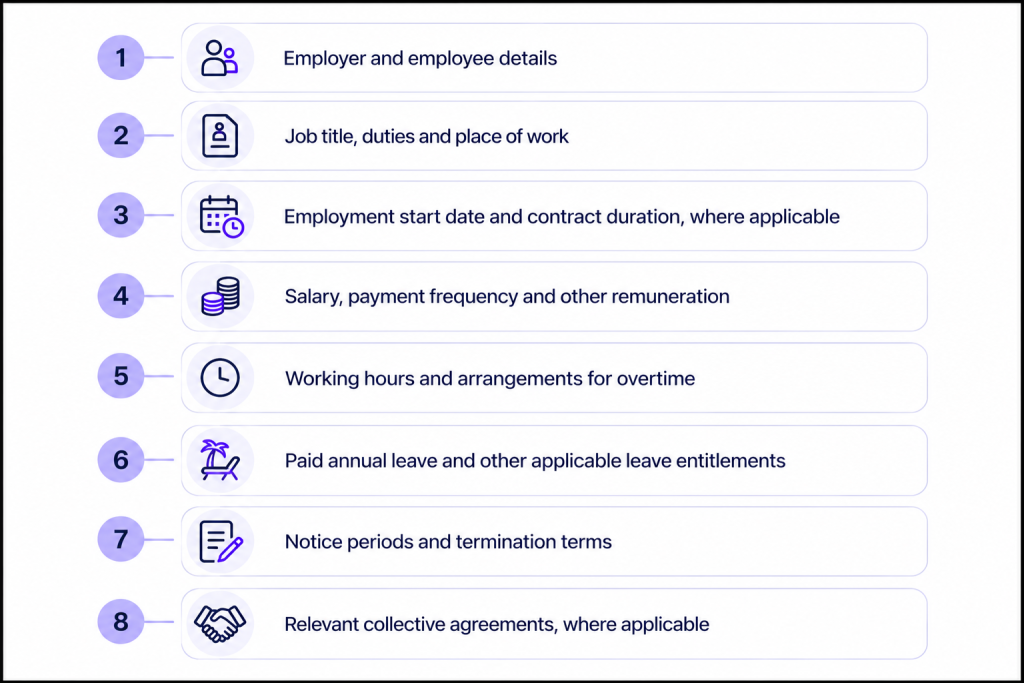
Employers should also maintain accurate records of contracts, working time, salary payments, leave and employee registration details.
How Does Payroll in Cyprus Work?
Payroll in Cyprus involves calculating an employee’s gross salary, applying the required deductions and paying the remaining net salary. Employers must also calculate their own contributions, which form part of the total cost of employment.
A typical monthly payroll process includes:
- Calculate gross salary and any additional remuneration
- Calculate employee Social Insurance and General Healthcare System (GHS) contributions
- Calculate Pay As You Earn (PAYE) income tax withholding, where applicable
- Determine the employee’s net pay
- Calculate employer contributions and other applicable charges
- Pay the employee and remit the deductions and contributions to the relevant authorities
- Maintain payroll records and complete the required declarations
Employers should provide a clear record of salary and deductions and ensure wages are paid according to the employment agreement and applicable law.
What Is the PAYE System in Cyprus?
PAYE stands for Pay As You Earn. Employers use this system to withhold income tax from employees’ earnings where tax is due.
The amount withheld depends on the employee’s taxable income and the applicable tax rules. Payroll calculations should account for the employee’s circumstances and any relevant information required by the Tax Department.
Employers subject to PAYE reporting must submit the required monthly declarations and make payments through the applicable tax system. Annual employer declarations may also be required.
What Social Insurance Contributions Must Employers Pay in Cyprus?
Employers must calculate both employee and employer contributions. Employee contributions are deducted from gross salary, while employer contributions are an additional employment cost.
The following rates apply in 2026, subject to the relevant ceilings, exemptions and special rules.
| Contribution | Employee rate | Employer rate |
| Social Insurance | 8.8% | 8.8% |
| General Healthcare System (GHS) | 2.65% | 2.9% |
| Redundancy Fund | Not applicable | 1.2% |
| Human Resource Development Authority Fund | Not applicable | 0.5% |
| Social Cohesion Fund | Not applicable | 2% |
Social Insurance contributions are subject to a maximum level of insurable earnings. For 2026, the annual ceiling is €68,904, equivalent to €5,742 per month for monthly paid employees. The Social Cohesion Fund contribution is calculated without this earnings ceiling.
Some employers may also need to contribute to the Central Holiday Fund, unless exempt. The applicable requirements depend on the employer’s circumstances.
Employers should verify current contribution rates, ceilings and exemptions before finalising payroll calculations.
What Payroll Taxes and Other Deductions Apply to Employees in Cyprus?
Employee deductions reduce gross salary to determine the amount paid to the employee. Employer contributions are calculated separately and should not be confused with deductions from the employee’s pay.
Common employee deductions include:
- Social Insurance contributions
- GHS contributions
- PAYE income tax, where applicable
The amount deducted depends on the employee’s earnings, taxable income and applicable contribution rules. Some contributions are subject to earnings ceilings, while others have different calculation limits.
For example, an employee earning €2,000 gross per month would generally have Social Insurance contributions calculated at 8.8% and GHS contributions calculated at 2.65%, subject to the applicable rules. PAYE would be calculated separately based on the employee’s taxable income.
Employers should keep a clear record of each deduction and the method used to calculate it.
When Must Employers Pay Payroll Taxes and Social Insurance Contributions?
Employers must follow the payment and reporting deadlines set by the relevant authorities.
Social Insurance contributions and the applicable employer fund contributions are generally due by the end of the calendar month following the month to which they relate. For example, contributions for March are generally due by the end of April.
PAYE and relevant GHS-related amounts reported through the Tax Department have their own declaration and payment procedures. Employers should check the current Tax For All system requirements and applicable deadlines.
Late payment can result in additional charges, penalties or interest. Employers should therefore:
- Reconcile payroll figures each month
- Submit required declarations on time
- Pay contributions by the applicable deadline
- Keep evidence of payments and submissions
- Check official announcements for changes to filing procedures
What Employment Rules Must Businesses Follow When Hiring in Cyprus?
In addition to payroll and registration, employers must comply with applicable employment legislation.
Minimum wage
From 1 January 2026, the national minimum monthly wage for covered full-time employees is €979 gross upon hiring. It rises to €1,088 gross after six months of continuous employment with the same employer.
Certain categories, including domestic workers, agricultural and livestock workers, seafarers and employees covered by the separate hotel industry minimum wage order, are excluded from the general decree. Employers should verify which rules apply to the role.
Working time and annual leave
Employers should set out working hours, overtime arrangements and annual leave entitlements in the employment terms. Sector-specific rules or collective agreements may impose additional requirements.
Hiring non-EU nationals
Businesses hiring non-EU nationals should check the relevant residence and work authorisation requirements before employment begins. The appropriate procedure depends on the employee’s status and the nature of the job.
What Common Payroll and Employer Registration Mistakes Should You Avoid?
Errors during hiring can create administrative and financial problems. Businesses should pay particular attention to the following areas:
- Hiring before completing the required ERGANI notification
- Providing incorrect employee or employer registration details
- Using outdated recruitment forms or procedures
- Applying incorrect contribution rates or earnings ceilings
- Confusing employee deductions with employer contributions
- Missing tax declaration or contribution payment deadlines
- Failing to maintain contracts, payroll records and payment evidence
- Overlooking work authorisation requirements
A consistent payroll process and regular checks against official guidance can help prevent these mistakes.
How Can Arnifi Help With Company Setup in Cyprus?
Setting up a company in Cyprus involves selecting an appropriate structure, preparing incorporation documents and completing the required administrative procedures.
Arnifi can support entrepreneurs with Cyprus company formation and guidance on incorporation requirements. Businesses planning to hire should also consider employer registration, payroll administration and employment compliance before recruiting their first employee.
FAQs
How do you register as an employer in Cyprus?
Complete the employer registration application and submit it to the relevant District Social Insurance Office. The Social Insurance Services will provide an employer registration number for contributions and official communication.
When must a new employee be registered in Cyprus?
Employers must generally notify the Social Insurance Services through ERGANI no later than one day before the employee starts work.
What social insurance contributions must employers pay?
Employers generally pay Social Insurance at 8.8% of applicable insurable earnings, alongside other applicable contributions such as the Redundancy Fund, Human Resource Development Fund and Social Cohesion Fund. GHS employer contributions also apply where relevant.
How does PAYE work in Cyprus?
PAYE requires employers to withhold income tax from employees’ earnings where tax is due and submit the relevant declarations and payments to the Tax Department.
When are payroll contributions due?
Social Insurance and applicable employer fund contributions are generally due by the end of the month following the month to which they relate. PAYE and GHS reporting should follow the relevant Tax Department deadlines.
Can a foreign company hire employees in Cyprus?
A foreign company may be able to employ staff in Cyprus, but it must assess the applicable employer registration, payroll, tax and employment requirements. Work authorisation rules may also apply depending on the employee’s nationality and status.
Conclusion
Hiring employees in Cyprus requires businesses to complete employer registration, notify new hires through ERGANI and establish a reliable payroll process. Employers must also calculate employee deductions, pay applicable employer contributions and meet tax reporting deadlines.
Preparing these processes before the first employee starts can help reduce errors and support ongoing compliance. Businesses should verify current rates and requirements with the relevant Cyprus authorities and seek professional advice from experts at Arnifi where their circumstances require a more detailed assessment.
References
Top UAE Packages
Related Articles



Top UAE Packages
Planning Your Next Business Move?
