
Understanding Corporate Taxation in the USA | Rates, Filing and Compliance

Anushka
Content Writer
Anushka Basu is a business content writer specialised in global business market insights. She aims to simplify complex regulatory, financial, and business concepts into… Read more

Tulika Saxena
AVP, Sales & Marketing | IIM Nagpur
Tulika Saxena specializes in business finance, sales strategy, and market positioning. Leads growth and partnerships, ensuring seamless business setup experiences and client success across… Read more



Key Fact: The USA levies a flat 21% federal corporate income tax on taxable income for C Corporations. Businesses may also face state-level taxes depending on their activities, location and tax nexus.
Table of contents
- Introduction
- How does corporate taxation work in the USA?
- What is the federal corporate tax rate in the USA?
- Do businesses pay state corporate taxes in the USA?
- What Deductions and Tax Credits can US businesses claim?
- What are the corporate tax filing and payment requirements?
- How do US tax treaties affect international businesses?
- How can Arnifi help businesses expanding internationally?
- Conclusion
- References
Introduction
Imagine a foreign company that has its subsidiary in the US all sorted. It’s got a business plan, a revenue forecast, a local team in place, and it’s shortlisted a state for incorporation. The only thing left before it can actually go live is for the founders to work out how much of their profits will be subject to tax and what the filing requirements will be.
Understanding the US corporate tax system is key to any business wanting to work out its costs, pick the right entity type and stay in compliance. The tax liability, though, does vary depending on the type of company, its taxable income, where it operates and the relevant federal and state tax rules.
How does corporate taxation work in the USA?
Corporate tax in the USA is both a federal and a state tax. The IRS handles the federal side of things, and the individual states have their own business tax rules.
The tax treatment depends on the company’s structure:
- C Corporations pay corporate income tax on taxable profits
- S Corporations generally pass income and losses to shareholders, subject to eligibility requirements
- Partnerships generally pass profits and losses to their partners
- Sole proprietorships report business income through the owner’s individual tax return
For instance, a C corp will pay corporate income tax on its profits, whereas an eligible partnership will generally pass its profits through to its partners. The structure you choose can therefore have a massive impact on the tax position of the company.
What is the federal corporate tax rate in the USA?
The federal corporate income tax rate is 21% on C corps. That’s on taxable income (i.e. after all the eligible deductions and adjustments), not on total revenue.
For example, if a C Corporation generates $500,000 in taxable income, its federal corporate tax would generally be:
| Particulars | Amount |
| Taxable income | $500,000 |
| Federal corporate tax rate | 21% |
| Federal income tax payable | $105,000 |
The calculation is pursuant to the federal corporate tax provisions under Section 11 of the Internal Revenue Code.
Some companies may also be liable under further tax provisions depending on their particular financial position and activities.
Do businesses pay state corporate taxes in the USA?
State corporate taxes vary across the country. Some states have a corporate income tax, others have a franchise tax, others have a gross receipts tax or some other form of business tax.
Businesses can also establish tax nexus via physical presence, employees, property or qualifying economic activity (depending on the rules of the individual state).
A company based in Texas that sells to customers and has a sales rep based in California may be subject to California registration, reporting and/or tax obligations under the state’s nexus rules regardless of where the company is headquartered.
Businesses running in multiple states should look at their tax exposure on a state-by-state basis.
What Deductions and Tax Credits can US businesses claim?
Eligible deductions and tax credits can be used to reduce a business’s tax liability. Whether or not they are available will depend on the type of business, the type of expenditure and the relevant tax rules.
Common opportunities include:
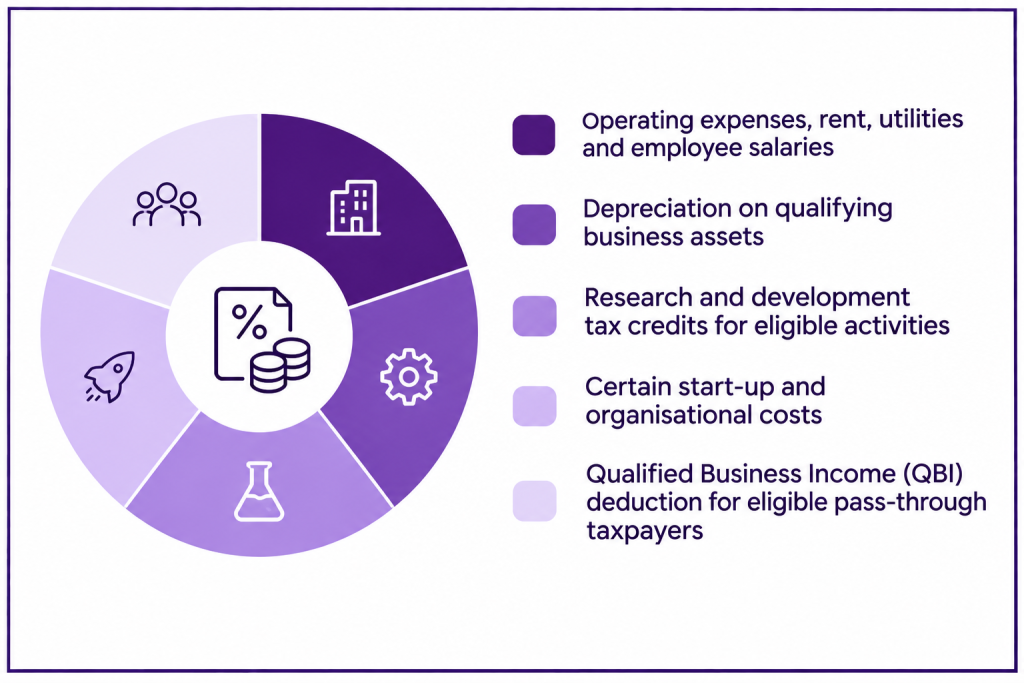
For instance, a company buying machinery for the purposes of manufacturing may be entitled to claim depreciation or other qualifying asset deductions. Likewise, a technology company carrying out eligible research activities may be able to claim research tax credits.
Deductions reduce your taxable income; credits reduce your tax liability directly. The IRS Instructions for Form 1120 set out how corporations report their income, deductions, credits and their federal tax liability.
What are the corporate tax filing and payment requirements?
Businesses must comply with the federal filing requirements and any additional state requirements where applicable.
Corps generally file their annual federal income tax return on Form 1120. They may also be required to make quarterly estimated tax payments depending on their estimated tax liability.
Common compliance requirements include:
- Filing annual federal corporate income tax returns
- Submitting applicable state corporate tax returns
- Making estimated tax payments within prescribed deadlines
- Maintaining invoices, financial statements, payroll records and expense documentation
- Reporting income, deductions and credits accurately
Let’s say a company making taxable profits throughout the year will probably be required to make estimated payments as and when they occur rather than pay the full amount when it files its annual return.
The IRS Form 1120 filing instructions contain the reporting requirements, instructions for preparing the return and the applicable filing rules.
Late filings, missed payments, and inaccurate reporting can all lead to penalties, interest and additional compliance obligations.
How do US tax treaties affect international businesses?
The USA has tax treaties with a number of countries to deal with the avoidance of double taxation and to establish the rules as to how income is to be taxed in the circumstances of a cross-border transaction.
Treaties can provide relief where income is taxable in more than one jurisdiction. Depending on the treaty in question, eligible businesses may be entitled to reduced withholding tax on dividends, interest or royalties.
For instance, an Indian company receiving qualifying income from its US subsidiary may need to consider whether a tax treaty provision will allow it to reduce the applicable withholding tax. The benefit will depend on the company’s residency, the eligibility of the income, the nature of the payment and the particular treaty provision.
Businesses should look at the relevant treaty rules and obtain professional advice prior to claiming any treaty benefits.
How can Arnifi help businesses expanding internationally?
Getting into the US market is more than just registering a company. You may well need assistance with the corporate structure, the documentation, the admin and the co-ordination of ongoing compliance.
Arnifi help companies set up in international markets, with support on corporate documentation, structure and administrative compliance, along with expert assistance with the requirements of your expansion.
FAQs
What’s the federal corporate tax rate in the USA?
The federal corporate income tax rate for C corporations is 21%. It’s calculated on taxable income after all eligible deductions and adjustments.
Do all businesses in the USA pay 21% corporate tax?
No, the 21% rate applies to C corps. Partnerships, S corps and sole proprietors are generally treated differently for tax purposes.
Do US companies pay both federal and state corporate tax?
Some companies may have obligations at both levels. State tax liability will, of course, vary according to jurisdiction, business activity, nexus and the applicable state regulations.
What’s the difference between a tax deduction and a tax credit?
A deduction reduces your taxable income; a tax credit reduces your actual tax liability. The eligibility requirements will vary depending on the particular tax provision in question.
Do foreign companies have to pay US corporate tax?
Foreign companies may be subject to US tax on certain US-source income or on income arising from business activities in the US. The rules that apply will depend on the nature of the income, the nature of the foreign company’s business presence in the US and any applicable tax treaties.
Conclusion
Corporate taxation in the USA involves federal income tax, state-level obligations, deductions, filing requirements and rules governing cross-border income. Businesses should evaluate their entity structure, operating locations and expected taxable income before entering the US market.
With proper planning, organised documentation and the right professional guidance, companies can approach US tax compliance with greater clarity. Arnifi can support businesses with international setup, structuring and documentation requirements as they prepare to expand into the US market.
References
Top USA Packages
Related Articles



Top USA Packages
Planning Your Next Business Move?
