
How to Start a Business in the USA Without Residency

Nishant
Content Writer
Nishant Kumar is a technical content writer, he shares global business insights and bridges the gap between complex regulatory frameworks and actionable growth strategies.… Read more

Tulika Saxena
AVP, Sales & Marketing | IIM Nagpur
Tulika Saxena specializes in business finance, sales strategy, and market positioning. Leads growth and partnerships, ensuring seamless business setup experiences and client success across… Read more



Table of contents
- Introduction
- Can Non-Residents Complete Company Formation in the USA?
- Which U.S. Business Structures Suit Non-Residents?
- How Does Non-Resident U.S. Company Formation Work?
- What Federal Tax and Compliance Rules Apply Without Residency?
- How We at Arnifi Support Non-Resident U.S. Expansion
- Conclusion
- FAQs
- References
Key Facts
- U.S. federal and state statutes allow 100% foreign ownership during company formation in USA for non residents without U.S. citizenship, a green card, or a visa
- Nonresident aliens are not permitted to hold S-corporation stock as per the Internal Revenue Code, 1361. The LLCs and the C-Corporations remain the common entities
- With regard to FinCEN’s final rule that came into effect on August 14, 2026, U.S.-organized domestic entities are permanently exempt from filing federal BOI reports, while foreign-organized entities are liable to file Form 5472; failure to do so results in a penalty of $25,000
Introduction
It is no longer necessary to move to America to launch an American enterprise. By means of proper company formation in USA for non residents, overseas founders gain access to institutions that provide payment processing, venture capital, and common law protection remotely.
Yet having an American company abroad does not make one a resident or employee of the United States. Isolating the requirements for owning a business from the requirements for filing with the IRS and USCIS protects foreign founders from compliance penalties.
Can Non-Residents Complete Company Formation in the USA?
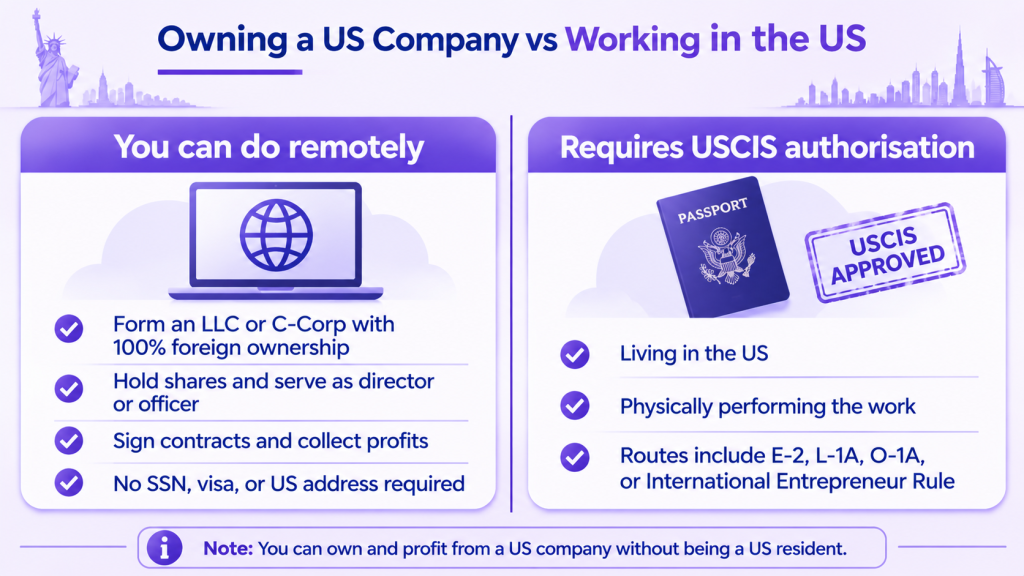
Yes. Through state corporation laws and SBA structures, non-residents and foreign parent companies can form, hold stock, and serve as directors or officers of a U.S. company from any location worldwide. No SSN, U.S. residency, or visa is needed to form a corporation.
Foreign shareholders are permitted to oversee management of their U.S. business, enter into contracts, and collect profits without ever being in the U.S. If you need to move to the United States to physically do the work, then separate authorization from USCIS is required.
Which U.S. Business Structures Suit Non-Residents?
The selection of the proper structure determines federal taxes, fundraising, and compliance requirements.
| Entity Structure | Non-Resident Eligibility | Federal Tax Treatment | 2026 FinCEN BOI Status | Ideal Use Case |
| Limited Liability Company (LLC) | 100% non-resident ownership permitted | Pass-through by default (disregarded entity or partnership); optional corporate election via Form 8832 | Exempt as a U.S.-formed domestic entity | E-commerce, SaaS, consulting, and cross-border holding vehicles |
| C-Corporation (C-Corp) | 100% non-resident ownership across unlimited shareholders | Separate corporate taxpayer subject to the 21% federal corporate rate | Exempt as a U.S.-formed domestic entity | Venture-backed startups, equity grants, and scaling subsidiaries |
| S-Corporation (S-Corp) | Ineligible for non-resident alien shareholders (IRC Section 1361) | Pass-through restricted strictly to qualifying U.S. citizens and residents | Exempt as a U.S.-formed domestic entity | Not available for non-resident founders |
| Foreign Entity Registration | Existing overseas company registering directly in a U.S. state | Taxed as a foreign corporation on U.S.-connected income via Form 1120-F | Must file BOI for foreign beneficial owners within 30 calendar days | Established overseas firms operating without a U.S. subsidiary |
The most preferred locations for incorporation of startups still include Delaware and Wyoming, but corporations with offices or employees in another state will also need to foreign qualify in that other jurisdiction.
How Does Non-Resident U.S. Company Formation Work?
Adhering to the SBA and IRS application process guarantees state registration and federal tax identifier compatibility for corporate banking registration:
- Pick the Entity Type and State: Start-up entrepreneurs decide between LLC and C-Corporation status and check for state annual report and franchise taxes requirement
- Appoint a Registered Agent in the State: All states require that companies appoint a state resident with a physical address who can receive correspondence from the government
- File Organizational Documents: The agents will file Articles of Organization/Incorporation with the Secretary of State, then file an Operating Agreement/Certificate of Corporate Bylaws
- Apply for an IRS Employer Identification Number (EIN): Foreign founders without a Social Security number or Individual Taxpayer Identification Number cannot use the online EIN form and must file Form SS-4 through the IRS international fax, international phone, or mail
- Open a Corporate Bank Account: Once all the company’s formation documents and the EIN confirmation letter are received, the company goes through KYC due diligence to open its business bank account
These five stages, when executed sequentially, protect from rejection and create tax-compliant records for income generation.
What Federal Tax and Compliance Rules Apply Without Residency?
Remote ownership is still strictly regulated by the U.S. federal government during periods when the company generates no income whatsoever within the United States:
- IRS Form 5472 Requirement: A 100% foreign-owned disregarded LLC or 25% foreign-owned C-Corporation that engages in reportable related-party transactions (like equity capitalization by owner) needs to file Form 5472 together with Form 1120 every year; filing errors result in a $25,000 fine per form
- August 2026 FinCEN BOI Rule: As of August 14, 2026, FinCEN removed domestic LLCs and corporations from U.S. federal BOI filings, retaining only foreign LLCs and corporations registered in a U.S. state subject to BOI filings within 30 calendar days of registration
- USCIS Work Limitations: Non-residents interested in working in the United States must qualify on their own under one of the following categories, such as E-2 Treaty Investor, L-1A Intracompany Transferee, O-1A Extraordinary Ability, or the International Entrepreneur Rule ($311,071 U.S. investment or $124,429 government grants)
Maintaining an accurate record of filings and immigration limits since day one will ensure that non-resident companies are not subject to multiple penalties or dissolution.
How We at Arnifi Support Non-Resident U.S. Expansion
Arnifi provides a platform that enables founders, startups, small and medium-sized enterprise companies, and enterprises to create their cross-border companies with ease, transparency, and clarity. For global leaders looking for Business Setup in the USA, our team manages state filings, registered agent creation, operating agreements, and IRS EIN applications all the way through.
Once the corporate documents are created, our consultants help non-resident businesses to set up successfully through Banking Services.
Conclusion
Company Formation in USA for non residents allows for immediate access to the global investment community, institutional payment networks, and commercial markets, all without the need for U.S. residency. Picking between an LLC and a C Corporation right from the start, getting an IRS EIN through Form SS-4, and annual reporting on Form 5472 ensures that remote corporations stay safe from $25,000 fines from the government. Although FinCEN’s August 2026 regulation has taken away federal BOI reporting obligations from domestic U.S. entities, it is important to continue to keep up with state annual reporting and proper bookkeeping.
Contact us at Arnifi to structure, register, and manage a compliant U.S. company from abroad.
FAQs
1. Is it possible to form a U.S. company for a non-resident without a visa or residency?
Yes, U.S. regulations permit remote formation of an LLC or C-Corporation without being a citizen or resident of the country, or having a visa.
2. Is it possible for a non-resident alien to be the owner of an S-Corporation?
No, Section 1361 of the Internal Revenue Code permits only citizens and resident aliens of the U.S. to own an S-Corporation.
3. How can non-residents apply for an IRS EIN without an SSN or ITIN?
Non-residents may file Form SS-4 for free using IRS international fax, international phone, or mail.
4. Are non-residents’ U.S. LLCs still filing FinCEN BOI in 2026?
No, according to the final rule of FinCEN that took effect on August 14, 2026, U.S. formed domestic LLCs and corporations are no longer subject to BOI reporting.
5. What is IRS Form 5472 for non-resident owners of businesses?
This is used to report related-party transactions in the case of 100% foreign-owned disregarded LLCs and 25% foreign-owned corporations, with a penalty of $25,000 per form not filed.
6. Is establishing a company in the United States automatically an immigration option?
No. There is no automatic immigration option for corporate owners; those who move here have to meet their eligibility through one of the E-2, L-1A, O-1A, or IER parole routes.
7. Is it necessary to have a street address in the USA in order to incorporate?
No need for a personal US residence, but every US-based business needs to have a local registered agent with a physical address.
References
U.S. Small Business Administration (SBA), Launch Your Business
How to Start and Fund Your Own Business
Internal Revenue Service (IRS), Employer Identification Number (EIN) & Foreign Persons
Internal Revenue Service (IRS), Limited Liability Company (LLC) & Foreign Persons
Top USA Packages
Related Articles



Top USA Packages
Planning Your Next Business Move?
