
How to Open a Company in the USA as a Foreign Entrepreneur?

Nishant
Content Writer
Nishant Kumar is a technical content writer, he shares global business insights and bridges the gap between complex regulatory frameworks and actionable growth strategies.… Read more

Tulika Saxena
AVP, Sales & Marketing | IIM Nagpur
Tulika Saxena specializes in business finance, sales strategy, and market positioning. Leads growth and partnerships, ensuring seamless business setup experiences and client success across… Read more



Table of contents
- Introduction
- Can Foreigners Start a Company in the USA?
- Comparing U.S. Business Incorporation Structures
- Step-by-Step Guide to Open a Business in the US as a Foreigner
- IRS Tax, Form 5472, and 2026 FinCEN BOI Compliance
- Visa and Work Authorization Pathways for Foreign Founders
- How We at Arnifi Streamline U.S. Market Entry
- Conclusion
- FAQs
- References
Key Facts
- The laws of the U.S. allow 100% foreign ownership without having U.S. citizenship or a visa upon business incorporation in the United States
- According to Section 1361 of the Internal Revenue Code, Non-resident aliens are prohibited from being the owners of S-Corporations
- Under the Financial Crimes Enforcement Network (FinCEN) final rule issued in August 2026, domestic companies formed in the United States are exempt from federal BOI reporting, whereas entities formed under foreign law that register to do business in a U.S. state must report within 30 calendar days of state registration
- Foreign disregarded LLCs and 25% foreign-owned corporations need to file Form 5472 of IRS or face a fine of $25,000
Introduction
Accessing the US market begins with choosing the proper business structure and US regulatory compliance system. Compliance in business incorporation links the foreign founder with institutional finance, global payment networks, and state corporate law.
US business incorporation does not grant work eligibility or exemptions from US reporting obligations. Distinguishing between corporate ownership regulations and US tax filing and immigration regulations saves one from statutory fines.
Can Foreigners Start a Company in the USA?
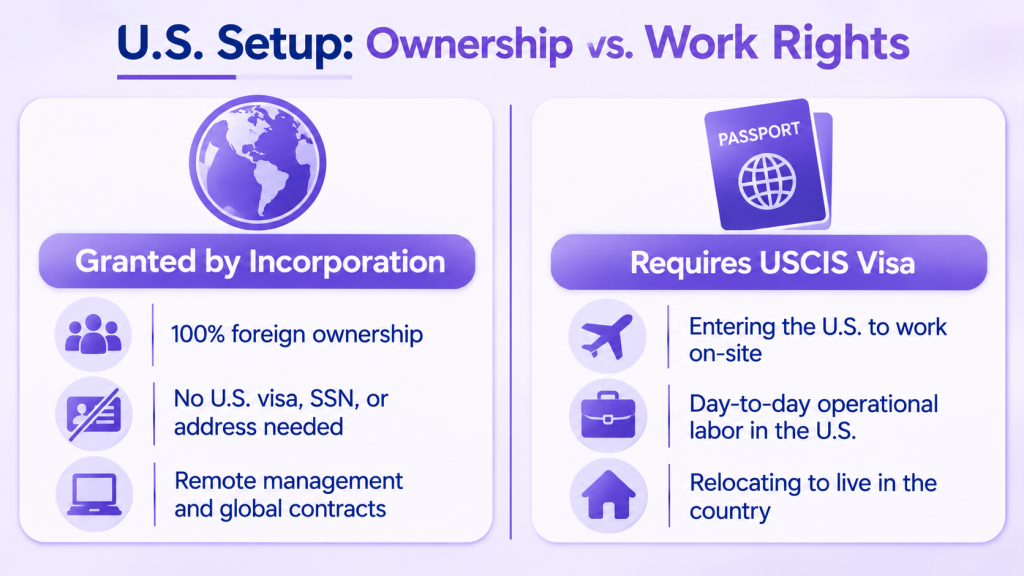
Yes. Federal and state laws permit non-resident foreign individuals and companies to register, hold shares, and function as officers or directors in a US business from a distance. It is not necessary to have an SSN, a US residential address, or a visa for incorporation.
But owning the business entity does not give permission to enter the country and work. Foreign founders can manage the company from outside the country, whereas those who relocate to work in the US will need work authorization or parole from USCIS.
Comparing U.S. Business Incorporation Structures
Selection of the right entity under the SBA and IRS guidelines determines liability protection, funding capability, and federal taxation. The non-resident entrepreneurs can either go for an LLC or C-Corporation, as federal laws forbid non-residents from being S-Corporation shareholders.
| Entity Structure | Foreign Ownership | Federal Tax Status | 2026 FinCEN BOI Status | Primary Use Case |
| LLC | 100% foreign ownership permitted. | Pass-through by default; optional corporate election (Form 8832). | Exempt as a U.S.-formed domestic entity. | E-commerce, consulting, SaaS, and holding entities. |
| C-Corporation | 100% foreign ownership; unlimited shareholders. | Separate taxpayer at the 21% federal corporate rate. | Exempt as a U.S.-formed domestic entity. | Venture-backed startups and scaling subsidiaries. |
| S-Corporation | Ineligible for nonresident aliens (IRC Section 1361). | Pass-through restricted to qualifying U.S. taxpayers. | Exempt as a U.S.-formed domestic entity. | Unavailable for nonresident founders. |
| Foreign Qualification | Overseas parent registered in a U.S. state. | Foreign corporation filing Form 1120-F on U.S. business income. | Must file BOI within 30 calendar days of state registration. | Overseas firms operating directly without a U.S. subsidiary. |
Both Delaware and Wyoming still serve as key formation states, although companies having an office, warehouse, or employees in other states also need to register as foreign corporations there.
Step-by-Step Guide to Open a Business in the US as a Foreigner
Following the SBA and IRS order of formation helps ensure that both state and federal record-keeping works seamlessly for banking.
- Choose Entity Type and State: The founders select an LLC or C-Corporation and check the requirements of the state for franchise tax and annual reports
- Appoint Registered Agent: Each state needs a registered agent inside the state with a street address for accepting legal notifications
- File Business Formation and Operating Documents: The agents file Articles of Organization/Incorporation with the Secretary of State and Operating Agreement/Bylaws
- Apply for IRS Employer Identification Number (EIN): Non-residents who lack SSN/ITIN cannot apply using the online portal of the IRS and will have to submit Form SS-4 through international fax, phone, and mail to the IRS
- Open Corporate Bank Account: After formation documents and EIN letter are received, the company completes institutional KYC checks to open U.S. accounts
Performing the five tasks in order ensures that no problems arise and that compliance is achieved prior to any income being generated.
IRS Tax, Form 5472, and 2026 FinCEN BOI Compliance
Post-Incorporation Governance involves very stringent requirements for reporting to the federal government regardless of lack of income from the U.S. during the year.
- Form 5472 Reporting Requirements: A 25% foreign-owned C-Corporation or 100% foreign-owned disregarded LLC with reportable related-party transactions (such as capital contributions) must file Form 5472 annually (attached to a pro forma Form 1120 for disregarded LLCs, even with $0 revenue); non-filing or incomplete filing carries a $25,000 penalty per return
- Tax Returns and State Returns: C-Corporations pay at a 21% tax rate on Form 1120, multi-member LLCs with effectively connected income file Forms 1065 and 1040-NR, and all entities file annual state reports
- BOI Rule under FinCEN (August 2026): Under FinCEN’s August 2026 final rule, U.S.-formed domestic entities are exempt from federal BOI reporting, whereas entities formed under foreign law that register to do business in a U.S. state must report within 30 calendar days
Maintaining U.S. accounting from the start shields foreign-owned entities from mounting federal information return penalties.
Visa and Work Authorization Pathways for Foreign Founders
As business incorporation doesn’t provide employment authorization, founders seeking relocation must fit into a special USCIS category rather than work on the B-1 visa.
- E-2 Treaty Investor: Available to citizens of treaty countries who invest significant funds in operating a U.S. business, on two-year renewals
- L-1A Intracompany Transferee: For an executive who has been employed continuously for at least one year with a qualifying parent firm abroad to establish a new U.S. office
- O-1A Extraordinary Ability: Initially granted for up to three years for founders with sustained national or international acclaim (a U.S. company owned by the founder may act as petitioner)
- International Entrepreneur Rule (IER): Provides up to 30 months of initial parole status for founders with at least 10% ownership in a startup founded within five years that received at least $311,071 investment from qualified U.S. sources or $124,429 in qualified government grants
For founders seeking permanent residency, they may consider EB-1A, EB-2 NIW, or EB-5 immigrant investor categories.
How We at Arnifi Streamline U.S. Market Entry
Arnifi provides a fully digital global expansion platform for startups, entrepreneurs, small/medium businesses, investors, and enterprises to create and run their cross-border companies faster, with transparency and ease of operation. As a CSP platform, we consolidate multi-jurisdictional incorporation and compliance management.
For global firms pursuing a Business Setup in the USA, our specialists coordinate state filings, registered agent setup, and IRS EIN submissions. Beyond registration, our advisory teams guide institutional onboarding for dedicated Banking Services to accelerate U.S. operational readiness.
Conclusion
A compliant business incorporation within the United States ensures that one has international investor credibility, payment structure, and access to the biggest commercial market in the world. Selecting an LLC or C-Corporation, obtaining an IRS EIN using Form SS-4, and maintaining annual Form 5472 requirements ensure that foreign-owned businesses are protected from harsh penalties of up to $25,000 by statute. Despite FinCEN’s final rule in August 2026 that exempted U.S.-based domestic businesses from federal BOI reporting, continuous state filings, accurate accounting, and USCIS work authorizations are crucial for conducting business.
Preparation of legal, taxation, and bank structures beforehand will save one a lot of trouble later on.
Contact us at Arnifi to incorporate and manage a compliant U.S. company with operational clarity.
FAQs
1. Can foreigners form a business entity in the USA without being resident in the USA?
Yes. Non-resident persons or entities from abroad can have 100% ownership of LLCs or C-Corporations in the USA and run businesses from anywhere in the world.
2. LLC or C-Corporation – which is better for foreign founders?
C-Corporations are ideal for venture-funded startups that offer shares, and LLCs work well for consulting firms, e-commerce, and holdings.
3. Can a foreign founder get an EIN from the IRS without having an SSN/ITIN?
Yes. Foreign individuals apply for an EIN using Form SS-4 without any fee through the IRS international fax, telephone, or mail services, other than online.
4. Is there still a need to submit a FinCEN BOI report in 2026 for U.S.-based companies
No. Under FinCEN’s August 2026 final rule, domestic entities formed in the USA are exempt, whereas entities formed under foreign law that register to do business in a U.S. state must report within 30 calendar days.
5. What is the reason for IRS Form 5472?
It reports related-party transactions by 25% foreign-owned corporations and 100% foreign-owned disregarded LLCs, with a $25,000 fine for noncompliance.
6. Can nonresidents be owners of an S-Corporation?
No. According to IRC Sec. 1361, ownership of an S corporation is limited to qualifying citizens and residents of the U.S.
7. Will creating a U.S. business give one a work visa?
No. Being an owner will not provide any work authorization in the U.S., and the founders need to qualify independently through E-2, L-1A, O-1A, or the IER parole route.
References
U.S. Small Business Administration (SBA), Business Launch & State Registration Guides
USA.gov, Start a Business Portal
Internal Revenue Service (IRS), Employer Identification Number (EIN) & Form SS-4
Internal Revenue Service (IRS), Limited Liability Company (LLC) & Foreign Persons
Financial Crimes Enforcement Network (FinCEN), Beneficial Ownership Information Reporting
Top USA Packages
Related Articles



Top USA Packages
Planning Your Next Business Move?
