
UAE Insurance Sector Growth | Premiums, Claims & Market Outlook

Anushka
Content Writer
Anushka Basu is a business content writer specialised in global business market insights. She aims to simplify complex regulatory, financial, and business concepts into… Read more

Tulika Saxena
AVP, Sales & Marketing | IIM Nagpur
Tulika Saxena specializes in business finance, sales strategy, and market positioning. Leads growth and partnerships, ensuring seamless business setup experiences and client success across… Read more



KEY FACT: UAE insurance-sector gross written premiums reached AED 35.7 billion in H1 2024, increasing 31.2% year-on-year, according to CBUAE data. The latest CBUAE figures show continued growth in the sector, with gross written premiums reaching AED 40.9 billion in H1 2025. This growth is expected to match a similar pace in 2026.
Table of contents
- Introduction
- UAE Insurance Sector Growth | Numbers
- Which Insurance Segments Are Driving UAE Premium Growth?
- How are Insurance Claims Changing in the UAE?
- What are UAE Insurance Technical Provisions?
- How Much Do UAE Insurance Companies Have in Invested Assets?
- Is the UAE Insurance Sector Financially Stable?
- What is the Current Profitability Picture for UAE Insurers?
- What is the Insurance Retention Ratio in the UAE?
- How Many Insurance Companies Operate in the UAE?
- What Do These UAE Insurance Sector Figures Mean for the Market?
- What is Driving Growth in the UAE Insurance Sector?
- What Does Insurance Sector Growth Mean for Businesses in the UAE?
- How Can Businesses Set Up an Insurance Company in the UAE?
- How Can Arnifi Help With UAE Insurance Business Setup?
- FAQs
- Conclusion
Introduction
The UAE insurance sector continues to play an important role in the country’s financial services market, with strong activity across health, property and liability, and life insurance.
Recent Central Bank of the UAE (CBUAE) data highlights significant growth in gross written premiums, alongside increases in claims, technical provisions and invested assets. The sector also continues to maintain strong capitalisation.
For insurers, businesses and investors, understanding these indicators provides a clearer picture of the UAE insurance market and its broader outlook.
UAE Insurance Sector Growth | Numbers
Gross written premiums are one of the key indicators used to measure insurance-sector activity. The latest CBUAE data reported gross written premiums of AED 35.7 billion during the first half of 2024, representing 31.2% year-on-year growth from AED 27.2 billion during the corresponding period.
Gross written premiums represent the total premiums written by insurers before accounting for deductions such as reinsurance.
Note: Gross written premiums reached AED 35.7 billion, reflecting 31.2% year-on-year growth in the latest CBUAE figures, with reference to its respected time period.
Which Insurance Segments Are Driving UAE Premium Growth?
Health insurance and property and liability insurance are among the largest contributors to premium activity in the UAE.
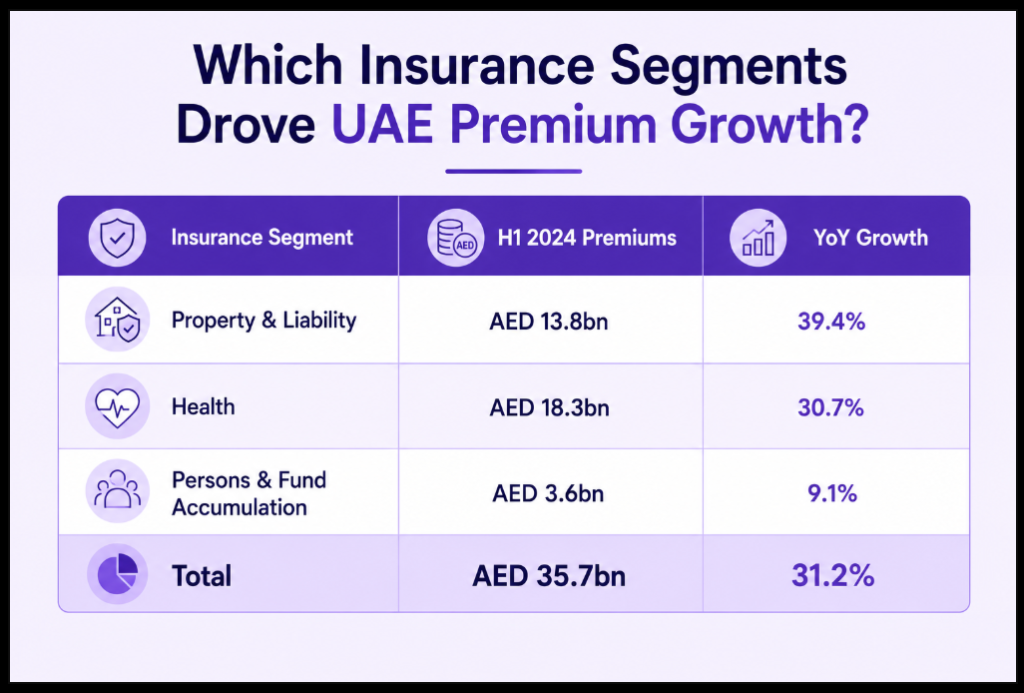
Property and Liability Insurance
Property and liability insurance recorded premiums of AED 13.8 billion, compared with AED 9.9 billion during the corresponding previous period, representing 39.4% growth.
Health Insurance
Health insurance remained the largest reported segment, with premiums reaching AED 18.3 billion, compared with AED 14.0 billion previously.
This represented 30.7% growth.
Persons and Fund Accumulation
Premiums in this segment reached AED 3.6 billion, compared with AED 3.3 billion previously, representing 9.1% growth.
The increase was primarily attributed to growth in group and individual life insurance premiums.
How are Insurance Claims Changing in the UAE?
Claims are another important indicator of insurance-sector performance.
CBUAE data reported gross paid claims of AED 18.9 billion, compared with AED 14.1 billion during the corresponding previous period, representing 34% growth.
Segment Breakdown
Property and Liability Claims
- AED 5.7 billion
- 46.2% year-on-year increase
Health Insurance Claims
- AED 10.7 billion
- Increased from AED 9.2 billion
Persons and Fund Accumulation Claims
- AED 2.5 billion
- 150% year-on-year increase
Claims therefore increased faster than gross written premiums in the period covered by the cited data, making claims development an important part of assessing the sector.
What are UAE Insurance Technical Provisions?
Technical provisions are amounts maintained by insurers to meet their accrued financial obligations.
The latest CBUAE figures referenced in this article show technical provisions of AED 94.2 billion, representing 22.8% growth compared with the corresponding previous period.
The increase reflects a larger volume of financial provisions being maintained against insurers’ accrued obligations.
How Much Do UAE Insurance Companies Have in Invested Assets?
Invested assets form an important part of insurers overall asset base.
CBUAE data reported invested assets of AED 78.7 billion, representing 50.8% of total assets.
For comparison, invested assets stood at AED 72.9 billion during the corresponding previous period and represented 57.1% of total assets.
Other reported figures included:
- Total insurance-sector assets: AED 154.8 billion
- Total equity: AED 28.0 billion
Although invested assets increased in absolute value, their share of total assets declined.
Is the UAE Insurance Sector Financially Stable?
The UAE insurance sector remains strongly capitalised according to the CBUAE’s reported indicators.
| Capital Indicator | Latest Reported Figure |
| Own Funds / Minimum Capital Requirement | 376% |
| Own Funds / Solvency Capital Requirement | 185.8% |
| Own Funds / Minimum Guarantee Fund | 286.7% |
The CBUAE described the sector as well-capitalised.
Changes in individual capital-adequacy ratios should be considered in context and should not automatically be interpreted as signs of financial stress.
What is the Current Profitability Picture for UAE Insurers?
Premium growth does not necessarily translate directly into higher profitability.
The net total profit to net written premiums ratio stood at 6%, compared with 10.4% during the corresponding previous period.
At the same time, return on average assets increased to 0.7%, compared with 0.5%.
These different movements demonstrate why premium growth should be assessed alongside claims, capital adequacy and profitability indicators.
What is the Insurance Retention Ratio in the UAE?
The insurance-sector retention ratio stood at 53.1% in the latest CBUAE figures referenced here, compared with 53.8% during the corresponding previous period.
Retained written premiums reached AED 18.9 billion, compared with AED 14.6 billion previously.
The retention ratio indicates the proportion of gross written premiums retained by insurers after reinsurance arrangements.
How Many Insurance Companies Operate in the UAE?
The UAE insurance market includes national insurers, takaful companies and branches of foreign insurance companies. The CBUAE reported 59 licensed insurance companies in the period covered by the cited data.
| Category | Number |
| Traditional national insurance companies | 23 |
| National takaful companies | 10 |
| Foreign insurance company branches | 25 |
| Foreign reinsurance company branch | 1 |
| Total | 59 |
The sector also included 498 insurance-related professions.
What Do These UAE Insurance Sector Figures Mean for the Market?
The available CBUAE data highlights several important characteristics of the UAE insurance market:
- Strong growth in gross written premiums
- Health insurance as a major premium segment
- Significant property and liability growth
- Increasing claims
- Higher technical provisions
- Growth in invested assets
- Strong capitalisation
- Mixed profitability indicators
- A diversified base of national, takaful and foreign insurers
The overall picture is therefore one of an active and expanding market where premium growth needs to be considered alongside claims, capital and profitability.
What is Driving Growth in the UAE Insurance Sector?
The CBUAE data specifically attributes premium growth to increases in:
- Property and liability insurance
- Health insurance
- Persons and fund-accumulation insurance
Growth in group and individual life insurance also contributed to the persons and fund-accumulation segment.
These figures provide evidence of increasing activity across major insurance categories without requiring unsupported assumptions about broader market drivers.
What Does Insurance Sector Growth Mean for Businesses in the UAE?
For insurers and investors, an expanding premium pool can create opportunities across major insurance categories.
However, businesses also need to consider:
- Claims management
- Technical provisions
- Capital adequacy
- Reinsurance
- Regulatory compliance
- Sustainable profitability
- Competition across insurance segments
For businesses evaluating the UAE market, the available data demonstrates both growth opportunities and the importance of effective risk and financial management.
How Can Businesses Set Up an Insurance Company in the UAE?
Insurance is a regulated activity in the UAE. Establishing an insurance company therefore involves requirements that go beyond those applicable to a conventional commercial business.
Depending on the proposed activity and structure, businesses may need to consider:
- Appropriate corporate structure
- Regulatory licensing
- Capital requirements
- Solvency requirements
- Governance and compliance
- Regulatory approvals
- Insurance-related professional requirements
Businesses can also seek support with insurance-related requirements and administrative processes alongside their wider UAE business setup. Arnifi can assist with relevant processes, helping entrepreneurs navigate the requirements involved in establishing and operating their UAE business, while insurance-specific regulatory approvals remain subject to the relevant authorities.
How Can Arnifi Help With UAE Insurance Business Setup?
Arnifi can support businesses with relevant setup and administrative requirements, including:
- UAE company formation
- Corporate structuring
- Business licensing
- Market-entry planning
- Documentation support
- Compliance guidance
- Administrative assistance
For insurance-related businesses, this can help entrepreneurs understand the broader business setup process while the required insurance-specific regulatory approvals remain with the relevant authorities.
FAQs
How large is the UAE insurance market?
CBUAE data reported gross written premiums of AED 35.7 billion in the first half of 2024.
How much did UAE insurance premiums grow?
Gross written premiums increased 31.2% year-on-year in the latest CBUAE period referenced in this article.
Which type of insurance has the largest market share in the UAE?
Health insurance recorded AED 18.3 billion in premiums in the latest CBUAE figures referenced here.
How many insurance companies operate in the UAE?
The CBUAE reported 59 licensed insurance companies in the period covered by the cited data.
Is the UAE insurance sector growing?
Yes. CBUAE data shows strong premium growth, although claims, capitalisation and profitability should also be considered.
Who regulates insurance companies in the UAE?
The Central Bank of the UAE regulates the UAE insurance sector.
Conclusion
The UAE insurance sector continues to be an important part of the country’s financial services market, with strong activity across health, property and liability, and life insurance.
CBUAE data shows gross written premiums of AED 35.7 billion in the latest period referenced, with premiums increasing significantly across major segments. Claims, technical provisions and invested assets also recorded growth.
The sector remained well-capitalised, while profitability indicators moved in different directions. This highlights the importance of looking beyond premium growth when assessing the insurance market.
For insurers, investors and businesses, the UAE continues to offer an active insurance environment supported by a diverse market of national, takaful and foreign insurers. Connect with our experts at Arnifi today to learn more!
References
Top UAE Packages


Related Articles



Top UAE Packages
Get in Touch