
Net Worth Certificate in the UAE | Requirements, Uses & Process

Anushka
Content Writer
Anushka Basu is a business content writer specialised in global business market insights. She aims to simplify complex regulatory, financial, and business concepts into… Read more

Tulika Saxena
AVP, Sales & Marketing | IIM Nagpur
Tulika Saxena specializes in business finance, sales strategy, and market positioning. Leads growth and partnerships, ensuring seamless business setup experiences and client success across… Read more



Key Fact: A Net Worth Certificate summarises an individual’s or business owner’s assets and liabilities to show their financial position at a particular date. In the UAE, it may be requested by banks, investors, government authorities or other institutions as part of financial verification and due diligence.
Table of contents
- Introduction
- When Is a Net Worth Certificate Required in the UAE?
- What Does a Net Worth Certificate Include?
- How Is Net Worth Calculated?
- How Does a Net Worth Certificate Support CDD and Source of Wealth Verification?
- What Documents Are Needed for a Net Worth Certificate?
- What Common Mistakes Should You Avoid?
- Who Can Prepare a Net Worth Certificate?
- How Can Arnifi Help With a Net Worth Certificate?
- FAQs
- Conclusion
Introduction
A Net Worth Certificate is a formal statement of a person’s financial position at a specified point in time. It brings together assets such as property, bank balances and investments and sets them against outstanding liabilities.
In the UAE, this type of document may be requested when an institution needs more than basic identification documents. Depending on the circumstances, it can support banking, investment, residency, financing or enhanced due diligence processes.
It is also relevant to the wider Customer Due Diligence (CDD) and Source of Wealth (SOW) process. UAE financial institutions are expected to understand a customer’s source of wealth and source of funds, with the level of evidence depending on the customer’s risk profile.
A net worth certificate can be simply defined as a formal statement of a person’s financial position at a specific point in time. Not only does it bring together assets like bank, balances, investments and properties, but it also sets them against outstanding liabilities.
When Is a Net Worth Certificate Required in the UAE?
There is no general rule requiring every individual or business owner in the UAE to obtain a Net Worth Certificate. It is usually prepared when a bank, government authority, investor, lender or another institution specifically asks for evidence of financial standing.
It may be useful in situations such as:
- Investor or residency-related applications
- Bank loans and mortgage applications
- Investment or business transactions
- Financial disclosures
- Cross-border transactions
- Enhanced due diligence
- Situations involving substantial assets or funds
The exact requirement depends on the organisation requesting the document and the purpose for which it is being submitted.
For financial institutions, the underlying reason is often verification. The CBUAE’s current guidance requires licensed financial institutions to understand relevant customer information, including source of wealth and source of funds, and to obtain supporting evidence where appropriate.
What Does a Net Worth Certificate Include?
A certificate normally presents a snapshot of the applicant’s financial position rather than simply listing one asset or bank balance.
| Information | What it covers |
| Applicant details | Name and other identifying information |
| Valuation date | Date on which the financial position is assessed |
| Assets | Property, cash, investments, business interests and other declared assets |
| Liabilities | Loans, mortgages and other outstanding obligations |
| Net worth | Total assets after deducting total liabilities |
| Professional details | Details and certification of the professional preparing the document |
| Supporting basis | Documents used to substantiate the figures |
The supporting evidence is important. A figure included in the certificate should be capable of being traced back to an ownership document, account statement, valuation or another appropriate record.
Depending on the purpose, the certificate may also include a declaration that the information has been prepared from documents and information supplied by the client.
How Is Net Worth Calculated?
The basic calculation is straightforward:
Net Worth = Total Assets − Total Liabilities
For example, if an individual’s verified assets total AED 8 million and outstanding liabilities total AED 2 million, the stated net worth would be AED 6 million.
The calculation itself is simple. Establishing the figures behind it is where most of the work lies.
Assets may include:
- Residential or commercial property
- Bank balances
- Fixed deposits
- Shares and other investments
- Business ownership interests
- Vehicles
- Other significant assets
Liabilities may include:
- Mortgages
- Personal loans
- Business loans
- Credit facilities
- Other outstanding financial obligations
The valuation date should also be clear because asset values and liabilities can change over time.
How Does a Net Worth Certificate Support CDD and Source of Wealth Verification?
A Net Worth Certificate can help bring different pieces of financial information into one document. This can be useful when an institution needs to understand how a customer’s wealth has been accumulated and whether the financial position is consistent with the information provided.
The CBUAE’s current CDD guidance specifically distinguishes between source of funds and source of wealth. Source of funds concerns the origin of money being used, while source of wealth concerns the sources that have generated or significantly contributed to a person’s overall wealth.
A certificate can therefore support:
- Financial-position verification
- Source of wealth documentation
- Enhanced due diligence
- Banking onboarding
- Investment reviews
- Risk assessment
It should not, however, be treated as a universal substitute for the underlying evidence. A bank or other institution can request additional documents depending on its own procedures and the risk associated with the relationship.
What Documents Are Needed for a Net Worth Certificate?
The documents required will depend on the assets and liabilities being declared.
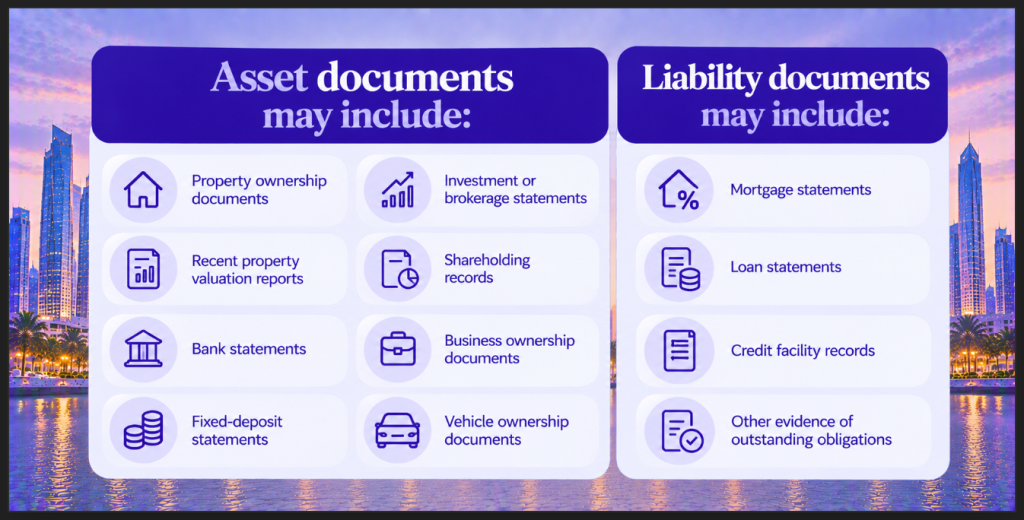
The more complete the supporting file, the easier it is to verify the figures used in the certificate.
For higher-risk customer relationships, the CBUAE guidance gives examples such as bank or brokerage statements and property documentation as evidence that may be used to corroborate source of wealth.
What Common Mistakes Should You Avoid?
A Net Worth Certificate can become difficult to use if the information behind it is incomplete or outdated.
Common problems include:
- Leaving out significant liabilities
- Using outdated property valuations
- Providing incomplete bank records
- Failing to document business ownership
- Using inconsistent figures across documents
- Preparing the certificate without adequate supporting evidence
Why does this matter?
An institution reviewing the certificate may ask for clarification when the figures do not match the underlying documents. That can delay an application or result in additional due diligence.
It is therefore better to prepare the supporting documentation before the certificate is finalised rather than trying to collect missing evidence afterwards.
Who Can Prepare a Net Worth Certificate?
The certificate is generally prepared or certified by an appropriately qualified accounting or financial professional, depending on the requirements of the organisation requesting it.
The final format can vary. Some institutions may specify:
- The professional qualification required
- Whether a signature is needed
- Whether a professional stamp or seal is required
- The valuation date
- Supporting documents
- Whether the certificate must be recently issued
For that reason, businesses and individuals should check the recipient’s requirements before preparing the final certificate.
How Can Arnifi Help With a Net Worth Certificate?
Arnifi can help businesses and individuals organise the information required for a Net Worth Certificate and coordinate the documentation needed for its intended use.
Support can include:
- Reviewing the required financial information
- Organising asset and liability documentation
- Coordinating certificate preparation
- Helping present financial information clearly
- Supporting document verification
- Guiding applicants on requirements based on the intended use
This can make the preparation process more structured, particularly when the certificate forms part of a wider banking, investment or regulatory application.
FAQs
What is a Net Worth Certificate in the UAE?
A Net Worth Certificate is a document that summarises an individual’s or business owner’s assets and liabilities and states their net financial position as of a specified date.
When is a Net Worth Certificate required?
It may be requested for banking, financing, investment, residency-related applications, financial disclosures or enhanced due diligence. It is not a universal requirement for every UAE resident or business owner.
What documents are needed for a Net Worth Certificate?
Documents can include property records, valuation reports, bank statements, investment statements, business ownership records, vehicle documents and evidence of loans or other liabilities.
How is net worth calculated?
Net worth is calculated by subtracting total liabilities from total assets. The figures should be supported by appropriate ownership, valuation and financial documents.
Who can prepare a Net Worth Certificate?
The certificate is generally prepared or certified by an appropriately qualified accounting or financial professional, subject to the requirements of the institution receiving it.
Conclusion
By now, we know a net worth certificate not only provides a proper understanding of an individual’s financial position, but it also brings together liabilities, assets and supporting evidence. Especially in the UAE, this is useful for investment financing, banking and every due diligence purpose where proof of financial standing is mandatory.
This certificate is a reliable source as long as the information supporting it is of the same nature. Complete financial records, accurate evaluation, and consistent documentation contribute to making the review process smoother.
Arnifi can support the preparation and coordination of the documentation required for a Net Worth Certificate and related UAE business and financial processes.
Official References
Top UAE Packages
Related Articles



Top UAE Packages
Get in Touch
