
UAE VAT Rules Change in 2026 | What Businesses Need to Know

Anushka
Content Writer
Anushka Basu is a business content writer specialised in global business market insights. She aims to simplify complex regulatory, financial, and business concepts into… Read more

Tulika Saxena
AVP, Sales & Marketing | IIM Nagpur
Tulika Saxena specializes in business finance, sales strategy, and market positioning. Leads growth and partnerships, ensuring seamless business setup experiences and client success across… Read more



Key Fact: The UAE has amended its VAT Executive Regulation through Cabinet Decision No. 149 of 2026. Most amendments take effect from 1 October 2026, while certain input-tax apportionment provisions apply from the first tax year beginning after 1 October 2027.
Table of contents
- Introduction
- What Has Changed Under the UAE VAT Rules?
- How Will the New Cash Payment Rule Affect Businesses?
- What Has Changed for Employee Accommodation?
- How Do the New Rules Affect Medical Products?
- What Is Changing in Input-Tax Apportionment?
- What Is the Change to the Capital Assets Scheme?
- What Is the New Rule for Composite Supplies?
- When Do the New UAE VAT Amendments Take Effect?
- What Should UAE Businesses Do Now?
- Why Do These VAT Changes Matter for UAE Businesses?
- How Can Arnifi Help With UAE VAT Compliance?
- FAQs
- Conclusion
Introduction
The UAE has introduced another round of changes to its VAT framework, with most of the new provisions taking effect from 1 October 2026. The amendments cover several areas that can affect how VAT-registered businesses record transactions and recover input tax. They also clarify existing provisions, including those on medical products, employee accommodation, and capital assets.
Another change comes later. The standard method for input-tax apportionment has been revised, but the new methodology will apply from the first tax year beginning after 1 October 2027. For businesses, the practical question is simple: which rules apply now, and which ones should you plan for later?
What Has Changed Under the UAE VAT Rules?
The main amendments introduced through Cabinet Decision No. 149 of 2026 are:
| VAT area | What has changed | When it applies |
| Cash payments | Input-tax recovery may be restricted for qualifying cash-paid supplies above a prescribed threshold | From 1 October 2026 |
| Employee accommodation | Input-tax recovery treatment for employee accommodation has been clarified | From 1 October 2026 |
| Medical products | VAT provisions for the supply and import of medical products have been updated | From 1 October 2026 |
| Input-tax apportionment | The standard apportionment methodology has been revised | From the first tax year beginning after 1 October 2027 |
| Capital Assets Scheme | The scope of the scheme has been clarified | From 1 October 2026 |
| Composite supplies | New rules address when interconnected components can be treated as one composite supply | From 1 October 2026 |
The Ministry of Finance says the amendments are intended to simplify procedures, provide greater clarity for taxable persons and support voluntary compliance.
How Will the New Cash Payment Rule Affect Businesses?
The amended VAT rules introduce a new restriction on input-tax recovery for certain supplies paid for, or intended to be paid for, in cash.
The important detail is that the value threshold has not been specified in the Cabinet Decision itself. A separate decision by the Minister of Finance will establish the applicable threshold.
What should businesses watch?
Businesses making substantial cash purchases should:
- Review their existing payment procedures
- Keep clear records of significant cash transactions
- Monitor the Ministerial decision establishing the threshold
- Check whether affected purchases could change their input-tax recovery position
- Update procurement and accounting procedures once the threshold is confirmed
The measure is intended to strengthen compliance and reduce the risk of tax evasion.
Until the separate threshold is issued, businesses should avoid assuming that a particular cash-payment amount automatically prevents input-tax recovery.
What Has Changed for Employee Accommodation?
The amendments clarify the VAT treatment of employee accommodation for input-tax recovery purposes.
The change matters particularly for employers that provide housing or accommodation as part of their employee arrangements. The amended rules introduce more specific conditions around when related input tax can be recovered.
What should employers review?
- Employee accommodation arrangements
- Employment contracts
- Internal HR policies
- VAT treatment of accommodation-related expenses
- Whether accommodation is provided because of a legal or regulatory requirement
The FTA has also issued a 2026 decision dealing with cases and conditions for input-tax recovery on employee expenses, so businesses should consider the Executive Regulation together with the relevant FTA requirements.
How Do the New Rules Affect Medical Products?
The VAT provisions covering the supply and import of medical products have been updated to align with the UAE’s revised healthcare legislative framework.
Businesses that may need to review their VAT treatment
- Healthcare businesses
- Pharmaceutical companies
- Medical-product suppliers
- Importers of relevant medical products
- Businesses involved in healthcare supply chains
The amendment does not mean that every healthcare or pharmaceutical product automatically receives the same VAT treatment. The applicable classification and conditions still need to be considered under the relevant legislation.
What Is Changing in Input-Tax Apportionment?
Input-tax apportionment becomes relevant when a business has input tax that cannot be directly attributed entirely to supplies allowing input-tax recovery.
The new rules replace the existing standard input-tax-based method with an output-based approach. Under the revised method, the proportion of recoverable input tax is calculated by reference to the value of supplies.
What does this mean in practice?
The revised method will:
- Use the value of relevant supplies in determining the apportionment percentage
- Exclude specified capital-asset supplies from the calculation
- Exclude certain receipts relating to concerned goods and services subject to the reverse-charge mechanism
- Apply a separate methodology to government entities and charities
The revised provisions do not begin on 1 October 2026. They apply from the first tax year commencing after 1 October 2027.
For a business whose tax year follows January to December, this would generally mean the new method applies from 1 January 2028.
Why should businesses prepare early?
Partially exempt businesses may need to model the effect of the revised calculation before it becomes applicable. That gives finance teams time to review their accounting systems and determine whether existing apportionment procedures need to change.
What Is the Change to the Capital Assets Scheme?
The amendments clarify the scope of the VAT Capital Assets Scheme.
One notable change is the wording used to define a capital asset. The amended provision focuses on a business asset with a cost rather than referring simply to a single item of business expenditure. The existing AED 5 million threshold and applicable useful-life conditions remain relevant.
Businesses with significant capital expenditure should review:
- Major business assets
- VAT incurred on qualifying capital expenditure
- Existing Capital Assets Scheme calculations
- The way qualifying assets are recorded in accounting systems
The change is a clarification of the framework rather than a reason to reassess every ordinary business expense.
What Is the New Rule for Composite Supplies?
Some transactions contain several components but function commercially as one supply.
The amended VAT rules now provide for a single composite supply where the components are interconnected and the nature and economic substance of the transaction show that they cannot reasonably be separated. The VAT treatment then follows the principal component.
This may matter to businesses selling:
- Packages
- Bundled services
- Combined products and services
- Interconnected offerings
Businesses should therefore look at how the components work together commercially, rather than relying only on separate pricing or invoicing.
When Do the New UAE VAT Amendments Take Effect?
There are two main implementation dates to track.
1 October 2026
Most of the amendments under Cabinet Decision No. 149 of 2026 take effect.
This includes the changes relating to cash payments, employee accommodation, medical products, composite supplies and the Capital Assets Scheme.
After 1 October 2027
The revised input-tax apportionment provisions apply from the first tax year commencing after this date.
1 January 2028
For businesses following a January–December tax year, the revised apportionment methodology would generally begin with the 2028 tax year.
This later date is important. The revised apportionment method should not be treated as an October 2026 requirement simply because the wider VAT amendments take effect then.
What Should UAE Businesses Do Now?
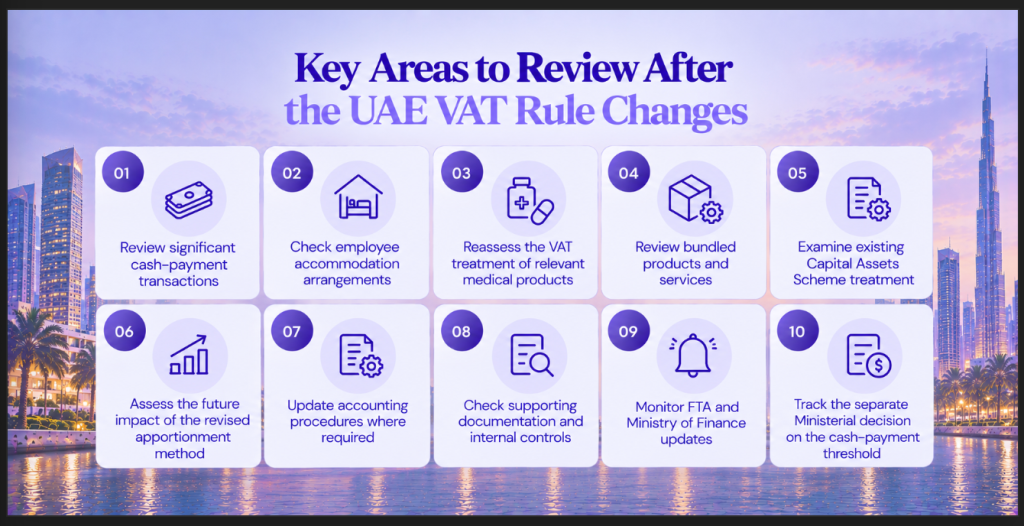
There is no need to overhaul every VAT procedure overnight. A targeted review can help identify where the amendments may affect existing processes.
A practical review can include:
The FTA’s current VAT legislation database includes the amended Executive Regulation and other related 2026 VAT decisions.
One point businesses should not overlook
The effective date is not the same for every amendment. Finance teams should map each change against the business’s own tax year and transaction profile before updating accounting procedures.
Why Do These VAT Changes Matter for UAE Businesses?
The amendments can affect how businesses handle transactions before those transactions ever reach a VAT return.
A payment method, for example, could become relevant to input-tax recovery where the new cash-payment restriction applies. Similarly, businesses providing employee accommodation may need to revisit their treatment of related expenses.
For businesses selling bundled offerings, the revised composite-supply provision may also require a closer look at contracts, pricing and invoicing arrangements.
The later change to input-tax apportionment is particularly relevant to businesses with residual input tax. Those businesses have more time to prepare, but the change may warrant analysis before the new methodology takes effect.
How Can Arnifi Help With UAE VAT Compliance?
Arnifi can help businesses review and manage their accounting and VAT processes when UAE tax rules change. Support can include VAT compliance, accounting and recordkeeping, transaction reviews, tax documentation and ongoing tax-related assistance. This can help businesses identify areas that may need to be updated following regulatory changes and keep their financial processes aligned with evolving UAE tax requirements.
FAQs
What are the latest UAE VAT rule changes in 2026?
Cabinet Decision No. 149 of 2026 amends several provisions of the UAE VAT Executive Regulation. The changes cover cash payments, employee accommodation, medical products, composite supplies, capital assets and input-tax apportionment. Most provisions apply from 1 October 2026, while the revised apportionment provisions take effect later.
When do the new UAE VAT rules take effect?
Most of the amendments take effect from 1 October 2026. The revised input-tax apportionment provisions apply from the first tax year beginning after 1 October 2027.
How do the new cash-payment rules affect input-tax recovery?
The amended rules restrict certain supplies where the consideration is paid, or intended to be paid, in cash above a value that will be specified by the Minister of Finance. The exact threshold has not been established in Cabinet Decision No. 149 itself.
What is changing in UAE VAT input-tax apportionment?
The standard method is changing from an input-tax-based approach to an output-based method linked to the value of supplies. Government entities and charities have a separate methodology under the amended rules. The revised provisions apply from the first tax year commencing after 1 October 2027.
Do the new UAE VAT rules affect employee accommodation and medical products?
Yes. The amendments clarify the treatment of employee accommodation for input-tax recovery and update VAT provisions concerning the supply and import of medical products. Businesses operating in these areas should review their current treatment against the amended provisions.
Conclusion
The UAE’s 2026 VAT amendments cover several areas of day-to-day tax administration, from cash payments and employee accommodation to composite supplies and capital assets.
Most of the changes take effect on 1 October 2026. The revised input-tax apportionment methodology comes later, applying from the first tax year beginning after 1 October 2027.
For businesses, the next step is to identify which changes actually touch their operations. Reviewing accounting procedures, transaction classifications and supporting documentation now can make the transition easier.
Further decisions and guidance will also matter for provisions that depend on additional requirements, including the threshold for the new cash-payment restriction.
Businesses that need support reviewing their UAE VAT and accounting processes can work with Arnifi for ongoing tax and compliance assistance.
References
Top UAE Packages
Related Articles



Top UAE Packages
Get in Touch
