
Saudi Arabia to Regulate Work Permits for Expatriate Dependents | What Businesses and Families Must Know

Anushka
Content Writer
Anushka Basu is a business content writer specialised in global business market insights. She aims to simplify complex regulatory, financial, and business concepts into… Read more

Tulika Saxena
AVP, Sales & Marketing | IIM Nagpur
Tulika Saxena specializes in business finance, sales strategy, and market positioning. Leads growth and partnerships, ensuring seamless business setup experiences and client success across… Read more


KEY FACT: Saudi Arabia allows eligible expatriate dependents to obtain an Ajeer work permit in specified circumstances. The current MHRSD service requires both the dependent and sponsoring expatriate to hold valid residency, with the dependent aged at least 18 and the employing establishment and sector also having eligibility conditions.
Table of contents
- Introduction
- Why is Saudi Arabia Regulating Work Permits for Expatriate Dependents?
- Who is Eligible for a Saudi Arabia Dependent Work Permit?
- Can Dependents Work in Saudi Arabia Without Changing Their Sponsorship?
- What Documents are Required for a Saudi Arabia Dependent Work Permit?
- How Do You Apply for a Work Permit as a Saudi Arabia Dependent?
- What Rights Does a Dependent Receive After Getting a Work Permit?
- How does the Dependent Work Permit Benefit Expatriate Families?
- How does the Dependent Work Permit Benefit Saudi Employers?
- How should Employers Prepare for Hiring Expatriate Dependents?
- What Challenges Can Employers and Dependents Face?
- How could the Rules Affect Saudi Arabia’s Labour Market?
- What does This Mean for Expatriate Spouses and Other Eligible Dependents?
- What should Dependents Do Before Starting Work in Saudi Arabia?
- How can Arnifi Help With Saudi Arabia Work Permits and Business Setup?
- FAQs
- Conclusion
Introduction
Saudi Arabia’s labour framework provides a regulated route for certain expatriate dependents to work without transferring their family sponsorship in applicable cases. The current Ministry of Human Resources and Social Development (MHRSD) service is delivered through Ajeer and authorises eligible dependents to work for a specific establishment for a defined period.
This is particularly relevant to expatriate families where a spouse or adult dependent already lives legally in Saudi Arabia but wants to participate in the formal workforce.
However, family residency and work authorisation are not the same thing. Holding a dependent Iqama does not, by itself, authorise employment. The applicable work permit must be obtained before the dependent starts working.
Why is Saudi Arabia Regulating Work Permits for Expatriate Dependents?
Historically, expatriate employment in Saudi Arabia has been closely connected to employer-sponsored work and residency arrangements. Dependents accompanying expatriate residents therefore faced restrictions on entering formal employment without the appropriate authorisation.
The dependent work-permit route provides an alternative mechanism for eligible family members to participate in employment while remaining connected to the sponsoring expatriate.
The broader objectives include that the establishment must be in the low-green range or above and in the listed sectors.
The policy can also make Saudi Arabia more attractive to expatriate families by allowing eligible spouses and dependents to pursue employment opportunities without necessarily changing their family-residency arrangement.
Who is Eligible for a Saudi Arabia Dependent Work Permit?
The current MHRSD Ajeer service identifies specific eligibility conditions. The accompanying dependent and the primary expatriate must both have valid residency permits, and the accompanying person must be at least 18 years old. The service also requires the relevant professional accreditation where applicable.
| Eligibility condition | Requirement |
| Dependent residency | Valid residency required |
| Primary expatriate | Must have valid residency |
| Age | At least 18 years |
| Relationship | Must fall within the permitted relationship categories |
| Professional accreditation | Required where applicable |
| Employer | Must satisfy applicable Ajeer conditions |
The current official service specifically identifies the relationship between the dependent and primary expatriate as including husband, wife or a specified eligible companion relationship.
Note: Do not assume that every adult child with family residency automatically qualifies. Eligibility depends on the specific Ajeer service conditions and the relationship category recognised under the applicable rules.
Can Dependents Work in Saudi Arabia Without Changing Their Sponsorship?
In applicable cases, yes. The Ajeer route is designed to allow eligible dependents to work without transferring their sponsorship to the employing establishment.
However, this does not mean a dependent can start working simply because they hold a valid family Iqama. A valid work authorisation is still required.
MHRSD’s current Ajeer service describes the permit as an electronic document authorising a worker to work for a specific establishment for a specific, temporary period.
Therefore, the practical distinction is:
Family residency = lawful residence in Saudi Arabia
Ajeer work permit = authorisation to perform the permitted work
This distinction is important for both employees and employers.
What Documents are Required for a Saudi Arabia Dependent Work Permit?
The exact documents can vary according to the application and employment arrangement. Applicants should generally be prepared to provide information supporting identity, residency, family relationship and professional eligibility.
| Document | Purpose |
| Passport | Identity verification |
| Valid Iqama/residency | Confirms lawful residence |
| Family relationship documents | Establishes eligibility |
| Professional credentials | Supports regulated roles |
| Employment information | Identifies the proposed work |
| Professional accreditation | Required where applicable |
Additional documentation may be requested by the relevant authority or employer.
Note: The document list should not be treated as a universal checklist for every dependent work-permit application. Current Ajeer requirements and the nature of the proposed employment determine what must be submitted.
How Do You Apply for a Work Permit as a Saudi Arabia Dependent?
The current MHRSD Ajeer process provides the relevant digital route.
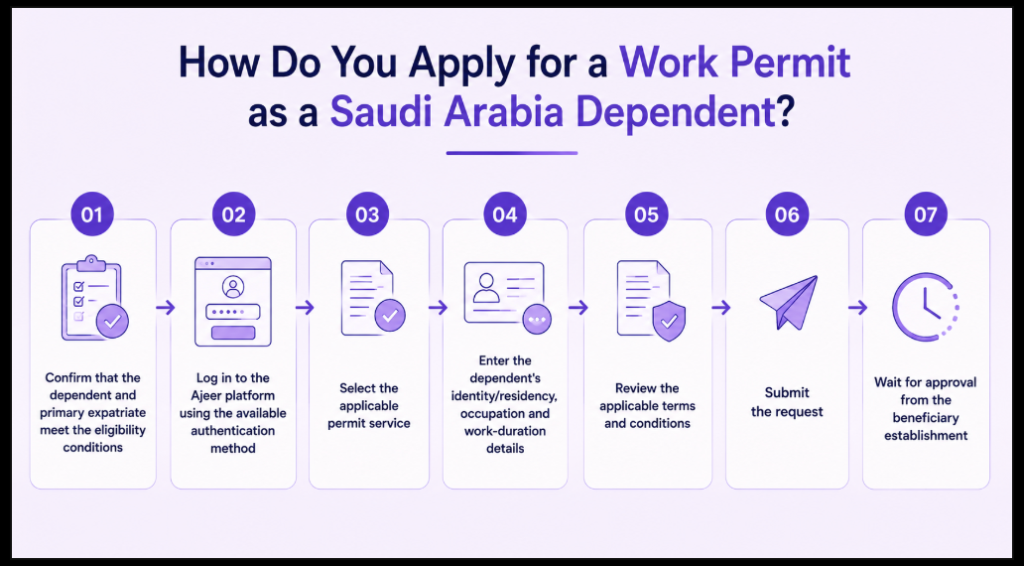
MHRSD service states that applicants can access Ajeer using a Qiwa account or the National Access Portal, select Permit Services and choose the temporary work-permit option. The service lists a five-working-day service duration and no service fee.
Relevant Authority: The Ministry of Human Resources and Social Development oversees the applicable labour and work-permit framework, while Ajeer provides the relevant electronic permit service.
What Rights Does a Dependent Receive After Getting a Work Permit?
An approved permit provides legal authorisation to perform the work covered by the permit and subject to its conditions.
Depending on the employment arrangement, the dependent may receive applicable employment rights and protections under Saudi labour regulations.
However, the permit should not be interpreted as unrestricted authorisation to work for any employer or in any occupation. The current Ajeer service specifically links the permit to a particular establishment and defined work period.
How does the Dependent Work Permit Benefit Expatriate Families?
Greater Career Opportunities
Eligible spouses and adult dependents can potentially pursue employment while continuing to live with their families in Saudi Arabia.
Better Workforce Participation
The route allows qualified family members who are already resident in the Kingdom to participate in the formal economy.
Greater Financial Independence
Employment can provide an additional source of household income and allow qualified dependents to maintain career continuity.
Professional Development
Working in Saudi Arabia can provide local experience, professional exposure and opportunities to develop existing qualifications.
The overall benefit is particularly relevant to expatriate households where a spouse or other eligible dependent previously remained outside the formal labour market.
How does the Dependent Work Permit Benefit Saudi Employers?
Employers can potentially access a wider pool of candidates who are already legally resident in Saudi Arabia.
This can provide:
- Access to existing expatriate talent
- A broader recruitment pool
- Greater workforce flexibility
- Reduced dependence on overseas recruitment for certain positions
- Potentially faster access to suitable candidates
For employers, however, recruitment still needs to comply with the applicable work-permit, occupation, professional accreditation and labour requirements.
How should Employers Prepare for Hiring Expatriate Dependents?
Employers should first confirm whether the proposed employment can be processed through the applicable Ajeer route.
HR teams should:
- Verify the dependent’s residency
- Confirm eligibility
- Check professional credentials
- Confirm the permitted employment arrangement
- Complete the applicable electronic process
- Maintain employment documentation
- Track permit validity
- Ensure the employee performs only permitted work
The employer should also avoid treating a family Iqama as equivalent to a work permit.
What Challenges Can Employers and Dependents Face?
Common challenges can include:
Eligibility Verification
The applicant may not satisfy the applicable relationship, residency or age requirements.
Professional Requirements
Certain occupations may require professional accreditation before the dependent can legally perform the role.
Employer Eligibility
The employing establishment must satisfy the conditions applicable to the Ajeer service. The current MHRSD service specifies establishment conditions for the relevant sectors, including green-range requirements.
Permit Limitations
An Ajeer permit is tied to the permitted establishment and work period. It should not be treated as an unrestricted employment licence.
How could the Rules Affect Saudi Arabia’s Labour Market?
The dependent work-permit route can increase labour-market participation by allowing qualified expatriate family members already living in the Kingdom to enter formal employment.
Potential effects include:
- Better utilisation of existing skills
- Greater workforce flexibility
- A broader talent pool
- Increased participation by expatriate spouses
- More recruitment options for eligible employers
- Reduced reliance on informal work arrangements
The impact will depend on the sectors, occupations and categories covered by the applicable implementation rules.
What does This Mean for Expatriate Spouses and Other Eligible Dependents?
For eligible dependents, the framework can create an opportunity to pursue employment without necessarily moving to a conventional employer-sponsored residency arrangement.
This can support:
- Career continuity
- Professional development
- Additional household income
- Greater economic participation
- Continued family residence in Saudi Arabia
However, eligibility should be confirmed before accepting employment because the rules do not provide blanket work authorisation to every dependent.
What should Dependents Do Before Starting Work in Saudi Arabia?
Before beginning employment, a dependent should:
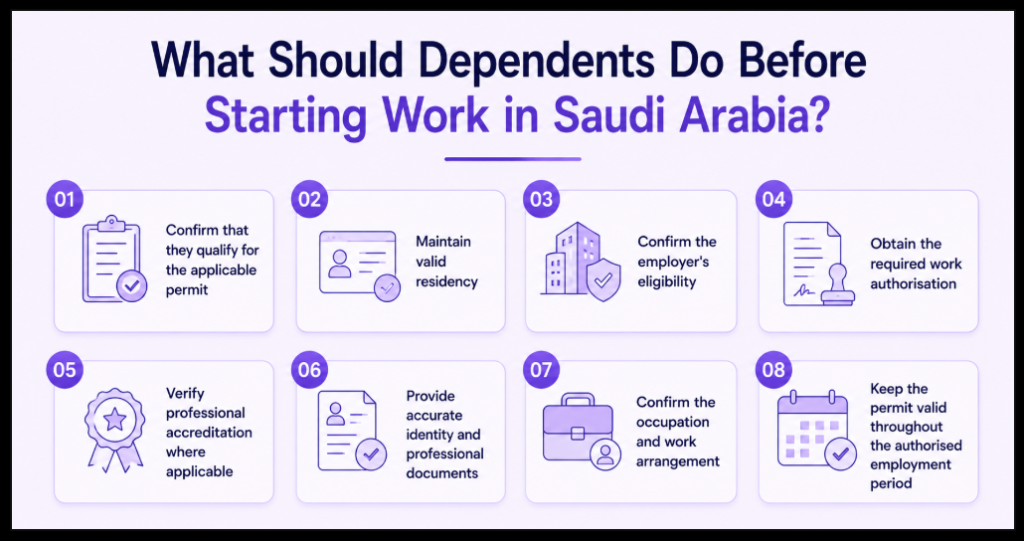
Note: A dependent should not assume that holding a family residency permit alone authorises employment. Saudi labour rules generally require non-Saudis to obtain the appropriate work authorisation before working.
How can Arnifi Help With Saudi Arabia Work Permits and Business Setup?
Arnifi can support businesses with:
- Saudi company formation
- Employment-related setup
- Workforce and HR processes
- Work-permit support
- Employee documentation
- Government-process assistance
- Labour compliance
- Ongoing business administration
For companies looking to recruit expatriate dependents, understanding the applicable employment route before onboarding can help reduce documentation and compliance issues.
FAQs
Can dependents work in Saudi Arabia on a family visa?
Eligible dependents may work through an applicable authorised route such as Ajeer, subject to current conditions.
How can an expatriate dependent get a work permit in Saudi Arabia?
Eligible dependents can use the applicable Ajeer electronic service and complete the required approval process.
Who is eligible for a dependent work permit in Saudi Arabia?
Current Ajeer rules require valid residency for the dependent and primary expatriate and an eligible relationship.
Can a spouse work in Saudi Arabia without changing sponsorship?
In applicable cases, Ajeer allows eligible dependents to work without transferring family sponsorship.
Can adult children of expatriates work in Saudi Arabia?
Eligibility depends on the applicable dependent category, age, residency and current Ajeer conditions.
What documents are required for a Saudi Arabia dependent work permit?
Requirements vary, but applicants may need valid residency, identity, relationship and professional documents.
Conclusion
Saudi Arabia provides a regulated mechanism through Ajeer for eligible expatriate dependents to participate in employment without necessarily transferring their family sponsorship. The current MHRSD service requires the dependent and primary expatriate to have valid residency, sets an 18-year minimum age and applies additional conditions depending on the employment arrangement.
The route is therefore different from simply allowing dependents to work on a family Iqama. Employers and dependents should confirm eligibility, obtain the appropriate authorisation and comply with occupation-specific requirements before employment begins.
For businesses, the framework can expand access to talent already living in Saudi Arabia. Arnifi can assist companies with Saudi business setup, employment processes and broader labour-compliance requirements. Connect with us today!
Official References
Top Saudi Arab Packages
Related Articles



Top Saudi Arab Packages
Get in Touch
