
Singapore VCC vs. Limited Partnership | Which Fund Structure Is Right for Your Strategy?

Zahira Shaik
SEO Content Writer
Zahira Shaik is an SEO Content Writer and Published Author specializing in research-based content. She excels at analyzing market trends, regulations, and industry developments… Read more

Tulika Saxena
AVP, Sales & Marketing | IIM Nagpur
Tulika Saxena specializes in business finance, sales strategy, and market positioning. Leads growth and partnerships, ensuring seamless business setup experiences and client success across… Read more


Key Fact: Singapore’s Variable Capital Company (VCC) enables dividends from capital, while a Limited Partnership (LP) depends only on the capital of the partners as per the partnership agreement.
Table of contents
- Introduction
- Legal Personality, Liability, and Investor Protection
- Capital Structure, Redemptions, and Distributions
- Umbrella VCC vs. Standalone Limited Partnership
- Tax Treatment, Double Tax Treaties, and Fund Incentives
- Governance, Fund Management, and Re-Domiciliation
- Singapore VCC vs. Limited Partnership: Side-by-Side Comparison
- VCC vs. LP: Which Fund Structure Should You Choose?
- How Arnifi Helps With Singapore Fund Setup and Compliance
- Frequently Asked Questions
- Conclusion: Choosing the Right Singapore Fund Structure
- References
Introduction
Comparison between Singapore VCC and Limited Partnership involves two different types of vehicles: the former being a corporation with varying capital, while the latter is a partnership for fixed capital. The choice of these entities can make a world of difference for the asset managers, family offices, and the private equity sponsors in Singapore under the Acts of 2018 and 2008, respectively.
Legal Personality, Liability, and Investor Protection
The decision on whether to opt for a separate legal entity or contract determines asset ownership and liability exposure.
Separate Legal Entity vs. Contractual Partnership
A VCC is a legal entity that can hold property and incur liabilities under Singapore law. A Limited Partnership (LP), however, is not a legal entity. It is simply a contractual partnership where the assets and liabilities of the business belong to the GP who conducts its affairs.
General Partner and Limited Partner Liability
The shareholders of a VCC are fully insulated from unlimited liability by virtue of having limited liability. On the other hand, the GP is personally responsible for any liabilities incurred under an LP. The LPs enjoy limited liability only if they are not actively involved in management.
Asset Protection and Sub-Fund Ring-Fencing
Under the VCC Act, a VCC may be set up as an umbrella structure. This ensures ring-fencing of liabilities of individual sub-funds. In a Limited Partnership, there is no statutory ring-fencing of liabilities.
Capital Structure, Redemptions, and Distributions
The fund liquidity mechanism is highly dependent on the structure of the entity.
Variable Capital and NAV-Based Redemptions in a VCC
In a VCC, there is flexibility of capital where the value of the shares is equal to the Net Asset Value (NAV). The shares get issued or redeemed automatically at NAV without any approval from the shareholders. VCCs pay dividends using capital or profits.
Capital Commitments, Drawdowns, and Waterfall Distributions in an LP
LPs use capital commitments and a drawdown mechanism where the investors commit the capital upfront, which is drawn by the GP for investments. The Limited Partnership Agreement (LPA) specifies the distributions, hurdle rates, and allocations of carried interest.
Which Structure Suits Open-Ended and Closed-Ended Funds?
The open-ended strategy, such as a liquid hedge fund, suits the VCC. Closed-ended strategies such as Private Equity, Venture Capital, and Real Estate suit the LP.
Umbrella VCC vs. Standalone Limited Partnership
Managers adopting multiple strategies need to consider operational scalability in deciding between a Singapore VCC vs. Limited Partnership.
How Umbrella VCCs and Segregated Sub-Funds Work
An umbrella VCC consists of various sub-funds operating within the same corporate entity. While the sub-funds have their own board of directors and service providers, they still have different investment strategies and accounts.
Managing Multiple Strategies Through Separate LPs
Managers using multiple strategies through LPs need to create different partnership structures. Every LP will have its own separate bank accounts and operational administration.
Operational Efficiency and Cost Considerations
An umbrella VCC allows for smoother operations as it involves centralized governance, corporate secretarial services, and boards of directors. Using multiple LPs would involve administrative costs for every entity that is registered.
Tax Treatment, Double Tax Treaties, and Fund Incentives
Tax Efficiency affects the net returns of global investors over the long run.
Corporate Tax Treatment of Singapore VCCs
Singapore considers a VCC a unified corporate body for taxation. Tax is calculated at the sub-fund level, but the VCC files a consolidated corporate tax return.
Tax Transparency of Singapore Limited Partnerships
Singapore LP is considered tax transparent. The company itself does not pay any direct income tax, but the profit or loss passes through to the tax resident partners.
Access to Singapore’s Double Tax Agreements (DTAs)
A Singapore tax-resident VCC will get access to more than 90 Singapore DTAs in its own name, while LPs do not get access to Singapore DTAs.
Section 13O, Section 13OA, and Section 13U Fund Tax Incentives
There are fund tax incentives offered by Singapore for qualifying economic gains. Section 13O is for corporate funds such as VCCs, while Section 13OA is for LPs.
Governance, Fund Management, and Re-Domiciliation
Regulatory compliance is vital for ensuring the durability of the fund and investor confidence.
Fund Manager and Singapore-Resident Director Requirements
A VCC must appoint a Monetary Authority of Singapore (MAS) licensed or registered fund manager. It requires at least one Singapore-resident director, or two for retail schemes.
General Partner Responsibilities and Local Manager Requirements
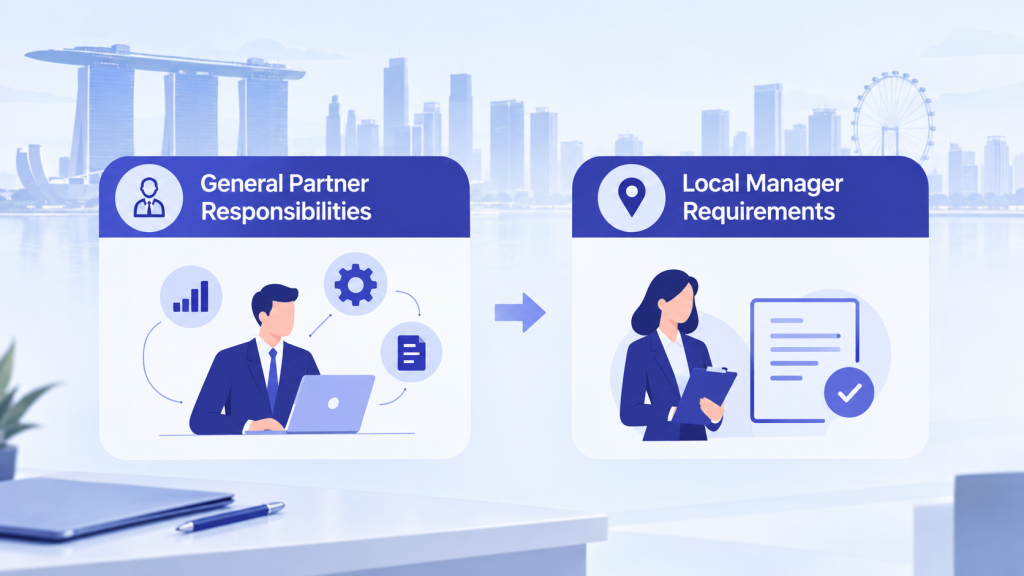
The GP is responsible for managing LP’s business activities and bears ultimate responsibility for its operations. If all GPs are non-Singapore residents, a local manager should be appointed to perform regulatory filings.
Moving an Existing Foreign Fund to Singapore
Foreign corporate funds can be re-domiciled directly into Singapore in a VCC structure, while retaining operating history. There is no legal possibility of re-domiciliation of a foreign limited partnership into Singapore.
Investor Privacy and Governance Considerations
VCCs provide public confidentiality of the register of shareholders, which is disclosed to regulatory agencies only. In LPs, the partners’ names are to be publicly registered with ACRA.
Singapore VCC vs. Limited Partnership: Side-by-Side Comparison
Evaluating key criteria simplifies selection for fund sponsors.
| Feature | Variable Capital Company (VCC) | Limited Partnership (LP) |
| Governing Legislation | Variable Capital Companies Act 2018 | Limited Partnerships Act 2008 |
| Legal Personality | Separate legal entity | No separate legal personality |
| Liability | Shareholders have limited liability | GP has unlimited liability; LP liability is conditional |
| Capital Structure | Variable capital linked to NAV | Commitments and drawdowns governed by LPA |
| Distributions | Paid from capital and profits | Governed by the LPA waterfall |
| Multiple Strategies | Umbrella structure with segregated sub-funds | Requires separate LP entities |
| Tax Treatment | Corporate entity | Tax-transparent |
| Treaty Access | Potential access in its own name | Partners rely on individual tax positions |
| Fund Tax Incentives | Section 13O and Section 13U | Section 13OA and Section 13U |
| Inward Re-Domiciliation | Available for foreign corporate funds | Not available |
VCC vs. LP: Which Fund Structure Should You Choose?
Strategy alignment guides the choice of the entity to be used when contrasting between a Singapore VCC and a Limited Partnership.
When to Choose a Limited Partnership
The LP is used where the investment strategy involves private equity, venture capital, or real estate funds where waterfall distributions and capital call structures are required.
When to Choose a Variable Capital Company
The VCC is used where there is a requirement for hedge funds, multi-strategy umbrella funds, or family office structures. Match liquidity needs and risk tolerance to the appropriate vehicle. Institutional investors seeking privacy and treaty access often prefer VCCs.uctures where corporate tax treaties are required.
Choosing Based on Investment Strategy and Investor Requirements
Institutional investors who want secrecy and tax treaty access may opt for a VCC.
How Arnifi Helps With Singapore Fund Setup and Compliance
Sponsors need professional assistance to meet regulatory obligations. With Arnifi, creating funds from inception to compliance is easy.
Fund Structure Planning and Entity Formation
Arnifi analyzes your plan to determine the best possible structure. Estimate your formation cost with Arni Cost Calculator.
Legal Documentation and Ownership Structure Visualization
Create legal documents quickly with Arni Docs. Visualize ownership layers and sub-funds with Arni Organogram.
Ongoing Compliance, Accounting, and Banking Support
Arnifi performs corporate secretarial duties, appoints local directors, files reports and tax returns, and sets up corporate banking.
AML Screening, Visa Processing, and Employer of Record (EOR) Services
Reduce compliance risk with Arni AML Checker. Obtain employment visas for crucial staff and recruit through Arnifi HR and EOR services.
Frequently Asked Questions
What is the difference between a Singapore VCC vs. Limited Partnership?
VCC is a corporate form of variable capital, whereas an LP is a tax-transparent partnership.
Is a VCC better than an LP for a hedge fund?
Yes, VCC works well for hedge funds because of NAV-based redemptions and capital adjustment flexibility.
Why do private equity funds use Limited Partnerships?
PE funds prefer to work with LPs because of fixed capital commitment, drawdown, and customized waterfall distributions.
Does a Singapore VCC provide limited liability to investors?
Yes, VCC shareholders benefit from limited liability protection.
How does taxation differ between a VCC and an LP?
VCCs pay tax as corporate entities, while LPs pass profits directly through to partners.
Can a Singapore VCC access double tax treaties?
Yes, tax-resident VCCs access Singapore’s DTA network in their own name.
What are the differences between Section 13O, Section 13OA, and Section 13U?
Section 13O applies to Singapore companies, whereas Section 13OA applies to LPs, and Section 13U – to large fund structures.
Conclusion: Choosing the Right Singapore Fund Structure
The choice of either a Singapore VCC or a Limited Partnership influences your management effectiveness, taxation, and attractiveness to investors. VCCs provide you with capital flexibility, segregation of sub-funds, and utilization of tax treaties. LPs provide you with tested commitment-based structures for closed-end funds.
- Learn how Arnifi makes fund structuring and entity formation easy.
- Consult Arnifi today to estimate your cost of formation with the Arni Cost Calculator.
- Optimize your compliance process, anti-money laundering process, and licensing through Arnifi.
- Team up with Arnifi to establish your Singapore fund effortlessly.
References
Top Singapore Packages
Related Articles

Top Singapore Packages
Get in Touch
