
Saudi Arabia Permanent Establishment Risk | When Foreign Companies May Create a Taxable Presence

Anushka
Content Writer
Anushka Basu is a business content writer specialised in global business market insights. She aims to simplify complex regulatory, financial, and business concepts into… Read more

Tulika Saxena
AVP, Sales & Marketing | IIM Nagpur
Tulika Saxena specializes in business finance, sales strategy, and market positioning. Leads growth and partnerships, ensuring seamless business setup experiences and client success across… Read more


Key Fact: Under Saudi Arabia’s Income Tax Law, a non-resident may be subject to income tax when conducting business through a permanent establishment in the Kingdom. The applicable tax treaty may also affect whether a permanent establishment exists and how profits are taxed.
Table of contents
- What Is a Permanent Establishment in Saudi Arabia?
- Which Activities Can Create a Permanent Establishment in Saudi Arabia?
- Can Employees or Consultants Create a Permanent Establishment in Saudi Arabia?
- How Long Can a Foreign Company Operate in Saudi Arabia Before Creating a Permanent Establishment?
- Can a Dependent Agent Create a Permanent Establishment in Saudi Arabia?
- Which Activities May Be Excluded From Permanent Establishment Rules?
- What Are the Tax Consequences of Creating a Permanent Establishment in Saudi Arabia?
- What Is the Difference Between Permanent Establishment Risk and Withholding Tax?
- How Can Foreign Companies Assess and Manage Permanent Establishment Risk?
- What Should a Foreign Company Do If It Creates a Permanent Establishment?
- How Can Arnifi Help With Saudi Arabia Business Setup?
- FAQs
- Conclusion
What Is a Permanent Establishment in Saudi Arabia?
A permanent establishment (PE) is a business presence that allows a country to tax certain profits earned by a foreign enterprise. In Saudi Arabia, a non-resident conducting business through a permanent establishment may become subject to corporate income tax on the income attributable to that presence.
A foreign company does not always need to incorporate a separate Saudi entity before permanent establishment risk arises. Its existing business arrangements may be enough to trigger a review of its tax position.
Saudi Arabia’s Income Tax Law identifies circumstances in which a non-resident may have a PE. An applicable double tax treaty may contain additional conditions or definitions that affect the outcome.
For international businesses, understanding permanent establishment risk early can help prevent unexpected tax liabilities and reporting issues.
Which Activities Can Create a Permanent Establishment in Saudi Arabia?
The nature and location of a company’s activities can affect whether it creates a taxable presence in the Kingdom.
Activities that may create permanent establishment risk include:
- Operating through a fixed place of business in Saudi Arabia
- Maintaining a licensed branch that conducts business in the Kingdom
- Carrying out construction, assembly or installation projects
- Performing supervisory activities connected with qualifying projects
- Surveying natural resources or operating related equipment in circumstances covered by the law
- Providing services where the applicable tax treaty’s service PE provisions are satisfied
- Conducting business through an agent in circumstances covered by domestic law or the relevant treaty
The precise conditions vary. A construction project may be assessed under a specific duration threshold in a treaty, while a fixed place of business may be examined under a different test.
Businesses should therefore assess the actual activities being carried out rather than rely only on the absence of a registered Saudi office.
Can Employees or Consultants Create a Permanent Establishment in Saudi Arabia?
Yes, employees and consultants working in Saudi Arabia can contribute to permanent establishment risk. The outcome depends on their responsibilities, the services performed and the applicable legal provisions.
Consider a foreign engineering company that sends employees to Saudi Arabia to supervise a local infrastructure project. If the work falls within the relevant construction or service PE rules, the company’s activities may create a taxable presence.
Businesses should review the following arrangements:
- On-site consulting and technical assignments
- Employees supervising construction or installation work
- Consultants delivering services within the Kingdom
- Personnel working on extended client projects
- Staff representing the company in commercial activities
The duration of a project may matter, particularly where the applicable treaty contains a service or construction threshold. The nature of the work also matters. A brief visit for internal meetings may have a different tax profile from employees delivering a contracted service on the ground.
Companies should review domestic legislation and the relevant treaty separately. A conclusion under one set of rules should not automatically be applied to the other.
How Long Can a Foreign Company Operate in Saudi Arabia Before Creating a Permanent Establishment?
There is no single time limit that determines permanent establishment risk for every foreign company. The relevant threshold depends on the type of activity, the applicable domestic provisions and the wording of any tax treaty.
Some Saudi tax treaties contain duration thresholds for construction projects or services. ZATCA’s guidance on permanent establishment taxation discusses treaty provisions that use thresholds such as more than 182 days, 183 days or six months within a specified period. The applicable period and test vary by agreement.
| Business activity | What to check |
| Construction and installation | Project duration and the relevant treaty’s construction PE provision |
| Consulting and technical services | Whether the treaty contains a service PE clause and how its duration test operates |
| Fixed place of business | Whether the location and activities satisfy the applicable PE conditions |
| Work through an agent | The agent’s authority, activities and the relevant legal provisions |
A company should not assume that remaining below a particular day-count threshold removes every form of PE risk. Another provision may apply independently, depending on the business arrangement.
Can a Dependent Agent Create a Permanent Establishment in Saudi Arabia?
A foreign company may face permanent establishment risk when it conducts business through an agent operating in Saudi Arabia. The outcome depends on the agent’s role and the applicable domestic law or treaty.
A review should consider whether the agent:
- Represents the foreign company in commercial dealings
- Negotiates or concludes contracts in circumstances covered by the applicable rules
- Acts under the foreign company’s authority
- Performs activities that go beyond the role of an independent service provider
The distinction between a dependent and an independent agent can be important. An independent agent acting in the ordinary course of its business may receive different treatment under a treaty from an agent whose activities effectively represent the foreign enterprise.
Companies should review the agent’s actual responsibilities, contractual authority and working arrangements. The title used in an agreement alone may not settle the question.
Which Activities May Be Excluded From Permanent Establishment Rules?
Saudi Arabia’s domestic Income Tax Law provides exclusions for certain activities carried out by a non-resident in the Kingdom. These include specified activities involving goods, information gathering and preparatory or auxiliary functions, subject to the applicable legal conditions.
Examples include:
- Using a location solely to store, display or deliver goods belonging to the non-resident
- Maintaining stock for processing by another person
- Purchasing goods or collecting information solely for the non-resident
- Carrying out qualifying preparatory or auxiliary activities
- Preparing certain contracts for signature involving loans, goods or technical services
These exclusions should be assessed carefully. The activity must satisfy the relevant conditions, and the applicable tax treaty may use different wording or impose additional requirements.
A location used for storage, for example, should not automatically be treated as exempt without examining the activities carried out there and the relevant legal provisions.
What Are the Tax Consequences of Creating a Permanent Establishment in Saudi Arabia?
A foreign company that creates a PE may become subject to Saudi corporate income tax on the taxable profits attributable to its activities in the Kingdom.
The tax calculation generally requires the company to identify the income associated with the PE and determine which expenses can be deducted under the applicable rules.
Key considerations include:
- Income generated by the Saudi business activities
- Expenses incurred for the purposes of conducting business through the PE
- Supporting records for revenue, costs and project transactions
- Applicable corporate income tax filing and payment requirements
- Treaty provisions affecting the scope of taxable profits
Saudi Arabia’s standard income tax rate is generally 20% for the relevant taxable income of non-residents conducting business through a PE, subject to the applicable law and any special regimes. The treatment of oil and hydrocarbon activities may differ.
A treaty may also affect how profits are attributed to the PE. ZATCA’s guidance explains that treaty provisions generally focus on profits attributable to the PE, while the wording of the specific agreement must be reviewed for any additional rules.
What Is the Difference Between Permanent Establishment Risk and Withholding Tax?
Permanent establishment and withholding tax are separate tax considerations. A company may need to assess both when receiving income from Saudi Arabia.
Withholding tax can apply to certain payments made from a Saudi source to a non-resident. The applicable rate depends on the payment category, domestic legislation and any available treaty relief.
| Tax consideration | Permanent establishment | Withholding tax |
| Main focus | Taxable business presence in Saudi Arabia | Certain payments made to non-residents |
| Tax treatment | Tax on taxable profits attributable to the PE, subject to applicable rules | Tax deducted from qualifying payments at the applicable rate |
| Key factors | Business activities, location, duration and treaty provisions | Payment type, recipient status and applicable tax rules |
| Possible compliance | Registration, tax returns and payment obligations | Withholding, reporting and payment requirements where applicable |
The absence of a PE does not automatically remove Saudi tax obligations. A payment to a non-resident may still fall within withholding tax rules, although a relevant treaty may provide relief.
Businesses should classify each transaction correctly before determining which tax requirements apply.
How Can Foreign Companies Assess and Manage Permanent Establishment Risk?
Foreign companies should assess their Saudi activities before starting a project or sending personnel into the Kingdom.
The following checks provide a useful starting point:
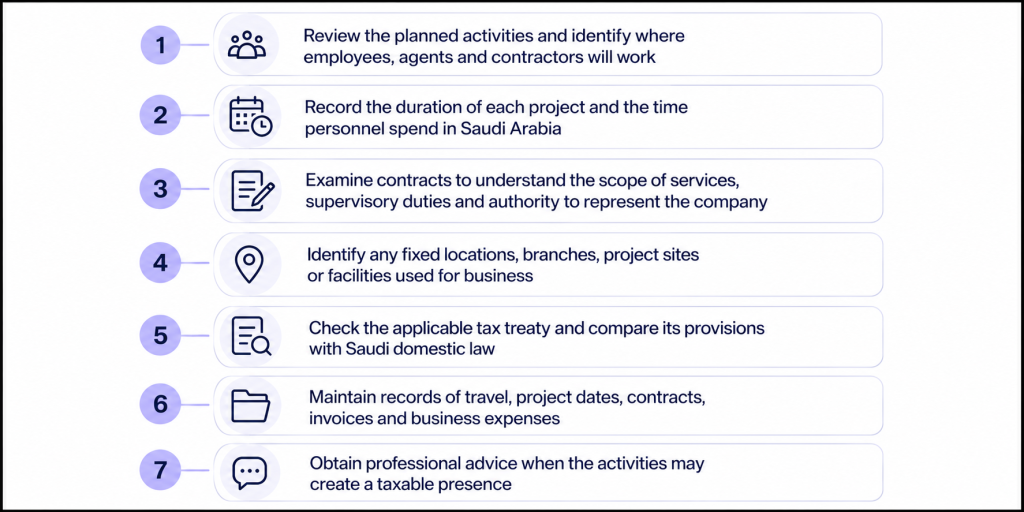
These checks should be repeated when a project changes scope, personnel remain in the Kingdom longer than expected, or a local agent takes on additional responsibilities.
What Should a Foreign Company Do If It Creates a Permanent Establishment?
If a company’s activities may create a PE, it should assess its tax position promptly and determine the steps needed to comply with Saudi requirements.
The process generally involves:
- Confirming whether the activities create a PE under domestic law and the applicable treaty
- Identifying the registration and reporting requirements that apply
- Determining the income and allowable expenses attributable to the Saudi activities
- Reviewing corporate income tax return and payment obligations with ZATCA
- Maintaining records to support tax calculations and any treaty position
- Reviewing withholding tax obligations associated with payments to or from non-residents
Businesses should not wait until a project ends to examine possible tax exposure. Early assessment can help identify documentation gaps and clarify the steps needed to meet applicable obligations.
How Can Arnifi Help With Saudi Arabia Business Setup?
Establishing a business in Saudi Arabia involves understanding the relevant incorporation requirements, preparing company documents and completing the applicable administrative procedures. Arnifi can support businesses exploring company formation in the Kingdom by helping them understand the incorporation process and organise the documentation required to establish their business.
FAQs
What qualifies as a permanent establishment in Saudi Arabia?
A PE may arise when a non-resident conducts business through a qualifying fixed place, branch, construction or installation project, agent or service arrangement covered by the applicable rules. The precise test depends on domestic law and any relevant tax treaty.
Can a foreign company create a PE without opening a Saudi office?
Yes. A separate incorporated office is not always necessary. A foreign company may create a taxable presence through qualifying project activities, services, a fixed place of business or an agent.
How many days can employees work in Saudi Arabia before creating a PE?
There is no universal threshold. Certain tax treaties contain specific duration tests for services or construction projects, while other PE provisions may operate differently.
Can a dependent agent create a taxable presence?
Yes, in circumstances covered by Saudi domestic law or the relevant treaty. The agent’s authority and actual activities are important when assessing the arrangement.
Does a permanent establishment have to pay corporate income tax?
A qualifying PE of a non-resident may be subject to Saudi income tax on its taxable profits, subject to applicable domestic law and treaty provisions. Registration, filing and payment requirements should be assessed separately.
Can a company face withholding tax without having a PE?
Yes. Saudi withholding tax may apply to certain Saudi-source payments made to non-residents even when the recipient has no PE in the Kingdom. The payment type, domestic rules and applicable treaty determine the treatment.
Conclusion
Permanent establishment risk in Saudi Arabia can arise through a fixed business location, project work, service delivery or activities conducted through an agent. The tax consequences depend on the company’s actual operations, the Income Tax Law and any applicable treaty.
Foreign businesses should review their contracts, project timelines, personnel responsibilities and local arrangements before starting or expanding activities in the Kingdom. Assessing potential exposure early with Arnifi can help companies prepare for tax registration, reporting and payment obligations where required.
References
Top Saudi Arab Packages
Related Articles

Top Saudi Arab Packages
Get in Touch
