
UAE Salary Slip Format | Complete Guide for Employees

Anushka
Content Writer
Anushka Basu is a business content writer specialised in global business market insights. She aims to simplify complex regulatory, financial, and business concepts into… Read more

Tulika Saxena
AVP, Sales & Marketing | IIM Nagpur
Tulika Saxena specializes in business finance, sales strategy, and market positioning. Leads growth and partnerships, ensuring seamless business setup experiences and client success across… Read more



KEY FACT: There is no single mandatory visual format for every UAE salary slip. Employers should maintain accurate payroll records showing salary components, deductions, gross pay, net pay and payment details.
Table of contents
- What is a UAE Salary Slip?
- Free UAE Salary Slip Templates
- UAE Salary Slip Format Example
- How to Read the Salary Slip
- UAE Salary Slip Format | Example Table
- What Information Should a UAE Salary Slip Include?
- Is There an Official UAE Salary Slip Format?
- UAE Salary Slip Requirements
- UAE Salary Slip and WPS
- Basic Salary vs Gross Salary vs Net Salary
- How to Calculate Salary on a UAE Salary Slip
- UAE Salary Slip Example With Calculation
- How to Create a UAE Salary Slip
- UAE Salary Slip for Different Employees
- Salary Slip vs Other Documents
- Can a Salary Slip Be Used as Proof of Income?
- Common UAE Salary Slip Problems
- UAE Salary Slip Checklist
- FAQs
- How Can Arnifi Help With UAE Payroll and Compliance?
- Conclusion
What is a UAE Salary Slip?
A salary slip in the UAE is a document that reflects an employee’s salary details and deductions, among other things. A salary slip makes it easy for the employee to know about their monthly salary, and the salary details in the slip should remain the same as stated in the employment contract.
Free UAE Salary Slip Templates
A practical salary slip can be prepared in several formats depending on the employer’s payroll system.
UAE Salary Slip Excel Template: Excel works well for employers needing formulas for allowances, overtime, deductions, gross salary and net salary.
UAE Salary Slip Word Template: Word is suitable for simple, individually prepared salary slips that can later be exported as PDFs.
UAE Salary Slip PDF: PDF is useful for issuing a fixed, non-editable copy to an employee.
UAE Salary Slip Google Sheets Template: Google Sheets can support collaborative payroll administration, but access should be restricted because salary information is confidential.
Arabic-English Salary Slip Template: A bilingual format can make payroll information easier to understand for employees and HR teams.
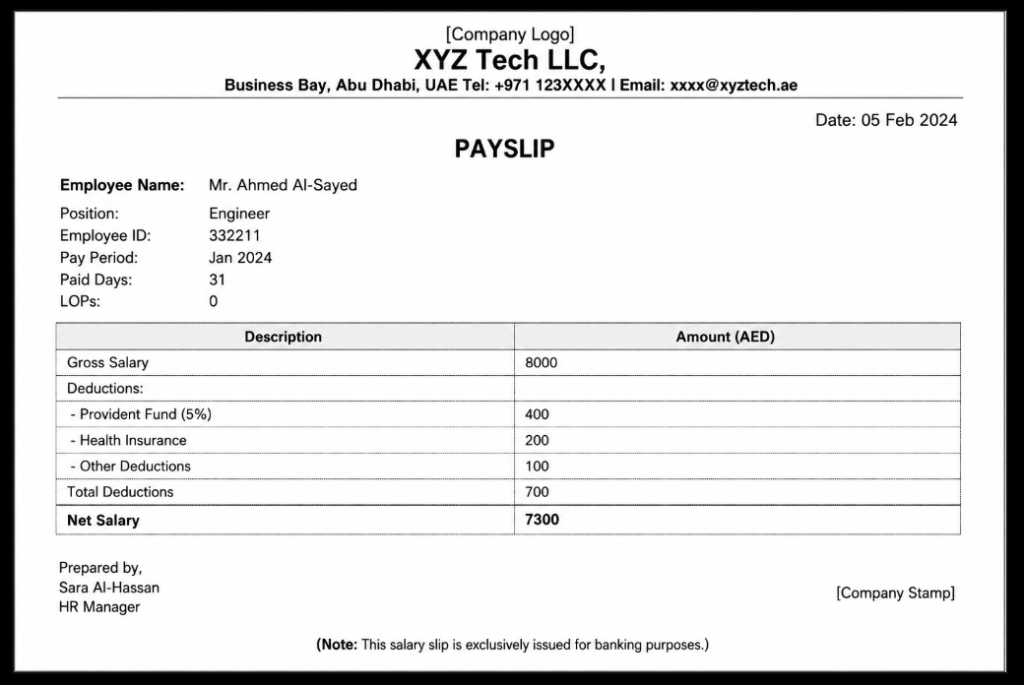
UAE Salary Slip Format Example
| Salary slip field | Example |
| Employer | ABC Trading LLC |
| Employee | John Doe |
| Salary period | August 2026 |
| Basic salary | AED 6,000 |
| Housing allowance | AED 2,000 |
| Transport allowance | AED 1,000 |
| Gross salary | AED 9,000 |
| Deductions | AED 500 |
| Net salary | AED 8,500 |
| Payment date | 31 August 2026 |
How to Read the Salary Slip
The basic calculation is:
Basic salary + allowances + overtime + bonuses = Gross salary
Gross salary − applicable deductions = Net salary
Employees should compare these figures with their employment contract and actual bank payment.
UAE Salary Slip Format | Example Table
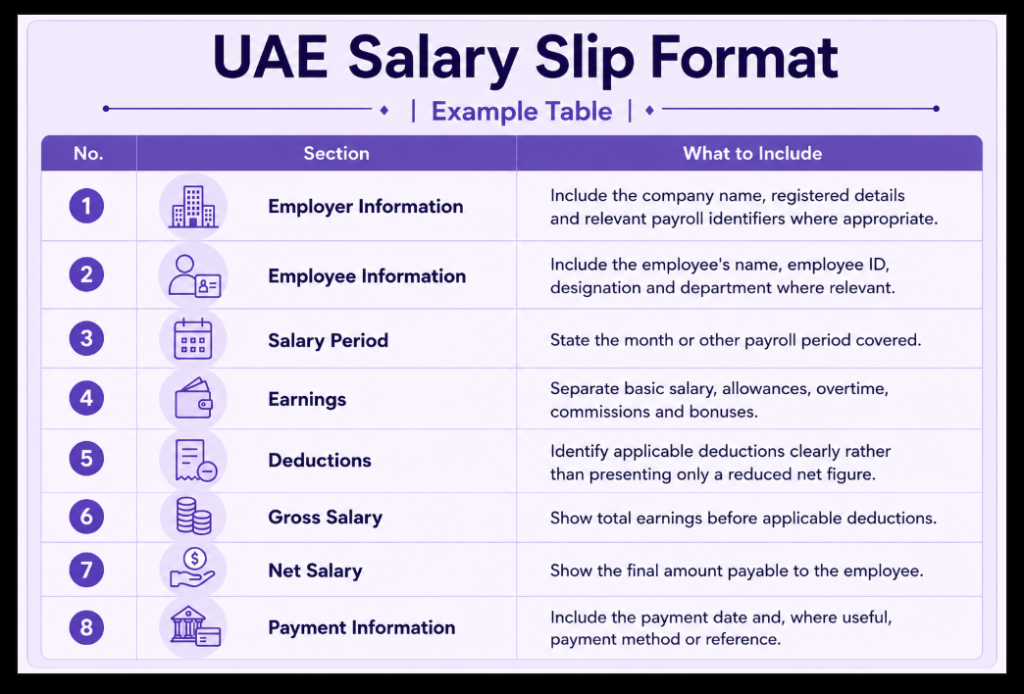
What Information Should a UAE Salary Slip Include?
| Payslip Component | Content / Description |
| Employer Details | Company name and relevant identifying information |
| Employee Details | Employee name, identification number, and job information |
| Basic Salary | Fixed basic wage stated in the employment arrangement |
| Allowances | Housing, transport, communication, and other contractual allowances |
| Overtime | Applicable overtime earnings separately identified |
| Bonuses & Commissions | Variable payments shown separately where applicable |
| Deductions | Itemised deductions made during the payroll period |
| Gross Salary | Total applicable earnings before deductions |
| Net Salary | Final amount payable after applicable deductions |
| Payment Date | Date on which the salary was paid or processed |
The UAE Labour Law defines basic wage separately from wage, with wage potentially including cash allowances and in-kind benefits.
Is There an Official UAE Salary Slip Format?
Standard vs Employer-Specific Format
There is no single visual salary-slip template that every UAE employer must reproduce. Employers can use their own payroll format while maintaining accurate records and complying with applicable employment requirements.
Legal Requirements vs Recommended Fields
Some fields are essential for understanding payroll, while others are useful additions. A good salary slip should make the calculation transparent rather than simply displaying the final amount.
UAE Salary Slip Requirements
UAE Labour Law: The employment contract should specify the salary and relevant employment terms. Salary documentation should remain consistent with those agreed terms.
Employment Contract: The contract is the reference point for agreed remuneration, while the salary slip records the amount calculated for a particular period.
Wage Payment: Employers must pay wages on their applicable due dates. Current UAE wage-payment rules also provide for WPS-related requirements for covered establishments.
WPS: Employers covered by WPS should ensure payroll records and wage payments are properly aligned.
Payroll Records: Employers should retain appropriate payroll and supporting records rather than relying solely on individual salary slips.
UAE Salary Slip and WPS
What Is WPS?
The Wage Protection System is an electronic mechanism for transferring and monitoring employee wages through approved financial institutions.
How WPS Works
Covered employers process employee wages through the applicable WPS arrangement, helping monitor whether wages are paid according to registered employment terms and applicable timelines.
Salary Slip vs WPS
A salary slip explains how salary was calculated.
WPS concerns how wages are paid and monitored.
What If Salary Slip and Bank Credit Differ?
Check whether the difference results from an authorised adjustment, deduction, unpaid leave, advance or payroll correction. If unexplained, HR should reconcile the payroll, bank and WPS records.
Basic Salary vs Gross Salary vs Net Salary
Basic Salary
Basic wage is the salary component specified in the employment contract without additional allowances or benefits.
Gross Salary
Gross salary generally combines basic salary with applicable allowances and other earnings.
Net Salary
Net salary is the amount remaining after applicable deductions.
Example Calculation
Basic salary: AED 6,000
Allowances: AED 3,000
Gross salary: AED 9,000
Deductions: AED 500
Net salary: AED 8,500
How to Calculate Salary on a UAE Salary Slip
- Basic Salary: Start with the contractual basic salary
- Allowances: Add applicable contractual allowances
- Overtime: Add eligible overtime payments calculated under the applicable employment rules
- Bonuses: Include bonuses or commissions payable for that period
- Deductions: Subtract applicable and properly supported deductions
- Net Salary: Gross earnings − applicable deductions = Net salary
UAE Salary Slip Example With Calculation
| Component | Amount |
| Basic salary | AED 6,000 |
| Housing allowance | AED 2,000 |
| Transport allowance | AED 1,000 |
| Overtime | AED 500 |
| Gross salary | AED 9,500 |
| Deductions | AED 500 |
| Net salary | AED 9,000 |
This is an illustrative example; actual payroll depends on the employee’s contract and circumstances.
How to Create a UAE Salary Slip
- How to Create It in Excel: Create fields for employee information, salary period, earnings, deductions, gross salary and net salary, then add calculation formulas
- How to Create It in Word: Build a structured table and save the completed document as a PDF for final issuance
- How to Create It in Google Sheets: Use protected cells, controlled access and formulas to reduce manual calculation errors
- How to Create a PDF: Export the completed payroll document as a PDF after reviewing all figures
UAE Salary Slip for Different Employees
- Private-Sector Employees: Apply the employment and wage-payment framework relevant to the employee.
- Mainland Companies: Follow the applicable mainland employment and payroll requirements.
- Free Zone Employees: Requirements can differ according to the applicable free-zone employment framework.
- UAE Nationals: Additional employment and pension-related considerations may apply.
- Expatriate Employees: Ensure salary records accurately reflect contractual remuneration and applicable deductions.
- DIFC/ADGM Considerations: DIFC and ADGM operate under separate employment frameworks. Their payroll documentation should not automatically be treated as identical to mainland UAE payroll.
Salary Slip vs Other Documents
Salary Slip vs Salary Certificate
A salary slip records a specific payroll period; a salary certificate confirms employment and salary information.
Salary Slip vs Bank Statement
A salary slip explains payroll; a bank statement records actual financial transactions.
Salary Slip vs Employment Contract
The contract establishes agreed employment terms; the salary slip records periodic payroll.
Salary Slip vs Salary Letter
A salary letter generally confirms salary for a specific purpose, while a salary slip records recurring payroll.
Can a Salary Slip Be Used as Proof of Income?
Yes, although the requesting organisation may require additional evidence.
Bank Loans – Banks may request salary slips, salary certificates and bank statements.
Credit Cards – Salary documentation can support income verification.
Rental Applications – Landlords may request salary evidence to assess affordability.
Visa Applications – Some visa or sponsorship processes may request proof of income.
Employment Verification – Salary slips can supplement contracts and salary certificates.
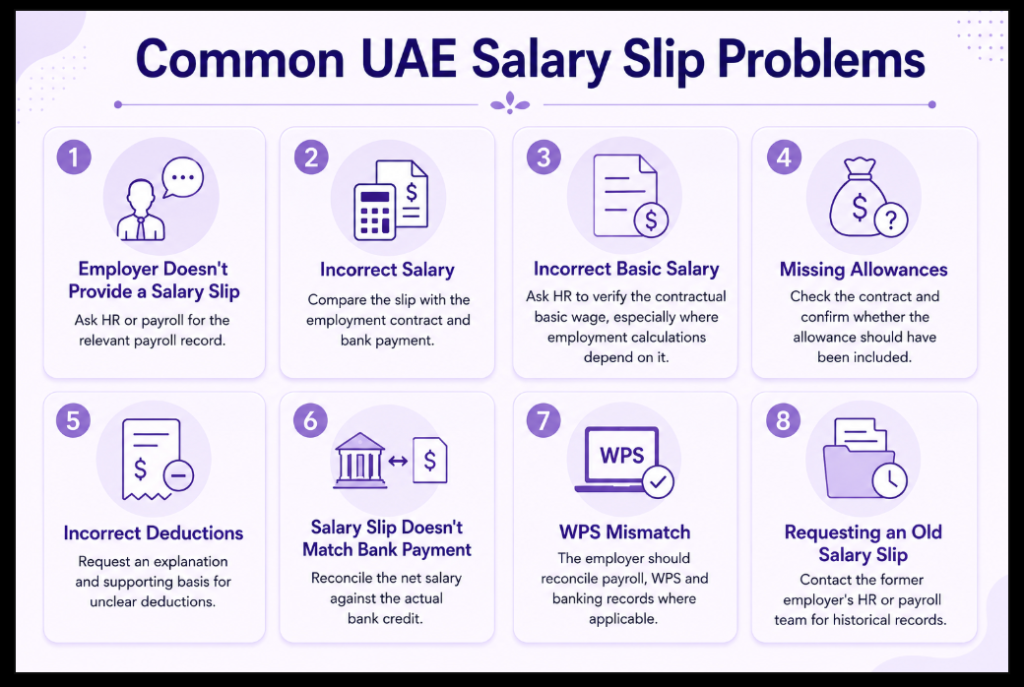
Common UAE Salary Slip Problems
UAE Salary Slip Checklist
Employee Checklist
- Employer details
- Salary period
- Basic salary
- Allowances
- Overtime
- Bonuses
- Deductions
- Gross salary
- Net salary
- Payment date
- Bank payment comparison
Employer/HR Checklist
- Employee information verified
- Contractual salary confirmed
- Earnings calculated
- Deductions documented
- Gross and net salary checked
- Payment information recorded
- Payroll and bank records reconciled
- WPS records reconciled where applicable
- Payroll records securely maintained
FAQs
How can I get my salary slip in the UAE?
Request the relevant salary slip directly from your employer’s HR or payroll department.
Can I get my UAE salary slip online?
Yes, employers may provide digital salary slips through HR portals, payroll systems, or employee applications.
How do I download my salary slip in the UAE?
Log into your employer’s payroll platform, select the required month, then download the available document.
How can I get a salary slip from my company?
Contact HR or payroll and request the salary slip for your required payroll period.
How can I get salary slips from a previous employer?
Contact your former employer’s HR department and request copies of historical payroll records.
How do I create a salary slip?
Use payroll software or a structured template containing employee, earnings, deductions, gross, net, and payment details.
How do I create a salary slip in Excel?
Create earnings and deductions columns, then use formulas to calculate gross salary and net salary.
How do I create a payslip for an employee?
Enter employee details, salary components, deductions, gross salary, net salary, and payment information into your template.
What does a UAE salary slip look like?
It typically contains employer, employee, period, earnings, deductions, gross salary, net salary, and payment information.
What information is needed to prepare a UAE salary slip?
You need employee details, payroll period, salary components, deductions, gross salary, net salary, and payment information.
How do I calculate net salary on a salary slip?
Add applicable earnings together, subtract valid deductions, and record the resulting amount as net salary.
What is the difference between a salary sheet and a salary slip?
A salary sheet summarises payroll across employees, while a salary slip records one employee’s individual pay.
What is the difference between a salary slip and a salary certificate?
A salary slip records periodic payroll, while a salary certificate confirms employment and salary information.
What is the difference between a salary slip and a salary statement?
A salary slip covers one payroll period, while a salary statement can summarise salary across multiple periods.
How can I get a salary certificate in the UAE?
Request a salary certificate from your employer’s HR or payroll department for the required purpose.
How Can Arnifi Help With UAE Payroll and Compliance?
Arnifi can support businesses beyond initial company formation by helping them navigate employment-related setup, documentation and ongoing UAE compliance requirements.
For companies managing employees, structured payroll administration can help maintain consistent salary records, employment documentation and workforce information. Arnifi’s broader business setup and compliance support can help employers organise these processes as their UAE operations grow.
Conclusion
In the United Arab Emirates, a salary slip should act as an indicator of the employee’s pay of the employee and not just indicate the total credit amount that will be credited to the account of the employee. It should include basic salary, allowance, overtime, bonuses, deductions, gross salary, net salary and payment details.
It is not the design that is important, but payroll documentation that is accurate and matches the employment contract and wage payment standards.
The employee should compare the salary slip with his employment contract and the bank payment to ensure that there are no discrepancies. The employer should keep salary slips along with the payroll, bank and relevant WPS records. Get in touch with our experts at Arnifi to ensure that your salary slip is understood from day 1!
REFERENCES:
UAE Government – Job Offers and Employment Contracts
Top UAE Packages
Related Articles



Top UAE Packages
Get in Touch
