
Hiring GCC Nationals in the UAE: MoHRE Work Permits & Compliance Guide (2026)

Zahira Shaik
SEO Content Writer
Zahira Shaik is an SEO Content Writer and Published Author specializing in research-based content. She excels at analyzing market trends, regulations, and industry developments… Read more

Tulika Saxena
AVP, Sales & Marketing | IIM Nagpur
Tulika Saxena specializes in business finance, sales strategy, and market positioning. Leads growth and partnerships, ensuring seamless business setup experiences and client success across… Read more


Key Fact: Nationals from GCC countries do not require a UAE residence visa; however, the mandatory work permit issued by the MoHRE needs to be secured before hiring any citizen from the GCC countries. Employment of GCC citizens does not contribute towards meeting the UAE national Emiratisation targets of the employer.
Table of contents
- Introduction
- Who Is Considered a GCC National in the UAE?
- Do GCC Nationals Need a UAE Visa to Work?
- What Is MoHRE’s Role in GCC National Employment?
- Step-by-Step: How to Hire a GCC National in the UAE
- Employment Contract Requirements
- Required Documents for a GCC Work Permit
- Do GCC Nationals Count Toward Emiratisation Quotas?
- Salary Payments and WPS Regulations
- Working Hours, Overtime and Statutory Leave
- End-of-Service Gratuity and Termination Rights
- Key Compliance Risks for Employers
- 2026 GCC Visa an Regional Mobility Updates
- How Advisory Partners Assist with Compliance
- Frequently Asked Questions
- References
Introduction
Employment of citizens of Gulf Cooperation Council (GCC) countries, Saudi Arabia, Kuwait, Bahrain, Oman, and Qatar, provides a hassle-free process compared to regular recruitment processes for foreign citizens in the United Arab Emirates (UAE). The main misunderstanding that many employers have is the process of recruiting citizens from the GCC countries who are allowed visa-free entry into the UAE.
Even though nationals from the GCC countries do not require a UAE residence visa, visa-free entry does not mean that employment is authorized. The employer needs to understand the work-permit processes, enter into employment agreements, and meet the payroll requirements for employment of GCC nationals in the UAE.
Who Is Considered a GCC National in the UAE?
In the UAE employment context, a GCC national refers to a citizen holding a passport from one of the following five member states:
- Saudi Arabia
- Kuwait
- Bahrain
- Oman
- Qatar
Distinct Employment Rules
GCC citizens have particular advantages in terms of legal benefits within the UAE, such as easier entry arrangements and equal rights of employment in the private sector. However, all work permits must still be secured by the employer, in addition to the registration of employment agreements according to the Human Resources laws of the UAE.
Do GCC Nationals Need a UAE Visa to Work?
Residence Visa vs. Entry Rights
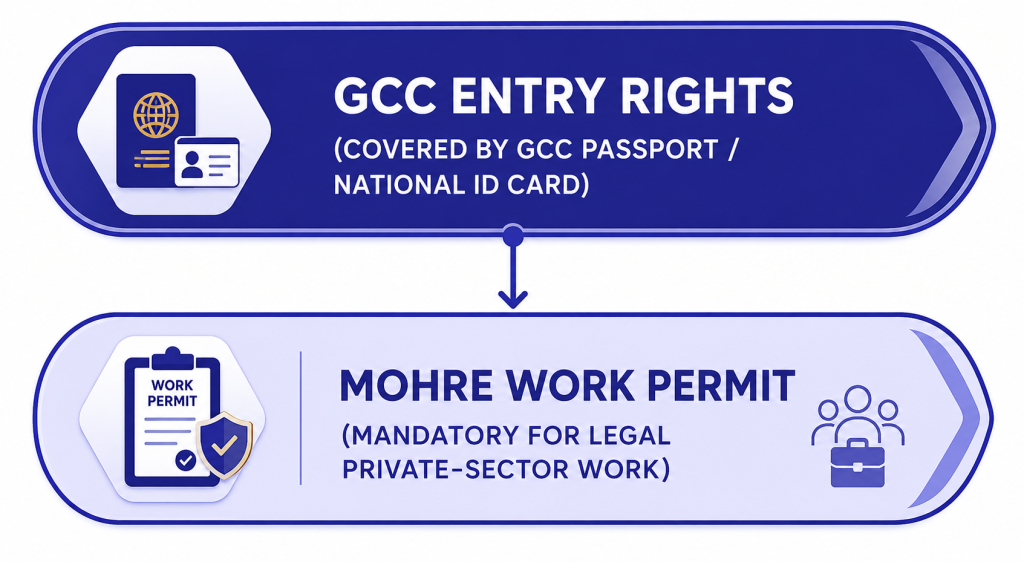
GCC nationals are not required to hold a residence visa to live and work in the UAE. They simply enter the UAE through the use of their national passport or GCC National ID.
Mandatory MoHRE Work Permit
Though visa-free entry allows access through the borders, it does not cover the right of employment. The employer must obtain a valid MoHRE Work Permit for the individual before he or she starts working. Failure to do so would result in the commission of illegal employment on the part of the company.
What Is MoHRE’s Role in GCC National Employment?
The Ministry of Human Resources and Emiratisation (MoHRE) is the primary federal authority regulating the private-sector labor market across the UAE. When hiring a GCC national, employers interact with several core MoHRE platforms:
| Platform / System | Primary Purpose |
| MoHRE Portal / Smart App | Processing work permits, initial approvals, and standard employment filings. |
| Tasheel | Official registration and processing of standard employment contracts. |
| Wage Protection System (WPS) | Monitoring automated, timely salary payments in accordance with UAE labor law. |
| Nafis | Tracking local UAE national Emiratisation metrics and quota compliance. |
Step-by-Step: How to Hire a GCC National in the UAE
- Verify GCC Nationality: Verify that the candidate is a citizen of a valid GCC country by checking their active passport and national ID.
- Confirm Role Requirements: Identify the job position, skill grade, and determine if any licensing is needed for the job.
- Draft the Employment Contract: Prepare a compliant employment contract specifying salary structure, working hours, notice periods, and leave policy.
- Apply for the MoHRE Work Permit: Apply for the MoHRE work permit using the online portal or the Tasheel center before starting employment of the candidate.
- Register the Contract: Register the prepared employment contract at Tasheel after getting the work permit.
- Integrate Payroll & Social Security: Enroll the employee into WPS and complete any relevant registration under the Insurance Protection Extension Program for GCC nationals.
Employment Contract Requirements
As per UAE Labour Law (Decree-Law No. 33 of 2021), the employment relationship in the private sector is governed by Fixed-Term Employment Contracts. Other flexible contracts are part-time, temporary, and flexible contracts based on requirements.
Mandatory Contract Terms
- Full identification details and nationalities of the employer and employee.
- Job title, nature, and location of work.
- Date of employment commencement and duration of contract.
- Details of payment, basic salary, and allowances.
- Work hours and weekly holidays/leave.
- Probation terms (maximum of 6 months).
Language Requirements
The contract should be signed in Arabic, or in bilingual form having both Arabic and English versions. In case of any dispute, the Arabic version will hold legal value in UAE courts.
Required Documents for a GCC Work Permit
The employer must prepare and present the following documents to the MoHRE:
- GCC Passport: Valid copy with at least 6 months remaining validity.
- GCC National ID Card: Clear copy of the employee’s active identification.
- Signed Employment Offer/Contract: Standardized MoHRE form signed by both parties.
- Educational Certificates: Attested academic credentials (required for specialized or professional job categories).
- Employer’s UAE Trade License: Valid copy from the relevant Department of Economy and Tourism (DET) or licensing authority.
- Company Establishment Card: Active card issued by MoHRE.
- External Professional Approvals: Industry-specific clearances (e.g., DHA/MOHAP clearances for medical staff or KHDA for educational roles).
Do GCC Nationals Count Toward Emiratisation Quotas?
No. Employing a GCC national does not help an organization meet its obligations for Emiratisation quotas as per the UAE requirements.
- Distinct Classification: A GCC citizen and an Emirati UAE citizen belong to separate classes when it comes to federal labor classification.
- Separate Tracking: Companies that have 20 or more employees must employ UAE citizens based on their target percentage under the Emiratisation requirement.
- Nafis Portal: Organizations have to use the Nafis portal to record their Emirati recruits.
Salary Payments and WPS Regulations
Registered employers who recruit GCC nationals must transfer their salaries through the Wage Protection System (WPS). WPS refers to an electronic payroll system to track payment of wages on time.
Permissible Salary Deductions
Salary deductions are governed by UAE law, where only the following deductions are allowable:
- Repayment of advances or loans granted by the employer.
- Social security contribution according to the insurance extension scheme of GCC.
- Penalty imposed pursuant to internal company policies as per approval of MoHRE.
- Court awards or child support orders.
Deduction Limit: The total amount of deductions cannot be more than 50% of the salary of the employee.
Working Hours, Overtime and Statutory Leave
GCC nationals working in the UAE private sector fall directly under standard statutory benefits outlined in Federal Decree-Law No. 33 of 2021.
Standard Working Hours: 8 hours/day (48 hours/week)
Ramadan Hours: Reduced by 2 hours daily
Overtime Rate: Basic Wage + 25% (or +50% for night hours/weekly rest day work)
Leave Entitlements
- Annual Leave: 30 calendar days per year after completing 12 months of service.
- Sick Leave: Up to 90 days per year (15 days full pay, 30 days half pay, remaining unpaid).
- Maternity Leave: 60 calendar days (45 days full pay, 15 days half pay).
- Paternity Leave: 5 working days within 6 months of the child’s birth.
- Bereavement Leave: 5 days for a spouse; 3 days for a parent, child, sibling, grandparent, or grandchild.
- Study Leave: 10 working days per year for employees enrolled in recognized educational institutions (after completing 2 years of service).
End-of-Service Gratuity and Termination Rights
Gratuity Eligibility & Calculation
GCC employees who complete at least one continuous year of service qualify for end-of-service gratuity:
- 1 to 5 Years of Service: 21 days’ basic wage for each year worked.
- Over 5 Years of Service: 30 days’ basic wage for each additional year beyond the fifth year.
- Cap: Total gratuity payout cannot exceed 2 years’ gross salary equivalent.
Termination and Final Settlement
Resignation or contract termination involves following the contractual notice period (usually 30 to 90 days). All accrued wages, unpaid annual leave, and gratuity dues need to be paid in full within 14 days from the contract termination date.
Key Compliance Risks for Employers
- Employing Without a Work Permit: Using GCC residency privileges to commence employment without a MoHRE work permit incurs heavy financial penalties.
- Contract Registration Failures: Failing to upload signed employment agreements onto the Tasheel system makes the company vulnerable to labor inspection fines.
- WPS Violations: Late/Incomplete Wage Payments lead to freezing of the employer’s account for issuing work permits.
- Confusing GCC Hires with Emiratisation: Classifying GCC nationals as Emirati in Emiratisation calculations attracts non-compliance penalties based on Nafis rules.
2026 GCC Visa and Regional Mobility Updates
The GCC Grand Tours Visa
The GCC Grand Tours Visa will be launched in late 2026 and will serve as an integrated travel visa for all six GCC countries. The pilot corridor will run between the UAE and Bahrain in Q4 2026. The visa helps streamline tourism and business travel within the region but cannot serve as a work authorization within the UAE.
Extended e-Visa for GCC Residents
Foreign expatriates who are already residents of other GCC countries can apply for a 30-day entry permit into the UAE (with an additional extension of 30 days possible). Their GCC residence visa should be valid for at least one year on the date of entering the country.
GCC National vs. GCC Resident Comparison
| Feature | GCC National | GCC Resident |
| Citizenship | Citizen of Saudi Arabia, Kuwait, Bahrain, Oman, or Qatar. | Foreign national holding residency in a GCC state. |
| UAE Entry | Visa-free entry using Passport or National ID. | Requires standard e-Visa or visa-on-arrival entry. |
| UAE Residence Visa | Not required for work or residency. | Required if residing long-term in the UAE. |
| Work Permit | Mandatory MoHRE Work Permit. | Mandatory MoHRE Work Permit + Employment Residency Visa. |
| Emiratisation | Excluded from Emirati quota counts. | Excluded from Emirati quota counts. |
How Advisory Partners Assist with Compliance
The management of these parallel requirements involving work permits from the MoHRE, WPS integration, Tasheel filings, and pension extension schemes calls for proper Human Resources management. Arnifi helps by clearing documents, preparing contracts that meet the Labour Law criteria, and managing the MoHRE portal processes.
Frequently Asked Questions
Do GCC nationals need a UAE residence visa to work?
No. A UAE residence visa is not needed for GCC nationals in order to work or reside in the UAE; however, a MoHRE work permit must be valid before work commencement. GCC nationals will use either a GCC passport or national ID when entering the UAE.
Do GCC nationals need a UAE work permit?
Yes. It is compulsory for any GCC national who works in the UAE private sector to obtain a work permit from MoHRE.
Do GCC nationals count toward Emiratisation quotas?
No. The Emiratisation quota does not apply to GCC nationals, as they are treated differently from UAE citizens for the Emiratisation quotas.
What type of employment contract can a GCC national have in the UAE?
A GCC national usually signs a fixed-term employment contract registered in accordance with Federal Decree-Law No. 33 of 2021. A part-time, temporary, or flexible employment contract is also possible if a MoHRE permit is obtained.
Are GCC nationals covered by UAE Labour Law?
Yes. After being employed and possessing an effective work permit, GCC nationals get all their labor rights, including annual leave, statutory sick leave, overtime compensation, non-discrimination clauses, and the ability to approach MoHRE for dispute settlement.
Can GCC nationals work part-time or for multiple employers?
Yes. GCC nationals may be employed for part-time jobs or be employed by multiple employers, as long as each employer gets a separate part-time MoHRE work permit.
Does the GCC Grand Tours Visa allow GCC nationals to work in the UAE?
No. The GCC Grand Tours Visa is a single-entry visa that is meant to facilitate tourism and business activities.
References
- Ministry of Human Resources and Emiratisation (MoHRE): https://www.mohre.gov.ae/
- UAE Government Portal (Work Permits & Visas): https://u.ae/en/information-and-services/jobs/working-in-the-private-sector
- Nafis Emiratisation Platform: https://nafis.gov.ae/
- Federal Authority for Identity, Citizenship, Customs and Port Security (ICP): https://icp.gov.ae/
Top UAE Packages
Related Articles



Top UAE Packages
Get in Touch
