
How to Set Up a Legal Consultancy in the UAE | Requirements and Process

Anushka
Content Writer
Anushka Basu is a business content writer specialised in global business market insights. She aims to simplify complex regulatory, financial, and business concepts into… Read more

Tulika Saxena
AVP, Sales & Marketing | IIM Nagpur
Tulika Saxena specializes in business finance, sales strategy, and market positioning. Leads growth and partnerships, ensuring seamless business setup experiences and client success across… Read more



Key Fact: Setting up a legal consultancy in the UAE involves both business licensing and professional regulatory approval. In Dubai, legal consultancy firms and practising legal consultants are regulated by the Dubai Legal Affairs Department (DLAD). DIFC follows a separate legal and court framework with its own practitioner-registration requirements.
Table of contents
- Introduction
- Legal Consultancy vs Law Firm vs Advocate in the UAE
- Which Regulatory Route Should You Choose | Dubai Mainland or DIFC?
- Requirements to Set Up a Legal Consultancy in Dubai
- How to Set Up a Legal Consultancy in Dubai
- Documents Required for a Legal Consultancy
- Legal Consultancy Firm Cost Elements in the UAE
- What Can a UAE Legal Consultancy Do?
- DIFC Legal Consultancy | What Is Different?
- Ongoing Compliance for a Legal Consultancy
- Common Mistakes to Avoid
- How Arnifi Helps With Legal Consultancy Setup in the UAE
- FAQs
- Conclusion
Introduction
Setting up a legal consultancy is different from establishing an ordinary professional-services business. The firm needs the appropriate commercial and professional approvals, while the individuals providing legal consultancy services must also satisfy the applicable professional registration requirements.
In Dubai mainland, the DLAD regulates legal consultancy firms and practising legal consultants. DIFC has a separate legal framework and its own rules for law firms and practitioners appearing before the DIFC Courts.
The right route therefore depends on the type of legal work, target clients, jurisdiction and whether the firm intends to conduct proceedings before a particular court.
Legal Consultancy vs Law Firm vs Advocate in the UAE
A legal consultancy can provide permitted legal services such as:
- Legal advice and opinions
- Contract drafting and review
- Company registration and liquidation services
- Settlement-related services
- Arbitration and conciliation-related legal services, where permitted
- Other legal consultancy services permitted under the applicable framework
In Dubai, registration as a practising legal consultant authorises the consultant to provide legal services through a licensed firm, but specifically excludes pleading and representing third parties before Dubai Courts.
This distinction matters because a legal consultant cannot assume that holding a professional registration automatically provides the same rights as an advocate before Dubai’s onshore courts.
Which Regulatory Route Should You Choose | Dubai Mainland or DIFC?
| Route | Main regulatory framework | Best suited for |
| Dubai Mainland | DET + DLAD | Legal consultancy services in Dubai |
| DIFC | DIFC legal framework + DIFC Courts requirements where applicable | Common-law, international and DIFC-related legal work |
DIFC operates under its own legal and regulatory framework. Its Courts maintain a separate Register of Legal Practitioners with Part I for law firms and Part II for individual practitioners seeking rights of audience.
The intended legal work should therefore determine the jurisdiction. A DIFC setup should not be treated simply as another Dubai trade-licensing option.
Requirements to Set Up a Legal Consultancy in Dubai
Setting up a legal consultancy in Dubai requires the appropriate legal structure, business licence and DLAD approval. Requirements vary by firm structure and applicant and may include:
- Legal consultancy licence and DLAD approval
- Registered practising legal consultants
- Recognised legal qualification and relevant experience
- Good-conduct documentation
- Company and professional documents
- Suitable professional premises
- Professional indemnity insurance, where required
- Other documents requested by DLAD
Individual legal consultants must also meet the applicable qualification, experience and registration requirements before practising through a licensed firm.
How to Set Up a Legal Consultancy in Dubai
The setup can generally follow this sequence:
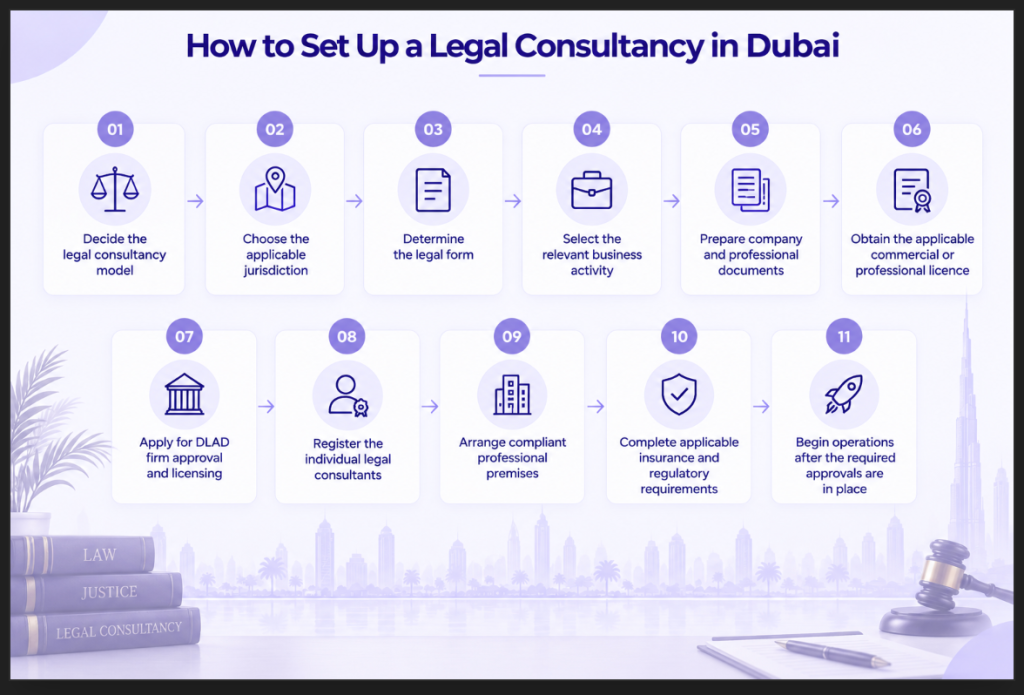
DLAD provides separate application routes for firm licensing and individual legal consultant registration, so both sides of the setup should be planned together.
Documents Required for a Legal Consultancy
The exact document list depends on the firm structure and the individual professional applying.
Common documents may include:
- Passport and identity documents
- Legal qualification certificates
- Attested or legalised certificates where required
- Practising certificate where applicable
- Professional experience letters
- Police clearance or good-conduct documents
- Company incorporation documents
- Professional business plan where applicable
- Commercial or professional licence
- Office lease or premises documents
- Professional indemnity insurance
- Additional documents requested by DLAD
For legal consultant registration, DLAD specifically refers to legalised professional qualifications or recognised law degrees and evidence describing the applicant’s legal experience.
Legal Consultancy Firm Cost Elements in the UAE
There is no single setup cost that applies to every legal consultancy. The overall amount depends on the jurisdiction, structure, number of consultants, professional registrations, premises and additional requirements.
Cost components can include:
- Company incorporation and business licence
- DLAD firm licensing
- Individual legal consultant registration
- Document attestation and legalisation
- Legal translation
- Office or professional premises
- Professional indemnity insurance
- Visa and immigration costs
- DIFC registration costs, where applicable
- DIFC Courts practitioner registration, where applicable
- Annual renewal costs
- Accounting, tax and ongoing compliance
DLAD separately charges for firm licensing and individual consultant registration. Its current service pages also distinguish fees according to firm structure and number of registered consultants.
What Can a UAE Legal Consultancy Do?
A legal consultancy may provide permitted services such as:
- Legal advice and opinions
- Contract drafting and review
- Company registration and liquidation services
- Settlement services
- Arbitration-related representation
- Conciliation-related services
- Other services permitted by the applicable regulatory framework
However, the scope of practice should not be confused with court advocacy. In Dubai, DLAD’s practising legal consultant registration expressly excludes pleading and representing third parties before Dubai Courts.
DIFC Legal Consultancy | What Is Different?
DIFC operates under a separate legal framework, with the DIFC Courts applying their own rules and practitioner-registration system.
The DIFC Courts Register of Legal Practitioners has:
- Part I for law firms
- Part II for individual practitioners seeking rights of audience
Part I registration is made in the name of the firm, while Part II registration is for individual practitioners.
Part II applicants must satisfy requirements relating to professional experience, rights to conduct litigation or audience in their qualifying jurisdiction, English-language ability and knowledge of the common-law system and DIFC Courts procedures. The current guidelines distinguish between limited and full rights of audience.
This means that registering a legal consultancy or law firm in DIFC does not automatically give every lawyer unrestricted rights of audience before the DIFC Courts.
Ongoing Compliance for a Legal Consultancy
Compliance continues after the firm is established.
Businesses should monitor:
- Commercial and professional licence renewal
- DLAD firm registration
- Individual consultant registration
- Professional indemnity insurance
- Compliant office premises
- Professional records
- Continuing legal professional development
- Changes to consultant employment or registration
- DIFC practitioner registration and renewal where applicable
DLAD requires practising legal consultants to maintain valid registration, and its renewal requirements include matters such as valid consultant registrations, compliant premises and professional indemnity insurance.
DLAD also operates a continuing legal professional development programme for registered legal consultants.
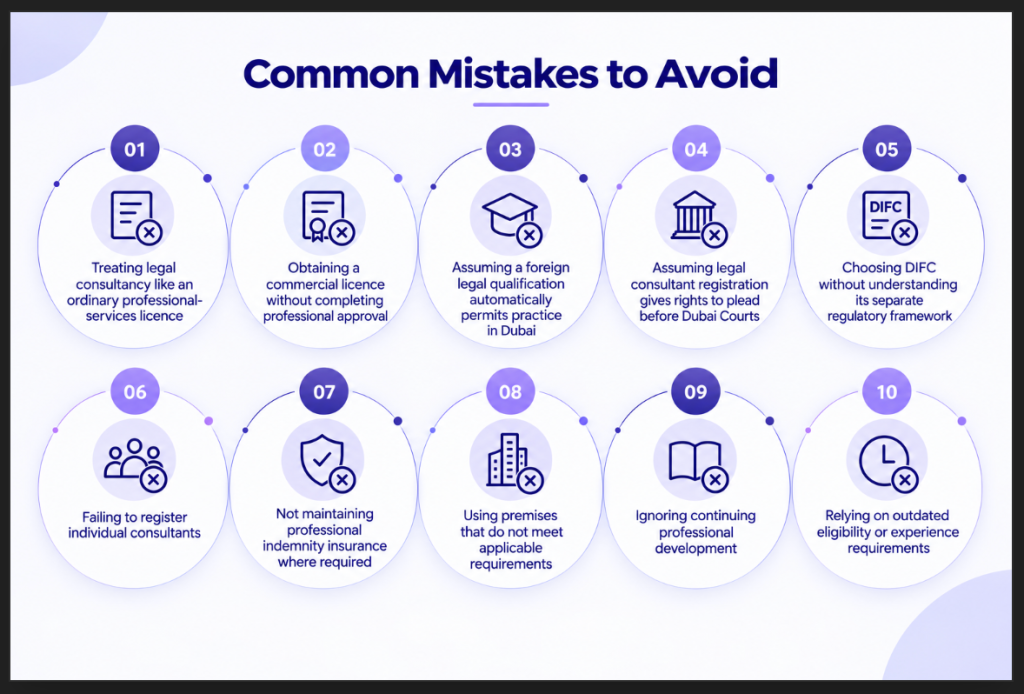
Common Mistakes to Avoid
Common mistakes when setting up a legal consultancy in the UAE include:
How Arnifi Helps With Legal Consultancy Setup in the UAE
Arnifi can support the business and regulatory setup through:
- Jurisdiction and structure assessment
- Business setup and licensing
- DLAD application support
- Legal consultancy documentation
- Consultant registration support
- Office and premises coordination
- DIFC setup support where applicable
- Visa and immigration support
- Corporate bank-account support
- Accounting, tax and ongoing compliance
The legal professionals remain responsible for satisfying the applicable professional qualification, registration and practice requirements.
FAQs
1. How do I set up a legal consultancy in the UAE?
Choose the appropriate jurisdiction and legal structure, obtain the required business licence, complete professional regulatory approval, register the practising legal consultants and satisfy applicable premises, insurance and compliance requirements.
2. Do legal consultants need DLAD registration in Dubai?
Yes. Individuals practising as legal consultants in Dubai must hold valid registration on the applicable Roll and practise through a licensed firm.
3. What is the difference between a legal consultant and an advocate in the UAE?
A legal consultant provides permitted legal consultancy services but does not automatically have the same court-representation rights as an advocate. In Dubai, practising legal consultant registration excludes pleading and representing third parties before Dubai Courts.
4. Can a foreign lawyer open a legal consultancy in Dubai?
Possibly, but eligibility depends on the applicable firm structure, professional qualifications, experience and DLAD requirements. Certain routes for non-UAE nationals or foreign firms are subject to specific conditions.
5. Can a legal consultant represent clients before Dubai Courts?
A practising legal consultant registered with DLAD cannot plead or represent third parties before Dubai Courts under the legal consultant registration framework.
6. What is the difference between a Dubai mainland and DIFC legal consultancy?
Dubai mainland legal consultancy is regulated through the applicable Dubai licensing authority and DLAD framework. DIFC operates under a separate legal framework, with its own law-firm and individual practitioner registration requirements for proceedings before the DIFC Courts.
Conclusion
Setting up a legal consultancy in the UAE requires more than obtaining a business licence. In Dubai, the firm and its practising legal consultants must meet the applicable DLAD requirements, while DIFC follows a separate legal and court framework. The overall cost depends on the structure, registrations, premises, insurance and other regulatory requirements. Professional compliance also continues after establishment.
Official references:
Dubai Legal Affairs Department – Legal Consultants Affairs
DLAD – Legal Consultant Registration
DLAD – Legal Consultancy Firm Licence (Company)
DIFC Courts – Guidelines for Registration of Legal Practitioners
Top UAE Packages
Related Articles



Top UAE Packages
Get in Touch
