
DHA Brokers Guidelines | Changes Taking Effect from January 2027

Anushka
Content Writer
Anushka Basu is a business content writer specialised in global business market insights. She aims to simplify complex regulatory, financial, and business concepts into… Read more

Tulika Saxena
AVP, Sales & Marketing | IIM Nagpur
Tulika Saxena specializes in business finance, sales strategy, and market positioning. Leads growth and partnerships, ensuring seamless business setup experiences and client success across… Read more


Key Fact: The Dubai Health Authority (DHA) issued Circular GC 05/2026 on 20 May 2026, introducing mandatory guidelines for health insurance brokers and relevant stakeholders in Dubai. The circular took effect upon publication, while the Broker Guidelines Manual is scheduled to come into force on 1 January 2027.
Table of contents
- What Are the DHA Brokers Guidelines GC 05/2026?
- Why Has the DHA Introduced New Insurance Broker Guidelines?
- What Are the Main Changes Under GC 05/2026?
- How Do the New Commission Rules Work?
- What Is a TOBA and Why Is It Required?
- What Is a BORA and How Does It Affect Brokers?
- When Will the New Requirements Come Into Effect?
- Do the Rules Apply to Insurance Agents and Direct Sales Agents?
- How Should Insurance Brokers Prepare for the Changes?
- What Happens If Brokers Are Not Ready for Compliance?
- How Can Arnifi Help Businesses Understand Regulatory Changes?
- FAQs
- Conclusion
What Are the DHA Brokers Guidelines GC 05/2026?
The DHA Brokers Guidelines GC 05/2026 were introduced through a circular issued on 20 May 2026. The circular applies to parties in Dubai’s health insurance system, particularly insurance brokers and intermediaries permitted by the Dubai Health Authority.
The accompanying guidelines establish requirements governing broker responsibilities, business operations, client relations and regulatory compliance. They also address commission arrangements and introduce a standardised framework for agreements between brokers, insurers and clients.
The guidelines aim to improve transparency across the health insurance market and clarify the parties’ responsibilities.
For insurance brokers, the changes affect how they document commercial arrangements, disclose commissions, manage client relationships and maintain compliance records. Reviewing these requirements early can help businesses identify areas that need attention before the applicable deadlines.
Why Has the DHA Introduced New Insurance Broker Guidelines?
The guidelines aim to strengthen oversight of health insurance distribution in Dubai. Brokers connect insurers with customers, so clear responsibilities and consistent operating practices are essential.
The updated framework focuses on several areas:
- Transparency: Clearer documentation of commission arrangements and contractual responsibilities
- Accountability: Defined obligations for brokers and other parties involved in insurance distribution
- Standardisation: A common framework for broker-insurer agreements through the TOBA
- Client protection: Better clarity around broker appointments, responsibilities and policy-related services
- Regulatory oversight: More structured monitoring of broker conduct and compliance
These measures are intended to support more consistent practices across the health insurance sector. Brokers should therefore assess how the requirements affect their existing agreements and internal procedures.
What Are the Main Changes Under GC 05/2026?
The guidelines cover several areas of broker operations. The commission framework and agreement requirements are particularly important for businesses preparing for implementation.
| Area | What brokers need to understand |
| Commission structures | Prescribed rates apply to different classes of health insurance business |
| Terms of Business Agreement | Standardised TOBA requirements govern the relationship between brokers and insurers |
| Broker of Record Agreement | Specific requirements govern broker appointments and the number of brokers a client may appoint |
| Documentation | Agreements and supporting records must reflect the applicable requirements |
| Compliance monitoring | Brokers must maintain records and follow the relevant reporting and oversight requirements |
The guidelines also address broker conduct, client communication, internal controls, risk governance and performance assessment.
Brokers should review the complete framework to identify every requirement relevant to their operations. Updating only the commission schedule or agreement templates may leave other compliance obligations unaddressed.
How Do the New Commission Rules Work?
The guidelines prescribe commission structures for different classes of health insurance business. These percentages should be understood in the context of the relevant category and the conditions set out in the framework.
The published commission schedule specifies the following rates:
| Class of health insurance business | Commission rate |
| Group health insurance with 151 or more members and gross written premium of AED 3 million or more at inception | 7% |
| Group health insurance with 151 or more members and gross written premium below AED 3 million at inception | 8% |
| Individual health insurance and SMEs with fewer than 150 members | 10% |
| Essential Benefits Plan policies | 5% |
The guidelines state that commission arrangements that depart from the prescribed structures are prohibited unless expressly authorised in writing by the Dubai Health Insurance Corporation (DHIC).
This means brokers should examine their existing arrangements against the relevant category rather than assume that commission percentages are simply maximum caps. The applicable rate and any permitted exceptions must be established from the rules governing the specific business.
Brokers should also review how commission arrangements are documented and disclosed. Any questions about the interpretation of a particular rate should be confirmed with the relevant authority or a qualified regulatory adviser.
What Is a TOBA and Why Is It Required?
TOBA stands for Terms of Business Agreement. Under the DHA framework, it governs the business relationship between an insurance broker and an insurer.
The standardised TOBA provides a common structure for documenting the responsibilities and obligations of both parties. It covers important commercial and operational matters, helping reduce uncertainty about how the relationship should work.
The agreement addresses areas such as:
- The scope of the business relationship
- The responsibilities of the broker and insurer
- Commission arrangements and payment terms
- Disclosure and documentation requirements
- Service levels and operational responsibilities
- Claims handling and dispute resolution
The guidelines include a standard TOBA in their annexures. Brokers should compare their existing agreements with the applicable requirements and identify provisions that need amendment or replacement.
The aim is to ensure that agreements accurately reflect the parties’ obligations and the regulatory framework.
What Is a BORA and How Does It Affect Brokers?
BORA stands for Broker of Record Agreement. It documents the relationship between a client and the insurance broker appointed to handle its insurance business.
The DHA guidelines establish requirements for these agreements, including limits on the number of brokers a client can appoint.
Under the published framework:
- A client with fewer than 500 members cannot enter into BORAs with more than one insurance broker
- A client with 500 or more members cannot enter into BORAs with more than two insurance brokers
- Each BORA must specify the insurance companies the broker is authorised to approach on the client’s behalf
- Where a client has two BORAs, the insurers listed in the agreements must not overlap
The framework also requires brokers and insurers to notify the DHA promptly when they become aware of a breach of these limitations. Brokers must submit an annual certified report from their independent auditors confirming compliance with the BORA requirements.
These provisions make it important to review existing client appointments and confirm that the agreements comply with the applicable limits.
When Will the New Requirements Come Into Effect?
The DHA Broker Guidelines Manual is scheduled to come into force on 1 January 2027, according to Circular GC 05/2026. Brokers should review the official DHA and ISAHD announcements for any subsequent updates to the implementation timeline. Any claim that the deadline has been postponed should be supported by an official notice confirming the revised date.
In the meantime, businesses can begin reviewing their agreements, commission arrangements and internal procedures. Waiting for the final deadline before identifying gaps could leave teams with limited time to make the necessary changes.
Do the Rules Apply to Insurance Agents and Direct Sales Agents?
The guidelines primarily establish requirements for insurance brokers and intermediaries permitted to operate in Dubai’s health insurance system. They also define the role of Permitted Health Insurance Representatives (PHIRs), including individuals who advise, market or sell health insurance through authorised arrangements.
The commission framework must be read alongside the applicable requirements for the relevant sales channel. Brokers should confirm how the prescribed rates and any related obligations apply to their arrangements involving representatives or direct sales.
Businesses should review their agreements and internal procedures to ensure that commission handling, documentation and disclosures follow the relevant rules. They should also confirm any specific obligations with the DHA or DHIC where the position is unclear.
How Should Insurance Brokers Prepare for the Changes?
Brokers can begin preparing by reviewing their existing arrangements and identifying the work needed to meet the applicable requirements.
A practical checklist includes:
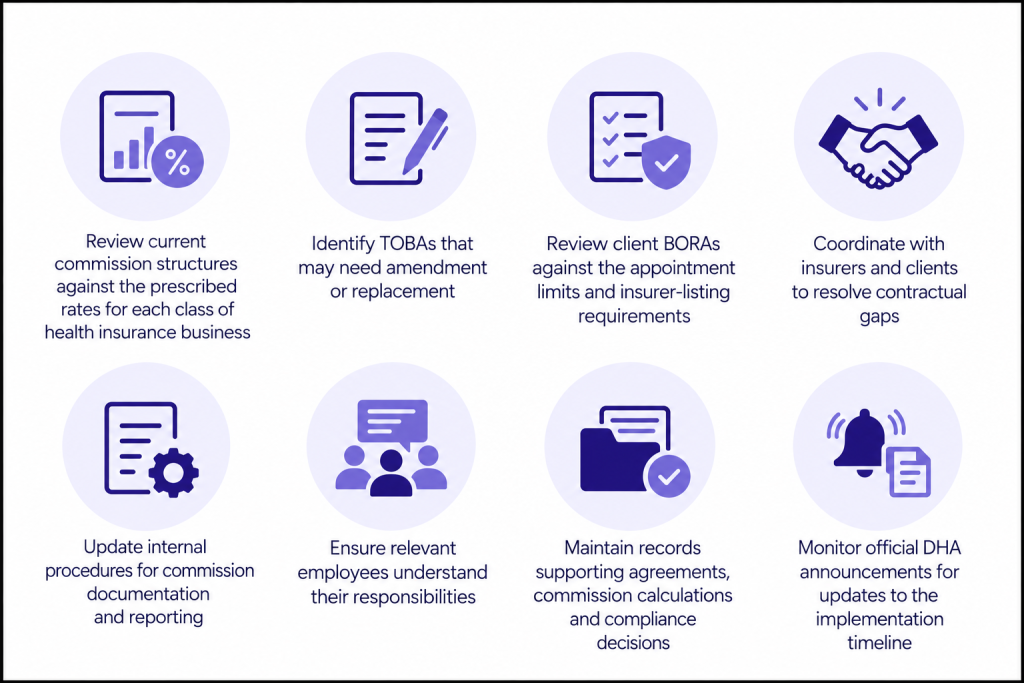
Assigning responsibility for each task can help teams track progress and avoid overlooking important requirements.
What Happens If Brokers Are Not Ready for Compliance?
Brokers must comply with the applicable regulatory requirements and any deadlines formally communicated by the relevant authority.
Incomplete agreements, inconsistent commission arrangements or gaps in required records can create operational problems and expose a business to regulatory scrutiny. The guidelines also provide for regulatory action in response to non-compliance with applicable requirements.
Brokers should identify gaps early and seek clarification where necessary. Specific penalties depend on the applicable provisions and circumstances, so businesses should not rely on assumed penalty amounts or interpretations.
Confirming the final requirements with the DHA or a qualified regulatory adviser can help businesses determine the appropriate corrective action.
How Can Arnifi Help Businesses Understand Regulatory Changes?
Regulatory updates can affect business documentation, internal processes and ongoing compliance responsibilities. Arnifi helps businesses understand corporate and administrative requirements relevant to their operations and identify the steps that may need attention.
Businesses reviewing their operating arrangements can contact Arnifi to discuss their business setup and corporate service requirements. For specific interpretations of DHA insurance regulations, commission rules or TOBA and BORA obligations, seek advice from a qualified insurance regulatory specialist.
FAQs
Are the commission percentages under GC 05/2026 fixed rates or maximum caps?
The guidelines prescribe commission rates for specific classes of health insurance business and prohibit departures from those structures unless expressly authorised in writing by DHIC. Brokers should check the applicable category and conditions before determining the rate.
Do the commission rules apply to sales through direct sales agents?
The applicable requirements depend on the sales arrangement and the relevant provisions. Brokers should verify the treatment of their specific arrangements with the DHA or DHIC.
What is a TOBA?
A Terms of Business Agreement sets out the business relationship, responsibilities and relevant commercial terms between an insurance broker and an insurer.
What is a BORA?
A Broker of Record Agreement documents the relationship between a client and its appointed insurance broker. The DHA framework sets limits on the number of brokers a client may appoint and requires the agreement to specify the insurers covered.
What should insurance brokers do to prepare?
Brokers should review commission arrangements, assess existing TOBAs and BORAs, update internal procedures, maintain supporting records and monitor official regulatory announcements.
Conclusion
The DHA Brokers Guidelines GC 05/2026 introduce important requirements for commission arrangements, standardised TOBAs and BORAs in Dubai’s health insurance sector. Brokers should review their existing agreements, check their commission structures and prepare the documentation needed to demonstrate compliance. The revised implementation timeline should also be confirmed through official DHA communication.
Planning changes to your business operations? Contact Arnifi to discuss your corporate service requirements and identify the support available for your business.
References
Top UAE Packages
Related Articles



Top UAE Packages
Get in Touch
