
DIFC Business Setup Cost 2026 | License, Registration, Office & Visa Fees

Shethana P
SEO Content Writer
Shethana specialises in creating content that simplifies complex business, compliance, and regulatory topics for global business incorporation. She focuses on SEO strategy, content accuracy,… Read more

Tulika Saxena
AVP, Sales & Marketing | IIM Nagpur
Tulika Saxena specializes in business finance, sales strategy, and market positioning. Leads growth and partnerships, ensuring seamless business setup experiences and client success across… Read more


Key Facts: DIFC business setup costs range from USD 9,500 (SPV) to USD 150,000+ (DFSA-regulated). Innovation Licence offers a 90% subsidy at USD 1,500/year. Flexi desks start at USD 250/month with up to 4 visas. Year 1 total typically USD 15,000–50,000 for non-financial companies.
How Much Does DIFC Business Setup Cost?
Setting up a company in DIFC typically costs between USD 15,000 and USD 50,000+ in Year 1, depending on your business type, office choice, and visa requirements. The cheapest route is the Innovation Licence at USD 1,500 per year plus USD 500 per month for a flexi desk, ideal for tech startups. Standard non-financial licences start around USD 7,500–12,000 annually, while DFSA-regulated financial firms can pay USD 25,000–100,000+ in licensing and compliance costs.
DIFC Business Setup Cost at a Glance
| Cost Component | Estimated Range (Year 1) |
| Company Registration | USD 500–5,000 |
| Licence Fee | USD 1,500–25,000+ |
| Office Space | USD 3,000–60,000+ |
| Visas (per person) | USD 1,000–2,500 |
| Data Protection | USD 250–1,250 |
| Audit & Compliance | USD 3,000–15,000+ |
| Total Year 1 | USD 15,000–50,000+ |
DIFC Government Fees vs Total Setup Cost
It’s important to separate government fees (paid to DIFC Authority) from total setup costs (which include office, visas, audit, and professional fees).
- Government fees: Registration, licence, data protection, visas
- Total costs: Government fees + office rent + visas + audit + legal/PRO fees + insurance
Most businesses find that government fees make up only 40–60% of their total Year 1 spend.
DIFC Company Registration Fees
| Entity Type | Estimated Fee | Key Notes |
| Private Company | USD 2,500–5,000 | No fixed minimum share capital for most activities |
| Branch | USD 2,500–4,000 | Parent company documents required |
| Representative Office | USD 2,000–3,500 | Promotional activities only; no revenue generation |
| SPV / Prescribed Company | USD 1,000–2,500 | Used for holding and special purpose structures |
| Innovation Company | USD 100 | For tech and innovation startups |
| Active Enterprise Commercial Package | Bundled | Licence, office and visa quotas at discounted rates |
DIFC Licence Fees 2026
- Standard Non-Financial Licence: USD 7,500–12,000 | Consulting, trading and professional services
- Innovation Licence: USD 1,500 + USD 100 registration | Tech, FinTech, AI, Web3 and GreenTech startups
- Retail Licence: USD 10,000–20,000+ | Cafes, restaurants and retail outlets within DIFC
DFSA-Regulated Financial Services
- Application fee: USD 5,000–15,000
- Annual licence fee: USD 25,000–100,000+
- Varies by activity (asset management, banking, insurance, etc.)
DIFC Office Costs
| Office Type | Cost | Key Notes |
| Flexi Desk | USD 250–500/month | Innovation Licence; up to 4 visas |
| Serviced Office | USD 1,000–3,000/month | Meeting rooms, reception and IT |
| Private Office | USD 3,000–10,000+/month | Varies by size and fit-out |
DFSA-Regulated Office Requirements
- Physical office space mandatory (no flexi desks)
- Minimum square footage based on employee count
- Must meet DFSA operational and compliance standards
DIFC Visa Costs
| Visa / Card Type | Cost | Key Notes |
| Investor Visa | USD 1,500–2,500 | Includes entry permit, residence visa and Emirates ID |
| Employee Visa | USD 1,200–2,000 | Depends on quota and office type |
| Dependent Visa | USD 1,000–1,800 | For spouse and children |
| Establishment Card | USD 500–1,000/year | Required for companies hiring employees |
| Flexi Desk Quota | Up to 4 visas | Innovation Licence holders only |
| Serviced Office Quota | 1 visa/desk | Varies by provider |
| Private Office Quota | Based on space | Subject to DIFC approval |
DIFC Data Protection & Government Fees
All DIFC companies must register with the Commissioner of Data Protection:
| Entity Type | Registration | Annual Renewal |
| DFSA-regulated | USD 1,250 | USD 500 |
| Non-regulated | USD 750 | USD 250 |
| Retail | USD 250 | USD 100 |
DIFC Accounting, Audit & Compliance Costs
- Annual audit: USD 3,000–10,000+ (depends on transaction volume)
- Bookkeeping: USD 2,000–6,000 annually
- Tax advisory (if applicable): USD 2,000–5,000
- PRO/legal fees: USD 1,000–5,000
DFSA Licensing Costs
For financial services firms:
- Application fee: USD 5,000–15,000
- Annual licence fee: USD 25,000–100,000+
- Compliance officer salary: USD 80,000–150,000 annually
- Office fit-out: USD 50,000–200,000+ (one-time)
Total DIFC Year 1 Cost by Business Type
| Entity Type | Licence | Office | Visas | Other Costs | Year 1 Total |
| Consulting Company | USD 7,500 | USD 18,000 | USD 4,500 | USD 5,000 | ~USD 35,000 |
| Technology Startup | USD 1,500 | USD 6,000 | USD 5,000 | USD 3,000 | ~USD 15,500 |
| Innovation Startup | USD 1,500 | USD 6,000 | USD 5,000 | USD 3,000 | ~USD 15,500 |
| Holding Company | USD 5,000 | USD 3,000 | — | USD 4,000 | ~USD 14,500 |
| SPV | USD 3,000 | USD 2,000 | — | USD 3,000 | ~USD 9,500 |
| Financial Services Company | USD 50,000 | USD 60,000 | USD 10,000 | USD 30,000 | ~USD 150,000+ |
DIFC Renewal Cost: Year 2 and Beyond
Year 2+ costs are typically 20–40% lower than Year 1 since registration fees are one-time.
Estimated renewal costs:
- Licence: USD 1,500–25,000 (same as Year 1)
- Office: USD 6,000–60,000
- Visas: USD 4,000–15,000
- Audit/data protection: USD 3,000–10,000
Total Year 2: ~USD 15,000–110,000+ depending on business type.
What Makes DIFC More Expensive Than Other Free Zones?
- Premium location: DIFC is Dubai’s financial hub with world-class infrastructure
- Regulatory oversight: DFSA regulation adds compliance costs but increases credibility
- Office requirements: Physical office mandatory for most licences
- Higher visa quotas: More flexible but costlier than some free zones
- Data protection: Mandatory registration and annual fees
DIFC vs ADGM Cost
| Feature | DIFC | ADGM |
| Licence | USD 7,500–12,000 | USD 6,000–10,000 |
| Innovation Licence | USD 1,500 | Similar programmes |
| Flexi Office | USD 250–500/month | USD 200–400/month |
| Financial Licence | USD 25,000–100,000+ | USD 20,000–80,000+ |
| Overall Cost | Slightly higher | Slightly lower |
DIFC vs DMCC Cost
| Feature | DIFC | DMCC |
| Licence | USD 7,500–12,000 | USD 5,000–9,000 |
| Flexi Office | USD 250–500/month | USD 150–350/month |
| Visas | USD 1,200–2,500 | USD 1,000–2,000 |
| Best For | Financial, professional, tech | Trading, commodities, general business |
DIFC vs Mainland Cost
| Feature | DIFC | Dubai Mainland |
| Licence | USD 7,500–12,000 | AED 4,000–8,000 |
| Office | USD 6,000–60,000+ | AED 5,000–40,000+ |
| Visa Quota | Flexible, higher cost | More restricted, lower cost |
| Ownership | 100% foreign | 100% foreign for most activities |
| Best For | Financial, tech, professional | Retail, F&B, local trading |
How to Reduce DIFC Setup Costs?
- Use Innovation Licence: 90% subsidy for tech startups
- Start with flexi desk: Lowest office cost option
- Limit visa quota: Only apply for what you need initially
- Bundle services: Some providers offer licence + office + visa packages
- Negotiate audit fees: Shop around for competitive audit quotes
Hidden DIFC Costs to Budget For
- Data protection registration: USD 250–1,250 annually
- Audit and bookkeeping: USD 5,000–15,000 annually
- PRO/legal fees: USD 2,000–5,000
- Insurance: USD 1,000–5,000
- Bank account setup: Some banks charge setup or maintenance fees
Note: These costs may or may not be applicable based on the service/business they choose.
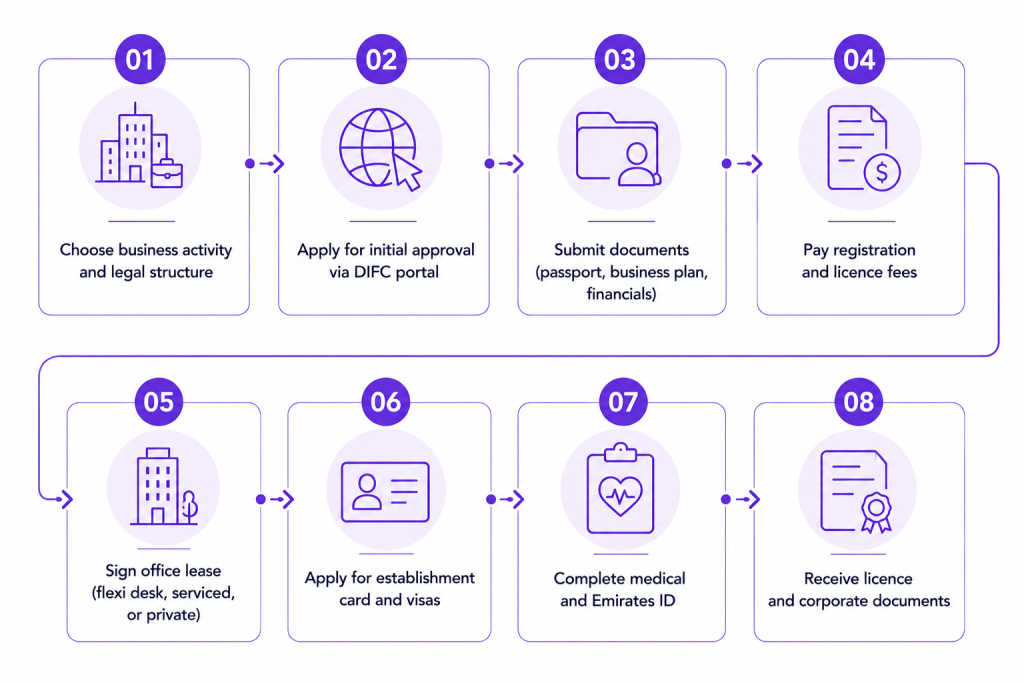
DIFC Setup Process
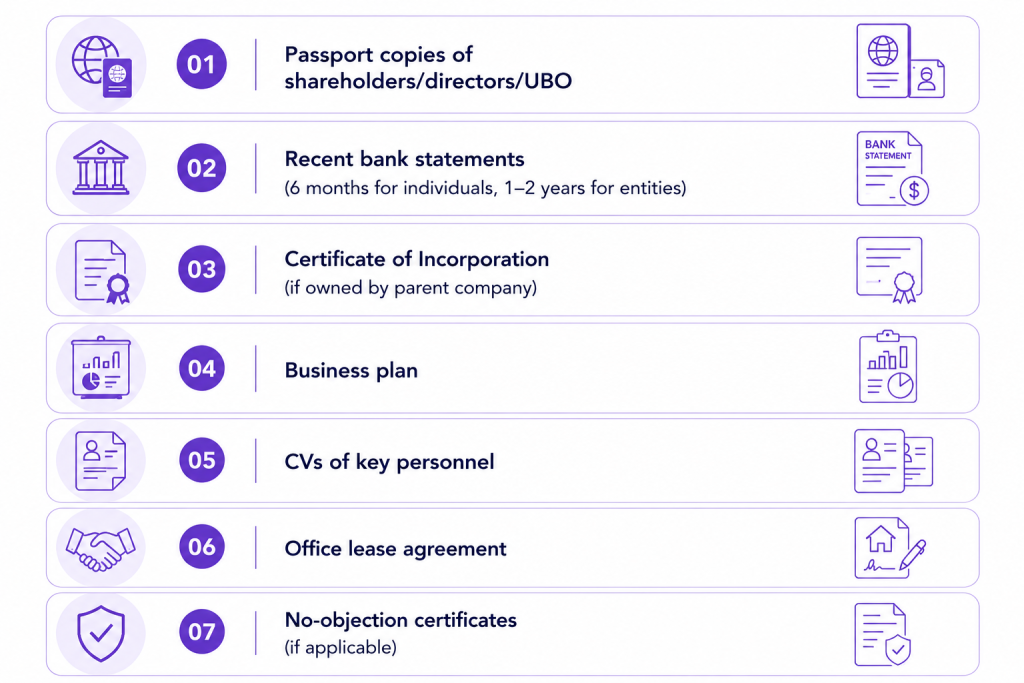
Documents Required
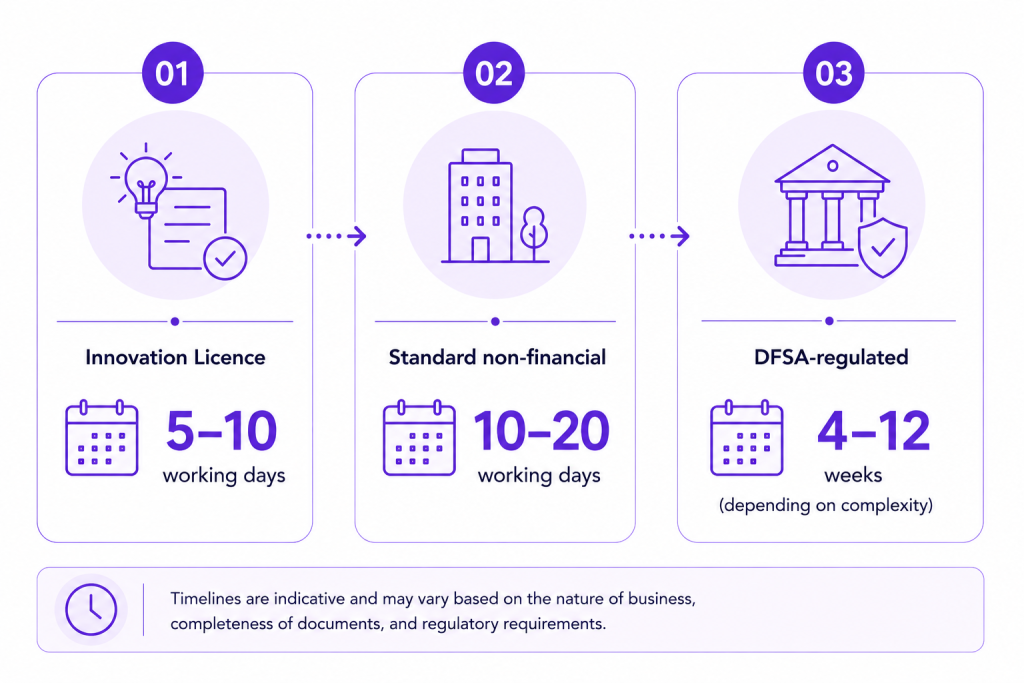
How Long Does DIFC Setup Take?
Is DIFC Worth the Cost?
Yes, if you need:
- International credibility and DFSA regulation
- Access to financial institutions and investors
- Premium office space and networking opportunities
- Tech/startup ecosystem (Innovation Hub)
Consider alternatives if:
- You’re on a tight budget
- You don’t need a financial or professional licence
- You’re okay with less prestigious locations
DIFC Cost Calculator
Rough estimate formula:
Total Year 1 Cost = Registration Fee + Licence Fee + Office (12 months) + Visas (number × cost per visa) + Data Protection + Audit/Compliance + Professional Fees
Example (Tech Startup):
- Registration: USD 100
- Licence: USD 1,500
- Flexi desk: USD 6,000
- Visas (4): USD 5,000
- Data protection: USD 250
- Audit: USD 3,000
- Total: ~USD 15,850
FAQs
- How much does it cost to set up a company in DIFC in 2026?
Around USD 15,000 for startups and USD 30,000–50,000 for most standard companies. - What is the cheapest way to set up a company in DIFC?
The Innovation Licence with a flexi desk can bring Year 1 costs below USD 16,000. - What costs are included in a DIFC company setup?
Registration and licensing are included. Office, visas, audit, data protection and professional fees are additional. - How much does it cost to maintain a DIFC company?
Typically USD 15,000–110,000+ annually, depending on the licence, office and compliance needs. - How much will a DIFC company cost after 5 years?
A standard company may cost USD 100,000–250,000 over five years, while financial firms can cost significantly more. - What is the DIFC company renewal cost in 2026?
Renewal generally includes the annual licence, office, visas and compliance costs. - Why is DIFC more expensive than other Dubai free zones?
DIFC has premium facilities, regulatory requirements and higher compliance costs. - What is the minimum investment required in DIFC?
Most activities have no fixed minimum investment, although fees and operating costs still apply. - Can I set up a DIFC company without a traditional office?
Yes. Eligible Innovation Licence holders can use a flexi desk instead of a traditional office. - What is a DIFC flexi desk?
A shared workspace costing around USD 250–500 per month, with visa eligibility depending on the setup. - What is the difference between DIFC licence fees and total setup costs?
Licence fees are only one part of the total. Office, visas, audit and compliance add to the overall cost. - What hidden costs should I budget for?
Allow for audit, data protection, legal or PRO services, insurance and additional visa costs. - How much should I budget for the first year?
Budget around USD 15,000–50,000 for most non-financial companies and more for regulated firms. - Which DIFC setup costs are one-time and recurring?
Registration is generally one-time, while licences, offices, visas and compliance costs recur annually. - How much does a DIFC company cost to renew every year?
Most companies should budget USD 15,000–110,000+ annually, depending on their structure and requirements.
References:
Top UAE Packages
Related Articles


Top UAE Packages
Get in Touch
