
Human Capital Management | A Practical Guide for Growing Firms
by Rifa S Laskar Dec 13, 2025  6 MIN READ


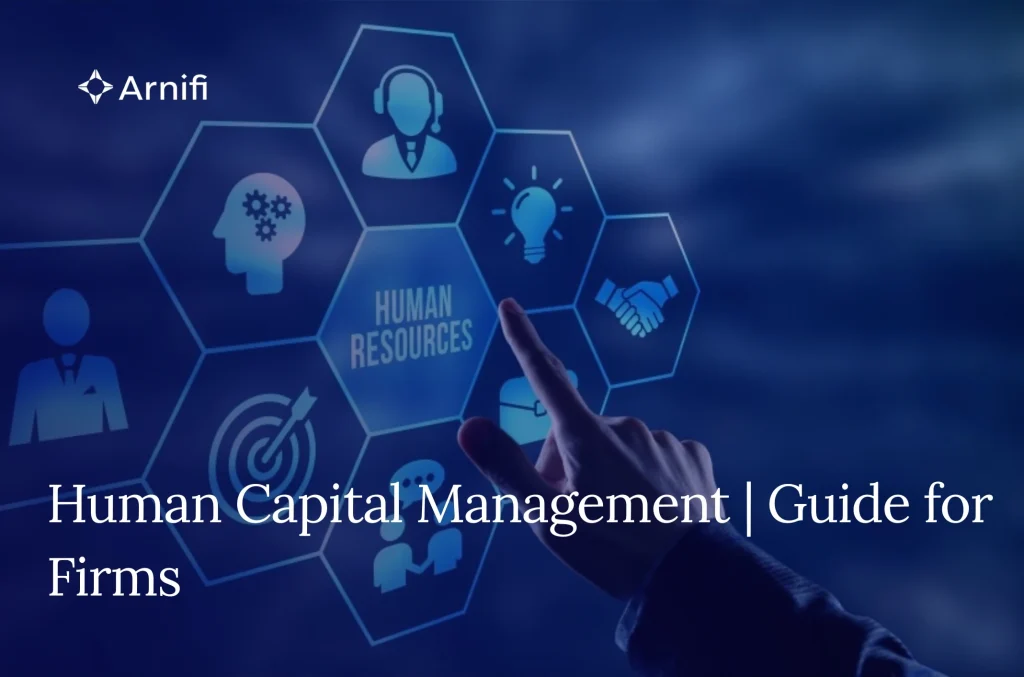
What is human capital management? Many leaders ask this while trying to build teams that actually perform, not just function. This blog breaks it down with clear steps, practical insight and a grounded understanding of how companies can treat people as their strongest asset rather than a checklist item.
Table of contents
- 1. Introduction
- 2. Grounding the Concept
- 3. Why the Question Matters
- 4. Recruitment as a Strategic Move
- 5. Development That Actually Works
- 6. Performance With Purpose
- 7. Culture as a Practical Tool
- 8. Technology’s Role Without the Buzzwords
- 9. The Long-Term Lens
- 10. A Practical Example of HCM in Action
- 11. ArnifiHR’s Strategic Support for Smarter Growth
- 12. Conclusion
1. Introduction
What is human capital management? This question often appears inside boardrooms, planning documents and hiring discussions. A quick definition rarely captures its full impact, so this article sets a simple goal to examine the idea, observe how it shapes workforce performance, and recognise its influence on long-term organisational strength. While reading, note how each part reflects real operations inside a firm it’s a guide to reassess existing practices and adjust anything that no longer serves the team or the business.
2. Grounding the Concept
At its core, human capital refers to the knowledge, skills and value that employees bring into a company. Human capital management focuses on building, organising and improving that value. Asking what is human capital management? means asking how a company turns a group of individuals into a coordinated force. It avoids buzzwords and simply looks at people as contributors with potential that can grow, stagnate or disappear depending on how they are managed.
3. Why the Question Matters
Many firms hire fast, promote slower and often leave development to personal initiative. This results in teams working hard but not necessarily working smart. Raising the question again that what is human capital management? As it helps shift attention to structures that support actual progress. When leadership grasps the idea, hiring becomes more intentional, training becomes purposeful, and roles become clearer.
4. Recruitment as a Strategic Move
Most companies treat recruitment as a task & not as a long-term investment. Human capital management changes as it encourages putting effort into identifying skills that match the company’s future & not just its present. Strong recruitment processes highlight attitude, adaptability and clarity of thought, not only job titles from the previous roles. When recruitment is done with this mindset, teams become sharper, more balanced and easier to retain.
5. Development That Actually Works
Training often becomes a box to tick & a true human capital management looks at development differently. It aims to understand what employees already know, what they aim to learn and how their strengths can serve the company better. Effective development programs are specific, measurable and relevant to real tasks. They increase confidence, expand capability and reduce idle talent. Good development eventually becomes a competitive advantage because skilled people solve problems faster and with fewer errors.
6. Performance With Purpose
A performance review is supposed to map progress, highlight gaps and plan growth. Instead, many reviews become formalities. Human capital management restores meaning to the process. Clear KPIs, consistent tracking and transparent expectations allow people to operate without confusion. Performance becomes a shared responsibility between management and staff, not a blame exercise. This fosters accountability and reduces conflict, which creates easier operations across the board.
7. Culture as a Practical Tool
Culture is often described as a feeling, but inside an organisation, it is a system. It influences how decisions are made, how challenges are approached and how employees behave when no one is watching. Human capital management treats culture as an asset that either drives or delays progress. A culture that rewards clarity, respectful communication and ownership builds strong teams and reduces friction. When culture aligns with company goals, execution becomes easier and mistakes become less costly.
8. Technology’s Role Without the Buzzwords
Technology in human capital management often gets overshadowed by trendy tools and complex dashboards. At its simplest, technology should make processes clearer, faster and more accurate. Good HR systems help track attendance, manage payroll, organise performance data and maintain employee records with minimal manual work. This frees HR teams to focus on strategy rather than paperwork & tools are only helpful when they reduce confusion & not add to it.
9. The Long-Term Lens
Human capital management is not a quick project. It is a long-term method for strengthening the organisation. When leadership takes the time to understand what is human capital management? and applies it consistently, the company sees steady improvements in retention, morale and operational efficiency. It creates an environment where people stay longer, contribute more and align themselves with the company’s direction. This stability often leads to faster growth and clearer decision-making.
10. A Practical Example of HCM in Action
Consider a growing firm with rising demand but inconsistent output. Instead of blaming workload or market pressure, leadership reviews its human capital strategy. They refine job roles, introduce targeted training, set measurable KPIs and use a simple HR system to track performance. Within months, communication improves, errors drop and productivity increases. Nothing magical happened. The firm simply applied the principles of human capital management with intention and consistency.
11. ArnifiHR’s Strategic Support for Smarter Growth
ArnifiHR works closely with businesses that want to refine their human capital structures. The team specialises in identifying gaps in recruitment systems, assessing workforce planning and building practical strategies that strengthen organisational capability. ArnifiHR’s guidance is grounded, clear and focused on realistic improvements that support both the workforce and the leadership. Firms that seek structured, dependable assistance in building stronger teams often find Arnifi’s approach direct, practical and easy to integrate into existing operations.
12. Conclusion
Human capital management remains one of the most effective ways to build a stronger, more capable organisation. The repeated question is what is human capital management? It serves as a reminder that people shape every achievement and every setback inside a company. When a firm understands how to select, develop and support its workforce, everything from productivity to culture improves. Arnifi continues to assist organisations that aim to strengthen these areas and build teams that perform with consistency and clarity.
Top UAE Packages


Related Articles


Top UAE Packages
Get in Touch