
How to Start a Business in Dubai from Singapore | Complete Guide for Singapore Entrepreneurs

Anushka
Content Writer
Anushka Basu is a business content writer specialised in global business market insights. She aims to simplify complex regulatory, financial, and business concepts into… Read more

Tulika Saxena
AVP, Sales & Marketing | IIM Nagpur
Tulika Saxena specializes in business finance, sales strategy, and market positioning. Leads growth and partnerships, ensuring seamless business setup experiences and client success across… Read more



Key Fact: Dubai offers both mainland and free-zone business structures, and the appropriate setup depends on the business activity, intended market, legal structure and operational requirements.
Table of contents
- Introduction
- Why Should Singapore Entrepreneurs Start a Business in Dubai?
- What Business Structure Can a Singapore Entrepreneur Choose in Dubai?
- How Do You Choose Between Mainland and Free Zone in Dubai?
- What Business Activity Should You Choose?
- How to Start a Business in Dubai From Singapore | Step-by-Step
- What Documents Does a Singapore Entrepreneur Need?
- Do Singapore Company Documents Need Attestation for Dubai?
- What Licences Are Available for Dubai Businesses?
- What Happens After You Receive the Dubai Business Licence?
- How Can a Singapore Entrepreneur Open a Dubai Corporate Bank Account?
- What Taxes Should Singapore Entrepreneurs Consider?
- What Are the Ongoing Compliance Requirements?
- What Should Singapore Entrepreneurs Consider Before Starting a Business in Dubai?
- How Can Arnifi Help?
- FAQs
- Conclusion
Introduction
Starting a business in Dubai from Singapore can give entrepreneurs a formal base to serve the UAE and explore wider regional markets. However, establishing a Dubai business involves more than obtaining a trade licence. Before starting operations, entrepreneurs must determine the business activity, legal structure, jurisdiction, trade name, approvals, premises, and banking and tax requirements. A Singapore entrepreneur may establish a new Dubai company as an individual founder or create a Dubai presence for an existing Singapore company. The appropriate route depends on what the business intends to do, where its customers are located and how it plans to operate.
Why Should Singapore Entrepreneurs Start a Business in Dubai?
Dubai is an established commercial centre with infrastructure connecting businesses to regional and international markets. For Singapore entrepreneurs, establishing a local presence can be considered when expanding beyond Southeast Asia or when the business requires a UAE-based operating structure.
Key considerations include:
- Access to the Dubai and wider UAE market
- Connectivity with GCC, Middle Eastern and international markets
- Established business and transportation infrastructure
- Opportunities for Singapore companies seeking regional expansion
- Mainland and free-zone setup options
- Sector-specific ecosystems and specialised free zones
- The need to select the structure according to the actual business model
The UAE’s official business platform provides separate frameworks for mainland and free-zone businesses, while Dubai’s official guidance similarly identifies mainland and free zones as the two primary setup options.
What Business Structure Can a Singapore Entrepreneur Choose in Dubai?
| Structure | How it works | Relevant considerations |
| Mainland Company | A UAE business licensed through the relevant Dubai mainland authority | Suitable for businesses requiring mainland operations, subject to the activity and licensing requirements |
| Free Zone Company | An entity established under a specific Dubai free-zone authority | Rules, permitted activities, legal forms and operating requirements vary by free zone |
| Branch of a Singapore Company | An extension of the existing Singapore company in Dubai | Requires parent-company documentation and applicable approvals |
The structure should therefore follow the business activity, target market, ownership arrangement and operating model, rather than simply the perceived convenience of one setup route.
How Do You Choose Between Mainland and Free Zone in Dubai?
Before choosing a jurisdiction, consider:
- Whether the business needs direct UAE/onshore operations
- Where the target customers are located
- The nature of the proposed business activity
- Whether physical premises are required
- Employee and visa requirements
- Import and export requirements
- Additional regulatory approvals
- Whether operations will be primarily UAE-based or international
- Whether a specialised free-zone environment fits the business
- Future expansion plans
Dubai’s official guidance specifically advises businesses to choose a jurisdiction and understand the differences between mainland and free-zone structures before registration.
What Business Activity Should You Choose?
The business activity should be established before registration because it influences the applicable licence and may affect the legal form and additional approvals required. Possible activities include commercial trading, professional services, consultancy, technology, e-commerce, industrial or manufacturing activities, media and logistics. Certain sectors can require approvals from other authorities, so the activity should accurately reflect what the Dubai business will actually do.
How to Start a Business in Dubai From Singapore | Step-by-Step
| Step | What the Singapore Entrepreneur Does |
| 1 | Define the Dubai business activity and operating model |
| 2 | Decide whether to establish a mainland or free-zone business |
| 3 | Select the appropriate legal structure |
| 4 | Choose and register the proposed trade name |
| 5 | Check whether the activity requires additional government approvals |
| 6 | Prepare founder/shareholder or Singapore parent-company documents |
| 7 | Apply for initial approval where applicable |
| 8 | Secure the required office or business premises |
| 9 | Prepare and submit incorporation documents |
| 10 | Complete registration with the relevant authority |
| 11 | Pay the applicable registration/licensing fees |
| 12 | Obtain the Dubai business/trade licence |
| 13 | Complete establishment and immigration registrations where applicable |
| 14 | Apply for corporate banking |
| 15 | Complete applicable tax registrations |
| 16 | Begin operations while maintaining ongoing regulatory and corporate compliance |
Dubai’s official setup guidance follows a similar broad sequence, beginning with selecting the licence and legal form, checking ownership eligibility and additional approvals, gathering documents and starting registration.
What Documents Does a Singapore Entrepreneur Need?
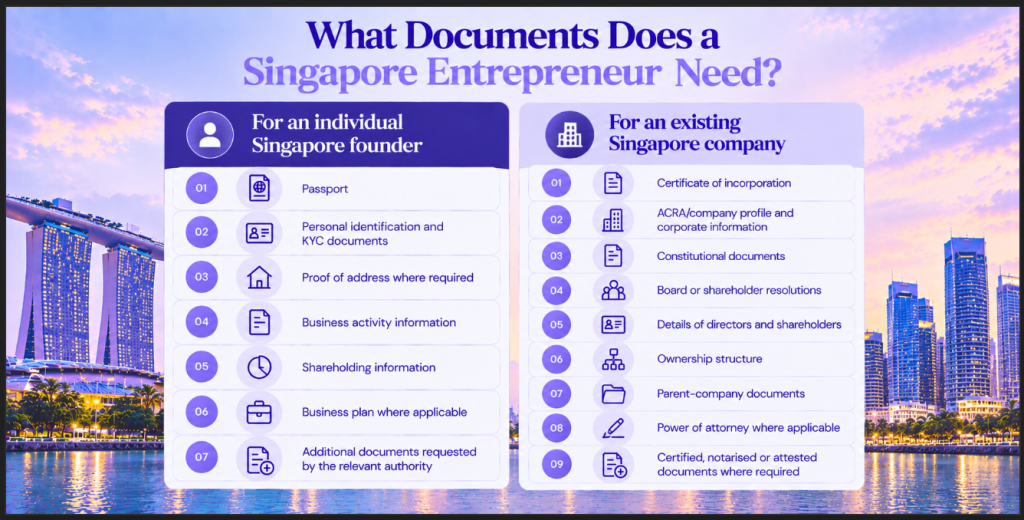
The exact documentation depends on whether the applicant is an individual, corporate shareholder or branch, as well as the selected free zone or authority.
Do Singapore Company Documents Need Attestation for Dubai?
Requirements can differ depending on the structure and authority involved. Entrepreneurs establishing a branch or using a Singapore company as a corporate shareholder may need authenticated or legalised corporate documents.
The relevant document chain may involve:
- Singapore-side authentication or notarisation
- Legalisation where applicable
- UAE Embassy attestation where required
- Additional certification requested by the relevant Dubai authority
- Authority-specific document formats
Attestation should therefore not be treated as universally required for every Dubai business setup. The requirements should be confirmed for the particular branch, subsidiary, corporate-shareholder or free-zone application before documents are submitted.
What Licences Are Available for Dubai Businesses?
| Setup | Examples of licence categories/activities |
| Mainland | Commercial, professional, industrial, e-trader and other applicable categories |
| Free Zone | Commercial, consultancy/service, industrial, e-commerce, media, manufacturing, warehousing, freelancer and other zone-specific licences |
A licence should correspond with the actual business activity. It does not automatically authorise activities outside its permitted scope, and regulated sectors may require additional approvals.
What Happens After You Receive the Dubai Business Licence?
Receiving the licence is only one stage of establishing the business. Depending on the structure and circumstances, the entrepreneur may then need to address:
- Establishment and immigration registration
- Visa and residency arrangements for eligible founders or employees
- Corporate bank account
- Accounting and bookkeeping
- Corporate Tax registration where applicable
- VAT registration where applicable
- UBO/beneficial ownership requirements
- Employee and payroll obligations
- Licence renewals
- Corporate records and governance
VAT registration, for example, is a separate process administered by the Federal Tax Authority. UAE-resident businesses generally must register when taxable supplies and imports exceed the mandatory AED 375,000 threshold, subject to the applicable rules.
How Can a Singapore Entrepreneur Open a Dubai Corporate Bank Account?
Opening a bank account is separate from incorporating the business. A bank may assess the company’s commercial activity and the background of its owners before establishing the banking relationship.
The entrepreneur should be prepared to explain:
- Business activity
- Ownership structure
- Source of funds
- Expected transaction volumes
- Customer base
- Business model
- Corporate documents
- Founder/director KYC information
- Expected countries of operation
A clear business plan and consistency between the licensed activity, business model and information submitted to the bank can help maintain a coherent application. However, obtaining a Dubai business licence does not automatically guarantee bank-account approval.
What Taxes Should Singapore Entrepreneurs Consider?
| Area | What to consider |
| UAE Corporate Tax | Determine whether the UAE entity is a taxable person and whether Corporate Tax registration and filing obligations apply |
| UAE VAT | Assess whether the business meets the applicable mandatory or voluntary VAT registration requirements |
| Singapore taxation | Review potential Singapore tax consequences of establishing and operating a Dubai entity |
| Cross-border matters | Consider the actual ownership, management and transaction structure when assessing tax obligations |
The Federal Tax Authority states that taxable persons are required to register for UAE Corporate Tax under the applicable Corporate Tax legislation. VAT has separate registration rules and thresholds.
Dubai should therefore not be described as completely “tax-free”, and incorporation should not be treated as equivalent to completing all tax obligations.
What Are the Ongoing Compliance Requirements?
After incorporation, Singapore entrepreneurs need to maintain the company’s legal, tax and operational requirements. Depending on the entity and activity, these can include:
- Licence renewal
- Maintaining accurate company information
- Accounting and financial records
- Corporate Tax filings
- VAT filings where applicable
- UBO information
- Corporate governance records
- Employee and visa compliance
- Activity-specific regulatory obligations
- Keeping operations within the scope of the business licence
Tax registration also remains distinct from business registration. For example, the FTA notes that VAT-registered businesses may still need separate Corporate Tax registration where applicable.
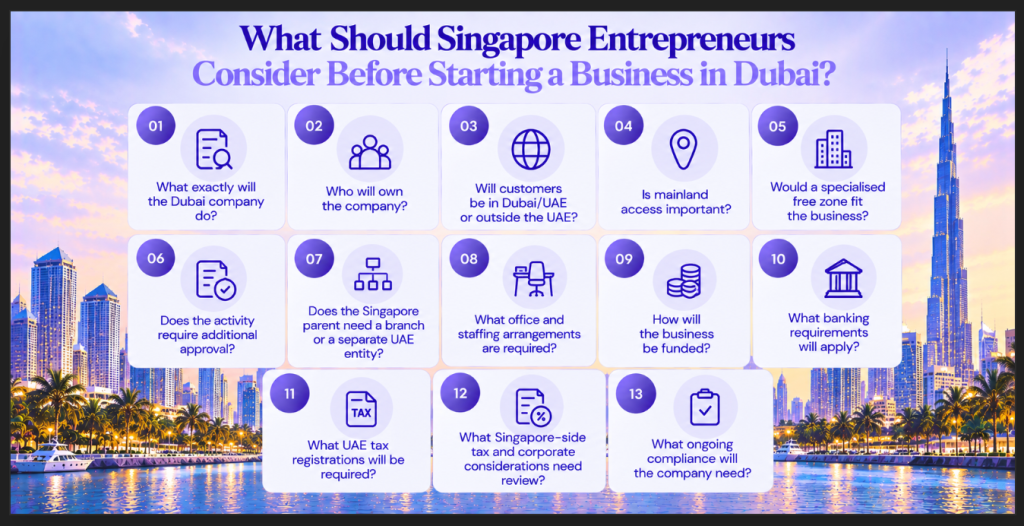
What Should Singapore Entrepreneurs Consider Before Starting a Business in Dubai?
How Can Arnifi Help?
Arnifi can support Singapore entrepreneurs through the UAE establishment process by helping coordinate the practical requirements around structure, licensing and post-incorporation administration.
Support can include:
- Understanding Dubai mainland and free-zone setup options
- Business activity and structure selection
- Company formation coordination
- Documentation support
- Licensing assistance
- Corporate banking preparation
- Post-incorporation requirements
- Accounting and tax coordination
- Ongoing compliance support
The appropriate setup ultimately depends on the entrepreneur’s actual business model, ownership arrangement and intended market.
FAQs
1. Can a Singapore citizen start a business in Dubai?
Yes. A Singapore citizen can establish a Dubai business subject to the applicable UAE licensing, ownership, documentation and regulatory requirements. The appropriate structure depends on the proposed activity and jurisdiction.
2. How do I start a business in Dubai from Singapore?
Start by defining the business activity and operating model, then choose the appropriate mainland or free-zone structure, prepare the required documents, obtain approvals and complete licensing. Banking, tax registration and ongoing compliance follow as applicable.
3. Should a Singapore entrepreneur choose a Dubai mainland or free-zone company?
There is no single structure for every business. The decision depends on the activity, target customers, premises, regulatory requirements and intended operating model.
4. Can a Singapore company open a branch in Dubai?
An existing Singapore company can consider establishing a Dubai branch, subject to the applicable authority requirements, parent-company documentation and approvals.
5. What documents are required to start a business in Dubai from Singapore?
Requirements vary according to the structure. Individual founders may need passport and KYC documentation, while branches and corporate shareholders can require incorporation documents, constitutional documents, ownership information, resolutions and authenticated documents where applicable.
Conclusion
Starting a business in Dubai from Singapore involves selecting the right activity, legal structure and jurisdiction before beginning registration. Mainland and free-zone structures serve different operating models, while an existing Singapore company may also consider a branch where appropriate. Licensing, documentation, banking and tax registration are separate parts of the wider setup process, and compliance continues after incorporation. The appropriate Dubai structure should therefore be selected around the actual business model, target market and long-term expansion plans. Arnifi can support Singapore entrepreneurs with UAE business setup, licensing, banking preparation and ongoing compliance coordination.
References
Top Singapore Packages
Related Articles


Top Singapore Packages
Get in Touch
