
Cayman Islands Unit Trusts for Asian Investors | Structure, Setup & Requirements

Anushka
Content Writer
Anushka Basu is a business content writer specialised in global business market insights. She aims to simplify complex regulatory, financial, and business concepts into… Read more

Tulika Saxena
AVP, Sales & Marketing | IIM Nagpur
Tulika Saxena specializes in business finance, sales strategy, and market positioning. Leads growth and partnerships, ensuring seamless business setup experiences and client success across… Read more


Key Fact: Cayman unit trusts can be used for both open-ended and closed-ended investment funds, with the applicable CIMA regulatory framework depending on the fund’s structure, investment interests and activities. CIMA distinguishes qualifying mutual funds from private funds rather than applying one regime to every trust.
Table of contents
- What is a Cayman Islands unit trust?
- Why are Cayman unit trusts relevant to Asian investors?
- How does a Cayman unit trust structure work?
- What investment strategies can a Cayman unit trust support?
- How are Cayman unit trusts regulated?
- When does a Cayman unit trust need CIMA registration?
- What are the main Cayman unit trust setup requirements?
- What documents are required to establish a Cayman unit trust?
- What are the ongoing compliance requirements?
- How does investor liability work in a Cayman unit trust?
- What are the advantages of a Cayman unit trust?
- How do Cayman unit trusts compare with other fund vehicles?
- What should Asian investors consider before choosing a Cayman unit trust?
- What changed for Cayman unit trusts under the 2024 Perpetuities (Amendment) Act?
- What are the current Cayman fund fees and filing considerations?
- How can Arnifi help with Cayman unit trust setup?
- FAQs
- Conclusion
What is a Cayman Islands unit trust?
A Cayman Islands unit trust is a trust-based investment vehicle in which investors hold units representing their interests in the trust. Investor capital is pooled and invested according to the fund’s stated strategy, with the trustee holding and administering the trust assets in accordance with the trust deed.
The principal parties can include:
- Settlor, who establishes the trust arrangement
- Trustee, which holds and administers the trust property
- Investment manager or adviser, which manages the portfolio
- Unitholders, who hold economic interests through units
- Fund administrator, where appointed, to support administration, NAV and investor records
- Auditor, where required
Unlike an ordinary operating company, a unit trust is designed as a fund vehicle. It can accommodate both open-ended and closed-ended investment strategies, depending on its terms and regulatory classification.
Why are Cayman unit trusts relevant to Asian investors?
Cayman unit trusts are particularly relevant to Asian investors because of the jurisdiction’s established fund infrastructure and long-standing use in regional investment structures.
- Established ecosystem: Specialist trustees, administrators, auditors, lawyers and other fund-service providers support Cayman structures
- Strong Japanese familiarity: Cayman unit trusts have a long history of use among Japanese fund managers and investors
- Institutional appeal: Insurers, banks, pension funds and regional financial institutions use such structures for alternative investments
- Alternative strategies: Unit trusts can support private credit, infrastructure, private equity and venture capital strategies
- Broader Asian relevance: Cayman structures can also feature in fund arrangements involving investors and managers in Hong Kong and Singapore
- Japanese distribution: Feeder structures can support Japanese distribution, including JPY-denominated classes investing into offshore master funds
- Investor expectations: Familiarity with the structure can support expectations around governance, distribution and fund documentation
How does a Cayman unit trust structure work?
A simplified structure can be represented as:
Asian Investors
↓
Cayman Unit Trust
↓
Trustee → Investment Portfolio
↑
Investment Manager + Administrator + Auditor
The trustee holds and administers the trust property according to the trust instrument. The investment manager manages the portfolio within the investment mandate, while the administrator handles functions such as subscriptions, redemptions, NAV calculations, and investor records.
The auditor performs the required audit work, while CIMA regulates the fund where it falls within a regulated category. The precise allocation of responsibilities depends on the trust deed, offering documents, regulatory classification and appointed service providers.
What investment strategies can a Cayman unit trust support?
Cayman unit trusts can be structured around a broad range of investment strategies, including:
- Hedge fund and other open-ended strategies
- Private equity
- Venture capital
- Private credit
- Infrastructure
- Other alternative investment strategies
The investment strategy does not, by itself, determine the regulatory classification. The characteristics of the investment interests, redemption rights, pooling arrangements and management structure must be assessed against the applicable Cayman legislation.
For example, CIMA’s definition of a mutual fund focuses on equity interests that are redeemable or repurchasable at the investor’s option, while the private-fund framework covers qualifying investment interests that are not redeemable or repurchasable at the investor’s option.
How are Cayman unit trusts regulated?
CIMA regulates relevant Cayman investment funds under different statutory frameworks.
For qualifying open-ended funds, the Mutual Funds Act applies to certain companies, trusts and partnerships that issue redeemable equity interests, pool investor funds and seek to spread investment risk. Unit trusts can therefore fall within the mutual-fund regime where the statutory conditions are met.
For qualifying closed-ended investment structures, the Private Funds Act can apply. CIMA defines a private fund as a company, unit trust or partnership whose investment interests are used to pool investor funds for investment, where investors do not have day-to-day control and investments are managed as a whole on behalf of the fund’s operator.
This distinction is important. A Cayman unit trust does not automatically fall under one particular CIMA regime simply because it is established as a trust.
When does a Cayman unit trust need CIMA registration?
Registration depends on the characteristics of the proposed fund and whether it falls within a regulated category or an applicable exemption.
For mutual funds, CIMA identifies several regulated categories, including registered funds, master funds, limited investor funds, administered funds and licensed funds.
For private funds, the statutory definition includes qualifying unit trusts with non-redeemable investment interests and the other characteristics prescribed by the Private Funds Act.
There is no universal minimum investment amount imposed by the Private Funds Act simply because a fund is a private fund. Classification instead depends on the statutory requirements and the specific structure.
Businesses should therefore establish the fund’s characteristics first and then determine whether CIMA registration is required.
What are the main Cayman unit trust setup requirements?
Establishing a unit trust generally involves several interconnected steps:
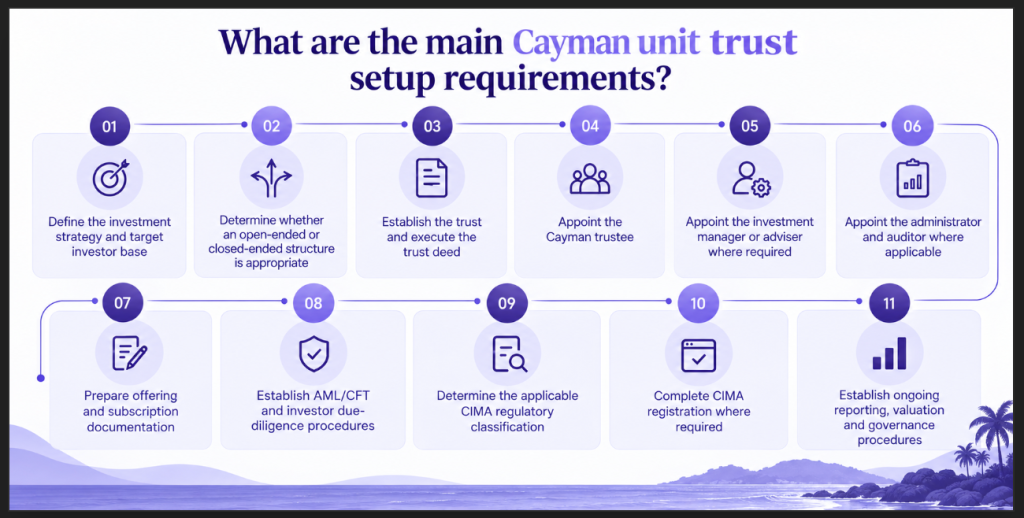
The trustee is particularly important because the trustee of a Cayman unit trust can perform a regulated operator role within the Cayman fund framework. CIMA identifies a trustee of a unit trust among the persons who can act as an operator of a mutual fund.
What documents are required to establish a Cayman unit trust?
The documentation will depend on the fund’s structure and regulatory classification, but can include:
- Trust deed or declaration of trust
- Offering memorandum or other offering document
- Subscription or application documents
- Investment management agreement
- Administration agreement
- Trustee documentation
- Auditor consent
- AML/CFT documentation
- Structure chart
- Service-provider information
- CIMA registration documentation, where applicable
For a private fund, CIMA’s registration requirements include the constitutive documents, offering memorandum or summary of terms, auditor consent, administrator consent where applicable and a structure chart identifying relevant entities and service providers.
The documentation should be consistent across the trust deed, offering materials, investment-management arrangements and regulatory filings.
What are the ongoing compliance requirements?
Once established, the fund may have continuing regulatory and operational obligations.
These can include:
- CIMA filings and regulatory fees
- Annual audited financial statements
- Fund Annual Return (FAR)
- Valuation and NAV procedures where applicable
- Cash-monitoring requirements for relevant private funds
- Custody and safekeeping requirements where applicable
- AML/CFT and sanctions compliance
- Investor and trust records
- Regulatory notifications
- Ongoing service-provider oversight
For regulated private funds, CIMA requires audited financial accounts and the Fund Annual Return to be submitted within six months of the fund’s financial year-end.
The specific obligations depend on whether the vehicle is regulated as a mutual fund, private fund or another type of arrangement.
How does investor liability work in a Cayman unit trust?
Investor liability is an important point to review before subscribing to units.
Under the common-law trust framework, unitholders may in some circumstances have obligations relating to indemnification of the trustee. The trust instrument should therefore clearly address the rights and liabilities of unitholders and the extent to which liability is limited.
This differs from an exempted company, where shareholders generally benefit from statutory limited liability.
The practical position depends on the terms of the particular trust instrument and applicable Cayman law. Investors should therefore review the trust deed and offering documentation rather than assuming that the liability position is identical to holding shares in a company.
What are the advantages of a Cayman unit trust?
A unit-trust structure can offer several characteristics relevant to international investment funds:
- Trust-based governance
- Flexibility for different investment strategies
- Suitability for open-ended and closed-ended structures
- Established Cayman fund infrastructure
- Familiarity among certain Asian institutional investors
- Flexible distribution arrangements
- Compatibility with master-feeder and other fund structures
The Cayman market also has specialist trustee expertise, particularly for Japan-focused funds. Industry providers report experience servicing Cayman unit trusts for Japanese managers and investors as well as clients elsewhere in Asia.
The appropriate structure nevertheless depends on the fund’s strategy, investor requirements, governance preferences and regulatory classification.
How do Cayman unit trusts compare with other fund vehicles?
| Factor | Unit Trust | Exempted Company | ELP |
| Legal structure | Trust | Corporate entity | Partnership |
| Investors hold | Units | Shares | Partnership interests |
| Trustee | Required | No | Generally no separate trustee |
| Open-ended use | Possible | Possible | Structure-dependent |
| Closed-ended use | Possible | Possible | Common |
| Governance | Trust deed and trustee | Articles and directors | Partnership agreement and GP |
| Key consideration | Trustee and trust framework | Corporate governance | Partnership economics and GP structure |
The choice should follow the fund’s commercial and investor requirements rather than being based solely on the name or familiarity of a particular vehicle.
What should Asian investors consider before choosing a Cayman unit trust?
Investors and fund managers should assess:
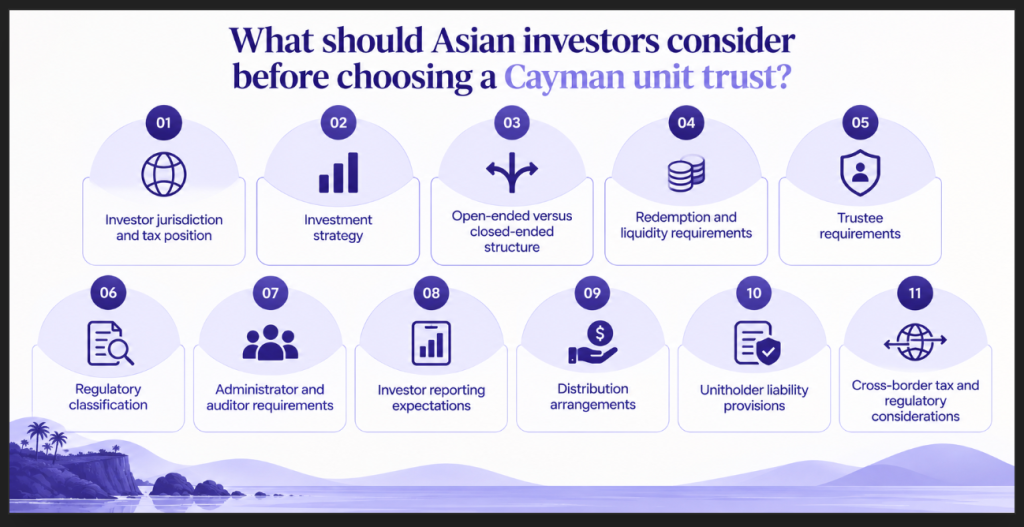
A Cayman fund structure does not determine the tax treatment of an investor in their home jurisdiction. Asian investors should separately consider local tax, reporting and investment-regulatory requirements.
What changed for Cayman unit trusts under the 2024 Perpetuities (Amendment) Act?
The 2024 amendments to Cayman’s perpetuities legislation changed the framework governing the duration of certain trusts. The amendments introduced provisions addressing trusts of unlimited duration and their relationship with the rule against perpetuities.
For investment structures, the ability to establish a trust with an indefinite duration where the applicable legal and documentary requirements are satisfied can be relevant to long-term fund planning.
The trust instrument should therefore be drafted with the intended duration and applicable perpetuities provisions in mind.
What are the current Cayman fund fees and filing considerations?
CIMA fees depend on the regulatory category and structure.
From 1 January 2026, revised annual fees apply to regulated mutual and private funds. CIMA states that the annual fee for registered funds increased to CI$4,125, while the annual fee for master funds increased to CI$3,075. Additional sub-fund fees can also apply.
For registered private funds, CIMA’s current fee framework also includes additional amounts for sub-funds or alternative investment vehicles where applicable.
These figures should not be treated as a universal fee for every unit trust. The applicable amount depends on the fund’s regulatory category, structure and any sub-funds or AIVs.
How can Arnifi help with Cayman unit trust setup?
Arnifi can help businesses and fund managers assess whether a unit trust fits their proposed investment structure and investor base.
Support can include:
- Reviewing the proposed fund structure
- Coordinating trust establishment
- Supporting fund documentation
- Coordinating trustee, administrator and auditor appointments
- Assisting with CIMA registration where applicable
- Supporting ongoing compliance and fund administration
- Coordinating the wider Cayman fund setup process
The focus is on coordinating the different elements of fund establishment rather than promising regulatory approval or a particular tax outcome.
FAQs
What is a Cayman Islands unit trust?
It is a trust-based investment vehicle where investors hold units representing economic interests in pooled investment assets.
Why do Asian investors use Cayman unit trusts?
The structure has established familiarity in Asian markets, particularly Japan, and supports various international investment strategies.
Are Cayman unit trusts regulated by CIMA?
Qualifying unit trusts can be regulated by CIMA under the Mutual Funds Act or Private Funds Act, depending on their characteristics.
Does every Cayman unit trust need CIMA registration?
No. Registration depends on the fund’s structure, activities, statutory classification and applicable exemptions.
What is the difference between a Cayman unit trust and an exempted company?
A unit trust is governed through a trust and trustee, while an exempted company is a separate corporate legal entity.
Can a Cayman unit trust be used for private equity?
Yes. Unit trusts can support closed-ended strategies such as private equity, subject to the applicable regulatory requirements.
What documents are required to establish a Cayman unit trust?
Typical documents include a trust deed, offering materials, subscription documents and service-provider agreements.
Who acts as trustee for a Cayman unit trust?
A Cayman trustee holds and administers the trust property under the trust deed and applicable legal requirements.
What are the ongoing compliance requirements?
Depending on classification, these can include audits, CIMA filings, FAR submissions, valuation, cash monitoring and AML/CFT compliance.
Is there a minimum investment requirement for a Cayman private fund?
The Private Funds Act does not impose a universal minimum investment amount simply because a vehicle is a private fund.
Conclusion
Cayman unit trusts provide a trust-based vehicle for structuring both open-ended and closed-ended investment funds. Their relevance to Asian investors is particularly established in Japan, while the structure can support broader strategies including private credit, infrastructure, private equity and venture capital. The applicable CIMA framework depends on the fund’s characteristics, making trustee arrangements, investor liability, documentation, regulatory classification and ongoing compliance important considerations before launch.
Official references
Top Cayman Island Packages
Related Articles



Top Cayman Island Packages
Get in Touch
