
Cayman Islands Private Equity Structures | Cayman Private Equity Fund Guide

Anushka
Content Writer
Anushka Basu is a business content writer specialised in global business market insights. She aims to simplify complex regulatory, financial, and business concepts into… Read more

Tulika Saxena
AVP, Sales & Marketing | IIM Nagpur
Tulika Saxena specializes in business finance, sales strategy, and market positioning. Leads growth and partnerships, ensuring seamless business setup experiences and client success across… Read more


Key Fact: A Cayman private equity fund may use a company, unit trust or partnership structure, but a qualifying private fund must comply with the Cayman Islands Private Funds Act and applicable CIMA requirements.
Table of contents
- What is a Cayman private equity fund?
- What is the Cayman private funds law?
- What are the main Cayman private equity fund structures?
- How does a Cayman private equity fund structure work?
- How do you set up a Cayman private equity fund?
- What documents are required for a Cayman private fund?
- When must a Cayman private equity fund register with CIMA?
- What are the compliance requirements for a Cayman private fund?
- What is Cayman fund finance?
- What does a Cayman private equity fund cost?
- How long does Cayman private equity fund setup take?
- How is a Cayman private equity fund taxed?
- What are the common mistakes when setting up a Cayman private equity fund?
- How can Arnifi help?
- FAQs
- Conclusion
What is a Cayman private equity fund?
A Cayman private equity fund is an investment vehicle that pools capital from investors and deploys it into private companies, growth businesses, buyouts, or other eligible investments. The fund is generally designed around a longer-term investment strategy rather than continuous investor redemptions.
The fund vehicle is separate from the entities and professionals that manage it. A typical structure may include:
- The fund, which holds the investment interests and investment assets.
- The general partner or other operator, which has responsibility for the fund’s governance.
- The investment manager, which manages some or all of the investments.
- Limited partners or other investors, who provide capital without day-to-day control over investments.
- Service providers such as an administrator, auditor, legal counsel and custodian where applicable.
This distinction matters because establishing a Cayman entity does not, by itself, determine the fund’s regulatory status.
What is the Cayman private funds law?
The principal framework is the Private Funds Act (2025 Revision), which has also been amended in 2026 to address tokenised private funds. The Act applies to qualifying private funds carrying on business or attempting to carry on business in or from the Cayman Islands, subject to specified exclusions.
Under the Act, a private fund generally involves a company, unit trust or partnership that issues investment interests and pools investor funds to generate profits or gains from investments. Investors must not have day-to-day control over the investments, and the investments must be managed as a whole by or on behalf of the fund operator.
Certain arrangements are excluded, including specified regulated entities and non-fund arrangements.
The classification therefore depends on the legal and operational characteristics of the arrangement, rather than simply the name given to the vehicle.
What are the main Cayman private equity fund structures?
The appropriate structure depends on the investment strategy, investor base, governance requirements and regulatory considerations.
Exempted limited partnership
An Exempted Limited Partnership (ELP) consists primarily of a general partner and limited partners. The general partner manages the partnership, while limited partners contribute capital and participate according to the partnership agreement.
The structure is frequently used for private equity because it can accommodate capital commitments, drawdowns, distribution waterfalls and different investor rights through contractual arrangements.
Exempted company
A Cayman exempted company provides a corporate structure with shares and company-level governance. Directors oversee the company, while investors hold shares or other interests according to the constitutional and offering documents.
This structure can be considered where corporate governance or investor requirements make a company preferable to a partnership.
Segregated portfolio company
A Segregated Portfolio Company (SPC) is a single Cayman company that can establish separate segregated portfolios. Each portfolio can be used for a different investment strategy or investor grouping, subject to the applicable legal and regulatory requirements.
An SPC is a corporate form rather than a separate category of private fund.
Master-feeder structure
A master-feeder arrangement uses separate feeder vehicles that invest into a central master fund. It can be useful where different investor groups require separate access vehicles, such as investors from different jurisdictions or with different tax and regulatory considerations.
A master-feeder arrangement is a structural arrangement rather than a standalone Cayman legal entity type.
How does a Cayman private equity fund structure work?
A simplified private equity structure can look like this:
Investors / Limited Partners
↓
Cayman Private Equity Fund
↓
Portfolio Companies / Investments
↑
General Partner + Investment Manager
Investors commit capital to the fund. The fund can then call that capital according to the terms of its governing documents and deploy it into portfolio investments.
The general partner or other operator handles the fund’s governance, while the investment manager is responsible for investment management where separately appointed.
Administrators, auditors, legal advisers and other service providers support the fund’s operational and regulatory infrastructure.
How do you set up a Cayman private equity fund?
A typical formation process involves:
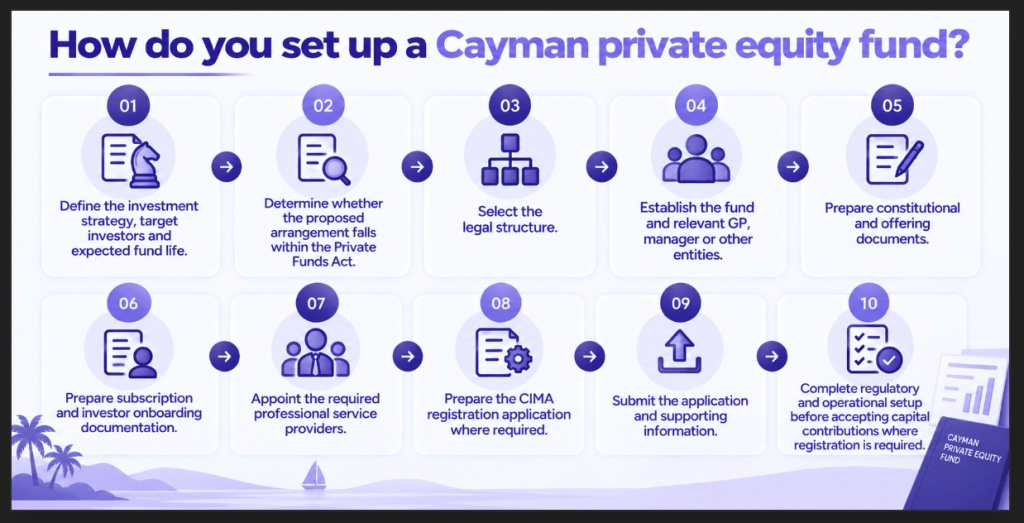
The Private Funds Act requires a private fund that falls within the registration regime to submit its registration application within 21 days after accepting capital commitments for investment purposes. However, it cannot accept capital contributions for investments until it has been registered.
What documents are required for a Cayman private fund?
CIMA’s private fund registration process generally requires documents such as:
| Document | Purpose |
| Certificate of incorporation or registration | Establishes the legal vehicle |
| Constitutive documents | Sets out the fund’s legal framework |
| Offering memorandum, summary of terms or marketing material | Explains the investment offering |
| Auditor’s consent letter | Confirms the proposed auditor |
| Administrator’s consent letter | Confirms the administrator where applicable |
| Structure chart | Shows the fund, GP, manager, feeders, AIVs and related entities |
| Investor subscription documents | Supports investor onboarding |
| CIMA application | Provides regulatory information required for registration |
CIMA states that applications are submitted through its prescribed process, with the required documents and fees provided before processing begins.
When must a Cayman private equity fund register with CIMA?
A qualifying private fund carrying on business in or from the Cayman Islands generally falls within the registration requirements of the Private Funds Act unless an applicable statutory exception applies.
The key distinction is between incorporation and regulatory registration. Creating an ELP or company establishes the legal vehicle; it does not automatically satisfy the fund’s obligations under the Private Funds Act.
CIMA’s registration process is administered through its regulatory systems, and the Act requires registration before the fund accepts investment capital where section 5 applies.
What are the compliance requirements for a Cayman private fund?
Registration is only the beginning of the regulatory lifecycle. Key requirements include:
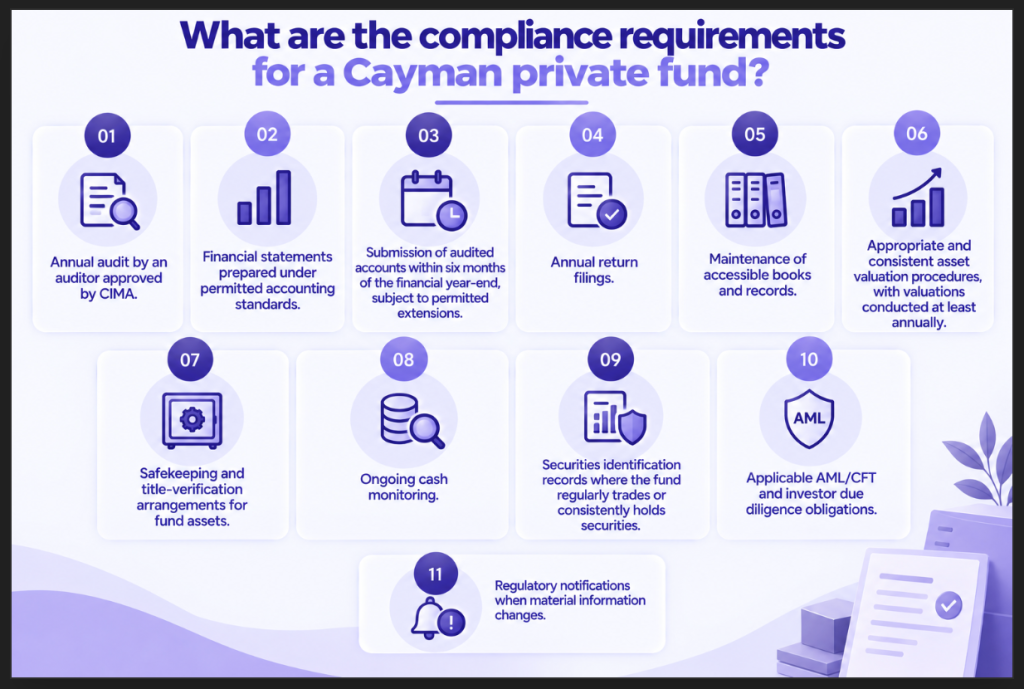
The Act specifically requires annual audits, annual returns, appropriate valuation procedures, asset safekeeping and cash monitoring.
CIMA also requires material changes to information submitted to the Authority to be notified within the applicable 21-day period.
What is Cayman fund finance?
Fund finance refers to borrowing arrangements used within a fund structure to support liquidity and investment operations.
For a private equity fund, financing can be used around capital calls, investment timing and short-term liquidity needs. The financing arrangement should be considered alongside the fund’s limited partnership agreement, subscription terms, capital commitments and investment strategy.
Fund-level financing should also be distinguished from debt raised by individual portfolio companies. Portfolio-company financing sits below the fund level and is generally associated with the financing of a specific investment.
What does a Cayman private equity fund cost?
There is no single setup price because the overall cost depends on the structure and operational requirements.
Typical cost categories include:
- Cayman entity incorporation and government fees
- CIMA registration and annual regulatory fees
- Legal structuring and fund documentation
- Fund administration
- Audit
- Registered office and corporate services
- Custody or other asset-related services where required
- AML/KYC and compliance support
- Banking and other operational expenses
For 2026, CIMA states that the annual fee for registered funds is CI$4,125, with an additional CI$525 applicable to each private fund sub-fund or alternative investment vehicle where relevant. Other professional and operating costs are separate.
How long does Cayman private equity fund setup take?
The timeline depends on the complexity of the structure and how quickly the legal documents, service providers and regulatory information are prepared.
The main stages are:
- Strategy and structural planning
- Entity incorporation
- Fund and offering documentation
- Service-provider appointments
- CIMA registration
- Investor onboarding
- Operational launch
A straightforward structure may progress faster than a multi-vehicle arrangement involving feeders, AIVs, multiple investor classes or more complex governance requirements.
How is a Cayman private equity fund taxed?
The Cayman Islands operates without income tax, corporation tax or capital gains tax under its current direct-tax framework. The Cayman Government describes its model as one based primarily on indirect taxes and fees.
However, Cayman tax neutrality does not mean investors or portfolio companies are automatically free from taxation.
Tax consequences can arise in the jurisdictions where:
- Investors are resident or domiciled
- Portfolio companies operate
- Investments are located
- Investment managers conduct business
Cross-border tax advice should therefore be considered alongside the Cayman structure rather than after formation.
What are the common mistakes when setting up a Cayman private equity fund?
Several issues can create unnecessary restructuring or compliance work:
- Choosing the legal vehicle before defining the investment strategy.
- Assuming every Cayman investment vehicle is automatically a private fund.
- Waiting until fundraising begins to consider CIMA registration.
- Using inconsistent names or information across incorporation and fund documents.
- Underestimating audit, valuation, cash-monitoring and reporting requirements.
- Failing to distinguish the fund from its GP and investment manager.
- Selecting service providers without considering the fund’s regulatory requirements.
- Ignoring investor-specific legal and tax considerations.
How can Arnifi help?
Arnifi can support international fund managers through the Cayman fund formation process, including:
- Fund structure planning
- Cayman entity formation
- Coordination of fund documentation
- CIMA registration support
- Service-provider coordination
- Operational setup
- Ongoing compliance coordination
The appropriate scope depends on the proposed fund structure, investment strategy and regulatory requirements.
FAQs
What is a Cayman private equity fund?
It is an investment vehicle that pools investor capital for private-market investments and distributes profits according to its governing documents.
What is the Cayman private funds law?
The Private Funds Act establishes the regulatory framework for qualifying Cayman private funds and their ongoing obligations.
What is the most common structure for a Cayman private equity fund?
An exempted limited partnership is widely used for private equity, although companies and other permitted structures may also be appropriate.
Does a Cayman private equity fund need to register with CIMA?
A qualifying private fund generally must register with CIMA unless a statutory exception applies.
What documents are required to register a Cayman private fund?
Documents can include constitutional documents, offering materials, service-provider consents, a structure chart and the prescribed CIMA application.
What is Cayman fund finance?
It refers to financing arrangements used at the fund level to support liquidity, capital calls or investment activity.
How much does it cost to set up a Cayman private equity fund?
Costs vary based on the structure, fund size, service providers, regulatory requirements and operational complexity.
How long does Cayman private equity fund setup take?
The timeline depends on incorporation, documentation, service-provider onboarding, CIMA registration and the complexity of the structure.
Are Cayman private equity funds tax neutral?
Cayman has no income or corporation tax, but investors and portfolio investments may have tax obligations in other jurisdictions.
What are the ongoing compliance requirements?
They include annual audits, annual returns, valuation, cash monitoring, asset safekeeping, recordkeeping and applicable regulatory notifications.
Conclusion
A Cayman private equity fund can use different structures to accommodate its investment strategy, investor base and governance requirements. An ELP, exempted company, SPC or master-feeder arrangement can serve different purposes. Beyond incorporation, the fund must address CIMA registration, documentation, service providers, tax considerations and ongoing compliance as part of one coordinated structure.
Official references
Top Cayman Island Packages
Related Articles

Top Cayman Island Packages
Get in Touch
