
Asset Purchase Agreement vs Share Purchase Agreement in the UAE | Legal and Compliance Implications

Anushka
Content Writer
Anushka Basu is a business content writer specialised in global business market insights. She aims to simplify complex regulatory, financial, and business concepts into… Read more

Tulika Saxena
AVP, Sales & Marketing | IIM Nagpur
Tulika Saxena specializes in business finance, sales strategy, and market positioning. Leads growth and partnerships, ensuring seamless business setup experiences and client success across… Read more



Key Fact: An asset purchase agreement in UAE transfers specific business assets, while a share purchase agreement in UAE transfers ownership of shares in a company. The choice affects liabilities, due diligence, approvals, tax treatment and how the transaction is completed.
Table of contents
- Introduction
- What Is an Asset Purchase Agreement in UAE?
- What Is a Share Purchase Agreement in UAE?
- What Is the Difference Between an Asset Purchase and a Share Purchase in UAE?
- How Does an Asset Purchase Work in the UAE?
- How Does a Share Purchase Work in the UAE?
- What Due Diligence Is Required for UAE Business Acquisitions?
- What Liabilities Transfer in an Asset vs Share Purchase?
- What Clauses Should a UAE Asset Purchase Agreement and a UAE Share Purchase Agreement Include?
- How Do Taxes and UAE Regulatory Considerations Differ?
- Which Is Better | Asset Purchase or Share Purchase in UAE?
- What Should Businesses Check Before Signing an Acquisition Agreement?
- How Can Arnifi Help With UAE Business Acquisition Structuring?
- FAQs
- Conclusion
- References
Introduction
Buying a business in the UAE does not always mean buying the company itself. Depending on the transaction, a buyer may acquire selected assets or purchase the shares of the existing company.
That distinction matters. An asset deal can allow the buyer to choose what it takes over, while a share deal transfers ownership of the company and leaves its existing legal structure in place.
The agreement used for the transaction therefore needs to match what is actually being acquired.
The two common structures are:
- Asset purchase: The buyer acquires specified assets or parts of a business.
- Share purchase: The buyer acquires shares in the target company.
Before choosing either route, businesses should consider the assets involved, existing liabilities, contracts, licences, tax position and regulatory requirements.
What Is an Asset Purchase Agreement in UAE?
An asset purchase agreement is a contract under which a buyer purchases specified assets or business operations from a seller.
Depending on the transaction, these could include:
- Equipment and machinery
- Inventory
- Intellectual property
- Customer relationships
- Business contracts
- Technology
- Business premises or lease interests, where transferable
- Other identified assets
The agreement should clearly state what is being transferred and what remains with the seller. It should also distinguish between liabilities assumed by the buyer and those that remain with the seller.
This makes the drafting of the asset schedule particularly important. A vague description of the assets can create problems during completion or later when ownership is disputed.
An asset purchase does not automatically transfer ownership of the seller’s company.
What Is a Share Purchase Agreement in UAE?
A share purchase agreement (SPA) is used when the buyer purchases shares in an existing company.
The company itself continues to exist. What changes is its ownership.
As a result, the company’s underlying assets generally remain where they are. The buyer acquires the shares and, through that ownership, acquires an interest in the company and its existing business.
This also means the buyer needs to look carefully at the company’s history before completing the transaction.
Due diligence may uncover:
- Outstanding debts
- Tax exposures
- Employee claims
- Litigation
- Contractual obligations
- Regulatory issues
- Undisclosed liabilities
Under the UAE Commercial Companies Law, transfers of shares are subject to applicable legal and corporate procedures, including registration requirements.
What Is the Difference Between an Asset Purchase and a Share Purchase in UAE?
| Factor | Asset Purchase Agreement | Share Purchase Agreement |
| What is purchased? | Specified assets or business components | Shares in the target company |
| Legal entity | Seller generally retains the company | Target company continues under new ownership |
| Assets | Agreed assets are transferred | Company retains its existing assets |
| Liabilities | Can be allocated between parties | Generally remain with the target company |
| Due diligence | Focuses on assets and related business operations | Covers the target company as a whole |
| Contracts | Transfer or consent may be required | Usually remain with the company, subject to restrictions |
| Employees | Transfer arrangements may need consideration | Generally remain with the same employer |
| Approvals | Depend on the assets and transaction | Depend on ownership, activity and applicable rules |
| Typical use | Selective acquisition | Acquisition of an existing business |
How Does an Asset Purchase Work in the UAE?
An asset acquisition usually moves through several stages.
| Step | What happens |
| 1. Identify the assets | Buyer and seller agree on exactly what is being acquired |
| 2. Conduct due diligence | Ownership, contracts, IP, liabilities and records are reviewed |
| 3. Agree the value | Parties determine the purchase price and allocation |
| 4. Allocate liabilities | The agreement identifies assumed and excluded liabilities |
| 5. Draft the agreement | Price, warranties, indemnities and completion conditions are documented |
| 6. Obtain approvals | Required regulatory, contractual or third-party consents are obtained |
| 7. Transfer assets | Asset-specific transfer documents are completed |
| 8. Close the deal | Payment is made and the agreed assets are transferred |
Not every asset can simply be handed over with the signing of the agreement. Certain contracts, licences, intellectual property rights or property interests may require separate transfer procedures or consent.
How Does a Share Purchase Work in the UAE?
A share acquisition follows a different route because the company itself is not being dismantled and transferred piece by piece.
The usual process involves:
- Identifying the target company and shares being sold
- Conducting legal, financial and regulatory due diligence
- Agreeing the purchase price and transaction terms
- Drafting and negotiating the SPA
- Setting out warranties, indemnities and conditions precedent
- Obtaining required approvals and third-party consents
- Completing the share transfer
- Updating the relevant corporate records
For an unlisted company, UAE legislation provides for share transfers to be recorded in the company’s share register, with the transfer becoming effective against the company and third parties from the relevant registration date.
What Due Diligence Is Required for UAE Business Acquisitions?
Due diligence is important in both structures, but the scope can be different.
Asset Purchase
The buyer will generally focus on:
- Ownership of the assets
- Condition and value
- Existing security interests
- Transferability
- Contracts connected with the assets
- Intellectual property
- Related liabilities
Share Purchase
The review is broader because the buyer is taking ownership of the company.
It can cover:
- Corporate records
- Shareholding
- Financial statements
- Tax and VAT records
- Licences
- Employment matters
- Material contracts
- Intellectual property
- Litigation
- Debt
- Regulatory compliance
- Real estate and leases
The central question is simple: what exactly are you taking on after completion?
What Liabilities Transfer in an Asset vs Share Purchase?
This is one of the biggest differences between the two structures.
With an asset purchase, the agreement can identify which liabilities the buyer agrees to assume and which remain with the seller. The allocation still needs to be considered against applicable UAE law and the nature of the liability.
With a share purchase, the company remains the same legal entity after the transaction. Its existing obligations therefore do not disappear simply because its shareholders have changed.
That makes historical and contingent liabilities particularly important during an SPA.
A change in ownership does not automatically erase the target company’s existing obligations.
What Clauses Should a UAE Asset Purchase Agreement and a UAE Share Purchase Agreement Include?
| Clause | UAE Asset Purchase Agreement (APA) | UAE Share Purchase Agreement (SPA) |
| Subject of the transaction | Purchased and excluded assets | Target company and shares being sold |
| Purchase price | Purchase price and payment terms | Purchase price and payment terms |
| Liabilities | Assumed and excluded liabilities | Liabilities remain with the target company, subject to agreed protections |
| Conditions precedent | Conditions required before completion | Conditions required before completion |
| Representations and warranties | Seller representations and warranties relating to the assets and transaction | Seller and buyer representations and warranties relating to the company, shares and transaction |
| Indemnities | Indemnities for specified losses, liabilities or breaches | Indemnities for specified losses, liabilities or breaches |
| Pre-completion obligations | Completion-related obligations before the asset transfer | Seller’s obligations concerning the target before completion |
| Confidentiality | Confidentiality obligations | Confidentiality obligations |
| Restrictive covenants | Restrictions applicable to the parties, where relevant | Restrictions applicable to the parties, where relevant |
| Completion obligations | Transfer and delivery of the purchased assets | Transfer of shares and completion mechanics |
| Change-of-control matters | Generally less central to the transaction | May be relevant where contracts, licences or approvals are affected by the change in ownership |
| Governing law | Applicable governing law | Applicable governing law |
| Dispute resolution | Mechanism for resolving disputes | Mechanism for resolving disputes |
| Termination rights | Circumstances allowing the agreement to be terminated | Circumstances allowing the agreement to be terminated |
How Do Taxes and UAE Regulatory Considerations Differ?
The tax consequences can differ depending on what is being transferred.
Businesses should consider:
- UAE Corporate Tax
- VAT
- Treatment of individual assets
- Treatment of a business transfer
- Tax history of the target company
- Potential restructuring relief
- Applicable regulatory approvals
The UAE Federal Tax Authority specifically recognises the concept of transferring a whole business or an independent part of a business as a going concern for VAT purposes, subject to the applicable conditions. A qualifying transfer is not treated as a supply for VAT purposes.
That does not mean every asset acquisition is automatically outside VAT. The actual transaction needs to be examined against the relevant conditions.
Corporate Tax also needs to be considered separately. The FTA confirms that Corporate Tax and VAT continue to operate as separate taxes in the UAE.
Regulatory considerations may also include:
- Business activity
- Ownership requirements
- Licensing authority
- Sector-specific rules
- Change-of-control provisions
- Third-party approvals
Which Is Better | Asset Purchase or Share Purchase in UAE?
There is no universal answer. The better structure depends on what the buyer actually wants to acquire.
| If the buyer wants to… | Structure that may be considered |
| Acquire selected assets | Asset purchase |
| Exclude unrelated business assets | Asset purchase |
| Acquire an established company | Share purchase |
| Keep the existing corporate entity | Share purchase |
| Take over an existing operating business | Share purchase may be appropriate |
| Separate selected assets from the seller | Asset purchase |
| Avoid acquiring unrelated company liabilities | Asset purchase may offer greater selectivity |
The decision should be made after reviewing the legal, commercial and tax implications rather than simply choosing the structure with the lower headline cost.
What Should Businesses Check Before Signing an Acquisition Agreement?
Before signing, the buyer should confirm:
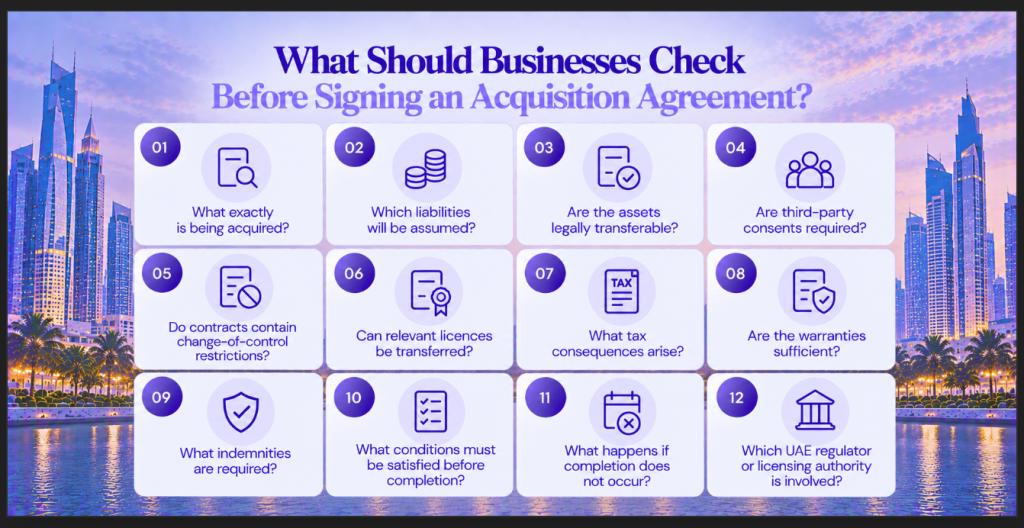
Getting these points clear before signing can prevent costly changes later.
How Can Arnifi Help With UAE Business Acquisition Structuring?
Arnifi can support businesses evaluating the right structure for a UAE acquisition, whether the transaction involves selected assets or an existing company.
Support can include:
- Assessing the proposed acquisition structure
- Assisting with UAE company and corporate structuring
- Supporting documentation and incorporation requirements
- Coordinating relevant tax and corporate-service requirements
- Helping businesses understand UAE regulatory considerations
- Supporting the broader setup and compliance process
FAQs
What is an asset purchase agreement in UAE?
An asset purchase agreement is a contract under which a buyer acquires specified assets or business components from a seller. The agreement identifies the assets being transferred and can also allocate specific liabilities between the parties.
What is a share purchase agreement in UAE?
A share purchase agreement governs the sale and purchase of shares in an existing company. The company continues to operate as the same legal entity, but ownership changes from the seller to the buyer.
What is the difference between an asset purchase and share purchase in UAE?
An asset purchase transfers selected assets, while a share purchase transfers ownership of the company itself. The difference affects liabilities, due diligence, contracts, approvals and the way the transaction is completed.
Which is better for buying a business in the UAE: assets or shares?
Neither structure is automatically better. An asset purchase may suit a buyer seeking selected assets, while a share purchase may be more appropriate when the buyer wants to acquire an established company and its existing operations.
What due diligence is required before signing an acquisition agreement in the UAE?
Due diligence may cover corporate records, ownership, financial statements, tax and VAT, contracts, licences, employees, intellectual property, debt, litigation, regulatory compliance and other matters relevant to the transaction.
Conclusion
An asset purchase agreement in UAE and a share purchase agreement in UAE serve different purposes.An asset transaction allows the parties to identify the assets and liabilities being transferred, while a share transaction changes ownership of the company without transferring its underlying assets individually.
The right choice depends on the buyer’s objectives, the target company’s liabilities, contractual arrangements, regulatory position and tax considerations. Before signing either agreement, businesses should carry out appropriate due diligence and assess the transaction structure carefully.
Looking to acquire a business or restructure an investment in the UAE? Arnifi can help you assess the appropriate setup and coordinate the corporate and compliance requirements involved.
References
Top UAE Packages
Related Articles

Top UAE Packages
Get in Touch
