
Singapore Private Equity Fund Setup: Structure and Requirements

Nishant
Content Writer
Nishant Kumar is a technical content writer, he shares global business insights and bridges the gap between complex regulatory frameworks and actionable growth strategies.… Read more

Tulika Saxena
AVP, Sales & Marketing | IIM Nagpur
Tulika Saxena specializes in business finance, sales strategy, and market positioning. Leads growth and partnerships, ensuring seamless business setup experiences and client success across… Read more


Table of contents
Key Facts
- The establishment of a Singapore private equity fund involves obtaining a license of Capital Markets Services (CMS) from the Monetary Authority of Singapore (MAS)
- The MAS officially repealed the Registered Fund Management Company (RFMC) regime on August 1, 2024.
- Companies need to function as Licensed Fund Management Companies (LFMC) or Venture Capital Fund Managers (VCFM) in their operations.
- Arnifi offers an all-encompassing platform for business incorporation, operational management, compliance management, and digital business operations in many international jurisdictions
Introduction
Setting up a private equity fund in Singapore allows one to benefit from a well-regulated and tax-friendly financial environment. The MAS takes very stringent measures in enforcing fund management frameworks in order for the country to remain reputable in the international arena. The founders and corporate heads have no choice but to adjust to the changes in regulations in order to be absolutely compliant when entering into the markets.
Not adhering to the required corporate structure according to the new categories of MAS licenses is an instant cause for delay.
What is a Singapore Private Equity Fund?
A private equity fund in Singapore is a collective investment structure meant to gather the resources of accredited investors and institutions. Such funds make investments in privately owned companies through acquisitions, venture capital, and growth equity methods.
Legally setting up such funds requires creating an official company to hold the funds and obtaining a license for the management of the funds. There are strong legal regulations in place in the jurisdiction that guarantee protection of the limited partners along with offering flexibility to the fund managers.
What Are the Current MAS Fund Management Licenses?
MAS fundamentally revamped its regulatory framework through the abolition of the RFMC scheme. Companies that wish to undertake management of private equity capital must apply for a Capital Markets Services license. The founders usually choose either the Licensed Fund Management Company catering to accredited and institutional investors or the Venture Capital Fund Manager classification.
The LFMC is an entity that provides a wide range of flexibility for the utilization of private equity capital. They are required to have a minimum base capital of S$250,000 and sufficient funds that can cover 120 percent of their operational risk needs. On the other hand, the VCFM category presents an easy route for managers utilizing private capital only in venture capital and early-stage equity investments.
How Does the Variable Capital Company (VCC) Framework Operate?
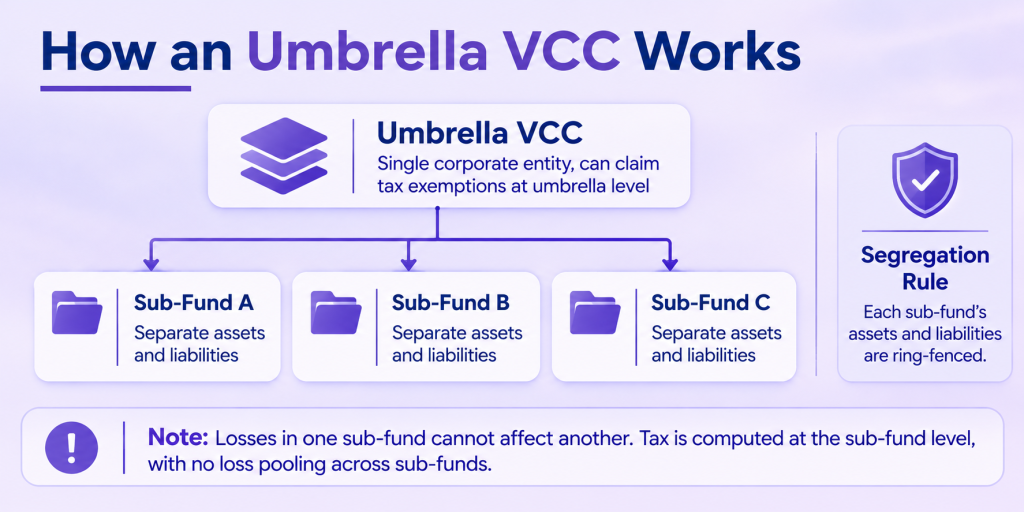
VCC is the most suitable corporate form for investment funds in Singapore. The VCC may work independently or in the form of an umbrella that includes several sub-funds under one umbrella VCC. Asset and liability separation becomes possible with such a structure, which means that the losses incurred by one sub-fund will not affect the capital of any other sub-fund.
According to the guidelines of the Inland Revenue Authority of Singapore (IRAS), tax treatment is done on a sub-fund basis. But in case of an umbrella VCC, tax exemptions can be claimed partially at the umbrella level because multiple claims can be made by claiming at the sub-fund level. VCCs residing in Singapore can benefit from Singapore’s tax treaties.
What Are the Core Setup Requirements for a PE Fund?
Getting an LFMC license demands stringent compliance with corporate substance and governance requirements. In Singapore, for instance, fund managers must have physical office space and stringent Anti-Money Laundering (AML) measures in place.
| Setup Requirement | LFMC (Accredited/Institutional) | Venture Capital Fund Manager (VCFM) |
| Minimum Base Capital | S$250,000 | No statutory minimum (must remain solvent) |
| Risk-Based Capital | 120 percent of operational risk requirements | Not applicable |
| Director Requirements | Minimum two directors (one must reside in Singapore) | Minimum two directors (one must reside in Singapore) |
| Professional Staffing | Two full-time, Singapore-based relevant professionals | Two full-time, Singapore-based relevant professionals (including a full-time CEO resident in Singapore) |
All investors require additional scrutiny and thorough due diligence on the actual source of their wealth and funding. An independent compliance unit must be formed for firms having assets under management above S$1 billion. (Note: Managers who only carry out research and advisory services can meet this requirement through the use of a compliance team at their parent firm or a foreign subsidiary.)
How We at Arnifi Support Singapore Fund Setup
We at Arnifi offer a digital-first global expansion platform that helps founders, startups, SMEs, investors, and enterprises establish and operate businesses across multiple jurisdictions with speed, transparency, and operational clarity. For a Business setup in Singapore, our platform eliminates fragmented paperwork and offline delays.
Beyond initial licensing, our advisory teams execute comprehensive due diligence to secure reliable Banking Services. Our teams also handle Visa Services for relocating executives and compliance professionals. To explore the broader ecosystem, decision-makers can review our guide on Singapore fund management company setup.
Conclusion
Proper establishment of a Singapore private equity fund requires total conformity with the requirements of MAS regulations and IRAS taxes. The need to move from the RFMC framework calls for fund managers to quickly adhere to the standards set by the LFMC or VCFM frameworks. Using the VCC framework is the best approach to maximizing tax efficiency and segregating assets.
Contact us at Arnifi to structure a compliant and highly efficient global expansion strategy.
FAQs
What is a Singapore Private Equity Fund?
It is a collective investment structure meant to gather the resources of accredited investors and institutions.
Has the MAS repealed the RFMC system?
Yes. The Monetary Authority of Singapore formally repealed the Registered Fund Management Company system on August 1, 2024, moving the managers under the CMS licensing system.
What is the distinction between an LFMC and a VCFM?
An LFMC provides for wide-ranging investment and has risk-based capital. A VCFM provides a simpler regulatory process for venture capital investments only.
What is a Variable Capital Company (VCC)?
VCC is a special type of company formed specifically for investment funds in Singapore with the ability to create several segregated sub-funds under one umbrella company.
How are umbrella VCCs taxed in Singapore?
Tax provisions generally apply at the sub-fund level, where chargeable income is computed for each sub-fund. There are certain tax provisions that apply at the umbrella level, for instance, the Start-Up Tax Exemption.
Is there a requirement for a physical office of a fund management company?
Yes. According to MAS, licensed fund managers are required to have a dedicated and secure physical office in Singapore.
What are the minimum capital requirements of an LFMC?
An LFMC catering to institutional and accredited investors must have a minimum base capital of S$250,000.
Does an LFMC need to appoint a resident Singapore director?
Yes. Under the framework, an LFMC is required to appoint at least two directors, out of which at least one director must be a full-time Singapore resident.
Are there provisions for loss pooling of VCC sub-funds?
No. There are no such provisions to allow the pooling of losses among sub-funds to maintain segregation.
Does there exist a requirement for separate compliance teams of fund managers?
For fund managers managing more than S$1 billion of funds under management, there is a need for having an internal compliance function which functions independently of the front office.
References
Inland Revenue Authority of Singapore (IRAS)
MAS – Guidelines on Licensing and Conduct of Business for Fund Management Companies [SFA 04-G05]
Top Singapore Packages
Related Articles

Top Singapore Packages
Planning Your Next Business Move?
