
How to Choose a Fund Administrator | Selection Criteria and Due Diligence

Anushka
Content Writer
Anushka Basu is a business content writer specialised in global business market insights. She aims to simplify complex regulatory, financial, and business concepts into… Read more

Tulika Saxena
AVP, Sales & Marketing | IIM Nagpur
Tulika Saxena specializes in business finance, sales strategy, and market positioning. Leads growth and partnerships, ensuring seamless business setup experiences and client success across… Read more



Key Fact: A fund administrator supports fund accounting, NAV calculations, investor reporting and operational processes. Choosing one requires evaluating its expertise, controls, technology, service quality and ability to support the fund’s long-term requirements.
Table of contents
- What Does a Fund Administrator Do?
- Why Is Choosing the Right Fund Administrator Important?
- What Criteria Should You Consider When Choosing a Fund Administrator?
- How Do You Conduct Fund Administrator Due Diligence?
- What Questions Should You Ask a Fund Administrator?
- How Can You Compare Fund Administrator Proposals?
- What Are Some Warning Signs When Selecting a Fund Administrator?
- How Much Does Fund Administration Cost?
- How Do You Appoint and Onboard a Fund Administrator?
- How Can Arnifi Help With Fund Setup and Structuring?
- FAQs
- Conclusion
- References
What Does a Fund Administrator Do?
Typically, a fund administrator manages essential operational and accounting activities that keep an investment fund organised. Depending on the agreement, its responsibilities may include:
- Fund accounting and financial recordkeeping
- Net asset value (NAV) calculations
- Investor onboarding and transfer agency
- Subscription, redemption and capital call processing
- Investor reporting and financial statement preparation
- Audit coordination and regulatory reporting support
Why Is Choosing the Right Fund Administrator Important?
Reporting delays can affect investor communication. An inaccurate NAV calculation can create reconciliation problems. Poor onboarding processes may slow capital deployment.
Choosing the right provider helps fund managers maintain accurate records, improve investor confidence and manage operational risks. It also gives the fund a reliable administration framework as its investor base and portfolio expand.
What Criteria Should You Consider When Choosing a Fund Administrator?
| Selection Criteria | What to Evaluate |
| Industry experience | Similar fund structures and asset classes |
| Accounting expertise | NAV calculations and reconciliations |
| Investor services | Onboarding and investor communication |
| Regulatory knowledge | Applicable reporting requirements |
| Technology | Secure platforms and reporting tools |
| Scalability | Ability to support additional funds |
| Service quality | Response times and escalation procedures |
| Pricing | Transparent fees and additional charges |
For example, a private equity fund with complex capital calls may need a provider experienced in investor capital accounts. A real estate fund may require stronger property-level accounting capabilities.
How Do You Conduct Fund Administrator Due Diligence?
Before appointing a provider, examine its operational reliability and financial stability.
- Review its track record and experience with comparable funds
- Verify relevant regulatory authorisations where applicable
- Examine internal controls and independent assurance reports
- Assess cybersecurity and data protection arrangements
- Review disaster recovery and business continuity procedures
- Check staff qualifications, turnover and account management
- Obtain references from existing clients
- Identify potential conflicts of interest
A provider’s presentation may look impressive, but its controls and actual service delivery deserve closer scrutiny.
What Questions Should You Ask a Fund Administrator?
During provider discussions, ask questions that reveal how the service operates in practice.
- Who will manage our account after onboarding?
- How are NAV calculations reviewed and approved?
- What reporting timelines are included in the agreement?
- How are accounting errors identified and corrected?
- Who handles investor queries and escalations?
- Which services attract additional charges?
- How will the administrator support our annual audit?
If a provider cannot explain its error-resolution process clearly, that deserves further investigation.
How Can You Compare Fund Administrator Proposals?
A structured request for proposal (RFP) helps compare providers consistently.
- Define the fund’s accounting, reporting and investor servicing requirements.
- Send the same RFP to shortlisted providers.
- Review sample NAV reports and investor statements.
- Arrange technical demonstrations and operational discussions.
- Compare service scope, controls and reporting timelines.
- Conduct reference checks before final selection.
A weighted scoring matrix can help evaluate providers against agreed priorities rather than choosing solely on price.
What Are Some Warning Signs When Selecting a Fund Administrator?
Watch for warning signs such as:
- Unclear service responsibilities
- Limited transparency about operational controls
- Frequent reporting delays
- Poor communication or unresolved investor complaints
- Weak cybersecurity arrangements
- High staff turnover
- Hidden fees or ambiguous contractual terms
For instance, a low-cost proposal may exclude investor reporting or complex transaction processing. Those charges can increase the overall cost considerably.
How Much Does Fund Administration Cost?
Administration fees vary according to fund size, complexity and service scope.
Common charging models include:
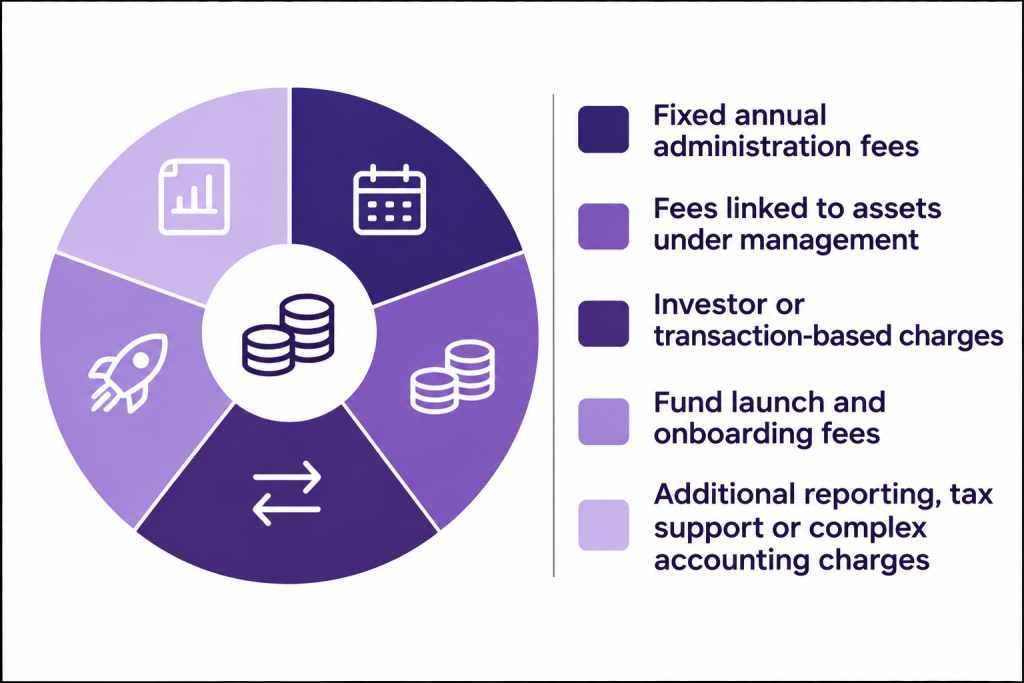
Review minimum fees, escalation clauses and termination charges before signing.
How Do You Appoint and Onboard a Fund Administrator?
Once due diligence is complete, finalise the administration agreement, service-level expectations and reporting responsibilities.
The onboarding process generally includes transferring fund records, establishing accounting workflows, configuring investor reporting and testing operational processes. Clear responsibilities during this transition help avoid reporting gaps.
How Can Arnifi Help With Fund Setup and Structuring?
Arnifi supports fund founders and investment businesses with company establishment, jurisdiction evaluation and incorporation documentation. This administrative groundwork can help managers prepare their legal entities and coordinate the wider requirements involved in launching a fund.
FAQs
How do you choose a fund administrator?
Evaluate relevant experience, accounting expertise, controls, technology, reporting quality, service standards and contractual transparency.
Is an independent fund administrator necessary?
Independent administration can strengthen operational oversight and investor confidence. Whether it is required depends on the fund’s jurisdiction, structure and regulatory framework.
How often should fund administrators undergo due diligence?
Due diligence should continue after appointment through periodic reviews, service assessments and monitoring of operational risks.
Can a fund change its administrator after launch?
Yes. A change is possible, subject to contractual terms, regulatory requirements and a properly managed transfer of records.
Conclusion
Choosing a fund administrator requires more than comparing quotations. Fund managers should assess operational controls, accounting expertise, reporting capabilities and service quality before making an appointment. A structured due diligence process helps identify a provider that can support accurate administration, investor servicing and the fund’s long-term operational requirements.
References
- Central Bank of Ireland – Fund Administrators: Outsourcing of Investment Fund Administration Activities
- ASIC – Review of Offshore Outsourcing: Responsible Entities
- World Bank – Assessment of Service Providers
- AIMA – Fund Directors’ Guide
- CAIA – A Guide to Hedge Fund Business Operational Due Diligence
- SEC – Custody of Funds or Securities of Clients by Investment Advisers
Top UAE Packages
Related Articles

Top UAE Packages
Planning Your Next Business Move?
