
How to Start a Fund Management Company in Singapore | Complete Setup Guide

Zahira Shaik
SEO Content Writer
Zahira Shaik is an SEO Content Writer and Published Author specializing in research-based content. She excels at analyzing market trends, regulations, and industry developments… Read more

Tulika Saxena
AVP, Sales & Marketing | IIM Nagpur
Tulika Saxena specializes in business finance, sales strategy, and market positioning. Leads growth and partnerships, ensuring seamless business setup experiences and client success across… Read more


Key Fact: Setting up a Singapore fund management company requires obtaining Monetary Authority of Singapore regulatory approval, setting aside minimum base capital of S$250,000, having local presence, and having effective compliance controls in place.
Table of contents
- 1. Introduction
- 2. Understanding Fund Management Licensing in Singapore
- 3. Regulatory Requirements for Setting Up a Fund Management Company
- 4. Choosing the Right Fund Structure in Singapore
- 5. Tax Incentives and Fund Management Schemes in Singapore
- 6. Step-by-Step Process to Set Up a Fund Management Company in Singapore
- 7. Timeline and Costs of Setting Up a Fund Management Company in Singapore
- 8. Common Challenges and Mistakes to Avoid
- 9. How Arnifi Helps With Singapore Fund Management Company Setup
- 10. Conclusion
- 11. Frequently Asked Questions (FAQs)
- References
1. Introduction
Fund Management Company (FMC) in Singapore is a regulated corporate organization that manages a collective investment scheme, private equity fund, venture capital portfolio, or segregated mandate. Singapore is considered to be the leading financial center in Asia because of its clear legal system, stability of politics and economic links. Monetary Authority of Singapore (MAS) regulates all fund management operations according to the Securities and Futures Act (SFA). The MAS has tight control over the fund management industry in order to provide investors’ protection.
Proper implementation of a Singapore fund management company establishment implies careful planning. Fund managers have to create their local operational presence, select the appropriate corporate structure, and get the necessary licenses prior to receiving capital from investors.
2. Understanding Fund Management Licensing in Singapore
MAS has defined the regulatory processes for specific licensing of each asset class, type of investor, and management strategy.
Licensed Fund Management Companies (LFMCs)
The operation of an LFMC is governed by the license under Capital Markets Services (CMS) regulations. The choice made relates to either accredited or retail investors.
- Accredited/Institutional LFMC (A/I LFMC): Provides services to accredited and institutional investors. A minimum base capital requirement of S$250,000.
- Retail LFMC: It has a requirement for regulatory oversight while providing services to retail investors. A minimum base capital requirement of S$1,000,000.
Venture Capital Fund Managers (VCFMs)
A special regulatory regime exists for VCFMs as per MAS regulations. VCFMs are responsible for managing funds that invest in unlisted startups.
- Exempted from capital and representation requirements.
- Should not be able to hold funds for continuous redemption by investors.
Exempt Fund Managers and Single Family Offices
Certain entity structures are entitled to exemptions under the statute from CMS licensing.
- Single Family Offices (SFOs) which operate only for one family can take advantage of licensing exemptions.
- The management of any third-party capital or pooled investor money means full licensing requirements under MAS.
What Happened to the RFMC Regime?
MAS abolished the Registered Fund Management Company (RFMC) regime in order to simplify the oversight of funds. The existing RFMCs were required to migrate into the A/I LFMC licensing regime to ensure consistent compliance standards.
3. Regulatory Requirements for Setting Up a Fund Management Company
Establishment of the FMC requires compliance with the regulatory requirements under MAS..
MAS Fit and Proper Requirements
MAS examines all parties to the deal according to very high standards of honesty, integrity, competence, and financial soundness. Board directors, executive officers, portfolio managers, and substantial shareholders must demonstrate relevant track records.
Minimum Capital and Financial Requirements
Capital requirements directly depend on your chosen licensing tier.
| Licensing Category | Minimum Base Capital | Target Investors |
| A/I LFMC | S$250,000 | Accredited & Institutional Only |
| Retail LFMC | S$1,000,000 | Retail & General Public |
| VCFM | No statutory minimum | Venture Capital Investors |
Local Management and Operational Substance
You need to hire local executives to create operations-based decision-making in Singapore.
- You need at least two Singapore-based executive directors.
- You should hire qualified local investment professionals who will undertake your daily operations.
Compliance, Risk Management, and AML/CFT
Firms need to develop their internal control systems, operational risk management systems, and Anti-Money Laundering and Countering the Financing of Terrorism (AML/CFT) processes.
Custody, Auditing, and Independent Service Providers
FMCs need to protect the money of their investors through hiring independent MAS-approved custodians. FMCs need to hire external auditors for annual audits.
4. Choosing the Right Fund Structure in Singapore
Choosing an appropriate fund structure guarantees effective management, proper governance, and an efficient investor onboarding process.
What Is a Variable Capital Company (VCC)?
The Variable Capital Company is a structure designed exclusively for investment funds in Singapore. Both open-ended and closed-ended funds can be established under this structure.
Standalone VCC vs. Umbrella VCC
- Standalone VCC: Single investment portfolio managed under one company structure.
- Umbrella VCC: Multiple sub-funds managed under one company structure. Isolates the assets and liabilities of the sub-funds in their separate compartments.
Key Features and Benefits of a VCC
- The capital varies dynamically depending on the number of shares issued or redeemed without any involvement from the shareholders.
- Works on NAV-based subscriptions and redemptions.
- The shareholder registers are kept confidential to maintain the secrecy of investors.
Alternative Fund Structures
- Private Limited Companies: Appropriate fund structure for traditional closed-ended private equity structures.
- Limited Partnerships (GP/LP): Traditional structure for private equity and venture capital funds.
- Unit Trusts: The preferred structure for conventional retail collective investment vehicles.
Singapore Funds vs. Offshore Fund Structures
Local structures are compared with Cayman Islands structures. It is a good idea to combine the use of a local structure and a fund manager in Singapore due to regulatory compatibility, tax efficiency, and compliance governance. Strategies in cross-border financing often employ master-feeder structures.
5. Tax Incentives and Fund Management Schemes in Singapore
Singapore offers beneficial tax incentives for funds under the Income Tax Act.
Section 13O Tax Incentive Scheme
Section 13O scheme (Singapore Resident Fund Scheme) offers tax exemptions on certain types of income from specified investments managed by a Singapore FMC.
Section 13U Tax Incentive Scheme
The Section 13U scheme (Enhanced-Tier Fund Scheme) applies to large funds and involves tax exemptions without imposing restrictions on the incorporation jurisdiction.
Tax Treatment of Fund Income and Performance Fees
Concessional tax rates are accorded to fund-level investment income. The FMC management fees will be charged according to normal taxation procedures applicable locally unless exempted under certain incentives.
Economic Substance and Local Spending Requirements
Section 13O and 13U incentives will only be accorded to those funds that fulfill annual criteria for expenditure in local businesses and employing local investment professionals.
6. Step-by-Step Process to Set Up a Fund Management Company in Singapore
Establishing an FMC will require a sequential approach covering seven stages.
- Define Strategy: Determine investor profiles, assets, and the structure of the fund.
- Select Licence Route: Decide as to whether your licence will be an LFMC, VCFM or SFO exemption license.
- Incorporate Entity: Register your private limited company through ACRA.
- Appoint Personnel: Hire resident executive directors and local investment professionals.
- Submit MAS Application: Compile compliance and risk control manuals and apply for corporate licensing.
- Set Up Infrastructure: Create corporate bank accounts and contract with independent fund administrators and auditors.
- Complete Approvals: Fulfill final conditions set out by MAS for your license and go into business.
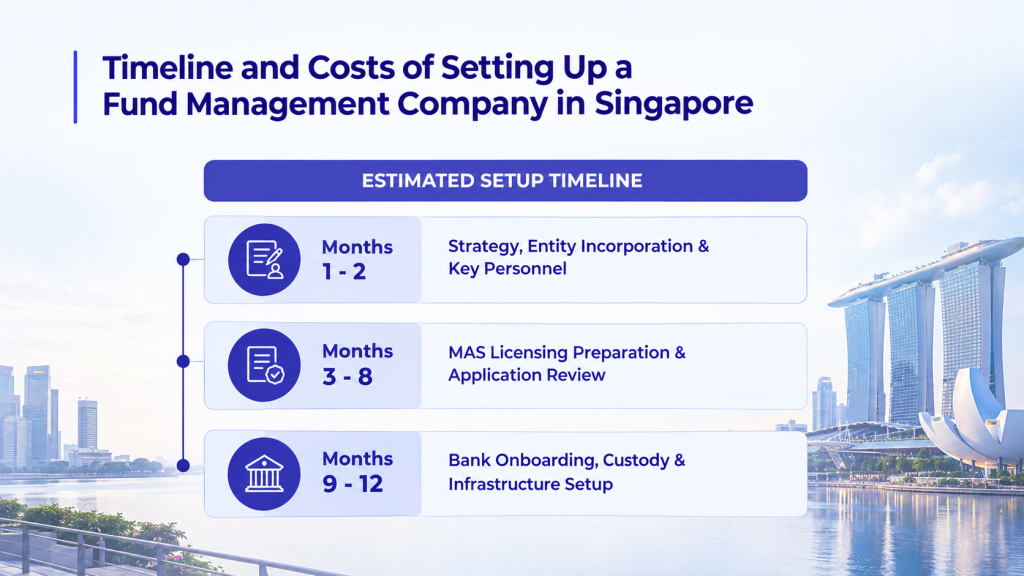
7. Timeline and Costs of Setting Up a Fund Management Company in Singapore
How Long Does FMC Setup Take?
Completing a Singapore fund management company setup typically takes between 6 to 12 months from incorporation to final licensing.
What Costs Should You Budget For?
- ACRA Incorporation: Corporate registration and filing fees.
- Capital Reserves: Minimum base capital of S250,000 or S1,000,000 depending on licence tier.
- Operating Expenses: Office lease, local executive salaries, and compliance staff.
- Professional Fees: Legal counsel, licensing consultants, and external auditors.
Factors Affecting Setup Costs and Timelines
Complex ownership structures, delayed KYC checks, or incomplete MAS license applications can extend setup timelines and increase overhead costs.
8. Common Challenges and Mistakes to Avoid
- Relying on Nominal Directors: MAS demands genuine operational decision-making by resident executives within Singapore.
- Underestimating Banking Timelines: Corporate bank account opening requires months of compliance verification.
- Using Off-the-Shelf Manuals: MAS rejects generic templates that fail to reflect your exact business model.
- Mismatched Fund Licensing: Choosing an incorrect licence tier leads to costly operational restructuring.
- Neglecting Ongoing Obligations: Missing annual tax filings, audit submissions, or regulatory reports endangers your licence.
9. How Arnifi Helps With Singapore Fund Management Company Setup
Establishing an FMC requires experienced corporate secretarial and administrative management. Arnifi assists founders through every stage of entity setup.
- Singapore Incorporation: Complete corporate formation support starting at SGD 2,250.
- Arni Organogram: Visualize corporate ownership, key officer roles, and governance structures before submission.
- Arni Docs: Generate customized legal documentation, board resolutions, and constituent files.
- Arni AML Checker: Conduct instant sanctions screening and risk profiling for key stakeholders.
- Immigration & Employment Passes: Process Employment Pass applications for foreign directors and investment professionals.
- Accounting & Compliance Support: Maintain audit-ready financial ledgers and fulfill mandatory annual filings.
- Attestation & Legal Coordination: Receive cross-border document legalization and bank coordination support.
10. Conclusion
Setting up your own Singapore fund management company needs proper legal preparation and operation, as well as adherence to the guidelines given by MAS.
Are you ready to start your business? Get in touch with Arnifi now to get the help that will allow you to incorporate your business and comply with all the necessary regulations without effort.
11. Frequently Asked Questions (FAQs)
1. How do I start a fund management company in Singapore?
Establish a private limited company, appoint resident executive directors, develop a compliance manual internally, and obtain the required license from MAS.
2. What is the minimum capital required to set up a fund management company in Singapore?
An A/I LFMC has S250,000, a Retail LFMC has S1,000,000, while VCFMs have no statutory minimum base capital requirement.
3. What is the difference between an LFMC and a VCFM in Singapore?
An LFMC manages diversified investments using ordinary compliance procedures, while VCFMs manage venture capital investments using simplified compliance procedures.
4. Does every fund management company in Singapore need an MAS licence?
Yes, unless the company is exempted under the statutory exceptions, such as single family offices which manage their own family wealth.
5. What happened to Singapore’s RFMC regime?
The RFMC regime was abolished by the MAS, and the managers were incorporated into the normal A/I LFMC regime.
6. How long does it take to establish a fund management company in Singapore?
The entire process generally takes between 6 and 12 months.
7. What is a Variable Capital Company (VCC) in Singapore?
It is a specialized company that has variable capital and a private shareholder register.
8. What is the difference between a standalone VCC and an umbrella VCC?
While standalone VCCs hold one portfolio, umbrella VCCs have more than one sub-fund.
9. Can a Singapore fund management company manage an offshore fund?
Yes, an FMC in Singapore can be appointed to manage offshore funds, like Cayman Islands Funds.
10. What are the Section 13O and Section 13U tax incentive schemes?
They are statutory tax schemes that give an exemption from tax on qualifying investment income earned by the fund.
References
Top UAE Packages
Related Articles


Top UAE Packages
Planning Your Next Business Move?
