
Fund Domicile vs Fund Manager Location | Key Differences

Anushka
Content Writer
Anushka Basu is a business content writer specialised in global business market insights. She aims to simplify complex regulatory, financial, and business concepts into… Read more

Tulika Saxena
AVP, Sales & Marketing | IIM Nagpur
Tulika Saxena specializes in business finance, sales strategy, and market positioning. Leads growth and partnerships, ensuring seamless business setup experiences and client success across… Read more


Key Fact: A fund’s domicile determines its legal establishment and governing regulatory framework, while its fund manager’s location determines where investment management activities are conducted and which regulatory requirements apply to the manager.
Table of contents
- What Happens When Your Fund and Investment Manager Are Based in Different Countries?
- What Does Fund Domicile Mean?
- What Does Fund Manager Location Mean?
- What Is the Difference Between Fund Domicile and Fund Manager Location?
- Can a Fund Be Domiciled in One Country and Managed From Another?
- How Does Fund Domicile Affect Regulatory Requirements?
- How Does Fund Manager Location Affect Licensing and Compliance?
- What Tax Considerations Apply to Fund Domicile and Manager Location?
- Which Jurisdictions Are Commonly Used for Fund Domicile and Management?
- How Should Fund Managers Choose Their Fund Domicile and Operating Location?
- What Are the Risks of Separating Fund Domicile and Manager Location?
- How Can Arnifi Help With International Fund Structuring?
- FAQs
- Conclusion
- References
What Happens When Your Fund and Investment Manager Are Based in Different Countries?
A fund manager preparing an international launch may find that investors prefer a Cayman Islands fund, while the investment team operates from London or Dubai. Does the manager need to relocate to the fund’s jurisdiction?
Usually, the fund and its manager can operate from different locations. However, each arrangement must comply with relevant fund regulations, manager licensing requirements, and tax rules. Understanding fund domicile vs. fund manager location helps you establish a structure that works for your investors and investment strategy.
What Does Fund Domicile Mean?
Fund domicile refers to the jurisdiction where an investment fund is legally established. It determines the legal framework governing the fund, its registration requirements and investor documentation.
Common fund domiciles include:
- Cayman Islands
- Luxembourg
- Ireland
- ADGM
- DIFC
For example, a private equity fund established in the Cayman Islands follows the applicable Cayman fund framework, even if its investment team operates elsewhere.
What Does Fund Manager Location Mean?
Fund manager location refers to where the investment management business operates and conducts investment activities.
It affects:
- Investment manager licensing
- Regulatory supervision
- Office and operational arrangements
- Compliance personnel and governance
- Employment and corporate obligations
An investment manager operating from Singapore, London or the UAE must consider the rules applicable to its management activities in that jurisdiction.
What Is the Difference Between Fund Domicile and Fund Manager Location?
| Factor | Fund Domicile | Fund Manager Location |
| Purpose | Establishes the fund legally | Determines where management operates |
| Regulation | Fund-level rules | Manager-level authorisation |
| Governing framework | Fund’s legal structure | Manager’s operating jurisdiction |
| Investors | Ownership rights and fund terms | Investment management services |
| Tax | Fund-level tax treatment | Manager’s corporate taxation |
Can a Fund Be Domiciled in One Country and Managed From Another?
Yes, but subject to regulatory requirements.
An investment manager based in London managing a fund domiciled in the Caymans. The fund itself is subject to Cayman requirements, and the manager is of course subject to the UK authorisation and conduct rules.
Another example is an ADGM-based investment manager managing a foreign fund. ADGM allows certain authorised managers to manage funds established overseas, subject to the relevant regulatory requirements.
How Does Fund Domicile Affect Regulatory Requirements?
The fund’s jurisdiction determines its applicable fund framework.
Depending on the fund category, requirements may include:
- Fund registration or authorisation
- Investor eligibility restrictions
- Offering documents and disclosures
- Governance and oversight arrangements
- Fund administration and audit
- Regulatory reporting
For instance, a Cayman Islands mutual fund may fall under the Cayman Islands Monetary Authority’s regulatory framework, depending on its classification.
How Does Fund Manager Location Affect Licensing and Compliance?
The manager’s jurisdiction will determine what permissions and supervisory requirements apply to its investment activities.
A manager carrying on business from the ADGM will need FSRA authorisation in respect of regulated investment management activities. A manager carrying on business from Ireland will of course need to consider the relevant Central Bank of Ireland requirements.
Where investment management is carried out across borders, supervisory cooperation and the manager’s regulatory status will also be relevant.
What Tax Considerations Apply to Fund Domicile and Manager Location?
Tax analysis should cover both entities and the investment activity.
- Fund-level taxation and available exemptions
- Manager corporate income tax
- Withholding taxes on investment income
- Double taxation treaty eligibility
- Permanent establishment exposure
- Transfer pricing and economic substance
A fund established in a particular jurisdiction does not automatically make its investment manager tax-resident there. Actual operations, management activities and applicable tax rules determine the outcome.
Which Jurisdictions Are Commonly Used for Fund Domicile and Management?
| Jurisdiction | Common Role |
| Cayman Islands | International fund domicile |
| Luxembourg | European fund domicile |
| Ireland | European fund domicile |
| UAE | Fund domicile and management hub |
| Singapore | Fund domicile and management hub |
| United Kingdom | Investment management hub |
The right combination depends on investor expectations, investment markets and regulatory access.
How Should Fund Managers Choose Their Fund Domicile and Operating Location?
Start with the commercial requirements of the fund.
- Identify target investors and fundraising markets.
- Evaluate suitable fund structures and regulatory requirements.
- Assess where investment decisions will take place.
- Compare tax treatment and substance obligations.
- Review administration, banking and professional services.
- Estimate long-term compliance and operating costs.
For example, a manager targeting European institutional investors may prioritise an EU fund domicile, while an international private fund may evaluate offshore structures alongside its investor requirements.
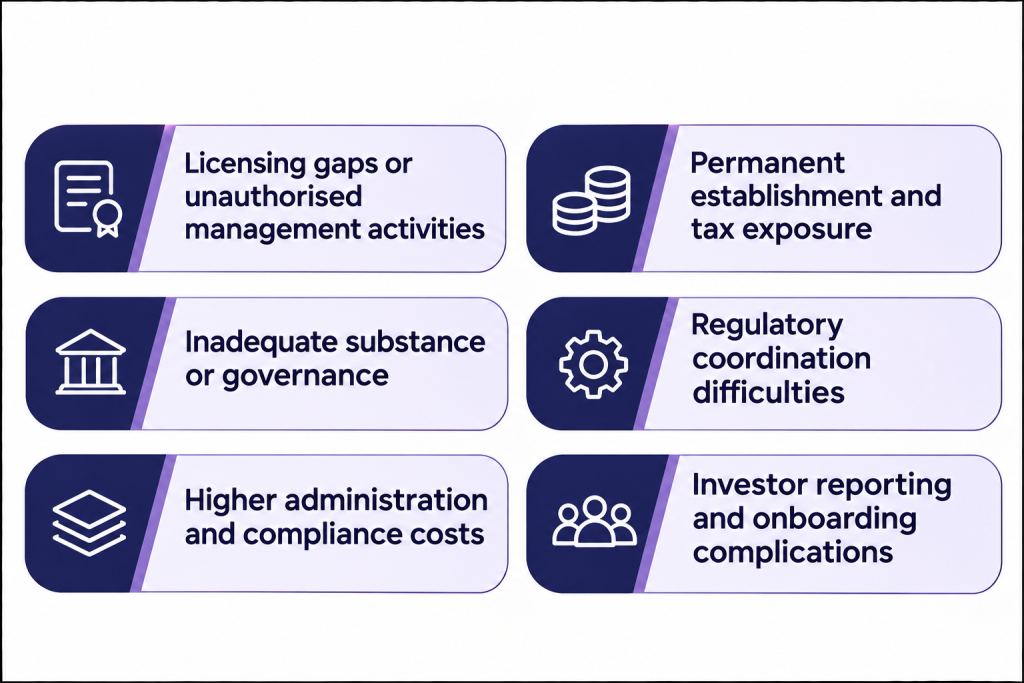
What Are the Risks of Separating Fund Domicile and Manager Location?
Cross-border structures require coordination between multiple regulatory and operational systems.
Common risks include:
How Can Arnifi Help With International Fund Structuring?
Arnifi supports investment businesses with UAE company establishment, holding company and SPV structures, incorporation documentation and administrative coordination. This can help fund managers organise supporting UAE entities alongside their wider international fund arrangements.
FAQs
Can a fund manager operate outside the fund’s domicile?
Yes. Cross-border management is possible when applicable fund and manager regulatory requirements are satisfied.
Does fund domicile determine where investment decisions are made?
No. Investment decisions may be made by an appropriately authorised manager operating in another jurisdiction.
Can a UAE investment manager manage an offshore fund?
Yes, subject to the manager’s permissions, the fund’s home-jurisdiction requirements and applicable cross-border rules.
Is fund domicile the same as fund registration?
No. Domicile identifies the fund’s legal jurisdiction. Registration or authorisation is a regulatory process within that jurisdiction.
Does fund manager location affect fund taxation?
It can affect manager taxation, permanent establishment exposure and other cross-border tax considerations.
Conclusion
Fund domicile and fund manager location serve different purposes in an international investment structure. The fund’s jurisdiction establishes its legal and regulatory framework, while the manager’s location determines the requirements governing its investment activities. Evaluating both together helps fund managers build an arrangement aligned with their investors, strategy and compliance obligations.
References
Top UAE Packages
Related Articles



Top UAE Packages
Planning Your Next Business Move?
