
Cyprus Business Setup for Non-EU Entrepreneurs

Anushka
Content Writer
Anushka Basu is a business content writer specialised in global business market insights. She aims to simplify complex regulatory, financial, and business concepts into… Read more

Tulika Saxena
AVP, Sales & Marketing | IIM Nagpur
Tulika Saxena specializes in business finance, sales strategy, and market positioning. Leads growth and partnerships, ensuring seamless business setup experiences and client success across… Read more



Key Fact: Non-EU entrepreneurs can establish companies in Cyprus without automatically obtaining the right to reside or work there. Company incorporation, immigration permission and business activity licensing are separate processes with distinct requirements.
Table of contents
- Why Do Non-EU Entrepreneurs Choose Cyprus for Business Setup?
- What Business Structures Can Non-EU Entrepreneurs Establish in Cyprus?
- What Are the Requirements for Cyprus Company Registration?
- How Can a Non-EU Entrepreneur Register a Company in Cyprus?
- Can Non-EU Entrepreneurs Live and Work in Cyprus Through Their Company?
- What Is the Cyprus Startup Visa for Non-EU Entrepreneurs?
- What Taxes Apply to Businesses Established in Cyprus?
- How Can Non-EU Entrepreneurs Open a Business Bank Account in Cyprus?
- What Licences and Compliance Requirements Apply After Incorporation?
- How Much Does Cyprus Business Setup Cost for Non-EU Entrepreneurs?
- How Can Arnifi Help With Cyprus Business Setup?
- FAQs
- Conclusion
- References
Why Do Non-EU Entrepreneurs Choose Cyprus for Business Setup?
Cyprus offers entrepreneurs a European business environment with international commercial connections. Its professional services sector supports company administration, accounting, legal work and cross-border transactions.
For founders considering Cyprus business setup, the country offers:
- Access to the European Union market, subject to applicable trade and regulatory requirements
- An established corporate services and financial infrastructure
- English-speaking professionals across legal, accounting and business services
- Connections between Europe, the Middle East and Asian markets
- A familiar environment for international holding structures and commercial operations
What Business Structures Can Non-EU Entrepreneurs Establish in Cyprus?
Foreign entrepreneurs can choose from several legal structures depending on their business model.
| Structure | Suitable for |
| Private limited company | International businesses, subsidiaries and commercial operations |
| Public limited company | Larger businesses planning broader share ownership |
| Partnership | Businesses operated by two or more partners |
| Foreign company branch | Overseas businesses establishing a Cyprus presence |
| Self-employed registration | Individuals operating eligible businesses personally |
A private limited company is commonly selected for Cyprus company formation because it provides a separate legal identity and generally limits shareholders’ liability to their investment, subject to applicable legal exceptions.
What Are the Requirements for Cyprus Company Registration?
The incorporation process involves preparing corporate documents and identifying the company’s ownership and management.
Typical requirements include:
- Approval of the proposed company name
- A registered office address in Cyprus
- Memorandum and Articles of Association
- Appointment of directors and a company secretary
- Shareholder and beneficial ownership information
- Identification documents and supporting KYC information
- Incorporation applications prepared through a Cyprus-qualified lawyer
The Registrar’s incorporation process requires prescribed documentation, including statutory declarations and corporate constitutional documents. Professional assistance is commonly used to prepare and submit these applications.
How Can a Non-EU Entrepreneur Register a Company in Cyprus?
The usual Cyprus company registration process follows these steps:
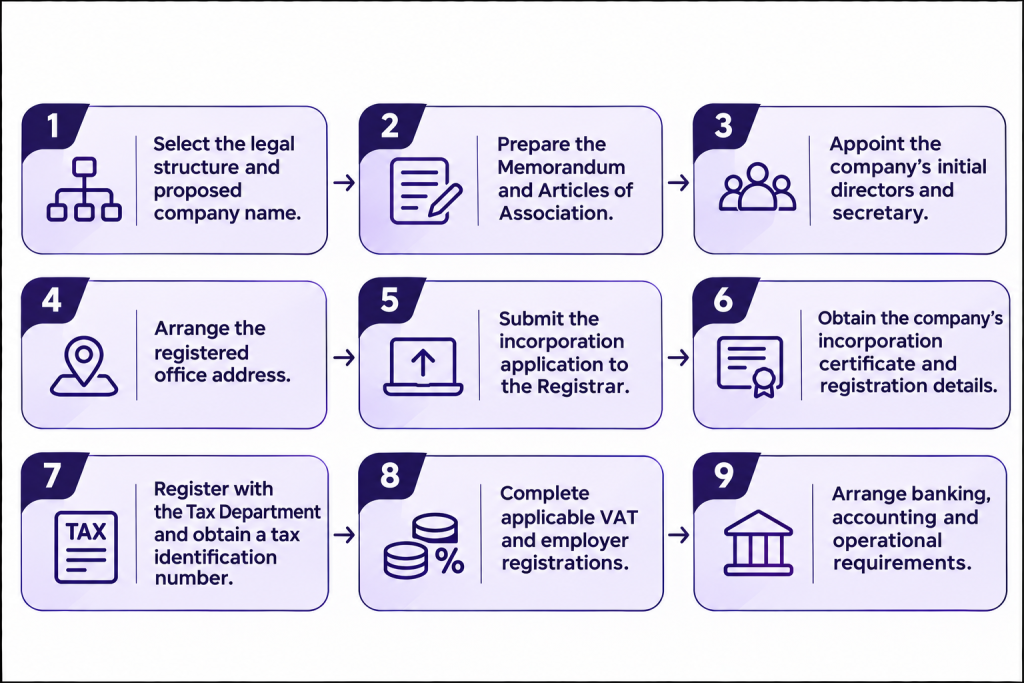
Companies generally need to register with the Tax Registry within 60 days of incorporation. VAT registration depends on applicable registration rules and business circumstances.
Can Non-EU Entrepreneurs Live and Work in Cyprus Through Their Company?
Starting a business in Cyprus does not automatically establish immigration rights.
A non-EU entrepreneur may own shares in a Cyprus company while living abroad. However, relocating to Cyprus or undertaking local employment requires an appropriate immigration permission.
The distinction matters when planning:
- Whether the founder will manage the business from overseas
- Whether the founder intends to relocate permanently
- Whether the company needs foreign employees
- Whether the proposed director or employment arrangement qualifies under immigration rules
Company ownership, directorship and permission to work are separate considerations.
What Is the Cyprus Startup Visa for Non-EU Entrepreneurs?
The Cyprus Startup Visa Scheme supports eligible entrepreneurs from outside the EU and EEA who want to establish, operate or develop innovative businesses with high growth potential.
The scheme has been renewed through December 2026.
Its main requirements and stages include:
- An innovative business concept with growth potential
- An application to the Deputy Ministry of Research, Innovation and Digital Policy
- Assessment of the proposed business and supporting documentation
- Initial approval before completing the relevant immigration procedures
- Separate entry, residence and employment applications where required
The authorities assess the innovation and growth potential of the proposed venture. Ordinary company incorporation does not automatically qualify a business for this scheme.
Initial approval also does not automatically guarantee entry, residence or employment permission. Entrepreneurs must complete the applicable immigration procedures.
What Taxes Apply to Businesses Established in Cyprus?
Cyprus companies must assess their tax obligations according to their activities, residence status and income.
| Tax or obligation | Key consideration |
| Corporate income tax | Standard rate of 15% from 1 January 2026 |
| VAT | Standard rate of 19%, subject to applicable reduced rates and exemptions |
| Tax registration | Tax identification and applicable reporting requirements |
| Payroll | Employer registration and Social Insurance obligations |
| Accounting | Maintenance of financial records and statutory reporting |
| International taxation | Transfer pricing and cross-border tax considerations where applicable |
Tax residency, management arrangements and international transactions can influence a company’s tax position. Entrepreneurs should assess these matters before commencing operations.
How Can Non-EU Entrepreneurs Open a Business Bank Account in Cyprus?
Company incorporation provides the corporate documents required to begin banking discussions. It does not guarantee account approval.
Banks generally assess:
- Certificate of incorporation and company registration documents.
- Shareholder and beneficial owner identification.
- Business activities and expected transaction volumes.
- Business plans and commercial evidence.
- Source of funds and source of wealth.
- Geographic exposure and customer profiles.
Banking timelines depend on the institution, ownership structure and due diligence requirements.
What Licences and Compliance Requirements Apply After Incorporation?
Businesses must maintain their corporate records and complete applicable regulatory obligations.
These can include:
- Sector-specific licences and operating approvals
- Registered office and company administration
- Annual returns and financial statements
- Accounting records and statutory audits
- Beneficial ownership reporting
- Tax returns and regulatory notifications
Companies operating in regulated sectors may need additional approvals before commencing activities.
How Much Does Cyprus Business Setup Cost for Non-EU Entrepreneurs?
The total cost depends on the company’s structure, activities and operating requirements.
Typical expenses include:
- Company incorporation and legal professional fees
- Registered office and corporate administration
- Accounting and audit services
- Immigration application expenses
- Business licences and premises
- Banking and ongoing compliance
Entrepreneurs should budget for annual administration alongside initial incorporation expenses.
How Can Arnifi Help With Cyprus Business Setup?
Arnifi can assist entrepreneurs with Cyprus company incorporation coordination, documentation preparation and registered office arrangements. Its corporate setup support can also help founders understand ongoing administration and compliance requirements. This allows business owners to organise their establishment process while evaluating separate immigration, banking and licensing requirements.
FAQs
Can a non-EU citizen own 100% of a Cyprus company?
Yes. Foreign individuals can generally hold 100% of the shares in a Cyprus private company, subject to applicable sector restrictions and investment screening requirements.
Can I open a Cyprus company without living there?
Yes. Company ownership and incorporation do not generally require the shareholder to reside in Cyprus.
Does Cyprus company registration provide residency?
No. Incorporation alone does not grant residence or employment permission.
Can a foreign entrepreneur become a director of a Cyprus company?
Yes. Foreign nationals can generally serve as directors, subject to applicable legal requirements and any relevant immigration restrictions.
How long does Cyprus company incorporation take?
The timeframe depends on name approval, document preparation, professional assistance and Registrar processing. Banking and licensing may require additional time.
Is a Cyprus Startup Visa available to non-EU entrepreneurs?
Yes. The Startup Visa Scheme supports qualifying innovative entrepreneurs from outside the EU and EEA. Its published validity extends through December 2026.
Conclusion
Cyprus business setup offers non-EU entrepreneurs an opportunity to establish a company within a European commercial environment. The process begins with selecting a suitable legal structure and completing incorporation, followed by tax registration, banking and operational compliance. Entrepreneurs planning to relocate must separately assess their immigration options, including the Startup Visa, where eligible. Treating company establishment and personal relocation as separate decisions helps founders plan their business more effectively.
References
Top UAE Packages
Related Articles



Top UAE Packages
Planning Your Next Business Move?
