
Changing Directors or Shareholders in a Singapore Company | A Complete Guide

Zahira Shaik
SEO Content Writer
Zahira Shaik is an SEO Content Writer and Published Author specializing in research-based content. She excels at analyzing market trends, regulations, and industry developments… Read more

Tulika Saxena
AVP, Sales & Marketing | IIM Nagpur
Tulika Saxena specializes in business finance, sales strategy, and market positioning. Leads growth and partnerships, ensuring seamless business setup experiences and client success across… Read more



Key Fact: The changing of corporate officers and/or shareholding in a Singapore company is strictly bound by the Companies Act 1967, stamp duty as per IRAS, and ACRA notification within 14 days.
Table of contents
- Introduction
- Understanding the Role of a Company Director in Singapore
- How to Remove or Change a Shareholder in a Singapore Company
- Step-by-Step Process for Transferring Shares in Singapore
- ACRA Filing Requirements When Changing Directors or Shareholders
- How Arnifi Helps Manage Singapore Director and Shareholder Changes
- Conclusion: Managing Corporate Changes Without Compliance Gaps
- Frequently Asked Questions (FAQs)
- References
Introduction
A change in corporate structure happens when a company either changes its officers or transfers shares according to statutory requirements. Singapore has a strong corporate governance structure governed by the Companies Act 1967 and ACRA.
Business firms might need to appoint/remove a director of a Singapore company or change/transfer the shareholding of a company due to growth. A change to the statutory record is necessary for regulatory compliance, banking, and investor relations.
Failure to manage changes may result in statutory penalties, officer disqualification, and an illegal transfer. Compliance with corporate regulations involves proper execution of every legal process.
Understanding the Role of a Company Director in Singapore
Company directors are responsible for managing and overseeing day-to-day operations as well as providing strategic direction in business decisions. There are stringent legal responsibilities of a Singapore company director within the statutory environment.
Singapore companies appoint a nominee Singapore company director to fulfill statutory requirements. In handling nominee arrangements, the Corporate Service Providers (CSPs) are subject to the Corporate Service Providers Act.
Statutory duties under the Companies Act 1967 include:
- Section 157: The responsibility to be honest and exercise reasonable diligence at all times.
- Section 156: The obligation to make disclosures regarding direct or indirect personal interest in company transactions.
Failure to comply with such statutory requirements subjects a Singapore company director to serious penalties, which may include fines, imprisonment, liability, and disqualification.
How to Remove or Change a Shareholder in a Singapore Company
Shareholders may not be removed from the company’s register without proper justification. The removal or change of ownership should involve recognized procedures and measures.
1. Voluntary Share Transfer or Buyout
The departing shareholder may transfer or give the shares to the other members and new subscribers through voluntary action. Pre-emption rights are provided for under the Constitution and the Shareholders Agreement.
2. Company Share Buyback
A company may buy back and cancel its shares under Section 76B of the Companies Act 1967. It requires specific corporate resolutions, and the company must pass the solvency test.
3. Forfeiture of Unpaid Shares
If a shareholder fails to pay on due payment calls, the company may forfeit the partially paid shares. The procedure of share forfeiture is provided for in the company’s constitution.
4. Court-Ordered Removal and Compulsory Acquisition
- Section 216: Minorities’ rights against oppression provide courts with authority to compel share buyouts.
- Section 215: Compulsory acquisition rights may be exercised by an acquiring body after achieving a 90% majority in a takeover.
Step-by-Step Process for Transferring Shares in Singapore
The transfer of equity requires a precise handling of administrative processes.
Step 1: Review the Company’s Constitution and Shareholders’ Agreement
Pre-emptive rights, requirements for board approval, and transfer restrictions should be taken into account. All the targeted shares must be paid in full.
Step 2: Prepare Transfer Documents and Obtain Board Approval
Make the official Instrument of Transfer signed by the transferor and transferee. Create a formal request letter addressed to the directors.
Step 3: Calculate and Pay IRAS Stamp Duty
Calculate and pay 0.2% stamp duty on either the purchase price or Net Asset Value (NAV), whichever is larger.
| Execution Location | IRAS Stamping Deadline |
| Documents signed in Singapore | Within 14 days of execution |
| Documents signed overseas | Within 30 days of receipt in Singapore |
Step 4: Submit Shareholding Updates to ACRA
Submit “Update Shares Information” transaction via BizFile+ service. ACRA will update the Electronic Register of Members (EROM).
Step 5: Update Share Certificates and Statutory Records
Cancel the original share certificate of the outgoing shareholder. The issuance of new certificates should be made within 30 days.
ACRA Filing Requirements When Changing Directors or Shareholders
Companies must notify ACRA of changes to officers, shareholdings, or business particulars within 14 days. Timely lodgements preserve statutory compliance when appointing a new Singapore company director or updating corporate records.
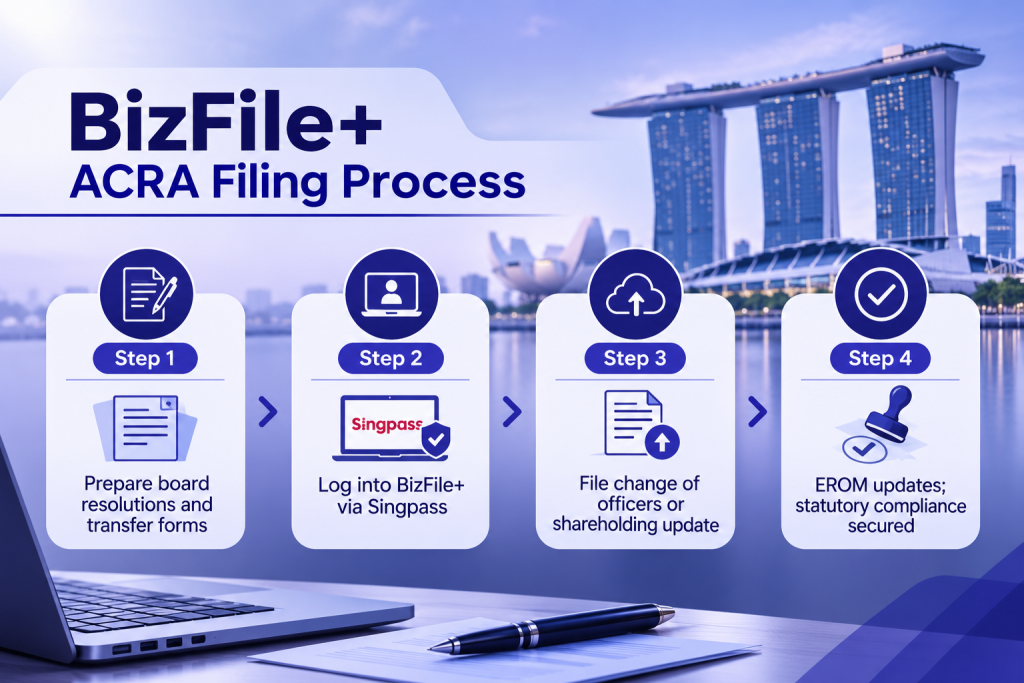
Late submission of notifications results in late lodgement fees, statutory fines, and prosecution. Failure to file causes problems in corporate due diligence checks, investor due diligence checks, and bank account checks.
How Arnifi Helps Manage Singapore Director and Shareholder Changes
Arnifi offers corporate governance, ownership change, and compliance management services for expanding companies.
- ACRA Compliance and Statutory Filings: Arnifi facilitates statutory notifications, share changes, and communication when changing a Singapore company’s director or shareholder.
- Arni Docs: Drafts customised board resolutions, instruments of transfer, and statutory registers.
- Arni Organogram: Creates visual ownership charts to track the corporate structure dynamically.
- Arni AML Checker: Runs due diligence and sanctions screening of incoming directors and investors.
- Accounting and Valuation Support: Computes the accurate NAV for the valuation and IRAS stamp duty notification.
Conclusion: Managing Corporate Changes Without Compliance Gaps
Changes to the corporate structure, whether changes to corporate officers or shareholdings, require compliance to the law, proper documentation, and timely statutory notifications. Companies are supposed to pay IRAS stamp duty on time and comply with ACRA regulations to avoid statutory violations.
Frequently Asked Questions (FAQs)
1. Can a shareholder be removed from a Singapore company without their consent?
No, as it is not possible to remove a shareholder without their agreement unless court orders under Section 216 or compulsory acquisition rights under Section 215 have authorized it.
2. How do I transfer shares to another person in a Singapore company?
Examine the Constitution, make an Instrument of Transfer, pay 0.2% IRAS stamp duty, and amend ACRA’s Electronic Register of Members.
3. How much stamp duty is payable on a Singapore share transfer?
0.2% of the purchase price or the Net Asset Value (NAV) of the share being transferred, whichever is larger.
4. How long does ACRA take to update shareholder information?
ACRA amends the Electronic Register of Members immediately after the online BizFile+ submission.
5. Can a Singapore company operate without a resident director?
Every Singapore company needs to have at least one ordinarily resident Singapore company director at all times.
6. What happens if a company fails to notify ACRA about director or shareholder changes?
Non-notification within 14 days will lead to composition fines, statutory penalties, and even prosecution of default officers.
7. How do I know if I need to remove a shareholder from a company in Singapore?
You have to learn how to remove a shareholder from a company in Singapore when you are restructuring your equity, dealing with leaving members, or buyout situations.
References
Accounting and Corporate Regulatory Authority (ACRA)
Top Singapore Packages
Related Articles


Top Singapore Packages
Planning Your Next Business Move?
