
What Is the Difference Between a Nominee Director and a Resident Director in Singapore?

Anushka
Content Writer
Anushka Basu is a business content writer specialised in global business market insights. She aims to simplify complex regulatory, financial, and business concepts into… Read more

Tulika Saxena
AVP, Sales & Marketing | IIM Nagpur
Tulika Saxena specializes in business finance, sales strategy, and market positioning. Leads growth and partnerships, ensuring seamless business setup experiences and client success across… Read more



Key Fact: Every Singapore company must have at least one director resident in Singapore. A nominee director may fulfil this requirement, but nominee status does not remove the director’s legal responsibilities.
Table of contents
- Who Is a Resident Director in Singapore?
- Who Is a Nominee Director in Singapore?
- What Is the Difference Between a Nominee Director and a Resident Director?
- Can a Nominee Director Fulfil Singapore’s Resident Director Requirement?
- Who Can Become a Resident Director in Singapore?
- What Are the Legal Responsibilities of a Nominee Director?
- What Are the Responsibilities of a Resident Director?
- What Are the Risks of Appointing a Nominee Director in Singapore?
- What Are the Nominee Director Disclosure Requirements in Singapore?
- How Do You Appoint a Nominee or Resident Director in Singapore?
- How Much Does a Nominee Director Cost in Singapore?
- How Can Arnifi Help With Singapore Resident Director Requirements?
- FAQs
- Conclusion
Who Is a Resident Director in Singapore?
Imagine an entrepreneur based in India who wants to register a private limited company in Singapore but does not live there. Since Singapore requires every company to have at least one locally resident director, the entrepreneur must appoint an eligible individual who ordinarily resides in Singapore. This person is known as a Resident Director and is responsible for fulfilling the legal duties of a company director under Singapore law.
The resident director requirement applies to companies regardless of whether their shareholders are Singapore residents or foreign investors. A company owned entirely by overseas shareholders must also appoint at least one ordinarily resident director.
Who Is a Nominee Director in Singapore?
A nominee director Singapore arrangement involves an individual who acts as a director while being accustomed or obligated to follow another person’s directions, instructions or wishes. The person or entity whose directions the nominee follows is known as the nominator.
Nominee arrangements are commonly used by foreign founders establishing Singapore companies. Overseas shareholders may appoint a nominee director who is ordinarily resident in Singapore to satisfy the local director requirement.
The arrangement allows the foreign shareholders to retain ownership and commercial control of their business while appointing an eligible individual to fulfil the statutory directorship requirement.
Nominee status concerns the relationship between the director and the nominator. It does not determine the director’s residency by itself.
What Is the Difference Between a Nominee Director and a Resident Director?
The distinction between a nominee director and a resident director lies in the basis of their appointment.
| Feature | Nominee Director | Resident Director |
| Meaning | Acts under a nominee arrangement | Ordinarily resident in Singapore |
| Purpose | Represents a nominator under an arrangement | Satisfies local residency requirement |
| Residency | May or may not be ordinarily resident | Must be ordinarily resident |
| Appointment | Based on nominee arrangement | Based on residency and director eligibility |
| Legal duties | Same statutory director duties | Same statutory director duties |
| Relationship | Has a nominator | May have no nominator |
| Company requirement | Optional arrangement | At least one required |
One individual can fulfil both roles. For example, a Singapore-resident professional appointed through a corporate service provider may act as a nominee director while also satisfying the company’s resident director requirement.
A foreign founder who appoints an independent Singapore-resident director without a nominee arrangement may also satisfy the local director requirement.
Can a Nominee Director Fulfil Singapore’s Resident Director Requirement?
Yes. A nominee director can fulfil Singapore’s resident director requirement if the individual is ordinarily resident in Singapore and meets the applicable director eligibility conditions.
This arrangement is common among foreign-owned Singapore companies. Overseas founders may appoint a resident nominee director through a corporate service provider while retaining their shareholder positions and managing their business operations.
The appointment must be legally valid, and the company must maintain at least one ordinarily resident director throughout its operations.
A nominee arrangement does not replace the company’s responsibility to comply with the Companies Act. The director remains accountable for statutory obligations, regardless of the arrangement under which they were appointed.
Who Can Become a Resident Director in Singapore?
An individual must meet the statutory eligibility requirements before accepting a Singapore directorship.
Eligible individuals generally include:
- Singapore citizens
- Singapore permanent residents
- Foreign individuals who meet the applicable ordinary residency and immigration requirements
The individual must also:
- Be at least 18 years old
- Have full legal capacity
- Not be disqualified or prohibited from acting as a director
- Meet applicable residency and immigration conditions
Employment Pass holders should check the Ministry of Manpower’s requirements before accepting an additional directorship. Holding an Employment Pass does not automatically authorise an individual to act as a director of another company.
The company’s proposed director should also be assessed for eligibility before the appointment is filed with ACRA.
What Are the Legal Responsibilities of a Nominee Director?
A nominee director Singapore appointment does not reduce the individual’s statutory responsibilities. Under Singapore law, directors must fulfil their duties regardless of whether they participate actively in daily business operations.
The responsibilities include:
- Acting honestly and exercising reasonable diligence
- Acting in the company’s best interests
- Understanding the company’s business and financial position
- Maintaining proper accounting records
- Ensuring statutory filings are completed
- Reviewing financial statements and relevant company information
- Disclosing conflicts of interest
- Complying with applicable Companies Act obligations
Nominee directors cannot simply follow a nominator’s instructions when doing so would breach their legal duties.
ACRA expressly states that there is no such thing as an inactive, sleeping or liability-free nominee director. Directors remain responsible under the legislation even if they are not involved in daily management.
What Are the Responsibilities of a Resident Director?
Resident directors are subject to the same statutory duties as other company directors. Their residency satisfies a local governance requirement, but it does not automatically make them responsible for running the company’s day-to-day operations.
Their responsibilities may include:
- Ensuring the company maintains statutory compliance
- Participating in board decisions where applicable
- Reviewing relevant corporate records and filings
- Exercising independent judgement
- Acting in the company’s best interests
- Monitoring financial and operational information
- Ensuring appropriate governance and reporting arrangements
A resident director should maintain sufficient communication with the company’s management and have access to the information needed to discharge their responsibilities.
Where a resident director is also a nominee, the person must understand the company’s activities and remain able to exercise independent judgement.
What Are the Risks of Appointing a Nominee Director in Singapore?
Nominee directorships can help foreign founders establish Singapore companies, but they carry responsibilities and risks for both the director and the business.
Potential risks include:
- Personal liability for statutory breaches
- Exposure arising from incomplete company information
- Risks associated with improper transactions or misconduct
- Difficulty resigning when a replacement resident director cannot be appointed
- Challenges caused by unresponsive foreign shareholders
- Reputational and regulatory consequences
A particularly important concern is the difficulty a nominee director may face when attempting to resign.
Singapore requires companies to maintain at least one ordinarily resident director. A sole resident nominee director may therefore be unable to complete a resignation if the company has no replacement who satisfies the requirement.
The Ministry of Finance has highlighted situations in which resident nominee directors cannot exit directorships because foreign shareholders or directors become uncontactable. Individuals should understand these risks before accepting appointments.
Companies should maintain proper communication arrangements, provide directors with relevant information and establish a clear process for replacing directors when required.
What Are the Nominee Director Disclosure Requirements in Singapore?
Singapore introduced expanded nominee director disclosure requirements under amendments that took effect on 16 June 2025.
The Register of Nominee Directors (ROND) records the particulars of nominee directors and their nominators. Companies must maintain the applicable private register and submit information to ACRA’s central register unless exempted.
The requirements include:
- Nominee directors must inform the company of their nominee status
- Companies must record the particulars of nominee directors and their nominators
- Private ROND information must be maintained at the registered office or registered corporate service provider’s office
- Applicable information must be lodged with ACRA’s Central ROND
- Changes to the private register must be recorded within seven days
- Updates to the central register must generally be filed within two business days after the private register is updated
For companies incorporated from 16 June 2025, nominee information must be filed at incorporation where applicable. Existing companies were required to lodge their relevant information by 31 December 2025.
Nominee status is publicly disclosed through ACRA’s business profile information. However, the complete particulars of nominators are restricted to authorised public agencies.
The Register of Nominee Directors is distinct from the Register of Registrable Controllers and the Register of Nominee Shareholders. Each register serves a separate compliance purpose.
How Do You Appoint a Nominee or Resident Director in Singapore?
Appointing a director involves checking eligibility, obtaining consent and completing the required corporate and regulatory procedures.
The process generally includes:
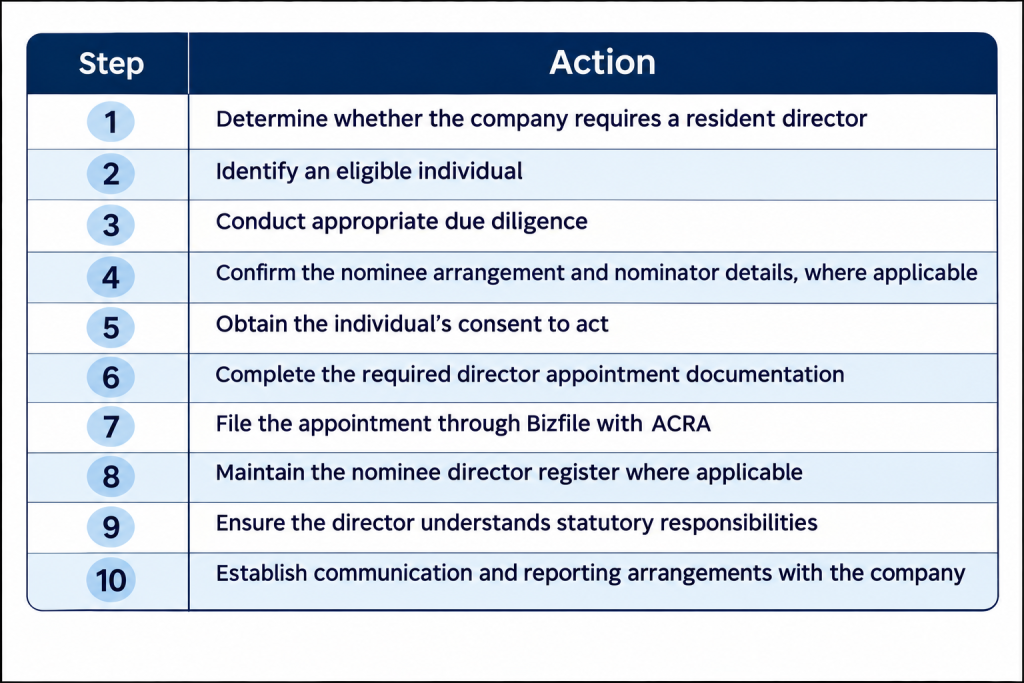
A director must formally consent to the appointment and acknowledge the relevant duties and responsibilities. The company should ensure that the individual has sufficient information about its business and ongoing compliance obligations.
How Much Does a Nominee Director Cost in Singapore?
Nominee director fees depend on the service provider, company activities and terms of the appointment. There is no universal government-set price for nominee director services.
Private service fees may vary according to:
- Annual nominee director service charges
- Company activities and risk profile
- Due diligence requirements
- Documentation and administrative arrangements
- Additional compliance or support services
Government filing fees and private nominee director service fees should be considered separately. ACRA does not prescribe a standard annual fee for appointing a nominee director.
Businesses should review the service agreement carefully, including the appointment conditions, responsibilities, resignation procedures and replacement arrangements.
How Can Arnifi Help With Singapore Resident Director Requirements?
Foreign founders establishing a Singapore company may need assistance understanding local director eligibility, nominee arrangements and incorporation documentation.
Arnifi supports businesses with Singapore company incorporation and administrative coordination, helping founders understand the resident director requirement and the documentation involved in establishing a company.
Its support can include:
- Guidance on resident director eligibility and appointment requirements
- Assistance with understanding nominee director arrangements
- Support with incorporation documentation and administrative coordination
- Guidance on director responsibilities and ongoing compliance
- Coordination with relevant professionals for corporate governance requirements
Businesses should ensure that any appointed director understands their statutory duties and that the company maintains appropriate governance arrangements throughout its operations.
FAQs
What is a nominee director in Singapore?
A nominee director is an individual who acts as a company director while being accustomed or obligated to follow another person’s directions, instructions or wishes. The person giving those directions is called the nominator.
What is a resident director in Singapore?
A resident director is a director who is ordinarily resident in Singapore. Every Singapore-incorporated company must have at least one ordinarily resident director.
Is a nominee director the same as a resident director?
No. Nominee status describes the director’s relationship with a nominator, while resident status describes the individual’s residency. One person can fulfil both roles.
Can a nominee director satisfy Singapore’s local director requirement?
Yes. A nominee director can satisfy the requirement if the individual is ordinarily resident in Singapore and meets the applicable director eligibility conditions.
Can a foreigner become a resident director in Singapore?
Yes, provided the individual meets Singapore’s ordinary residency, immigration and director eligibility requirements. Employment Pass holders should check applicable Ministry of Manpower conditions.
Does a nominee director have legal liability?
Yes. Nominee directors have the same statutory responsibilities as other directors. They remain accountable for compliance and cannot avoid their duties by following a nominator’s instructions.
Can a nominee director resign from a Singapore company?
A nominee director may resign subject to the applicable legal requirements. However, a company must continue to maintain at least one ordinarily resident director, which can complicate resignation where no replacement is available.
Is a nominee director mandatory for foreign-owned Singapore companies?
A nominee director is not mandatory by itself. However, foreign-owned companies must appoint at least one ordinarily resident director. A nominee arrangement is one way to satisfy that requirement.
What is the Register of Nominee Directors?
The ROND is a statutory register containing particulars of nominee directors and their nominators. Companies must maintain the applicable private register and lodge relevant information with ACRA’s central register unless exempted.
How much does a nominee director cost in Singapore?
Nominee director fees vary by service provider, company activities and arrangement. There is no universal government-set nominee director service price.
Conclusion
Understanding the difference between a nominee director Singapore arrangement and resident director eligibility helps foreign founders establish companies with the right governance structure. A nominee director acts under an arrangement with a nominator, while a resident director satisfies Singapore’s local residency requirement.
The same individual can fulfil both roles, but all directors remain accountable for their legal duties. Businesses should select eligible directors, maintain appropriate disclosure registers and establish clear communication and compliance arrangements throughout their operations.
References
Top UAE Packages
Related Articles



Top UAE Packages
Planning Your Next Business Move?
