
How Can De Minimis Revenue Affect QFZP Status in UAE Free Zones?

Anushka
Content Writer
Anushka Basu is a business content writer specialised in global business market insights. She aims to simplify complex regulatory, financial, and business concepts into… Read more

Tulika Saxena
AVP, Sales & Marketing | IIM Nagpur
Tulika Saxena specializes in business finance, sales strategy, and market positioning. Leads growth and partnerships, ensuring seamless business setup experiences and client success across… Read more


Key Fact: A Free Zone Person can satisfy the de minimis requirement only when its non-qualifying revenue does not exceed the lower of 5% of total revenue or AED 5 million in a tax period. Failure can result in loss of QFZP status for five tax periods.
Table of contents
- What Is De Minimis Revenue in UAE Corporate Tax?
- What Is the De Minimis Threshold for UAE Free Zone Companies?
- Which Revenue Counts as Non-Qualifying Revenue?
- Which Revenue Is Excluded From the De Minimis Calculation?
- How Is De Minimis Revenue Calculated?
- How Can Non-Qualifying Revenue Affect QFZP Status?
- What Happens to Corporate Tax When QFZP Status Is Lost?
- Which Business Activities Can Increase De Minimis Revenue?
- How Can Free Zone Companies Monitor De Minimis Revenue?
- What Other Conditions Must a QFZP Satisfy?
- How Can Companies Protect Their QFZP Status?
- How Can Arnifi Help Free Zone Companies Manage QFZP Compliance?
- FAQs
- Conclusion
What Is De Minimis Revenue in UAE Corporate Tax?
It refers to the permitted amount of non-qualifying revenue a Qualifying Free Zone Person (QFZP) can earn during a tax period while retaining its tax status. Under the UAE Corporate Tax framework, Free Zone companies meeting the prescribed conditions can benefit from a 0% Corporate Tax rate on Qualifying Income. The de minimis test determines how much non-qualifying revenue they can generate without losing this treatment. Exceeding the permitted threshold can result in a five-tax-period loss of QFZP status.
What Is the De Minimis Threshold for UAE Free Zone Companies?
Ministerial Decision No. 229 of 2025 establishes the UAE de minimis threshold for non-qualifying revenue. A QFZP satisfies this condition when its non-qualifying revenue does not exceed the lower of:
- 5% of its total revenue for the tax period
- AED 5 million for the tax period
The calculation applies separately to each tax period. The AED 5 million limit represents an absolute ceiling rather than an automatic allowance. Companies with lower revenue may have a much smaller permissible threshold.
| Total Revenue | 5% of Revenue | Applicable Threshold |
| AED 20 million | AED 1 million | AED 1 million |
| AED 60 million | AED 3 million | AED 3 million |
| AED 100 million | AED 5 million | AED 5 million |
| AED 150 million | AED 7.5 million | AED 5 million |
For instance, a company earning AED 20 million in revenue cannot automatically earn AED 5 million in non-qualifying revenue. Its applicable threshold is AED 1 million.
Which Revenue Counts as Non-Qualifying Revenue?
Non-qualifying revenue includes revenue from specified activities and transactions that do not satisfy the UAE Free Zone Corporate Tax requirements. Cabinet Decision No. 100 of 2023 establishes the calculation framework, while Ministerial Decision No. 229 of 2025 sets out the updated qualifying and excluded activities.
The principal categories include:
- Revenue from Excluded Activities
- Revenue from activities that are not Qualifying Activities when the counterparty is a Non-Free Zone Person
- Revenue from transactions with Free Zone Persons where the recipient is not the Beneficial Recipient of the relevant goods or services
The activity and customer relationship both matter. A transaction involving a Free Zone customer does not automatically qualify for the 0% Corporate Tax treatment. The customer must meet the Beneficial Recipient condition, meaning it must receive and benefit from the relevant goods or services.
Similarly, revenue earned from a mainland UAE customer may qualify when it arises from an eligible Qualifying Activity and meets the applicable conditions.
Which Revenue Is Excluded From the De Minimis Calculation?
Certain revenue is excluded from both non-qualifying revenue and total revenue when calculating the de minimis threshold. These exclusions are prescribed under Cabinet Decision No. 100 of 2023.
| Revenue Category | Treatment |
| Domestic Permanent Establishment | Excluded from both calculations |
| Foreign Permanent Establishment | Excluded from both calculations |
| Certain transactions involving immovable property in a Free Zone | Excluded under specified conditions |
| Ownership or exploitation of intellectual property | Excluded, subject to the qualifying IP income exception |
Revenue from commercial property transactions with Non-Free Zone Persons is excluded from the calculation when the property is located in a Free Zone. Revenue from transactions involving non-commercial immovable property in a Free Zone is also excluded under the prescribed conditions.
These exclusions do not automatically make the corresponding income eligible for the 0% Corporate Tax rate. Income attributable to permanent establishments and certain property transactions remains subject to the applicable Corporate Tax provisions.
Intellectual property income also requires careful treatment. Revenue from qualifying intellectual property is governed by specific rules, including the prescribed nexus approach, while other IP revenue is excluded from the de minimis calculation.
How Is De Minimis Revenue Calculated?
A QFZP should calculate its de minimis revenue using the prescribed revenue classifications and exclusions.
The practical calculation involves the following steps:
- Identify the company’s total revenue for the tax period
- Identify revenue from Excluded Activities
- Identify revenue from non-qualifying activities involving Non-Free Zone Persons
- Identify transactions with Free Zone Persons that fail the Beneficial Recipient condition
- Remove revenue specifically excluded under the applicable rules
- Calculate 5% of the remaining relevant total revenue
- Compare the percentage-based amount with AED 5 million
- Compare the resulting threshold against the company’s non-qualifying revenue
Worked Example
Consider a Free Zone company with the following revenue:
| Particulars | Amount |
| Total Revenue | AED 40 million |
| Non-Qualifying Revenue | AED 1.5 million |
| 5% of Total Revenue | AED 2 million |
| Fixed Threshold | AED 5 million |
| Applicable Threshold | AED 2 million |
The company’s non-qualifying revenue is AED 1.5 million, which falls below the applicable AED 2 million threshold.
Result: The de minimis requirement is satisfied.
This example assumes that the revenue figures have already been classified correctly and that the applicable exclusions have been applied.
How Can Non-Qualifying Revenue Affect QFZP Status?
Exceeding the de minimis threshold causes a Free Zone Person to fail one of the conditions required for QFZP status. Under Article 5 of Ministerial Decision No. 229 of 2025, failure to satisfy the prescribed conditions has consequences extending beyond the tax period in which the failure occurs.
The consequences include:
- Loss of QFZP status from the beginning of the relevant tax period
- Application of the ordinary Corporate Tax regime for that period
- Continued loss of QFZP status for the following four tax periods
- A total disqualification period covering five tax periods
The consequence applies to the company’s QFZP status as a whole. It is not restricted to the revenue exceeding the threshold.
This makes revenue classification an important consideration when accepting new contracts, expanding activities or entering into transactions with customers outside the Free Zone.
What Happens to Corporate Tax When QFZP Status Is Lost?
When a company loses QFZP status, it becomes subject to the ordinary UAE Corporate Tax regime for the relevant period and subsequent disqualification periods.
Under the standard Corporate Tax framework:
| Taxable Income | Corporate Tax Rate |
| Up to AED 375,000 | 0% |
| Above AED 375,000 | 9% |
The threshold applies to taxable income, not revenue. Companies must calculate their taxable income under the Corporate Tax Law, including applicable deductions, adjustments and exemptions.
For a company previously benefiting from QFZP treatment, losing its status can significantly increase its tax liability. Qualifying Income that would otherwise receive the 0% rate may become subject to the ordinary regime during the disqualification period.
The financial impact depends on the company’s taxable income, available deductions and applicable tax provisions.
Which Business Activities Can Increase De Minimis Revenue?
Certain business transactions can create non-qualifying revenue exposure, particularly where activities fall outside the prescribed qualifying categories.
Examples include:
- Sales to Non-Free Zone customers involving activities that are not Qualifying Activities
- Transactions with natural persons involving Excluded Activities
- Revenue from activities outside the permitted qualifying activity categories
- Ancillary activities that fail the relevant conditions
- Contracts involving mixed qualifying and non-qualifying supplies
Ministerial Decision No. 229 of 2025 identifies activities that qualify for the Free Zone tax regime, including manufacturing, processing, qualifying commodity trading, holding shares for investment purposes, logistics, distribution from Designated Zones and certain services to Related Parties.
Selling to mainland UAE customers does not automatically create non-qualifying revenue. The activity itself, the customer relationship, and the applicable qualifying conditions must be assessed.
How Can Free Zone Companies Monitor De Minimis Revenue?
Free Zone businesses should maintain a clear system for identifying and monitoring non-qualifying revenue throughout the tax period.
A practical compliance checklist includes:
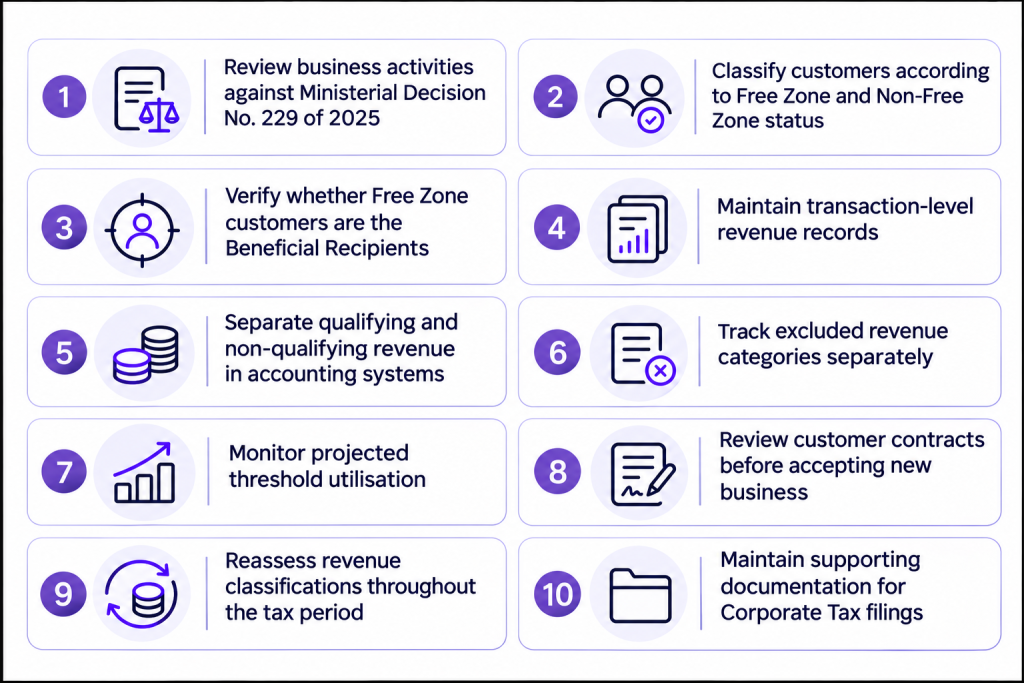
Regular monitoring allows companies to identify potential exposure before the threshold is exceeded.
What Other Conditions Must a QFZP Satisfy?
The de minimis test is only one requirement for retaining QFZP status. A company must satisfy the conditions under Article 18 of Federal Decree-Law No. 47 of 2022, Cabinet Decision No. 100 of 2023, and the applicable ministerial decisions.
These include:
- Maintaining adequate substance in the UAE
- Deriving Qualifying Income
- Complying with applicable transfer pricing requirements
- Maintaining appropriate transfer pricing documentation
- Preparing audited financial statements
- Avoiding an election to be subject to the ordinary Corporate Tax regime
- Meeting applicable statutory and ministerial conditions
A company that satisfies the de minimis threshold may still lose QFZP status if it fails another required condition. Eligibility therefore depends on maintaining compliance across the entire framework.
How Can Companies Protect Their QFZP Status?
Free Zone companies can reduce tax exposure by integrating revenue monitoring into their business and financial processes.
Practical measures include:
- Conducting periodic Corporate Tax reviews
- Reviewing new contracts and revenue streams before execution
- Establishing internal revenue classification procedures
- Maintaining documentation supporting qualifying transactions
- Monitoring non-qualifying revenue against the threshold
- Coordinating accounting and tax teams
- Reviewing licensed activities against actual operations
- Seeking professional advice where activity classification is uncertain
Companies should also assess the potential tax implications of new business models before entering new markets or expanding their customer base.
How Can Arnifi Help Free Zone Companies Manage QFZP Compliance?
Establishing a UAE Free Zone company involves decisions about licensing, business activities, and operational requirements. Arnifi supports businesses with company formation, Free Zone establishment, and administrative guidance to help founders understand their setup obligations.
Arnifi can help coordinate documentation and administrative processes, supporting a more organised approach to compliance as businesses grow.
FAQs
What is de minimis revenue in the UAE?
De minimis revenue is the permitted amount of non-qualifying revenue a QFZP can earn during a tax period while retaining its status under the UAE Corporate Tax regime.
What is the de minimis threshold for QFZP status?
The threshold is the lower of 5% of total revenue or AED 5 million for the relevant tax period.
Is the threshold 5% of revenue or AED 5 million?
Both limits apply. The company must use whichever amount is lower.
What happens if a Free Zone company exceeds the de minimis threshold?
The company loses QFZP status from the beginning of that tax period and for the following four tax periods.
Can a QFZP lose its status for five years?
Yes. Failure to satisfy the required conditions results in disqualification for the relevant tax period and four subsequent tax periods.
Does revenue from mainland UAE customers count towards de minimis?
It depends on the activity. Revenue from Qualifying Activities involving Non-Free Zone Persons can qualify for the prescribed treatment. Revenue from non-qualifying activities may count towards the de minimis calculation.
Are permanent establishment revenues included in the calculation?
Revenue attributable to a Domestic or Foreign Permanent Establishment is excluded from both non-qualifying revenue and total revenue for the de minimis calculation.
Does losing QFZP status mean all company income is taxed at 9%?
No. The ordinary Corporate Tax framework applies, including the 0% rate on taxable income up to AED 375,000 and the 9% rate on taxable income exceeding that amount.
Can a company regain QFZP status after the disqualification period?
A company may regain QFZP status after the prescribed disqualification period if it satisfies all applicable eligibility conditions for the relevant tax period.
Is de minimis revenue calculated annually or per transaction?
The calculation is performed for each tax period. Individual transactions contribute to the overall revenue figures used in the calculation.
Conclusion
Understanding what is de minimis is essential for Free Zone companies seeking to retain their QFZP status under the UAE Corporate Tax regime. The threshold is the lower of 5% of total revenue or AED 5 million for each tax period, subject to the prescribed classifications and exclusions. Exceeding this limit can result in a five-tax-period loss of QFZP status, affecting the company’s entire tax treatment. Businesses should maintain accurate revenue records, review activities before accepting new contracts, and monitor non-qualifying revenue throughout the year to manage potential tax exposure.
References
Top UAE Packages
Related Articles


Top UAE Packages
Get in Touch
