
Financial Adviser Licence in Singapore | A Regulatory Guide 2026

Zahira Shaik
SEO Content Writer
Zahira Shaik is an SEO Content Writer and Published Author specializing in research-based content. She excels at analyzing market trends, regulations, and industry developments… Read more

Tulika Saxena
AVP, Sales & Marketing | IIM Nagpur
Tulika Saxena specializes in business finance, sales strategy, and market positioning. Leads growth and partnerships, ensuring seamless business setup experiences and client success across… Read more


Key Fact: Creating investment recommendations for users in Singapore is subject to authorisation under the Financial Advisers Act, even if your app does not manage client funds or execute trades.
Table of contents
- Introduction
- Does Your Investment App Need a Licence in Singapore?
- Financial Adviser Licence vs. Capital Markets Services Licence
- General Investment Information vs. Algorithmic and Personalised Advice
- Singapore Company Incorporation Requirements for Fintech Businesses
- Regulatory Capital, Licensing Timelines and Fees
- Referring Users to Third-Party Brokers: Rules and Restrictions
- Ongoing Compliance Requirements for Licensed Financial Advisers
- How Arnifi Helps with Singapore Fintech Company Setup
- Pre-Launch Regulatory Checklist for Investment App Founders
- Conclusion
- Frequently Asked Questions
- References
Introduction
Financial Adviser Licence in Singapore permits the provision of advice, analysis, and investment recommendations concerning investment products within the Monetary Authority of Singapore (MAS) structure. Singapore remains one of the leading destinations in the world for wealthtech platforms and digital investment apps. Founders often ask whether it is possible to develop an investment app that will not manage clients’ funds or execute transactions. Everything depends on what exactly you will be able to do with your platform.
If your application is able to get the user preferences and create investment recommendations, then you are obliged to get the necessary authorization. Just not conducting any transactions does not protect your company from being subject to certain regulations. There are strict rules related to the provision of financial advice in the Monetary Authority of Singapore under the Financial Advisers Act 2001. Assessing your core business model before launch ensures complete compliance and prevents unexpected legal hurdles.
Does Your Investment App Need a Licence in Singapore?
Running a non-custodial application does not necessarily mean that you can avoid the financial regulatory framework in Singapore.
When Financial Advice Triggers Regulatory Licensing
If your app provides investment advice in light of the profile of the user, then this is regulated financial advice. This refers to securities, collective investment schemes, and derivatives contracts. Incorporating a company through ACRA will register your entity; however, it has no power to carry out any financial advisory work. If your app uses financial profiles to give out recommended investments, then you require a Financial Adviser Licence in Singapore.
Financial Adviser Licence vs. Capital Markets Services Licence
Fintech founders have to choose the appropriate licensing regime depending on their unique operating and product range.
Financial Adviser (FA) Licence in Singapore
This licence applies to companies that provide financial advice and publish investment research reports. This becomes the primary regime for firms making automated recommendations. The appointed representatives have to be registered in order to operate legally.
Capital Markets Services (CMS) Licence
CMS licence is required for dealing with securities, managing funds, and other types of custodial services. Having a CMS licence doesn’t automatically cover an entity with an FA licence unless certain conditions exist.
Can the Business Operate Under an Exemption?
Some qualified organizations such as banks or brokers receive certain exemptions from the regulation. However, this does not apply to independent fintech apps, and founders should consult legal advisers to know which exemptions they actually have.
General Investment Information vs. Algorithmic and Personalised Advice
The legal category of your platform highly relies upon whether your content is general market education or product-specific advice.
Classification of Investment Content and Advice Models
- General Investment Information: Market commentaries and financial education are usually not considered investment advice. But the use of a disclaimer will not make general market information investment advice.
- Algorithm-Generated Recommendations: Automated robo-investment advisory software using user inputs will still need appropriate licenses. The MAS considers automated advice the same way as human advice from a regulatory perspective.
- Personalised Investment Suggestions: Making personalized investment suggestions according to a specific financial goal falls under regulated financial advisory.
Founders have to analyze user surveys, algorithms, and output samples beforehand.
Singapore Company Incorporation Requirements for Fintech Businesses
Defining the Corporate Structure is the most important first step towards embarking on the Financial Technology startup journey.
Key Setup Rules for Fintech Ventures
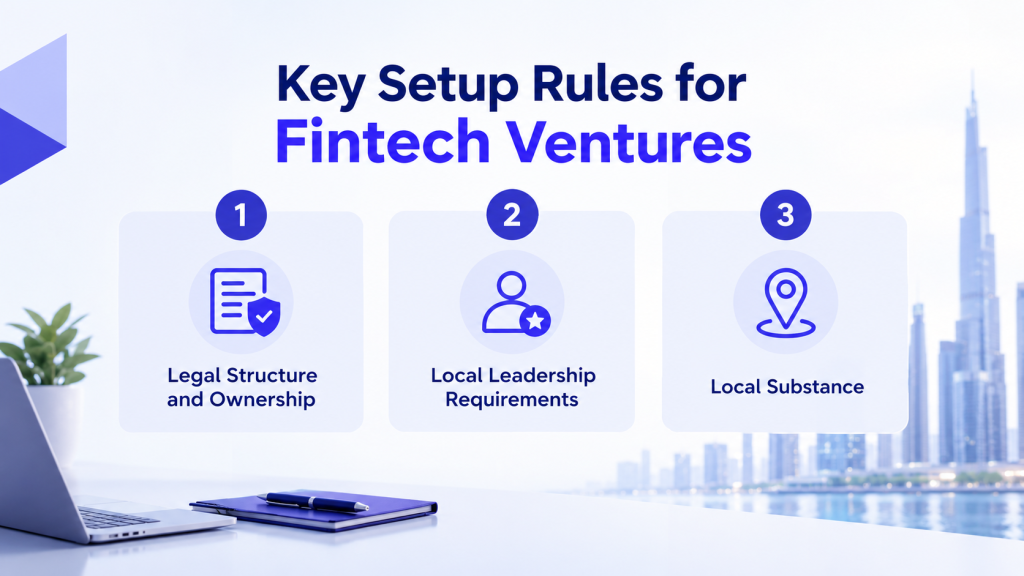
- Legal Structure and Ownership: Foreign entrepreneurs have the possibility of owning up to 100% of the shares in the Private Limited company.
- Local Leadership Requirements: You need a minimum paid-up capital of S$1 for ACRA setup, alongside one ordinarily resident director. Regulated entities require experienced local management.
- Local Substance: For setting up your firm through ACRA, you must have a minimum paid-up capital of S$1, along with an ordinarily resident director.
Regulatory Capital, Licensing Timelines and Fees
Differences in the company incorporation process and MAS regulatory licensing avoid operational and financial obstacles.
Financial and Timeline Expectations
- Capital Requirements: Base capital of licensed FAs is required starting at S$250,000 to S$500,000 depending on their range of activity. They also need to have professional indemnity insurance.
- Application Timelines: Registration by ACRA takes several days, while licensing by MAS can take between three and six months.
- Government Fees: MAS demands application and licensing fees together with legal and compliance costs.
Referring Users to Third-Party Brokers: Rules and Restrictions
Even redirecting app users to make trades on the outside brokerages’ platforms raises certain legal questions.
Navigating Broker Integration and Referrals
Routing of app traffic to licensed brokers is quite a popular practice. But receiving commissions on referred clients becomes a matter of regulatory responsibility. Exemptions of Introducers strictly prohibit your platform from giving direct investment advice. Besides, sending trade orders via APIs increases the regulatory burden of your business beyond mere referrals.
Ongoing Compliance Requirements for Licensed Financial Advisers
Licensing is a process that requires ongoing compliance with statutory standards.
- Governance Controls: Appoint fit-and-proper managers, which includes an experienced resident CEO.
- Financial Resources: Keep the minimum base capital and professional indemnity insurance cover in place.
- Consumer Protection: Conduct thorough customer due diligence and suitability assessments.
- AML/CFT Safeguards: Strict controls on money laundering and independent auditing.
How Arnifi Helps with Singapore Fintech Company Setup
Establishing a fintech company in compliance with regulatory standards requires smooth execution across all corporate, taxation, and administration services.
Arnifi helps non-resident entrepreneurs with company incorporation in Singapore, filings with ACRA, and share structure management. We facilitate local directors’ appointment, secretarial work, and immigration for key employees. Besides, Arnifi takes care of accounting and taxation services as well as operational document management. Please keep in mind that licensing by MAS is to be carried out only with a separate legal evaluation by a licensed Singapore lawyer.
Pre-Launch Regulatory Checklist for Investment App Founders
Please complete this compliance checklist before making your platform accessible to the public.
- Define target investment assets clearly.
- Document user profiling workflows and algorithm decision paths.
- Differentiate factual commentary from tailored recommendations.
- Map referral setups, commission models, and API integrations.
- Confirm whether your business requires a Financial Adviser Licence in Singapore.
- Verify local capital, resident director, and substance requirements.
- Obtain formal legal opinions from regulatory experts.
Conclusion
A Financial Adviser Licence in Singapore will provide credible operations for your wealthtech startup in the long run. Just because you do not hold any assets in custody, you cannot automatically be exempted from MAS regulation. Determining the journey of your customer will safeguard your venture from unnecessary regulatory issues.
Are you ready to launch your Singapore office? Get in touch with Arnifi now to facilitate your incorporation and structure of the company. Leave everything to us and just concentrate on growing your investment app!
Frequently Asked Questions
1. Does an investment app need a Financial Adviser Licence in Singapore?
Yes, if the app provides personalized recommendations or investment advice to customers from Singapore.
2. Can an investment app operate without a licence if it avoids holding client money?
The absence of client funds will not save you from the obligation to have a licence if your app generates personalized investment advice.
3. What is the difference between an FA licence and a CMS licence?
FA licence is about investment advice; a CMS licence is about trading execution, fund management, and asset custody.
4. Can foreign founders own 100% of a Singapore fintech company?
Yes, Singapore allows 100% foreign ownership for private limited businesses.
5. What is the minimum paid-up capital required to incorporate in Singapore?
The basic incorporation requirement with ACRA is just S$1.
6. What is the minimum capital required for an FA licence?
The capital requirement typically ranges from S$250,000 to S$500,000, depending on the type of approved advisory services.
7. How long does MAS take to process an FA licence application?
The processing time can take from three to six months following the submission of complete paperwork.
8. Are algorithm-based investment recommendations regulated in Singapore?
Yes, MAS regulates automated and AI-generated advice under the standard financial advisory framework.
References
- Monetary Authority of Singapore (MAS): Financial Adviser’s Licence Guidelines
- Singapore Statutes Online: Financial Advisers Act 2001
Top Singapore Packages
Related Articles


Top Singapore Packages
Get in Touch
