
The Ultimate Guide to Setting Up a Singapore VCC Fund in 2026

Zahira Shaik
SEO Content Writer
Zahira Shaik is an SEO Content Writer and Published Author specializing in research-based content. She excels at analyzing market trends, regulations, and industry developments… Read more

Tulika Saxena
AVP, Sales & Marketing | IIM Nagpur
Tulika Saxena specializes in business finance, sales strategy, and market positioning. Leads growth and partnerships, ensuring seamless business setup experiences and client success across… Read more


Key Fact: The Singapore VCC Fund provides for statutory asset segregation between sub-funds, the availability of tax exemptions through Sections 13O and 13U, and other efficiencies, including the average cost of administration in Singapore per year, estimated at S$60,000 and up based on the complexity of the portfolio.
Table of contents
- Introduction
- Understanding the Singapore VCC Structure
- Singapore VCC vs. Offshore Jurisdictions
- Licensing, Governance, and Local Substance Requirements
- Singapore VCC Setup Costs and Recurring Expenses
- Singapore Fund Administration Costs: Pricing Models and Cost Drivers
- Tax Incentives for Singapore VCC Funds: Sections 13O and 13U
- Key Service Providers Involved in VCC Fund Operations
- How Arnifi Simplifies Singapore VCC Setup and Compliance
- Step-by-Step Singapore VCC Launch Timeline
- Conclusion: Planning Your Singapore VCC Launch
- Frequently Asked Questions (FAQs)
- References
Introduction
The Variable Capital Company (VCC) is a unique corporate vehicle enabling investment funds to control capital, issue shares, and pay dividends using net assets directly. Singapore retains its leadership position as one of the leading financial centers for fund managers, venture capital companies, private equity fund managers, and family offices.
Reviewing the budgets required to set up the fund, Singapore fund administration costs, and tax incentives will help managers make the right decision about launching the fund. This guide describes the process of setting up a VCC.
Understanding the Singapore VCC Structure
The VCC framework provides high operational flexibility for investment management companies.
What Is a Variable Capital Company (VCC)?
Variable Capital Company functions as a specific fund structure provided by the Variable Capital Companies Act. The capital value changes automatically depending on subscriptions/redemptions of shares by investors.
Standalone VCC vs. Umbrella VCC
- Standalone VCC: Contains only one investment portfolio per fund vehicle.
- Umbrella VCC: Provides for several sub-funds under one master corporate umbrella, which reduces costs.
How Sub-Fund Ring-Fencing Works
Statutory asset segregation means that the assets of one sub-fund cannot be used to settle the liabilities of another sub-fund.
Open-Ended vs. Closed-Ended VCCs
An open-ended VCC is ideal for liquid investment strategies such as hedge funds, while closed-ended VCCs are suitable for illiquid private equity and venture capital strategies.
Singapore VCC vs. Offshore Jurisdictions
The comparison of Singapore to the Cayman Islands and the British Virgin Islands is common for managers.
Comparing Initial Setup Costs and Long-Term Expenses
While offshore centers can have low registration costs, Singapore can provide stronger institutional credibility, double taxation agreements, and lower ongoing maintenance costs.
Singapore’s Double Taxation Agreement Network
The VCC structure can take advantage of over 100 Double Taxation Agreements (DTAs), which helps reduce foreign withholding tax on investment abroad.
What the Expiry of the VCC Grant Scheme Means
Without the co-funding grant scheme, managers will need to develop realistic budgeting plans without government fee funding.
Licensing, Governance, and Local Substance Requirements
Compliance with regulatory requirements will require clear substance operations in Singapore.
Fund Manager Licensing Requirements
Each VCC is required to appoint a licensed or exempt fund manager under the regulation of the Monetary Authority of Singapore (MAS). The eligible fund managers will either have a license in Capital Markets Services (CMS) or be exempt.
Local Governance and Substance
- Directors: Each VCC is required to have a resident director in Singapore.
- Company Secretary: Each VCC is required to have an experienced company secretary in Singapore who takes care of the statutory books.
- Registered Office: The entity must retain an active physical office address in Singapore.
AML/CFT, Audit, and Custody Considerations
The funding should have very strict Anti-Money Laundering (AML) regulations and annual audits conducted. The MAS-licensed custodians will ensure that the assets are secured when needed.
Singapore VCC Setup Costs and Recurring Expenses
Launching a fund requires both mandatory statutory payments and recurring operational expenses.
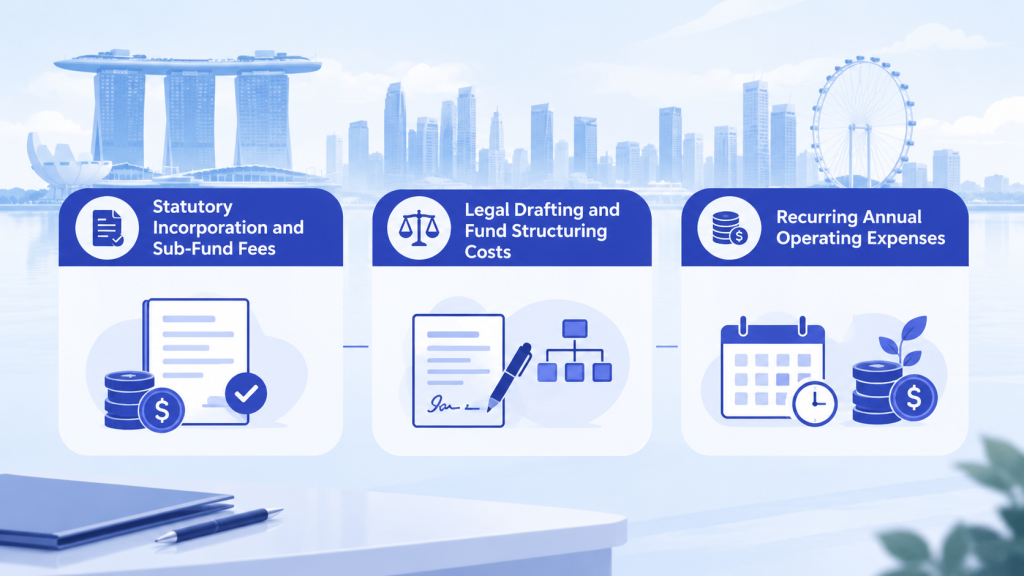
Statutory Incorporation and Sub-Fund Fees
ACRA will charge S8,000 for VCC incorporation, S15 for the company name filing, and S400 for sub-fund registration.
Legal Drafting and Fund Structuring Costs
- VCC Constitution and Private Placement Memorandum (PPM)
- Investment Management Agreement (IMA)
- Subscription Agreements
Recurring Annual Operating Expenses
The ongoing commitments will be the corporate secretary services, the audit fee, compliance, and the annual administration of the Singapore fund.
What Is the Estimated First-Year VCC Budget?
A small- to mid-sized VCC fund budget would generally be S45,000 and S90,000, respectively.
Singapore Fund Administration Costs: Pricing Models and Cost Drivers
Fund administration is separate from providing legal services and acting as a company secretary.
What Does Fund Administration Include?
The administrator will calculate the NAV, maintain shareholder registers, effect capital calls, perform distributions, and handle AML onboarding.
Understanding AUM-Based Pricing
Most fund administrators earn a basis point fee on all Assets Under Management (AUM) with a minimum annual floor rate.
Typical Annual Fund Administration Costs by AUM
| AUM Band | Estimated Annual Cost | Pricing Model |
| Below S$20M | S15,000–S25,000 | Fixed Minimum |
| S20M–S100M | S25,000–S45,000 | Hybrid / Basis Points |
| S100M–S500M | S45,000–S85,000 | Basis Points |
| Above S$500M | Custom Enterprise Quote | Tiered Basis Points |
Flat-Fee vs. Basis-Point Pricing
The flat fee approach suits closed-ended funds with straightforward investment. Basis point pricing fits well with liquid, high-frequency trading approaches.
Additional Fees and Hidden Cost Drivers
Number of sub-funds, investment complexity, frequent NAV calculations, and custom FATCA/CRS tax compliance drive up the fund administrator cost for a typical Singapore fund administration service.
Tax Incentives for Singapore VCC Funds: Sections 13O and 13U
Singapore offers generous tax exemption regimes for qualifying investment funds.
Understanding the Section 13O Resident Fund Scheme
Under Section 13O, tax exemptions are granted on income derived from specified investments made by onshore Singapore fund administration funds.
Understanding the Section 13U Enhanced-Tier Scheme
Under Section 13U, tax exemptions are provided to bigger onshore and offshore structures.
Eligibility and Minimum Fund Requirements
- Section 13O: Requires a minimum AUM of S$20 million.
- Section 13U: Requires a minimum AUM of S$50 million at application.
Local Business Spending Requirements
At least S$ 200,000 to S$ 500,000 per annum in local expenditure on the business carried out by the qualifying fund, including Singapore fund administration costs.
Key Service Providers Involved in VCC Fund Operations
- Fund Manager: Directs portfolio strategy and stock selection.
- Fund Administrator: Calculates NAVs and maintains investor registers.
- Corporate Secretary: Manages ACRA statutory filings.
- Auditor: Verifies yearly financial reports.
How Arnifi Simplifies Singapore VCC Setup and Compliance
Arnifi simplifies business incorporation, organization, and corporate secretary services.
Digital Setup & Operational Compliance
Arnifi offers digital workflow tools, bank account applications, accounting services, and compliance automation.
Get an estimate for operational setup and management costs with the Arnifi Cost Calculator.
Step-by-Step Singapore VCC Launch Timeline
- Phase 1: Structuring & Legal Drafting (Weeks 1–4): Define investment strategy and draft PPM documents.
- Phase 2: ACRA Incorporation (Weeks 5–6): Register entity name and pay statutory fees.
- Phase 3: Operational Onboarding (Weeks 7–10): Engage administrators, secretarial teams, and open bank accounts.
- Phase 4: Launch & Closing (Weeks 11–12): Onboard investors, issue shares, and deploy capital.
Conclusion: Planning Your Singapore VCC Launch
Benefits of Singapore VCCs include tax breaks, operational ease, and international recognition. The success of this venture will require one to know the total cost of legal fees initially, expenditures, and Singapore fund administration fees.
Looking to set up your own fund? Arrange a meeting with Arnifi specialists now to streamline your incorporation process. You may also check out our online products or request a compliance proposal for your VCC from Arnifi.
Frequently Asked Questions (FAQs)
1. What is a Singapore Variable Capital Company (VCC)?
VCC is a custom-made corporate structure designed for the use by investment vehicles in Singapore.
2. How much does ACRA charge to set up a VCC?
The cost is S$ 8,000 for VCC registration, S15 for filing of names, and S$400 per sub-fund.
3. What are average annual Singapore fund administration costs?
Base administration costs usually range from S$15,000 to S$60,000+ depending on fund size and strategy complexity.
4. How do administrators calculate VCC administration fees?
Providers use fixed annual minimums, basis-point charges on AUM, or hybrid models.
5. What minimum AUM is needed for Section 13O tax exemptions?
Section 13O requires a minimum fund size of S$20 million.
6. What minimum AUM applies to Section 13U exemptions?
Section 13U requires a minimum fund size of S$50 million at application.
7. How long does a Singapore VCC setup take?
A full launch typically takes between 8 and 12 weeks from drafting to capital closing.
References
Top Singapore Packages
Related Articles

Top Singapore Packages
Get in Touch
