
Cayman Fund Investor Letters | Role in Subscription Line Facilities

Anushka
Content Writer
Anushka Basu is a business content writer specialised in global business market insights. She aims to simplify complex regulatory, financial, and business concepts into… Read more

Tulika Saxena
AVP, Sales & Marketing | IIM Nagpur
Tulika Saxena specializes in business finance, sales strategy, and market positioning. Leads growth and partnerships, ensuring seamless business setup experiences and client success across… Read more


Key Fact: Investor letters can create a direct contractual relationship between fund investors and subscription-line facility lenders, strengthening clarity and enforceability around uncalled capital commitments.
Table of contents
- What is a subscription line facility?
- Why do lenders review Cayman fund investors?
- What documents are reviewed before a Cayman subscription facility?
- What is an investor letter in a Cayman subscription facility?
- What does an investor letter typically cover?
- How do investor letters strengthen a subscription line facility?
- When might a lender require an investor letter?
- How do side letters affect subscription line facilities?
- What happens when the investor is a sovereign entity?
- How does Cayman law support subscription line facilities?
- How is security perfected in a Cayman subscription facility?
- What ongoing obligations apply after an investor letter is signed?
- What are the benefits and limitations of investor letters?
- What should Cayman fund sponsors consider before using investor letters?
- How can Arnifi help with Cayman fund setup and finance coordination?
- FAQs
- Conclusion
What is a subscription line facility?
A subscription line facility, also called a sub-line or capital call facility, is financing secured primarily against a fund’s uncalled investor commitments. It allows a fund to borrow before calling capital from investors and repay the borrowing from subsequent capital contributions.
The basic structure is:
Fund → Lender → Capital Calls → Investor Commitments → Repayment
Subscription facilities are commonly used during a fund’s investment period, when substantial investor commitments remain undrawn. As capital is called and deployed, the available borrowing base generally decreases.
- Fund borrows under the facility.
- Lender relies on eligible uncalled commitments.
- GP makes capital calls under the LPA.
- Investors fund those calls.
- Proceeds are applied toward the facility according to the financing arrangements.
The lender’s primary credit support is therefore the fund’s contractual right to call and receive investors’ uncalled commitments.
Why do lenders review Cayman fund investors?
Subscription-line collateral is effectively “upward-looking” because the lender assesses the investors whose commitments ultimately support repayment. Investor due diligence is particularly important where the fund has a concentrated investor pool or a separately managed account.
- Investor identity and creditworthiness
- Size of unfunded commitments
- Investor concentration
- Enforceability of capital-call obligations
- Excuse and exclusion provisions
- Investor default provisions
- Side-letter restrictions
- Sovereign or special-status investors
A concentrated investor base can create greater reliance on a limited number of investors, making the quality and enforceability of their commitments particularly relevant to underwriting.
What documents are reviewed before a Cayman subscription facility?
Lenders generally review the fund’s constitutional, fund and investor documents together. The LPA receives particular attention because it governs the relationship between the fund and investors and contains key capital-call and borrowing provisions.
| Document category | Documents typically reviewed |
| Constitutional | Certificate of registration, registration statement, LPA and GP constitutional documents |
| Fund documents | Investment management agreement, administration agreement and offering documents |
| Investor documents | Subscription agreements and side letters |
The LPA should also be reviewed for restrictions on borrowing, leverage, security and the assignment of capital-call rights. Investor side letters need to be considered alongside the LPA because they may contain terms that modify an investor’s obligations.
What is an investor letter in a Cayman subscription facility?
An investor letter is generally an agreement or letter issued by an investor to a lender or facility/security agent. The fund will often also be a party to acknowledge the arrangements.
The scope can vary considerably. A simple letter may acknowledge that the fund’s rights to call undrawn capital have been secured in favour of the lender. A more detailed agreement can contain representations, confirmations and undertakings directly benefiting the lender.
- Investor acknowledges the financing arrangements.
- Investor confirms relevant commitment information.
- Lender receives direct contractual rights.
- Fund may acknowledge and agree to the arrangements.
- Governing law will generally align with the LPA.
The investor letter can therefore create a direct contractual relationship between the lender and investor that may not otherwise exist.
What does an investor letter typically cover?
There is no single universal investor-letter form. Its contents depend on the transaction, investor and lender requirements.
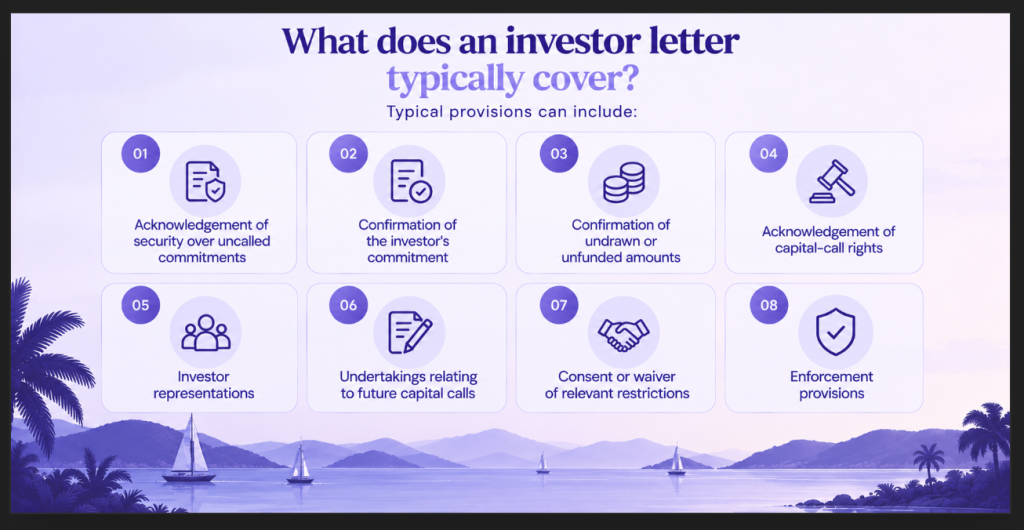
The precise drafting should be assessed against the LPA, subscription agreement, side letters and financing documents.
How do investor letters strengthen a subscription line facility?
Investor letters can address specific lender concerns and provide additional contractual protection. They may be particularly useful where the lender needs greater certainty around an investor’s commitment or capital-call obligations.
| Protection | Practical relevance |
| LPA clarification | Addresses ambiguity affecting financing or capital calls |
| Direct enforceability | Creates contractual obligations between lender and investor |
| Side-letter protection | Can address relevant restrictions or obtain waivers |
| Investor verification | Confirms commitment and awareness of the facility |
| Enforcement support | Can strengthen rights relating to capital-call proceeds |
| Fraud mitigation | Provides another layer of investor confirmation |
Investor letters strengthen lender protections but do not eliminate the need for fund, sponsor and investor due diligence.
When might a lender require an investor letter?
Investor letters may become particularly relevant where the lender has greater exposure to individual investors or specific legal risks.
- Concentrated investor pools
- Separately managed accounts
- Single or significant investors
- Sovereign or government-related investors
- Side letters containing relevant restrictions
- Uncertainty around capital-call enforceability
- Specific lender credit-approval requirements
They can be especially useful where a lender’s borrowing base depends heavily on a small number of investors.
How do side letters affect subscription line facilities?
Investor side letters can contain terms that differ from the standard LPA provisions. Those terms may affect capital calls, enforcement or other lender rights and therefore need to be reviewed alongside the LPA and subscription agreement.
- Review side letters before facility documentation is finalised.
- Identify restrictions affecting capital calls.
- Identify provisions affecting lender enforcement.
- Determine whether confirmation or waiver is required.
- Address relevant provisions through the investor letter where appropriate.
An investor letter does not automatically override a side letter. Its effect depends on the actual contractual language and the rights granted by the parties.
What happens when the investor is a sovereign entity?
Sovereign investors can create additional legal considerations, including potential sovereign-immunity issues. An investor letter may provide confirmations, acknowledgements or contractual protections intended to address some of these concerns.
However, an investor letter is not a universal solution to sovereign-immunity issues. Its effectiveness depends on the investor, applicable law, contractual drafting and the particular transaction.
How does Cayman law support subscription line facilities?
Cayman exempted limited partnerships are widely used for closed-ended funds, including private equity structures. The LPA provides the contractual foundation for capital calls and typically addresses whether the fund can incur subscription-line debt and grant security over relevant rights.
The typical security package can include:
- Assignment by way of security over capital-call rights
- Security over relevant collection accounts
- Security over proceeds of capital calls
- Investor notices where applicable
- Ancillary enforcement rights
Under the Cayman ELP framework, the fund’s ability to make capital calls and the permitted use of those calls are principally governed by the relevant partnership agreement.
How is security perfected in a Cayman subscription facility?
The security package depends on the structure and finance documents. For a Cayman ELP, lenders commonly take security over the fund’s rights to make capital calls and enforce payment, together with relevant collection-account arrangements.
- Security assignment over relevant capital-call rights
- Security over designated collection accounts
- Investor notices where applicable
- Alignment between security documents and the LPA
- Restrictions on amendments affecting lender rights
- Enforcement mechanics following an event of default
The precise perfection and priority steps should be determined for the specific transaction rather than treated as a universal process.
What ongoing obligations apply after an investor letter is signed?
An investor letter can create continuing obligations rather than simply serving as a closing document. Where one is used, compliance with its terms may become part of the fund’s ongoing obligations under the financing documents.
- Monitor investor-letter undertakings.
- Maintain accurate commitment information.
- Monitor amendments and waivers.
- Ensure the fund does not act contrary to the investor letter.
- Monitor changes affecting capital-call rights.
- Address potential breaches promptly.
Depending on the finance documents, non-compliance with an investor letter may constitute an event of default.
What are the benefits and limitations of investor letters?
| Benefit | Practical relevance |
| Direct lender-investor relationship | Gives lenders contractual rights directly against investors |
| Commitment confirmation | Helps validate uncalled capital |
| Side-letter protection | Can address provisions affecting financing rights |
| Enforcement support | Can strengthen capital-call enforcement |
| Fraud mitigation | Adds another layer of investor verification |
| Transparency | Makes financing arrangements clearer to investors |
However, investor letters have limitations:
- They do not replace LPA and subscription-document review.
- They do not eliminate investor credit risk.
- They do not remove the need for fund-level due diligence.
- Their effectiveness depends on drafting and applicable law.
Investor letters are therefore a risk-mitigation tool rather than a substitute for proper diligence.
What should Cayman fund sponsors consider before using investor letters?
Sponsors can reduce documentation friction by identifying investor-letter requirements early in the financing process.
- Review the LPA before negotiating facility terms.
- Identify relevant side-letter provisions.
- Map investor concentration and unfunded commitments.
- Identify sovereign or special-status investors.
- Establish lender requirements early.
- Coordinate sponsors, fund counsel, lender counsel and investors.
- Explain the financing arrangement clearly to investors.
Early preparation can make investor discussions more structured and help avoid documentation delays.
How can Arnifi help with Cayman fund setup and finance coordination?
Arnifi can support Cayman fund structuring and establishment while coordinating the practical requirements surrounding fund-finance readiness.
- Support Cayman fund structuring and establishment.
- Coordinate fund documentation and service providers.
- Assist with subscription-facility readiness from a structural and documentation perspective.
- Coordinate with Cayman legal counsel, lenders, administrators and other providers where required.
- Support ongoing fund administration and compliance requirements.
Arnifi’s role is to provide setup and coordination support rather than act as the lender or Cayman legal adviser.
FAQs
What is a subscription line facility?
It is financing secured primarily against a fund’s uncalled investor capital commitments.
What is an investor letter in a Cayman fund?
It is an agreement between an investor and lender that provides additional contractual protections around fund commitments.
Why do lenders require investor letters?
They can provide additional certainty around investor commitments, capital calls and lender enforcement rights.
Are investor letters mandatory for Cayman funds?
No. They are transaction-specific and depend on lender, investor and fund circumstances.
What does a Cayman investor letter contain?
It may contain commitment confirmations, representations, undertakings, security acknowledgements and enforcement provisions.
How do investor letters affect capital calls?
They can provide direct contractual confirmations and undertakings relating to the fund’s capital-call rights.
Can an investor letter override a side letter?
It can address or obtain waivers of relevant provisions where properly drafted, but the effect depends on the contractual language.
Why are investor letters important for concentrated funds?
They can provide additional protection where the lender relies heavily on a small number of investors.
Are investor letters useful for sovereign investors?
They can address certain legal uncertainties, including potential sovereign-immunity issues, but require transaction-specific analysis.
Does every Cayman fund need a subscription facility?
No. A subscription facility is a financing choice, and investor letters are used only where the transaction requires them.
Conclusion
Subscription line facilities rely primarily on investors’ uncalled capital commitments, making investor due diligence central to the lender’s credit assessment. Investor letters can establish a direct contractual relationship between lenders and investors and provide additional clarity around commitments, capital calls and enforcement. They can be particularly relevant for concentrated investor pools, SMAs, sovereign investors and funds with complex side letters. However, they complement rather than replace diligence on the fund, sponsor and investors. Cayman fund sponsors should review the LPA, subscription agreements, side letters and financing restrictions before entering into a subscription line facility.
Official references
Top UAE Packages


Related Articles


Top UAE Packages
Get in Touch