
Gratuity Rules in UAE 2026 | Eligibility, Calculation & End-of-Service Benefits

Tulika Saxena
AVP, Sales & Marketing | IIM Nagpur
Tulika Saxena specializes in business finance, sales strategy, and market positioning. Leads growth and partnerships, ensuring seamless business setup experiences and client success across… Read more


Key Facts: UAE gratuity in 2026 is generally based on an employee’s last basic wage and eligible service period, with 21 days’ pay for the first five years and 30 days thereafter. The rules also cover eligibility, unpaid leave, part-time work, resignations, final settlements, and free-zone differences.

Table of contents
- Introduction
- UAE Gratuity Rules at a Glance
- What Is Gratuity in the UAE?
- Who Is Eligible for Gratuity in the UAE?
- How Is Gratuity Calculated in the UAE?
- Gratuity Formula
- How to Calculate Daily Basic Wage
- UAE Gratuity Calculator
- UAE Gratuity Calculation Examples
- Is Gratuity Based on Basic Salary or Total Salary?
- Does Resignation Affect Gratuity in UAE?
- Gratuity After Termination
- Limited vs Unlimited Contracts: What Changed?
- Does Unpaid Leave Affect Gratuity?
- Gratuity for Part-Time Employees
- When Must the Employer Pay Gratuity?
- What Is Included in the Final Settlement?
- Can an Employer Deduct Money From Gratuity?
- UAE Gratuity Law: Article 51 Explained
- Does Gratuity Apply to Free Zones?
- UAE Alternative End-of-Service Savings Scheme
- Domestic Worker Gratuity Rules
- Government Employee Gratuity vs Private Sector
- What To Do If Your Employer Doesn’t Pay Gratuity
- Common UAE Gratuity Calculation Mistakes
- UAE Gratuity Checklist for Employees
- UAE Gratuity Checklist for Employers & HR
- FAQs
Introduction
Leaving a job in the UAE usually brings one big question: how much gratuity will I receive? For most eligible foreign employees in the UAE private sector, the calculation is based on the employee’s last basic wage and length of service. The standard formula is 21 days of basic wage for each of the first five years and 30 days for every year after that. But gratuity is not the same for everyone. Your employment type, unpaid leave, nationality, and the law covering your workplace can all affect the calculation. Employees in DIFC and ADGM, for example, follow separate employment frameworks. Here is how the UAE gratuity rules work in 2026 and how you can estimate your end-of-service benefit.
UAE Gratuity Rules at a Glance
| Rule | 2026 Position |
| Minimum service | 1 year for eligible employees |
| First 5 years | 21 days’ basic wage per year |
| After 5 years | 30 days’ basic wage per year |
| Salary used | Last basic wage |
| Unpaid leave | Not counted in the service period |
| Part years | Calculated on a pro-rata basis |
| Maximum | Up to 2 years’ wage |
| Payment | Generally within 14 days of the contract ending |
These rules mainly apply to employees covered by the UAE Federal Labour Law. Different rules can apply in DIFC, ADGM and other specific employment arrangements.
What Is Gratuity in the UAE?
Gratuity is an end-of-service payment made to an eligible employee when their employment ends. It is separate from the employee’s final salary and other amounts that may be due, such as unused annual leave or notice pay. For a standard full-time foreign employee covered by the Federal Labour Law, gratuity is calculated using the last basic wage, rather than the employee’s complete salary package.
Who Is Eligible for Gratuity in the UAE?
Eligibility depends on the employee’s work arrangement and the law that applies to the job.
Minimum 1-Year Service Requirement
Eligible full-time foreign employees generally need at least one year of continuous service to qualify for statutory gratuity.
Foreign Employees
Foreign employees covered by the UAE Labour Law receive gratuity based on their basic wage and eligible service period. The rate is 21 days for the first five years and 30 days thereafter.
UAE Nationals
UAE nationals generally fall under the applicable pension and social security system, so the standard expatriate gratuity formula does not automatically apply.
Part-Time Employees
Part-time gratuity depends on the employee’s work pattern and contracted hours, so the full-time formula should not be applied automatically.
Employees With Unpaid Leave
Unpaid leave is generally excluded from the gratuity service period, which can reduce the period used for the final calculation.
How Is Gratuity Calculated in the UAE?
The calculation is easier once you know three things:
- Your last basic monthly salary
- Your daily basic wage
- Your total eligible service
Gratuity Formula
For an eligible full-time foreign employee:
First five years:
Daily basic wage × 21 × years of service
After five years:
Daily basic wage × 30 × additional years
The total gratuity is also subject to the statutory maximum of two years’ wage.
How to Calculate Daily Basic Wage
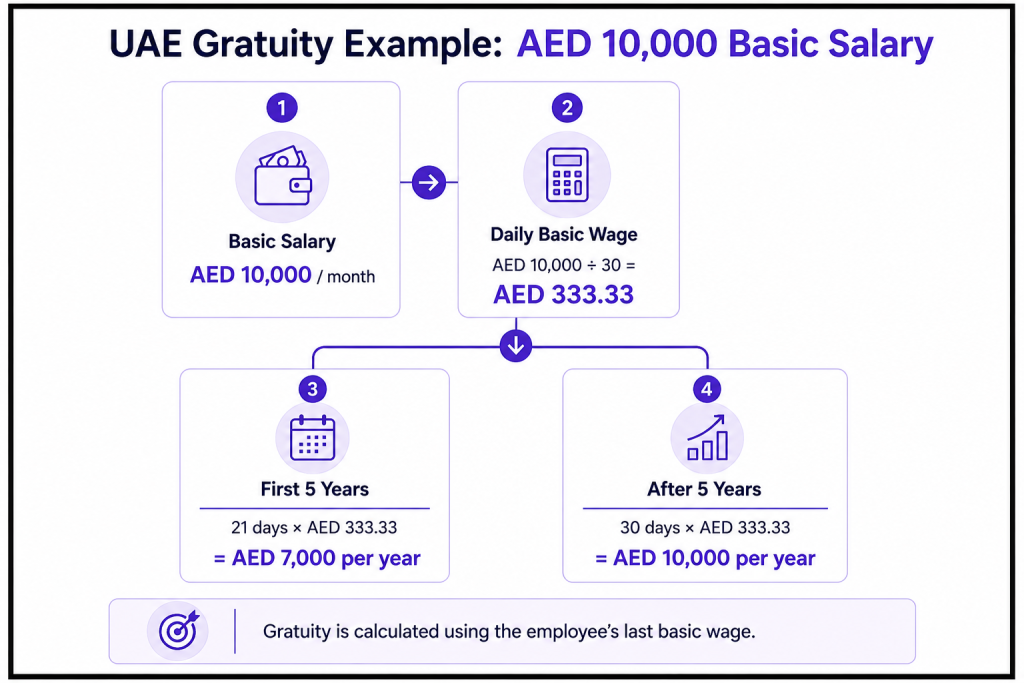
For a monthly-paid employee, divide the basic monthly salary by 30.
For example:
AED 10,000 ÷ 30 = AED 333.33
The employee’s daily basic wage is therefore AED 333.33.
21-Day Rule
For each year within the first five years, the employee receives 21 days of basic wage.
With a basic salary of AED 10,000:
AED 333.33 × 21 = AED 7,000 per year
30-Day Rule After Five Years
Once five years have been completed, each additional year is calculated at 30 days of basic wage.
With a basic salary of AED 10,000:
AED 333.33 × 30 = AED 10,000 per additional year
Two-Year Maximum
The total end-of-service gratuity cannot exceed the equivalent of two years’ wage under the federal gratuity rules.
Pro-Rata Calculation for Part Years
If an employee completes one year and then works part of another year, the eligible fraction can be calculated proportionately. For example, six months would represent half of the applicable annual gratuity amount.
UAE Gratuity Calculator
You can estimate your gratuity using these steps:
Basic salary ÷ 30 = daily basic wage
Then:
Daily wage × 21 × first five years
Add:
Daily wage × 30 × years after five
Finally, add any eligible part-year amount and check the two-year maximum.
For a more accurate result, use the employee’s exact joining and leaving dates and account for any unpaid absence.
UAE Gratuity Calculation Examples
1-Year Example
For a basic salary of AED 10,000:
AED 10,000 ÷ 30 = AED 333.33 daily basic wage
AED 333.33 × 21 × 1 = AED 7,000 gratuity
3-Year Example
AED 333.33 × 21 × 3 = AED 21,000 gratuity
5-Year Example
AED 333.33 × 21 × 5 = AED 35,000 gratuity
6-Year Example
The first 5 years are calculated at 21 days, while the sixth year is calculated at 30 days.
AED 333.33 × 21 × 5 = AED 35,000
AED 333.33 × 30 × 1 = AED 10,000
Total gratuity = AED 45,000
8-Year Example
First 5 years: AED 35,000
Next 3 years: AED 333.33 × 30 × 3 = AED 30,000
Total gratuity = AED 65,000
Part-Year Example
If an employee has completed 2 years and 6 months, the additional six months can be calculated proportionately.
2 years = AED 14,000
6 months = AED 7,000 × 0.5 = AED 3,500
Total gratuity = AED 17,500
Is Gratuity Based on Basic Salary or Total Salary?
For the standard federal calculation, gratuity is based on the employee’s last basic wage, not the total salary package.
For example, if the monthly package is:
- Basic salary: AED 10,000
- Housing allowance: AED 5,000
- Transport allowance: AED 2,000
The gratuity calculation would generally use AED 10,000 rather than the full AED 17,000.
Does Resignation Affect Gratuity in UAE?
Resigning does not automatically mean losing your gratuity. Under the current federal Labour Law, the old rules that reduced gratuity simply because an employee resigned under an unlimited contract should not be used for 2026 calculations. What matters is the employee’s eligibility, service period, basic wage, and the employment law that applies.
Gratuity After Termination
An employee’s final settlement can contain several amounts, not just gratuity.
Depending on the circumstances, it may include:
- Salary up to the final working day
- Gratuity
- Unused annual leave
- Notice pay, where applicable
- Other contractual or statutory entitlements
The reason for termination can affect other employment rights, so gratuity should be checked as part of the complete final settlement.
Limited vs Unlimited Contracts: What Changed?
Older UAE gratuity guides often explain different calculations for limited and unlimited contracts. That is no longer the right way to approach the rules in 2026. The current UAE Labour Law moved private-sector employment towards fixed-term contracts, replacing the previous unlimited-contract model. So employees should use the current Labour Law and their actual employment arrangement rather than relying on old limited-versus-unlimited gratuity formulas.
Does Unpaid Leave Affect Gratuity?
Yes. Unpaid absence is excluded from the service period used for calculating gratuity.
This means someone who has technically been employed for five calendar years may have a shorter gratuity-eligible period if they had qualifying unpaid absence during that time.
Gratuity for Part-Time Employees
Part-time employees should not simply use the full-time 21-day/30-day calculation.
The applicable work pattern and contracted hours need to be considered. The UAE’s alternative savings scheme also provides specific rules for employees working under part-time and job-sharing arrangements.
When Must the Employer Pay Gratuity?
For employees covered by the Federal Labour Law, wages and other entitlements are generally payable within 14 days from the end of the contract term. The exact rules can differ for employees covered by separate free-zone employment laws.
What Is Included in the Final Settlement?
A final settlement may include:
- Final salary
- Gratuity
- Unused annual leave
- Notice pay, where applicable
- Other outstanding contractual amounts
Employees should ask for a written breakdown so they can see exactly how the final amount was calculated.
Can an Employer Deduct Money From Gratuity?
An employer cannot simply make an unexplained deduction from an employee’s gratuity.
Certain deductions may be permitted where the employee owes money to the employer and the legal requirements are met. If a deduction appears unclear, the employee should ask for the reason and supporting calculation.
UAE Gratuity Law: Article 51 Explained
Article 51 is the main provision covering end-of-service benefits for eligible foreign employees under the Federal Labour Law.
In simple terms, an eligible employee receives:
21 days’ basic wage for each of the first five years
and
30 days’ basic wage for every additional year.
Eligible fractions of a year can be calculated proportionately, while unpaid absence is excluded and the total benefit is subject to the two-year wage limit.
Does Gratuity Apply to Free Zones?
Not every free zone follows exactly the same employment framework.
Mainland UAE
Employees covered by the Federal Labour Law generally follow the Article 51 gratuity calculation.
DIFC
DIFC has its own employment framework and uses an employee workplace savings system rather than simply applying the mainland gratuity formula. Under the DIFC framework, qualifying employer contributions are generally based on 5.83% of monthly basic wage for the first five years and 8.33% thereafter.
ADGM
ADGM also has its own employment regulations. Its gratuity calculation uses 21 days for each of the first five years and 30 days for each additional year, but its daily-rate calculation and definition of basic wage differ from the federal system.
Other Free Zones
For other UAE free zones, check which employment law applies. Being located in a free zone does not automatically mean that the federal Labour Law does not apply.
UAE Alternative End-of-Service Savings Scheme
The UAE also has a voluntary alternative to the traditional gratuity system. Under the Savings Scheme, participating employers make monthly contributions into approved investment funds. The employee receives the contributions allocated to them and any applicable investment returns when their employment ends.
For full-time employees, the basic contribution is generally:
- 5.83% of monthly basic salary for service of up to five years
- 8.33% for service exceeding five years
The scheme is voluntary, and gratuity already accrued before an employee joins the scheme remains protected.
Domestic Worker Gratuity Rules
Domestic workers are covered by a separate legal framework. Their end-of-service benefits should therefore be calculated according to the domestic workers’ regulations rather than automatically applying Article 51 of the private-sector Labour Law.
Government Employee Gratuity vs Private Sector
Government employees follow the rules applicable to their particular government employer.
UAE nationals in the private sector are generally covered by pension and social security arrangements rather than the standard expatriate gratuity formula. For this reason, employees should first identify which employment law and benefits system applies to them.
What To Do If Your Employer Doesn’t Pay Gratuity
Start by requesting a written final settlement.
Check your:
- Last basic salary
- Joining and leaving dates
- Eligible service period
- Unpaid leave
- Gratuity calculation
- Unused annual leave
- Notice pay
- Deductions
If the employer does not pay what is legally due, an employee covered by MoHRE can raise a labour complaint through the applicable dispute-resolution process. DIFC and ADGM employees should use their respective employment dispute mechanisms.
Common UAE Gratuity Calculation Mistakes
The most common mistakes are surprisingly simple:
- Using total salary instead of basic salary
- Applying 30 days to every year
- Ignoring the one-year service requirement
- Counting unpaid leave
- Using outdated limited/unlimited contract rules
- Applying mainland rules to DIFC or ADGM
- Forgetting the two-year maximum
- Treating gratuity as the entire final settlement
UAE Gratuity Checklist for Employees
Before accepting your final settlement, check:
- Last basic salary
- Joining and leaving dates
- Total eligible service
- Unpaid leave
- 21-day calculation for the first five years
- 30-day calculation after five years
- Pro-rata amount for a part-year
- Two-year maximum
- Unused annual leave
- Notice pay
- Any deductions
UAE Gratuity Checklist for Employers & HR
HR teams should:
- Confirm the applicable employment law
- Verify the employee’s work pattern
- Confirm the last basic wage
- Calculate the exact service period
- Exclude unpaid absence where applicable
- Apply the correct gratuity rate
- Check the maximum limit
- Calculate other final-settlement amounts separately
- Explain any deductions
- Pay the final settlement within the applicable deadline
FAQs
1. How is gratuity calculated in the UAE in 2026?
For an eligible full-time foreign employee, it is generally 21 days of basic wage for each of the first five years and 30 days for each additional year.
2. Is gratuity based on basic salary or gross salary?
It is generally based on the employee’s last basic wage, not the complete salary package.
3. Do I get gratuity if I resign?
Yes, resignation does not automatically cancel gratuity entitlement under the current federal Labour Law.
4. How long must I work to receive gratuity?
An eligible full-time foreign employee generally needs at least one year of continuous service.
5. What happens to gratuity after five years?
The calculation changes from 21 days to 30 days of basic wage for each additional year.
6. Is there a maximum gratuity amount?
Yes. Under the federal rules, gratuity cannot exceed the equivalent of two years’ wage.
7. Does unpaid leave reduce gratuity?
Yes. Unpaid absence is generally excluded from the service period used for the calculation.
8. When should gratuity be paid?
For federal private-sector employees, wages and other entitlements are generally due within 14 days of the contract ending.
9. Does gratuity apply in DIFC?
DIFC has a separate employment savings framework, so the standard mainland calculation should not simply be applied.
10. Does gratuity apply in ADGM?
Yes, but ADGM has its own employment regulations and calculation rules.
11. Can an employer deduct money from gratuity?
Certain lawful deductions may be possible, but an employer cannot make an arbitrary or unexplained deduction.
12. What is the UAE Savings Scheme?
It is a voluntary alternative to traditional end-of-service gratuity where employers make monthly contributions into approved investment funds.
13. Can I calculate my gratuity myself?
Yes, if you have a straightforward full-time employment arrangement. For part-time work, free-zone employment or unusual service periods, the calculation should be checked against the applicable rules.
References:
Top UAE Packages
Related Articles

Top UAE Packages
Get in Touch
