
WPS Salary in the UAE | Payment Process, Regulations & Deadlines

Anushka
Content Writer
Anushka Basu is a business content writer specialised in global business market insights. She aims to simplify complex regulatory, financial, and business concepts into… Read more

Tulika Saxena
AVP, Sales & Marketing | IIM Nagpur
Tulika Saxena specializes in business finance, sales strategy, and market positioning. Leads growth and partnerships, ensuring seamless business setup experiences and client success across… Read more



Paying employee salaries through the Wage Protection System (WPS) is part of the monthly payroll process for UAE private-sector employers. However, WPS salary payment is not simply a matter of transferring money to an employee. Employers also need to use the applicable WPS payment arrangement, maintain accurate salary information and make payments within the required timeframe.
The current WPS framework also supports expanded digital payment channels and electronic integration between MoHRE systems and participating financial institutions.
This guide focuses on how WPS salary payments work in practice, including payment timelines, salary cards and bank accounts, payment through personal accounts, WPS updates and what happens when a company is blocked.
Table of contents
- What Is WPS Salary in the UAE?
- How Does the WPS Salary Payment Process Work?
- Is a Salary Card or UAE Bank Account Required for WPS Salary?
- When Should WPS Salary Be Paid?
- What Happens If WPS Salary Is Not Paid by the Deadline?
- What Happens If the Company Pays Salary Through a Personal Account?
- How Is Salary Information Updated in the WPS System?
- What Happens When a Company Is Blocked on WPS?
- What Are the Common WPS Salary Payment Problems?
- WPS Salary Compliance | What Should Employers Check Every Month?
- WPS Salary vs Minimum Wage in the UAE | What’s the Difference?
- FAQs
- Conclusion
What Is WPS Salary in the UAE?
WPS salary refers to an employee’s wages being processed through the Wage Protection System using the applicable approved payment arrangement.
The process involves four main parties:
| Party | Role |
| Employer | Confirms salary details and initiates the payment |
| Employee | Receives the salary through the applicable payment arrangement |
| Financial institution | Processes the salary through the approved WPS channel |
| MoHRE | Monitors wage-payment information and employer compliance |
WPS salary payment is different from making an ordinary bank transfer. The employer needs to use the applicable WPS mechanism so that the salary payment is processed and monitored through the relevant system.
Under WPS, private-sector salaries can be transferred through banks, exchange houses and financial institutions authorised to provide wage-payment services.
The updated WPS also supports a wider range of digital salary-payment channels and electronic integration with participating financial institutions.
How Does the WPS Salary Payment Process Work?
The WPS salary process can be managed through four main steps.
Confirm the employee’s salary details
Before processing the payment, the employer should confirm that the employee’s salary information is accurate and corresponds with the relevant employment records.
This includes checking:
- The employee’s salary details
- Any approved salary changes
- The amount to be paid
- Whether the information being used for payment is current
Keeping these details accurate helps avoid discrepancies between the employee’s records and the salary payment.
Use the company’s WPS payment arrangement
The salary should then be processed through the company’s WPS arrangement.
The employer should use the appropriate:
- WPS company account
- Approved financial institution
- WPS salary-payment channel
The employee does not necessarily need to have a traditional UAE bank account in every situation. The applicable payment mechanism depends on the WPS requirements and the approved arrangement being used.
The important point is that the employer uses the correct company WPS arrangement rather than treating a normal personal-account transfer as the standard salary-payment method.
Process the salary payment
Once the salary details have been confirmed, the employer initiates the payment through the relevant WPS channel.
The practical flow is:
Employer → WPS payment arrangement → Approved financial institution → Employee
The relevant salary information is also processed through the WPS/MoHRE system.
The updated WPS allows employers to manage salary payments through digital platforms, with direct electronic data integration between MoHRE systems and participating financial institutions.
Allow the system to update
After the payment has been processed, the relevant information is reflected through the WPS/MoHRE system.
The updated system is designed to support electronic data integration, salary-transfer tracking and faster verification.
However, employers should still check the payment and WPS status when there is an issue, such as a failed payment, incorrect account or payment correction.
Is a Salary Card or UAE Bank Account Required for WPS Salary?
A salary card or traditional UAE bank account should not automatically be treated as mandatory for every employee.
The permitted arrangement depends on the applicable WPS requirements and the terms and conditions of the approved payment channel.
Is a salary card mandatory?
No, not necessarily.
An employee does not automatically need a salary card simply because the employer uses WPS.
The employer should instead confirm that the payment arrangement being used meets the applicable WPS requirements.
Does the employee need a UAE bank account?
Not necessarily.
An employee should not automatically be assumed to need a traditional UAE bank account in every WPS situation.
However, this does not mean that employees can universally receive WPS salary without a bank account or another approved payment arrangement.
The payment mechanism depends on:
- The applicable WPS requirements
- The approved payment channel
- The terms and conditions of that arrangement
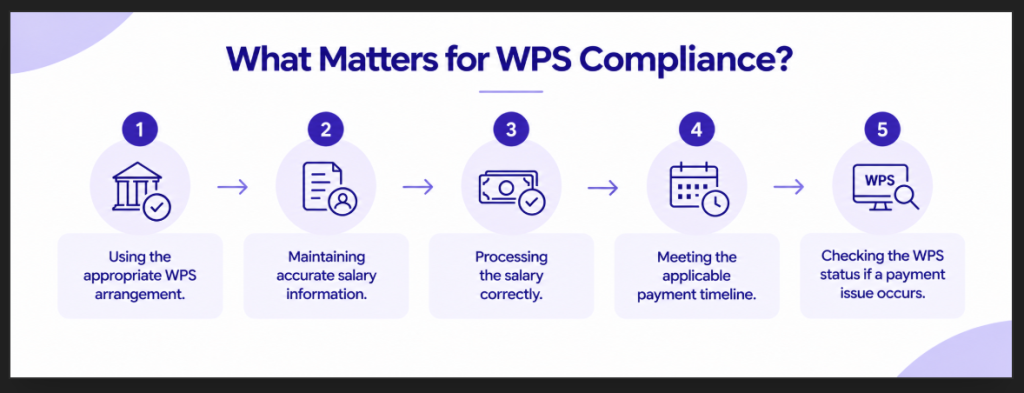
What matters for WPS compliance?
The key point is compliant salary processing through the applicable WPS mechanism. Employers should therefore focus on:
When Should WPS Salary Be Paid?
The salary due date should be considered together with the employee’s employment contract and the applicable WPS requirements.
Employers should first check the salary payment date agreed in the employment contract.
MoHRE guidance states that workers’ wages should be paid within the first 15 days after the due date unless a shorter period is specified in the employment contract.
This means the 15-day rule should not simply be presented as “salary must always be paid on the 15th.”
The distinction is:
| Point | What it means |
| Contractual due date | The salary payment date agreed under the employment contract |
| WPS compliance period | The applicable period for making the salary payment after the due date |
| 15-day point | MoHRE guidance generally refers to wages being paid within the first 15 days after the due date, unless a shorter period applies |
The current UAE Government guidance also states that employers must pay wages through WPS on the due date and sets out progressive measures for delayed payments.
For employers, the practical approach is to process salaries on time rather than waiting until the end of the applicable period.
What Happens If WPS Salary Is Not Paid by the Deadline?
If salary remains unpaid within the applicable period, the issue can affect both the employee’s salary payment and the company’s WPS status.
The practical point for employers is that if salary is not paid by the 15th of the relevant payment period, the company can face a WPS block or restriction.
The formal timing should still be understood in relation to the contractual due date and the applicable WPS rules.
Under the current 2026 WPS framework, measures for delayed payment begin shortly after the due date and can escalate to restrictions on new work permits and other measures.
This creates two separate but connected issues:
- The employee has not received the salary on time.
- The company may face restrictions because of its WPS status.
Employers should therefore address delayed salary payments promptly instead of waiting for the company’s WPS status to become restricted.
What Happens If the Company Pays Salary Through a Personal Account?
An employer may sometimes encounter a situation where salary has been paid through a personal account rather than the company’s normal WPS arrangement.
This should not be treated as the company’s standard salary-payment method.
Where this happens, the WPS account or relevant payment information needs to be updated so that the payment can be properly reflected.
The practical guidance for this situation is that the update takes approximately 24 hours.
The process can be viewed as:
- Salary is paid through the personal account.
- The relevant WPS account or payment information is updated.
- The system processes the update.
- The employer checks the WPS status.
The approximately 24-hour timeframe should be understood specifically in relation to this corrective situation. It should not be presented as a guaranteed processing time for every type of WPS update.
Most importantly, employers should not use personal-account payments as a routine alternative to the company’s WPS payment arrangement.
How Is Salary Information Updated in the WPS System?
Salary information is connected to the employer’s WPS payment process and the relevant MoHRE records.
The updated WPS provides electronic integration between MoHRE systems and participating financial institutions. This allows salary-payment information to be exchanged electronically and salary-transfer movements to be tracked through the relevant digital platforms.
In practical terms, the process is increasingly automated.
However, employers still need to take action when information needs to be corrected.
For example:
- A salary is paid through an incorrect account.
- The payment information needs to be corrected.
- The employer updates the relevant WPS information.
- The system reflects the correction.
- The employer checks the WPS status.
For the personal-account situation, the practical guidance is an approximately 24-hour update period. This should not be treated as a universal timeframe for every WPS correction.
What Happens When a Company Is Blocked on WPS?
A company may face a WPS block or restriction when salary payments are not made within the applicable timeframe or when the employer does not comply with the required payment arrangement.
Why can a company be blocked?
Common reasons include:
- Salary not processed on time
- Failure to meet applicable WPS payment requirements
- Incorrect salary information
- Incorrect or non-compliant payment arrangement
- Unresolved salary-payment issues
What does the employer need to do?
If a company is blocked, the employer should:
- Identify the salary or payment issue.
- Resolve the outstanding payment.
- Update the appropriate WPS account or payment information.
- Allow the system to reflect the correction.
- Check the company’s WPS status.
- Confirm the relevant restriction has been addressed before proceeding with affected transactions.
Can WPS blocking affect employer permits?
Yes, WPS non-compliance can affect employment-related transactions.
Under the current WPS framework, continued non-compliance can lead to suspension of new work permit issuance and other measures depending on the timing and circumstances of the violation.
Your PRO’s practical guidance refers to the company’s employer permit being closed when salary is not paid through the WPS company account. For publication, the exact government terminology should be used for the specific restriction that applies.
The practical takeaway is that an incorrect or non-compliant WPS salary arrangement can affect the company’s employment-related status and transactions.
What Are the Common WPS Salary Payment Problems?
| Problem | What the employer should check |
| Salary not processed on time | Contractual due date and applicable WPS period |
| Incorrect salary information | Employee records and salary details |
| Payment made through the wrong account | Company’s WPS payment arrangement |
| Personal-account payment | Whether WPS information needs to be updated |
| WPS account not updated immediately | Allow the relevant update process to complete |
| Company becomes blocked | Outstanding payment and WPS status |
| Employer misses the WPS status | Check the company’s WPS records |
| Payment date differs from system date | Confirm when the payment is reflected |
These issues are easier to manage when employers regularly review salary payments and WPS status instead of waiting for a restriction or employee complaint.
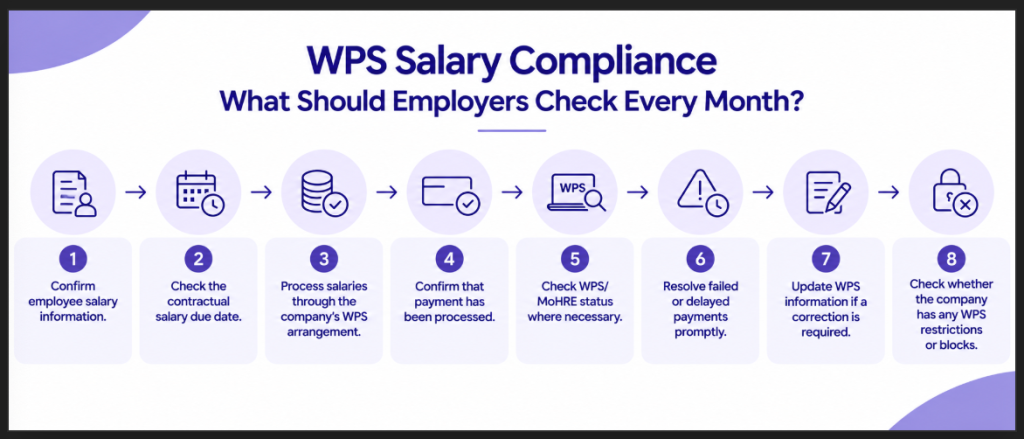
WPS Salary Compliance | What Should Employers Check Every Month?
Monthly WPS salary checklist
WPS Salary vs Minimum Wage in the UAE | What’s the Difference?
WPS salary and minimum wage are separate concepts.
| WPS salary | Minimum wage |
| Concerns the salary-payment process | Concerns the amount an employee is legally entitled to receive |
| Focuses on how wages are processed and monitored | Focuses on salary entitlement |
| Uses the applicable WPS mechanism | Is a separate employment requirement |
| Does not itself establish a universal UAE minimum wage | Relates to applicable salary requirements |
The UAE Government currently states that there is no minimum salary stipulated in the UAE Labour Law.
Therefore, employers should not confuse WPS compliance with minimum-wage compliance.
WPS answers the question of how the salary is paid and monitored. It does not, by itself, establish a universal minimum salary for employees in the UAE.
FAQs
What is WPS salary in the UAE?
WPS salary refers to employee wages being processed through the Wage Protection System using the applicable approved payment arrangement.
Is a salary card mandatory for WPS?
No, not necessarily. The permitted payment arrangement depends on the applicable WPS requirements and the terms of the approved payment channel.
Does an employee need a UAE bank account to receive WPS salary?
Not necessarily. The payment mechanism depends on the applicable WPS requirements and approved arrangement. Employers should not assume that one account type applies to every employee.
When should an employer pay WPS salary?
Salary should be paid according to the contractual due date and within the applicable WPS compliance period. MoHRE guidance generally refers to payment within the first 15 days after the due date unless a shorter period is specified in the employment contract.
What happens if salary is not paid by the 15th?
The company can face WPS restrictions if salary remains unpaid within the applicable period. The 15th should be understood in the context of the contractual due date and applicable WPS requirements.
What happens if a company is blocked on WPS?
The employer should resolve the salary or payment issue, update the relevant WPS information and check the company’s status after the correction is reflected.
Can an employer pay salary through a personal account?
A personal-account payment should not be treated as the company’s normal WPS payment method. If it occurs, the relevant WPS account or payment information may need to be updated.
How long does a WPS account update take?
For the personal-account situation, the practical guidance is that the update takes approximately 24 hours. This is not a universal guaranteed timeframe for every WPS update.
Does MoHRE automatically update salary information?
The updated WPS supports electronic integration between MoHRE systems and participating financial institutions, allowing salary-payment information to be handled electronically. Employers should still check and correct information when an issue occurs.
Is WPS the same as minimum wage?
No. WPS concerns the salary-payment and monitoring process, while minimum wage concerns the amount an employee is legally entitled to receive. WPS itself does not establish a universal UAE minimum wage.
Conclusion
WPS salary compliance in the UAE requires employers to manage salary details, payment timelines and the appropriate WPS arrangement together. By processing salaries correctly, monitoring payment status and resolving account or payment issues promptly, businesses can avoid unnecessary WPS restrictions and keep their monthly salary process running smoothly.
For businesses that need support with UAE salary processing and employment compliance, Arnifi can help coordinate the relevant WPS requirements and processes.
Official references
Top UAE Packages


Related Articles



Top UAE Packages
Get in Touch