
UAE Salary Check 2026: Growth Trends, High-Demand Roles & Key Skills

Zahira Shaik
SEO Content Writer
Zahira Shaik is an SEO Content Writer and Published Author specializing in research-based content. She excels at analyzing market trends, regulations, and industry developments… Read more

Tulika Saxena
AVP, Sales & Marketing | IIM Nagpur
Tulika Saxena specializes in business finance, sales strategy, and market positioning. Leads growth and partnerships, ensuring seamless business setup experiences and client success across… Read more



Key Fact: UAE Salary Check forecasts a 4.1% increase in salaries by 2026, with stronger growth anticipated in high-demand, specialized roles.
Table of contents
- Introduction
- Why You Need a UAE Salary Check?
- How Much Are Salaries Expected to Increase in the UAE in 2026?
- Sector & Role Salary Growth Matrix
- Which Roles Will Likely See the Highest Salary Growth?
- Which Roles Will See Moderate Salary Growth?
- How Are AI and Automation Redefining UAE Salaries?
- What Does AI Automation Mean for Junior Professionals?
- How Is GCC Competition Affecting UAE Employment Trends?
- What Should Jobseekers Consider Beyond Base Salary?
- Which Skills Can Increase Salary Potential in 2026?
- What Salary Thresholds Matter for UAE Long-Term Residency?
- How Does Salary Planning Affect UAE Payroll Setup?
- How Can Companies Prepare for UAE Salary Changes in 2026?
- Frequently Asked Questions
- Conclusion
- References
Introduction
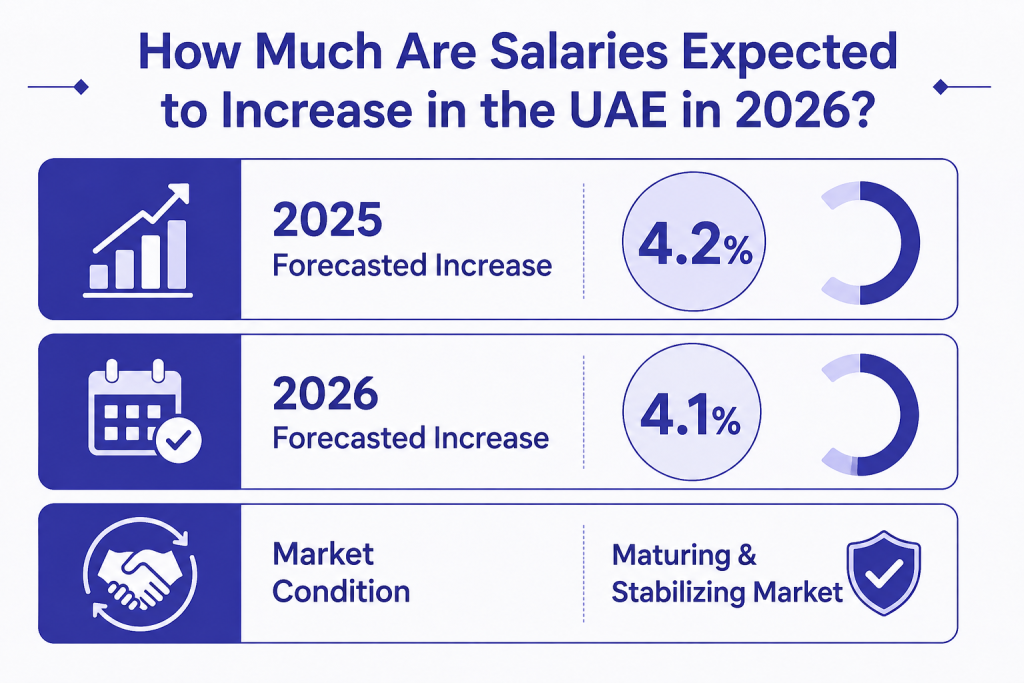
Instead of implementing across-the-board salary increases for all employees, businesses operating in Dubai, Abu Dhabi, and the Northern Emirates are focusing on targeted pay policies. Whereas salary increases in the UAE are expected to reach 4.1% in 2026, these increases will be mainly seen among skilled professionals working in high-impact industries.
This ultimate guide outlines the most significant trends influencing the structure of compensation in the UAE, the jobs and competencies that receive premium salaries, and important things to know about residence and payroll regulations.
Why Are Salaries Rising in Specific Roles in the UAE?
Growing business scale, digitalization, and implementation of advanced technology cause a shortage of candidates for certain niche positions. This supply and demand imbalance leads to premium salaries for those professionals who contribute to company growth and innovative progress.
Which Sectors Are Expected to Lead Salary Growth?
Salary increases are concentrated in sectors backed by major capital investments, national development plans, and digital initiatives. The primary drivers include:
- Banking & Financial Services
- Real Estate & Property Development
- Oil, Gas & Industrial Manufacturing
- Retail & Consumer Goods
How AI and Automation Are Changing Hiring?
More than 40% of businesses in the UAE plan to use artificial intelligence and automation in their day-to-day processes. This decreases the need for entry-level positions while increasing the pay of specialists who create, implement, and oversee these smart technologies.
What Employees and Jobseekers Should Focus on in the UAE?
To succeed in the 2026 job market, professionals will need to move away from general administrative skills. Instead, they must develop niche technical skills, seek out fast-growing industries, and consider total compensation packages as opposed to salaries.
Why You Need a UAE Salary Check?
The UAE Salary Check explains how the demand from employers for certain skill sets is directly impacting changes in the pay scales within the regional talent market.
Why UAE Salaries Are Changing?
- Business Expansion: Increase in domestic and international investments within Dubai and Abu Dhabi.
- Digital Transformation: Quick transformation of outdated systems in both public and private sectors.
- Technology Adoption: Enterprise-wide adoption of artificial intelligence, cloud computing, and cybersecurity technology.
- Talent Shortages: Lack of talent that is competent enough to work on the new technology systems.
- Rising Demand for Specialized Skills: Flight to quality where specialized skills are more valued than experience.
The Talent Imbalance
An imbalance in supply and demand for talent has made it difficult to fill certain specialized roles. To attract and retain talented people, organizations are changing their salary structures.
How Much Are Salaries Expected to Increase in the UAE in 2026?
Average Salary Increase
The projected average raise of 4.1% in 2026 signals an emerging mature labour market adapting to the effects of inflation.
Why Blanket Pay Hikes Are Declining
Broad raises are becoming increasingly unaffordable for firms. The strategy is changing from widespread raises to specific compensation packages geared towards motivating outstanding employees and nurturing future potential in the organization.
Who Is Most Likely to Receive Higher Increases?
- Highly Skilled Professionals: Individuals with unique skills in either technology or business.
- Difficult-to-Fill Roles: Jobs where there is a shortage of talent in the local labor market.
- Specialized Technical Positions: Engineers, AI professionals, quantitative financial analysts, and cyber risk managers.
Sector & Role Salary Growth Matrix
In order to comprehend how compensation is evolving in various segments of the UAE economy, the table below gives a comparative analysis between the anticipated salary growth rate, the factors that affect demand, and employee turnover for various industries.
| Industry Sector | Growth Projection Tier | Average Projected Increase | Top High-Demand Roles | Primary Growth Drivers | Turnover Risk Level |
| Technology & Digital | High | 6.5% – 9.0% | AI Engineers, Cybersecurity Specialists, Cloud Architects | Enterprise automation, cloud migration, national AI mandates | Very High |
| Banking & Financial Services | High | 5.5% – 8.0% | Fintech Leads, Quant Analysts, Risk & Compliance Managers | Capital inflows, wealth management expansion, regulatory oversight | High |
| Real Estate & Construction | High | 5.0% – 7.5% | Infrastructure Engineers, Project Directors, BIM Specialists | Mega-projects in Abu Dhabi/Dubai, high population inflow | High |
| Oil, Gas & Industrial | Moderate–High | 4.5% – 6.0% | Automation Engineers, Supply Chain Strategists, Process Engineers | Industrial diversification (Operation 300bn), sustainability upgrades | Moderate |
| Retail & Consumer Goods | Moderate | 3.5% – 5.0% | E-commerce Managers, Data Analytics Leads, Inventory Strategists | Population growth, shifting digital consumer habits | Moderate |
| Administrative & Support | Low–Moderate | 1.5% – 3.0% | General Coordinators, Office Managers, Administrative Assistants | Routine task automation, centralized shared services | Low |
Which Roles Will Likely See the Highest Salary Growth?
1. Engineering
- High-Demand Positions: Systems engineers, automation specialists, civil and structural design leads.
- Drivers: Expansion of smart infrastructure projects and major industrial developments across the Emirates.
2. Technology & Digital
- Data Professionals: Data engineers, data scientists, and business intelligence architects.
- Cybersecurity Experts: Information security managers, SOC analysts, and compliance specialists.
- Systems Engineers & AI Specialists: Enterprise cloud architects and machine learning engineers.
3. Logistics & Supply Chain
- Growing Demand: Supply chain strategists, trade compliance managers, and fleet optimization directors.
- Drivers: Expansion of regional distribution hubs and e-commerce growth across the GCC.
4. Finance & Accounting
- Quantitative Roles: Risk modeling experts, financial analysts, and quantitative traders.
- Specialized Positions: Corporate finance advisors, tax specialists, and fintech product leads.
- Risk & Compliance Functions: AML specialists, regulatory reporting managers, and internal auditors.
High Turnover Risk
Employee turnover is also high among high-demand jobs. Experience-rich professionals often change employers in search of higher salaries and quicker career advancement.
Which Roles Will See Moderate Salary Growth?
Administrative & Operational Roles
- General administrative personnel, office manager, operations support personnel, and customer service representative.
Entry-Level & Junior Roles
- General accountant, junior HR executive, entry-level marketing assistant, and general business coordinator.
Why Growth Is Slower
- Automation: Administrative procedures can be automated through artificial intelligence and software tools.
- Centralization: The centralized process will lead to fewer employees in back-office jobs.
- Employer Selectivity: Employers prefer people with technical skills as entry-level workers.
How Are AI and Automation Redefining UAE Salaries?
AI Integration
More than 40% of firms in the UAE are going to automate tasks, which will affect entry-level jobs, operational roles, and administrative roles.
Market Polarization
- Routine Roles: Reduced demand for jobs, causing no rise in salaries and possible consolidation of roles.
- High-Skilled Roles: Greater demand for individuals capable of managing AI architectures, leading to better salary growth.
What This Means for Employers
Companies need to regularly assess their staffing needs, work on upskilling employees, and change the salary structure.
What Does AI Automation Mean for Junior Professionals?
Hiring Challenges
- Longer Hiring Cycles: Employers perform deeper technical evaluations before extending offers.
- Lower Starting Salaries: Reduced entry-level starting compensation for purely administrative roles.
- Slower Promotion Paths: Traditional experience-based promotions are replaced by skill-based milestones.
Rising Employer Expectations
Junior candidates should be able to bring intermediate-level technical expertise, digital proficiency, and rudimentary project management abilities immediately out of the gate.
Junior Talent + AI Hiring Playbook
- Identify Automation Exposure: Identify repeatable tasks within the area of interest that could be automated.
- Prioritize Specialized Junior Skills: Identify a set of skills that are specific to data visualization, basic scripting, or administration of a specific software platform.
- Build Technical Capabilities: Take vendor certification exams in cloud software, digital marketing analytics, or enterprise systems.
- Target High-Demand Functions: Go for the functions that make money, comply with regulations, or engineer solutions.
How Is GCC Competition Affecting UAE Employment Trends?
The GCC Talent War
Regional economic strategies, most notably Saudi Arabia’s Vision 2030 initiatives, have intensified competition for experienced talent across the Gulf.
The Shift to Total Rewards
To remain competitive, UAE employers are expanding beyond base pay adjustments by offering comprehensive total rewards packages:
• Performance-linked variable bonuses
• Flexible and hybrid work arrangements
• Structured professional development and training budgets
• Internal mobility and cross-border career opportunities
• Enhanced health benefits and work-life balance initiatives
What Should Jobseekers Consider Beyond Base Salary?
- Specialization Is Key: Focus on building depth in high-value areas like engineering, data modeling, financial compliance, or cloud infrastructure.
- Generalist Slowdown: Transition generalist skill sets toward platform administration, operational analytics, or technical coordination.
- Choose the Right Sector: Target industries with active capital pipelines, such as financial services, real estate, manufacturing, or specialized retail.
- Evaluate the Whole Offer: Calculate the complete monetary and non-monetary value of performance bonuses, health coverage, flexible schedules, and professional development allowances.
Which Skills Can Increase Salary Potential in 2026?
- Cloud Computing: Enterprise cloud architecture (AWS, Azure), infrastructure management, and cloud migration design.
- AI & Machine Learning: Applied AI implementation, prompt engineering, dynamic modeling, and workflow automation.
- Data Analysis: Advanced SQL, Python, Power BI, and data-driven business modeling.
- Automation Tools: Robotic Process Automation (RPA) tools, low-code integration platforms, and workflow design.
- Cyber Risk Management: Information security auditing, threat detection, network architecture security, and risk mitigation.
- Advanced Project Management: Agile frameworks, cross-functional software deployment, and large-scale operational management.
What Salary Thresholds Matter for UAE Long-Term Residency?
Golden Visa Salary Requirements
For salaried employees applying under the “Skilled Professionals” route, specific compensation criteria apply:
| Criterion | Requirement Details |
| Minimum Basic Salary | AED 30,000 per month (Basic Pay only) |
| Allowances Included? | No (Housing, transport, and bonuses excluded) |
| Required Occupational Level | MOHRE Level 1 or Level 2 |
| Minimum Educational Level | Bachelor’s Degree (Attested with MOE Equivalency) |
| Visa Duration | 10-Year Renewable Residency |
Note: Only the guaranteed basic salary component listed in the official employment contract counts toward the AED 30,000 monthly threshold; allowances and bonuses are excluded.
Salary vs. Residency Planning
Compensation planning for people interested in residency must take care of the fact that their basic salary satisfies the eligibility criteria, rather than taking a low basic salary with generous allowances.
How Does Salary Planning Affect UAE Payroll Setup?
WPS Salary Payment Requirements
According to the Wages Protection System (WPS) set up by the Ministry of Human Resources & Emiratization (MOHRE) and the Central Bank of the UAE, any employer in the private sector is required to make salary payments of its employees electronically through designated channels within a certain deadline. Failure to do so may result in fines and restrictions on the labor permit.
Mainland vs. Free Zone Payroll
Whereas companies operating in the mainland UAE and registered with MOHRE abide by the WPS strictly, companies operating in free zones have their own guidelines to be followed. However, most of the prominent free zones have developed a payroll monitoring system along the lines of the WPS system.
Startup Cash-Flow Planning
Emerging firms need to coordinate their employee budgeting with tight salary disbursement timelines to avoid any hiccups in operations or fines due to non-compliance.
How Can Companies Prepare for UAE Salary Changes in 2026?
- Targeted Compensation: Reallocation of wage budgets to provide competitive compensation for hard-to-fill roles.
- Retention Strategy: Competitive base salaries plus performance incentives, career advancement opportunities, and work flexibility.
- Workforce Planning: Evaluate internal jobs for automation risks, skill up the current employees, and recruit strategically in technical fields.
Frequently Asked Questions
What is the average salary increase in the UAE in 2026?
An average salary increase of 4.1% is predicted for 2026 in the UAE due to market stability.
Which jobs will have the highest salary growth in the UAE?
The professions of technology (cybersecurity, AI, data science), engineering, logistics, and specializations in the financial sector will be among those with the largest salary increases.
Which industries are expected to increase salaries the most?
The largest salary increases will be in Banking & Financial Services, Real Estate & Property Development, Oil, Gas & Industrial Manufacturing, and Retail & Consumer Goods industries.
Are UAE salaries increasing in 2026?
Yes, but only for certain positions. Salaries of high-demand tech and specialty roles are growing rapidly, but routine admin salaries are rising slowly.
Which skills are most valuable for salary growth in the UAE?
Specialization in cloud architecture, AI/ML implementation, data analytics, automation of process engineering, cyber risk management, and enterprise project management.
How is AI affecting UAE salaries?
Due to AI, many routine back-office functions are automated. This results in slow wage growth for admin roles while the market demand for specialists is growing.
Are entry-level salaries increasing in the UAE?
There are no substantial increases in entry-level salaries. Companies are focusing on hiring entry-level applicants who have unique digital capabilities and technical skills.
Which UAE jobs are most in demand in 2026?
Data engineers, cyber risk experts, artificial intelligence developers, fintech managers, supply chain leaders, and smart infrastructure engineers.
What is the UAE Salary Check?
A benchmark analysis that monitors how market demands, economic changes, and skills gaps impact salary structures in the UAE.
Why are specialized roles receiving higher salary increases?
Due to candidate shortages in specialized technical roles, companies have to pay attractive salaries to attract candidates and keep them in the job.
What are the UAE Golden Visa salary requirements?
A salaried worker must earn a minimum monthly salary of AED 30,000, belong to MOHRE Occupational Level 1 or 2, and have an attested bachelor’s degree.
How does WPS affect UAE salary payments?
The Wage Protection System (WPS) requires the company to make salary payments using authorized banks or financial institutions.
Is salary growth higher in Dubai or Abu Dhabi?
Growth in salaries occurs in both emirates, due to the development of real estate, tourism, and the financial sector in Dubai, as well as the construction of infrastructure, the energy sector, and industries in Abu Dhabi.
What should employees consider besides base salary?
Employees should consider total rewards, which include performance bonuses, quality of medical insurance, allowances for professional development, hybrid work arrangements, and career advancement.
Conclusion
The salary market in the UAE in 2026 will be characterized by precision and proper distribution. Despite average salaries increasing steadily at 4.1%, the increase in true compensation is available for specialists in technologies, engineering, logistics, and finance. In connection with the increasing role of AI in operational positions and the rising competition, candidates and employers must consider specialized skills and total rewards strategy, respectively.
References
- Ministry of Human Resources and Emiratisation (MOHRE)
Website: https://www.mohre.gov.ae - Federal Authority for Identity, Citizenship, Customs and Port Security (ICP)
Website: https://icp.gov.ae - Central Bank of the UAE (CBUAE)
Website: https://www.centralbank.ae - General Directorate of Residency and Foreigners Affairs (GDRFA – Dubai)
Website: https://gdrfad.gov.ae
Top UAE Packages
Related Articles

Top UAE Packages
Get in Touch
