
National Industrial Development and Logistics Program (NIDLP) and Its Role in Powering Startup Creation in Saudi Arabia
by Rifa S Laskar Feb 27, 2026  7 MIN READ


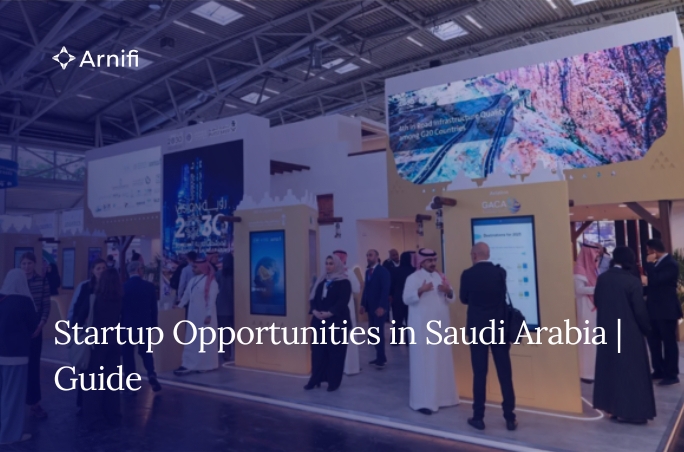
Most founders exploring startup opportunities in Saudi Arabia focus on fintech or consumer tech. Meanwhile, billions are being deployed into industry, mining, logistics & energy. The National Industrial Development and Logistics Program is quietly reshaping where the real long-term contracts sit. Ignoring it means competing in crowded markets while industrial demand expands elsewhere.
Table of contents
- 1. Introduction
- 2. What Is the National Industrial Development and Logistics Program (NIDLP)?
- 3. How NIDLP Creates Pathways for Startup Participation?
- 4. Industrial Innovation Opportunities for Startups
- 5. Logistics Innovation Opportunities Under NIDLP
- 6. Mining and Energy Startup Opportunities
- 7. P2P Sandbox for Emerging Digital Technologies
- 8. Daleel Platform and Market Intelligence Access
- 9. How NIDLP Strengthens the Saudi Startup Ecosystem
- 10. Who Is Eligible for NIDLP Startup Support
- 11. How Arnifi Supports Industrial and Logistics Startups
- 12. FAQs
- 13. Conclusion
1. Introduction
Here is the common problem that a founder sets up a business in KSA, builds a solid tech product, raises early capital & then struggles to secure predictable revenue.
At the same time, industrial zones are expanding, ports are being upgraded, mining exploration is accelerating & energy diversification is underway. Yet many founders never look there.
Startup opportunities in Saudi Arabia are not limited to consumer apps. Industrialisation is a pillar of Saudi Vision 2030. Logistics is treated as national infrastructure also, heavy sectors are being opened to private innovation.
The gap is very clear & startup supply is clustering in visible sectors. Demand is expanding in industrial ones. Founders who are evaluating startup opportunities in Saudi Arabia should reassess where long-term contracts and stable institutional buyers exist.
This is where NIDLP becomes relevant.
2. What Is the National Industrial Development and Logistics Program (NIDLP)?
The National Industrial Development and Logistics Program is one of the 13 Vision Realisation Programs under Vision 2030. Its major plan is straightforward, to transform Saudi Arabia into a leading industrial powerhouse and position it as a global logistics hub.
It’ll integrate industry, mining, energy & logistics all under one national framework.
When discussing startup opportunities in Saudi Arabia, this program matters because it coordinates regulation, infrastructure investment & sector expansion. Industrial cities, transport corridors & export capacity are expanding in parallel.
For founders that are seeking to that means predictable sector growth rather than isolated policy announcements.
3. How NIDLP Creates Pathways for Startup Participation?
Industrial markets are complex as entry barriers are high & procurement cycles are long. That alone keeps many startups away.
NIDLP addresses this through structured participation models.
There are direct startup-facing initiatives. There are public-private collaboration programs where emerging companies test solutions with established industrial players. There is growing emphasis on technology-driven industrial solutions.
Startup opportunities in Saudi Arabia under NIDLP are not accidental side effects. They are built into sector transformation plans. The state recognises that innovation cannot come solely from legacy corporations.
That shift changes the risk calculation for founders.
4. Industrial Innovation Opportunities for Startups
Industrial startups in Saudi Arabia are gaining traction in areas that once seemed inaccessible.
Advanced manufacturing is expanding. Local production capacity is increasing across automotive, aerospace components, and heavy machinery.
Smart factories are being deployed with digital monitoring systems and predictive maintenance layers.
Industrial automation demand is rising. Robotics, machine learning-based quality control & process optimisation tools are increasingly relevant.
Materials and chemicals innovation also presents space for growth, particularly where efficiency improvements integrate with existing petrochemical infrastructure.
These are not experimental niches. They are aligned with national production goals. Startup opportunities in Saudi Arabia in this segment tend to be contract-based and long term.
5. Logistics Innovation Opportunities Under NIDLP
Logistics startups in Saudi Arabia often underestimate the scale of transformation underway.
Saudi Arabia is positioning itself as a logistics hub connecting major global trade routes. Ports, inland dry ports, and freight corridors are being modernised.
The Logistics Innovation Studio supports solution development in:
- Supply chain visibility platforms
- Warehouse automation
- Fleet management systems
- Port technology
Each of these areas creates procurement demand. Institutional clients require digitisation. Manual processes are being replaced.
Startup opportunities in Saudi Arabia in logistics are practical and revenue-driven. They are tied to infrastructure expansion rather than short-term trends.
6. Mining and Energy Startup Opportunities
Mining startups in Saudi Arabia are emerging as exploration intensifies. Geological mapping, extraction efficiency, and environmental compliance monitoring create room for digital and operational tools.
Energy startups in Saudi Arabia also benefit from diversification efforts. Clean energy technologies, grid optimisation systems, and storage solutions are increasingly relevant.
Future Minerals Pioneers initiatives and innovation competitions encourage participation from emerging firms.
Founders often assume these sectors are reserved for large conglomerates. In reality, technology layers within these industries are open to agile operators. That expands startup opportunities into resource-based sectors.
7. P2P Sandbox for Emerging Digital Technologies
One consistent founder concern is regulatory uncertainty. Testing industrial technology in live environments can be risky.
The P2P Sandbox offers a controlled testing framework. Solutions can be prototyped, validated, and adjusted before commercial scaling.
This shortens validation cycles and reduces compliance friction. For startups building industrial tools, this structure lowers operational risk.
Startup opportunities have become more realistic when testing is supported rather than restricted.
8. Daleel Platform and Market Intelligence Access
Market opacity often blocks expansion & founders need clarity on where demand sits.
The Daleel platform provides AI-enabled guidance and sector mapping across multiple languages. It aggregates opportunity data across industry, mining, energy & logistics.
Access to structured market intelligence strengthens decision-making. Startup opportunities have become measurable rather than speculative.
9. How NIDLP Strengthens the Saudi Startup Ecosystem
The Saudi startup ecosystem is evolving beyond early digital models.
NIDLP reduces time-to-market through structured pilots. It encourages relocation of innovative startups into the Kingdom. It aligns capital with national priorities rather than short-lived hype cycles.
This deepens the ecosystem. Industrial participation introduces longer contract cycles and infrastructure-backed growth.
Startup opportunities under this model are less dependent on consumer trends and more tied to national economic direction.
10. Who Is Eligible for NIDLP Startup Support
Eligibility focuses on companies operating in:
- Industry
- Mining
- Energy
- Logistics
Startups aiming to relocate and contribute to local innovation are also considered. The emphasis is on sector alignment rather than company size.
Founders evaluating startup opportunities should assess whether their solutions intersect with industrial transformation goals.
11. How Arnifi Supports Industrial and Logistics Startups
Industrial business setup in Saudi Arabia is not as simple as registering a standard tech entity. As licensing varies by sector & compliance obligations differ across mining, energy & logistics.
Arnifi supports founders with:
- Company formation and sector licensing
- Regulatory structuring aligned with industrial frameworks
- Ongoing compliance management
Startup opportunities can stall if licensing is misaligned or documentation is incomplete. Structured setup reduces those risks and shortens entry timelines.
For founders entering heavy sectors, regulatory precision is not optional.
12. FAQs
What is the National Industrial Development and Logistics Program?
It is a Vision 2030 realisation program designed to transform Saudi Arabia into a leading industrial and logistics hub.
Does NIDLP support startups or only large companies?
It supports both. Structured initiatives allow startups to test and scale industrial solutions.
Which sectors qualify for NIDLP programs?
Industry, mining, energy & logistics.
Is Saudi Arabia good for industrial startups?
Yes. Infrastructure investment, regulatory reform & sector-focused programs create stable startup opportunities within heavy industries.
13. Conclusion
The conversations around the startup opportunities often centres on visible sectors. Meanwhile, industrial, mining, logistics & energy reforms are accelerating in the background.
NIDLP anchors that transformation & it creates structured access to infrastructure-backed demand. It lowers entry barriers through collaboration and testing frameworks.
For founders who are thinking long term, startup opportunities extend far beyond consumer-facing models. Industrial participation offers stability, scale & alignment with national priorities.
With proper regulatory structuring through Arnifi, entry into these sectors becomes organised rather than uncertain. Industrial growth is expanding & the strategic question is whether to compete in crowded markets or participate where infrastructure and policy are already aligned.
Top UAE Packages


Related Articles

Top UAE Packages
Get in Touch