
SMEs Registration in UAE 2026 | Eligibility, Process, Benefits & Requirements

Anushka
Content Writer
Anushka Basu is a business content writer specialised in global business market insights. She aims to simplify complex regulatory, financial, and business concepts into… Read more

Tulika Saxena
AVP, Sales & Marketing | IIM Nagpur
Tulika Saxena specializes in business finance, sales strategy, and market positioning. Leads growth and partnerships, ensuring seamless business setup experiences and client success across… Read more



Key Fact: SME registration in UAE can be completed through mainland or free-zone licensing authorities, depending on the business activity, legal structure and intended operations. Registration is only the first step; businesses may also need tax registration, visas, premises and ongoing compliance.
Table of contents
- What is an SME in the UAE?
- Who can register an SME in the UAE?
- Where can you register an SME in the UAE?
- What business licence does an SME need?
- What is the SME registration in UAE process?
- What documents are required for SME registration?
- How much does SME registration in UAE cost?
- How long does SME registration take?
- What happens after SME registration in UAE?
- What tax and compliance requirements apply to UAE SMEs?
- What are the common mistakes in SME registration?
- How can Arnifi help?
- FAQs
- Conclusion
What is an SME in the UAE?
An SME is a small or medium-sized business, but there is no single classification that determines every aspect of SME registration in UAE. Classification can vary depending on the government programme, sector and criteria being applied.
The UAE Government supports SMEs through dedicated programmes and services, while business registration itself is handled through the relevant mainland or free-zone licensing authority.
It is therefore important to distinguish between being classified as an SME and obtaining a legal business licence. An SME still needs to complete the applicable licensing and registration requirements for its chosen activity and jurisdiction.
Who can register an SME in the UAE?
UAE nationals, foreign investors and entrepreneurs can establish businesses in the UAE, subject to the requirements applicable to the selected activity and licensing authority.
Depending on the legal structure, an applicant may establish a business as:
- An individual entrepreneur
- A company with individual shareholders
- A company with corporate shareholders
- A partnership or other permitted legal form
- A foreign-owned business
Foreign ownership rules depend on the activity and jurisdiction. The appropriate authority should therefore be checked before submitting an application.
Where can you register an SME in the UAE?
The main options are mainland and free zones, and the appropriate route depends on how the business intends to operate.
Mainland
A mainland business is licensed by the relevant emirate’s economic authority. This route can suit businesses that need to operate directly in the local UAE market.
Requirements can vary by emirate and activity, including premises, external approvals and professional qualifications where applicable.
Free zones
Free zones provide their own licensing frameworks and can be suitable for businesses whose activities and operating models align with the relevant free-zone ecosystem.
Licence activities, office requirements, visa arrangements and permitted business operations vary between free zones.
The UAE Government maintains separate guidance for establishing businesses on the mainland and in free zones.
Choosing the jurisdiction based only on the advertised licence price can create problems later if the selected authority does not support the required activity or operating model.
What business licence does an SME need?
The licence should correspond to the business activity being carried out.
Common categories include:
| Licence type | Typical use |
| Commercial | Trading and commercial activities |
| Professional | Professional and service-based activities |
| Industrial | Manufacturing and industrial activities |
| Specialised | Activities requiring specific regulatory approval |
Some businesses may need additional approvals from federal or local authorities before the licence can be issued.
Selecting the correct activity is particularly important because it can affect the company’s banking arrangements, visas, premises, contracts and ability to conduct its intended operations.
What is the SME registration in UAE process?
The exact procedure varies between authorities, but a typical SME registration in UAE process involves:
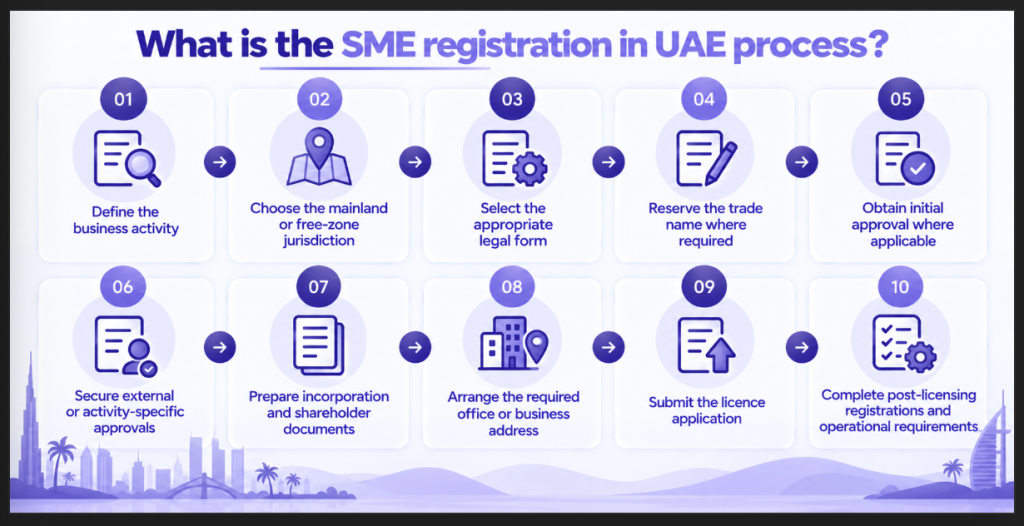
The sequence can change depending on the emirate, activity, legal structure and licensing authority.
What documents are required for SME registration?
The documentation required for SME registration in UAE depends on the proposed business and licensing authority.
Common documents may include:
- Passport or identity documents of shareholders
- Emirates ID and UAE residency documents where applicable
- Trade-name information
- Application forms
- Memorandum or other constitutional documents
- Corporate documents for corporate shareholders
- Lease or office documentation where required
- Business plan or additional information for certain activities
- External approvals for regulated activities
The licensing authority may request additional documents depending on the business activity and legal form.
How much does SME registration in UAE cost?
There is no single UAE-wide cost for SME registration in UAE.
The total amount can depend on:
- Emirate and jurisdiction
- Business activity
- Legal structure
- Licence type
- Trade-name and application charges
- Office or workspace requirements
- External approvals
- Establishment and immigration charges
- Number of visas
- Annual renewal fees
Accounting, tax, banking and compliance expenses should also be considered when estimating the total cost of establishing and maintaining the business.
A low initial licence fee does not necessarily represent the lowest overall operating cost.
How long does SME registration take?
The time required for SME registration in UAE varies according to the activity, jurisdiction, documentation and approval requirements.
Straightforward activities with complete documentation may be processed faster than regulated or specialised activities requiring additional approvals.
The UAE also provides digital registration through Basher. The official UAE Government platform states that eligible businesses can use Basher to register a business online, with the service connecting relevant federal and local government entities.
However, online licence issuance does not necessarily mean that every post-registration requirement is completed at the same time.
What happens after SME registration in UAE?
Obtaining the licence is only the beginning of the business setup process.
After SME registration in UAE, a company may need to:
- Open a corporate bank account
- Establish immigration and establishment files where applicable
- Apply for investor or employee visas
- Complete tax registrations
- Set up accounting and bookkeeping systems
- Obtain sector-specific registrations
- Maintain corporate and licence records
- Renew licences and related registrations on time
The post-licensing requirements depend on the company’s structure, activities and number of employees.
What tax and compliance requirements apply to UAE SMEs?
SME registration in UAE does not automatically complete a company’s tax obligations.
Businesses should review their Corporate Tax position separately. The Federal Tax Authority states that taxable persons are required to register for UAE Corporate Tax, subject to the applicable rules. For natural persons conducting a business, Corporate Tax registration applies where business revenue exceeds AED 1 million in a calendar year.
VAT is also separate. UAE-resident businesses generally must register for VAT when taxable supplies and imports exceed AED 375,000 over the preceding 12 months or are expected to exceed that amount in the following 30 days. Voluntary registration is available from AED 187,500, subject to the applicable conditions.
Businesses should also consider:
- Accounting and bookkeeping
- Corporate Tax returns
- VAT returns where registered
- Beneficial-owner information requirements
- AML/CFT obligations where applicable
- Invoicing and financial records
- Licence and corporate record maintenance
What are the common mistakes in SME registration?
Several issues can make SME registration in UAE more complicated than necessary:
- Choosing an activity that does not match the actual business model
- Selecting a jurisdiction based only on setup cost
- Ignoring activity-specific approvals
- Underestimating office or premises requirements
- Failing to plan visas and establishment registrations
- Assuming all free zones offer the same activities
- Delaying Corporate Tax or VAT compliance
- Failing to maintain accounting and corporate records
- Treating the business licence as the end of the setup process
A business should assess its intended activities and operating requirements before selecting the licensing authority.
How can Arnifi help?
Arnifi can support entrepreneurs through SME registration in UAE and the wider business setup process, including:
- Identifying suitable jurisdictions and activities
- Supporting incorporation and licence applications
- Coordinating documentation and government procedures
- Assisting with relevant external approvals
- Supporting visa and establishment-related processes
- Providing accounting and tax support
- Assisting with ongoing corporate and compliance requirements
The appropriate setup depends on the business activity, ownership structure, jurisdiction and operational plans.
FAQs
How can I register an SME in the UAE?
Choose the activity, jurisdiction and legal form, then complete the licensing authority’s application and required approvals.
Who can register an SME in the UAE?
UAE nationals and foreign investors can establish businesses subject to applicable ownership, activity and licensing requirements.
What documents are required for SME registration?
Common documents include identity documents, trade-name information, incorporation documents and premises or approval documents where applicable.
How much does it cost to register an SME in the UAE?
Costs vary according to the emirate, jurisdiction, activity, licence, premises, visas and additional government requirements.
How long does SME registration take?
Simple applications can be processed quickly, while regulated activities and additional approvals can require more time.
Is mainland or free-zone registration better for an SME?
The appropriate option depends on the business activity, target market, premises requirements, ownership structure and intended operations.
Can a foreigner register an SME in the UAE?
Yes, foreign investors can establish businesses in the UAE subject to the applicable activity and jurisdiction requirements.
Does an SME need a business licence in the UAE?
Yes. Businesses generally need the appropriate licence or registration to legally conduct their approved activities.
Does a UAE SME need to register for Corporate Tax?
Tax registration depends on whether the business is a taxable person and the applicable Corporate Tax rules.
Conclusion
SME registration in UAE starts with selecting the right business activity, legal structure and jurisdiction. Mainland and free-zone businesses follow different licensing processes, while documentation and approval requirements vary by activity. Registration is also only the starting point: businesses must address tax, accounting, immigration and ongoing compliance obligations to operate effectively.
Official references
Top UAE Packages
Related Articles


Top UAE Packages
Get in Touch
