
Complete Guide to Mauritius Trusts in 2026: Structuring, Governance, and Compliance

Zahira Shaik
SEO Content Writer
Zahira Shaik is an SEO Content Writer and Published Author specializing in research-based content. She excels at analyzing market trends, regulations, and industry developments… Read more

Tulika Saxena
AVP, Sales & Marketing | IIM Nagpur
Tulika Saxena specializes in business finance, sales strategy, and market positioning. Leads growth and partnerships, ensuring seamless business setup experiences and client success across… Read more


Key Fact: The Mauritian trusts law is found in the Trusts Act 2001. There have been changes to regulations in 2026 that will necessitate the disclosure of beneficial ownership information and change the VAT treatment for management services of qualifying trusts from being zero-rated to being exempt.
Table of contents
- Introduction
- What Is a Trust in Mauritius?
- Main Types of Trusts in Mauritius
- Asset Protection and Statutory Firewall Rules
- Trustee Governance, Licensing, and 2026 Compliance Updates
- Key Regulatory & Tax Changes in 2026
- What Founders Must Consider Before Establishment
- Cross-Border Structuring: Middle East, Africa, and Asia
- Practical Tools for Trust Structuring
- How Arnifi Supports Mauritius Trust Structuring
- Mauritius Trust Setup: Key Considerations at a Glance
- Frequently Asked Questions
- Conclusion
- References
Introduction
For years, Mauritius has been one of the leading International Financial Centres (IFCs) connecting Asia, Africa, Europe, and the Middle East. Wealthy families, international investors, and entrepreneurs make use of trusts in Mauritius in order to get protection for assets, ensure continuity, and plan for succession across jurisdictions.
This is unlike common guides that only look at simple trusts; the current guide will delve into the realities faced by entrepreneurs in 2026.
What Is a Trust in Mauritius?
Meaning of a Mauritius Trust
Under the Trusts Act 2001, a trust is an agreement whereby one individual (settlor) appoints someone else (trustee) as a custodian of their property with the aim of providing it for the benefit of other people (beneficiaries).
The most important thing about a trust is that a trust itself is not a legal entity; rather, it is a legal dissociation between legal ownership (which belongs to a trustee) and beneficial ownership (which belongs to beneficiaries).
- Settlor: The person or entity that creates the trust and places property within the trust.
- Trustee: A licensed person or individual who has legal title and manages the property within the trust in accordance with the trust deed.
- Beneficiaries: Individuals or classes of individuals who are the beneficiaries of the trust assets or income.
- Trust Deed: The governing document that defines the powers, distribution schemes, and terms of management.
Who Uses Mauritius Trusts?
- Global Families: Controlling inheritance in other jurisdictions.
- Business Founders: Securing their personal wealth against business debts.
- International Investors: Collecting funds in offshore international structures.
- Family Offices: Consolidation of estate planning, charitable endeavors, and foreign investment.
Why Choose Mauritius?
- International Financial Centre: Well-established system of law, combining the common and civil law systems.
- Regional Strategic Hub: Perfect position to hold assets in Africa, the Middle East, and Asia.
- Robust Governance: Stringent regulatory regime supervised by the Financial Services Commission (FSC).
Main Types of Trusts in Mauritius
1. Discretionary Trusts
In a discretionary trust, no beneficiary has an automatic right to the trust’s income or capital. A discretionary trust is where the beneficiaries do not have an automatic entitlement to the income or capital of the trust; instead, the trustee has the discretion on how, when, and to whom the distribution shall be made.
- Settlor Influence: The settlors can give non-binding advice through a letter of wishes. Reserved powers of the settlors that are limited (power to revoke/ amend the trust, removal of trustees) can be used without making the trust void according to section 47 of the Trusts Act 2001.
- Core Uses: Wealth transfer among generations, protecting vulnerable beneficiaries, flexible wealth distribution, and holding company shares.
2. Purpose Trusts
Purpose trusts do not have any beneficiaries but are rather set up to achieve certain specific purposes and goals.
- Charitable & Non-Charitable Purposes: The trust can be set up for various purposes, including philanthropic, environmental, or company structuring.
- Corporate & Family Office Utility: It is commonly used to hold the shares of Private Trust Companies (PTCs) or separate corporate ownership from operational management.
Asset Protection and Statutory Firewall Rules
There are robust statutory firewall provisions in the Trusts Act 2001 in Mauritius that help secure trust assets from foreign attacks on trust assets.
- Statutory Firewall Provisions: Foreign judgments or heirship rights (for instance, foreign forced-heirship principles) will not be recognized or enforced by Mauritian courts if they conflict with the trust in Mauritius.
- Asset Separation: The trust asset will remain separate from the personal estate of the settlor and the trustee and will therefore be free from personal bankruptcy.
Important Legal Limitations: There are important legal restrictions on asset protection, including asset protection where there is no genuine arrangement, fraud, and a scheme set up for fraudulent purposes.
Trustee Governance, Licensing, and 2026 Compliance Updates
Role of Trustees Under Mauritian Law
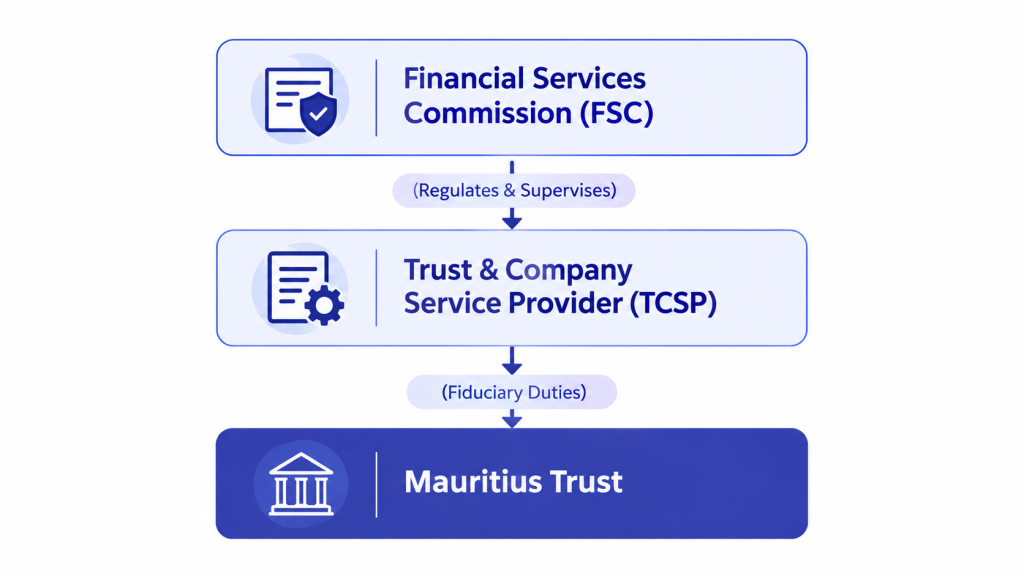
The trustees have very high fiduciary responsibilities. Some of their main responsibilities include the management of the trust assets, managing investments, record-keeping, reporting, and working in the best interests of the beneficiaries.
- Individual vs. Corporate Trustees: Individuals can act as trustees; however, corporate trustees are used in commercial or international cases through licensed Management Companies or TCSPs.
- FSC Licensing: Professional trustees dealing in or from Mauritius are licensed and regulated by the Financial Services Commission (FSC) as per the Financial Services Act 2007.
Enhanced Beneficial-Ownership Disclosure (2026 Update)
Under current regulatory requirements:
- Trustees must maintain accurate, up-to-date Beneficial Ownership (BO) registries.
- BO details are to be provided when valid requests are received from reporting entities and regulatory bodies.
- The regulations regarding AML/CFT compliance are strictly followed so as to ensure complete international transparency.
Key Regulatory & Tax Changes in 2026
1. Beneficial-Ownership Reporting
There have been significant enhancements in compliance frameworks. It is imperative that trustees continuously monitor the ultimate beneficial owner (UBO), the settlor, protector, and beneficiaries in order to comply smoothly with international reporting requirements.
2. VAT Treatment of Qualifying Trust Management Services
One of the important practical changes pertains to Value Added Tax (VAT):
- Management and administration services provided to qualifying trusts (settlor as well as the majority of the beneficiaries are non-residents) have changed from zero-rated VAT to exempt VAT.
- Practical Implication: The fiduciary service providers will not be able to reclaim input VAT for the provision of exempt services and therefore will need to reconsider the existing administration fee arrangements.
What Founders Must Consider Before Establishment
- Define Succession Objectives: Clarify whether the objective is family estate planning, philanthropic asset dedication, or business succession.
- Assess Cross-Border Tax Residency: Settlors and beneficiaries of a Mauritius trust may not be automatically protected from any taxes owed in their countries of residence. Professional cross-border tax planning is necessary.
- Select an Independent Trustee: Choose corporate trustees who are licensed, reputable, stable, and have solid compliance infrastructure.
- Evaluate Asset Types: Make sure that the trust deed specifies clear administrative powers depending on asset classes (e.g., real estate, liquid investments, private equity, operating company shares).
- Build Deed Flexibility: Include provisions for trust deed modification, appointment of trustees, and flexibility to deal with future legislation and taxes.
Cross-Border Structuring: Middle East, Africa, and Asia
For international founders and global families operating across emerging markets, a Mauritius trust acts as a centralized master holding mechanism.
Such a structure makes intergenerational inheritance simpler, unifies corporate governance among the entities, and prevents fragmentation of the family’s assets within different jurisdictions.
Practical Tools for Trust Structuring
To make the process of designing and managing complicated offshore structures easier, today’s entrepreneurs use automated setup processes:
- Arni Organogram: Make a visual representation of the corporate structure, ownership, and the roles of trustees and protectors before drawing up the legal paperwork.
- Arni AML Checker: Perform proactive compliance checks to ease the process of onboarding and to ensure the correctness of paperwork.
- Arni Cost Calculator: Estimate the costs of the initial setup, filings, and future annual fees (taking into account new VAT regulations).
- Arni Docs: Centralize all documents that are crucial for structuring the trust.
How Arnifi Supports Mauritius Trust Structuring
Arnifi helps start-up teams, family offices, and lawyers in assessing the appropriate structure for their international holdings and estate planning needs by providing end-to-end assistance in:
- Structural Planning: Advice on coordinating business structure, discretionary trusts, and investment holding structures.
- Legal & Compliance Coordination: Assistance in working with licensed Mauritian Management companies and lawyers to comply with FSC and AML regulations.
- Business Setup Assistance: Help in setting up business internationally, documentation, and structure.
Mauritius Trust Setup: Key Considerations at a Glance
| Consideration | What to Assess |
| Trust Type | Discretionary vs. Purpose Trust based on distribution goals |
| Trustee Selection | Individual vs. Licensed Corporate Trustee (TCSP) |
| Succession Goals | Multi-generational asset continuity and inheritance rules |
| Tax Residency | Tax exposures for Settlor, Beneficiaries, and Asset locations |
| Asset Suitability | Real estate, shares, operating businesses, liquid funds |
| Governance | Reserved powers, Protector roles, and Trustee independence |
| Compliance | FSC regulations, AML/CFT rules, and Beneficial Ownership tracking |
| VAT Impact | 2026 transition of qualifying trust management services to exempt status |
| Documentation | Robust drafting of Trust Deed, Letter of Wishes, and disclosures |
| Ongoing Costs | Annual trustee fees, compliance filings, and audit expenses |
Frequently Asked Questions
What is a trust setup in Mauritius?
Setting up a trust structure in Mauritius entails creating a fiduciary relationship through the Trusts Act 2001, where the settlor transfers his asset ownership to a trustee for management on behalf of the beneficiaries or a specific objective.
How do I set up a trust in Mauritius?
A trust can be created by drafting a trust deed, transferring property to a trustee (who is usually a licensed Mauritius Management Company), specifying beneficiaries or objectives, and adhering to FSC registration and beneficial ownership registration requirements.
What types of trusts are available in Mauritius?
Mauritius has Discretionary Trusts, Purpose Trusts, Fixed Interest Trusts, Charitable Trusts, Protective Trusts, and Private Trust Companies (PTCs).
What is a discretionary trust in Mauritius?
A discretionary trust is one where there is total discretion on the part of the trustee concerning the distribution of either capital or income to specified beneficiaries of the trust.
How does a purpose trust work in Mauritius?
A purpose trust is one formed for a definite purpose which could be charitable or otherwise, and not for the benefit of specific individuals. This kind of trust needs an enforcer to ensure compliance of the trustee with the objective.
Does Mauritius require a licensed trustee?
Yes, if professional services of the trust are offered commercially from Mauritius, the trustee should be a licensed trustee with a valid license from the Financial Services Commission (FSC).
Are Mauritius trusts protected from foreign judgments?
Yes. Mauritius provides statutory firewall protections through the Trusts Act 2001 of trusts from any foreign forced heirship claims or foreign judgments that may not have been recognized if the trust arrangement was not a sham or fraudulent transfer.
What are the beneficial-ownership requirements for Mauritius trusts?
Trustees should keep up-to-date records of ultimate beneficial owners, settlors, protectors, and beneficiaries, and should disclose such information to the appropriate authorities at the request of the latter.
How does VAT apply to Mauritius trust management services?
Qualifying trust management services that are performed for non-resident structures are VAT-exempt (previously zero-rated), impacting the input VAT recoverability of service providers.
Can foreigners establish a trust in Mauritius?
Yes, non-residents can be settlors or beneficiaries of a Mauritian trust.
Can a Mauritius trust be used for succession planning?
Yes, this instrument is considered one of the most efficient means of managing inheritance within different jurisdictions, without probate process delays and the application of local forced heirship laws.
Can a Mauritius trust hold company shares?
Yes, a Mauritian trust can contain shares of local companies, GBL companies, or foreign companies performing their activities.
How does a Mauritius trust protect family wealth?
Transferring the ownership of trust assets to the trustee makes trust assets protected from personal bankruptcy, liability claims, and uncertain local jurisdiction.
What documents are required to establish a Mauritius trust?
The key documents are the Trust Deed, KYC (Know Your Client) documents of the Settlor and Beneficiary (identity and address), Source of Wealth documentation, and Letter of Wishes.
How much does it cost to set up a trust in Mauritius?
Depends on structural complexity, trustee choice, asset types, and filing requirements. Also, it’s recommended to consider administrative VAT additions.
How long does it take to establish a Mauritius trust?
The timeframe for establishment is 2 to 4 weeks, depending on completion of full KYC and AML, and signing of the trust deed.
Can a Mauritius trust be used for a family office structure?
Yes, it can be. Mauritius purpose trusts or discretionary trusts are often used together with Private Trust Companies (PTCs) for single/multi-family offices.
What are the ongoing compliance requirements for a Mauritius trust?
Compliance procedures include keeping accurate financial statements, maintaining a beneficial owners registry, fulfilling AML requirements, and making annual payments.
Conclusion
Setting up a trust in Mauritius presents significant benefits for international families and entrepreneurs when it comes to protecting their assets, international continuity, and governance. Nevertheless, this requires understanding sophisticated structures, tax residency issues, and compliance matters, such as beneficial ownership disclosure in 2026 and new VAT rules.
With a clearly stated goal, licensed trustees, and Arnifi software to simplify the process, entrepreneurs can create robust wealth preservation systems.
References
- Financial Services Commission (FSC) Mauritius: https://www.fscmauritius.org
- Mauritius Revenue Authority (MRA): https://www.mra.mu
- Mauritius Laws Online (Trusts Act 2001): https://attorneygeneral.govmu.org
Top UAE Packages
Related Articles
Top UAE Packages
Get in Touch
